
Predictive AI for Digital Signage: How Autonomous Content Engines Will Reshape 2026
Why 2026 Is the Tipping Point for AI-Driven Signage
Predictive AI for digital signage uses machine learning models to forecast which content will perform best on a screen at a given moment, based on audience, context, and historical performance. Autonomous content engines take this further by using predictive, generative, and agentic AI to decide, create, schedule, and publish content automatically across a network of screens—often without human intervention.
What’s changing isn’t just more intelligent recommendations, it’s autonomy.
Advances in predictive AI, generative AI, and now agentic AI have converged to create systems that don’t merely suggest what to display. They decide, act, and learn—often without human intervention. In digital signage, this evolution manifests as autonomous content engines: software systems that continuously analyze context, forecast outcomes, select or generate content, and deploy it in real time.
This shift moved decisively from theory to production in early 2026. At NRF 2026 and ISE 2026, vendors demonstrated live deployments where signage responded dynamically to foot traffic, inventory, weather, and operational signals—without manual scheduling.
In other words, digital signage has crossed a line:
from programmed systems to agentic systems.
What Are Predictive AI Systems in Digital Signage?
Predictive AI in digital signage refers to machine learning systems that forecast future performance—for example, which message is most likely to drive engagement at a specific time, location, or audience context.
Traditional signage logic asks:
“What should we show at 3:00 PM?”
Predictive AI reframes the question as
“Based on historical and real-time data, what content is most likely to outperform alternatives right now—and why?”
These systems rely on continuous inputs such as:
- Audience engagement history
- Time-of-day and day-of-week patterns
- Environmental context (weather, congestion, events)
- Operational data (inventory, promotions, staffing levels)
The output is not a static playlist but a probability-weighted recommendation—a forecast of expected performance across content options.
On their own, predictive systems still require human approval, scheduling, and deployment. That’s where the next evolution begins.
The Agentic Evolution: From Recommendation to Autonomous Action
2026 SERPs increasingly use the term agentic AI—and for good reason. It describes systems that take action, not just generate insight.
To understand why this matters for digital signage, it helps to define the continuum:
| AI Type | Core Function | Signage Example |
| Predictive AI | Forecasts outcomes | “This promotion will perform 23% better at 3 PM.” |
| Generative AI | Creates content variants | “Generate five headline variations for this offer.” |
| Agentic AI | Acts autonomously | “Replace the playlist, deploy the best variant, and reschedule future content automatically.” |
Autonomous content engines are agentic AI systems that combine prediction, generation, and execution into a closed decision loop.
Instead of waiting for human approval, the system:
- Detects a change in context
- Predicts the optimal response
- Selects or generates content
- Publish it automatically
- Measures results and adjusts future behavior
In practice, agentic AI turns digital signage from a scheduling tool into an autonomous decision-maker.
A practical example already lives in early 2026 deployments:
On cruise ships and in hospitality environments, digital menus now auto-adapt based on guest package tier, time of day, and consumption patterns—without staff intervention. The system doesn’t ask what should be shown; it decides what must be shown to optimize experience and revenue.
This transition—from recommendation engines to autonomous decision-makers—is the defining shift reshaping digital signage in 2026.
Generative AI + Predictive AI: The 2026 Convergence
Predictive AI answers which content should perform best. Generative AI answers what that content could look like.
In isolation, each has limits. Together, they unlock scale.
In modern signage systems:
- Generative AI produces multiple creative variations (headlines, layouts, and calls to action).
- Predictive AI evaluates those variations against historical and live signals.
- Agentic logic selects, deploys, and iterates automatically.
The result is continuous creative optimization—without manual A/B testing cycles or content bottlenecks. Creative output expands, while decision latency collapses.
This convergence enables autonomous content engines to operate at enterprise scale across hundreds or thousands of screens.
How Autonomous Content Engines Work
At the systems level, autonomous content engines operate as continuous decision loops rather than linear workflows.
The Core Decision Loop
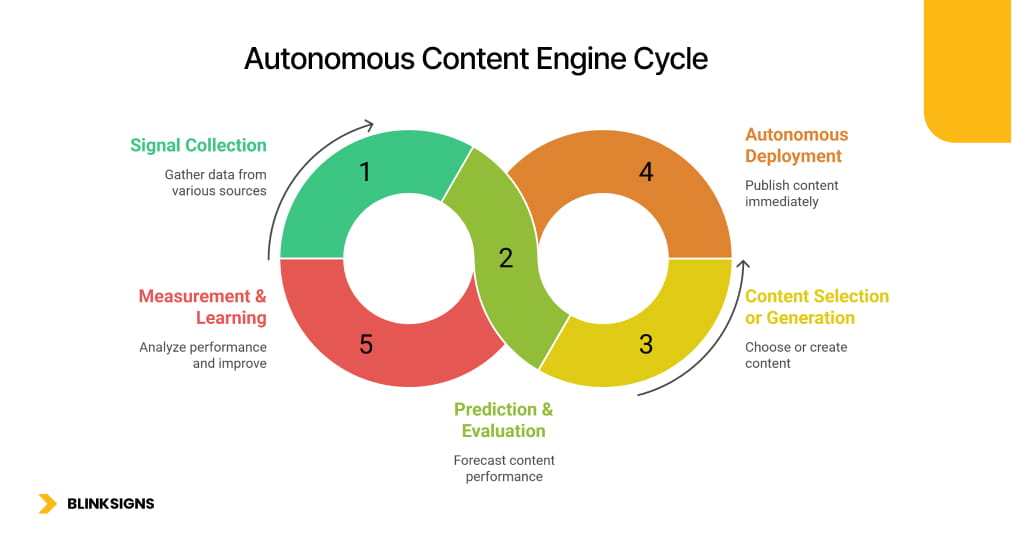
Autonomous Content Engine Cycle
- Signal Collection
Data flows in from multiple sources:
- Audience analytics (engagement, dwell time)
- Computer vision (anonymous demographic signals)
- Environmental context (weather, congestion)
- Business systems (POS, inventory, schedules)
- Device telemetry (health, performance)
- Audience analytics (engagement, dwell time)
- Prediction & Evaluation
Machine learning models forecast expected performance for available content options, factoring in confidence scores and historical patterns.
- Content Selection or Generation
The system either selects the highest-performing asset or generates new variations using generative AI.
- Autonomous Deployment
Content is published immediately—no human scheduling required.
- Measurement & Learning
Performance data feeds back into the model, improving future predictions.
This loop runs continuously, allowing signage networks to respond in near real time to changing conditions.
Computer Vision & Anonymous Audience Analytics
A key enabler of autonomy is privacy-compliant computer vision.
Modern systems no longer rely on identity tracking. Instead, they process video locally at the edge, extracting anonymous signals such as
- Approximate age range
- Group size
- Attention duration
- Directional movement
Raw video never leaves the device. Only aggregated, de-identified insights inform content decisions. This allows real-time personalization without surveillance—an expectation in 2026, not a differentiator.
Operational Autonomy: Self-Healing Infrastructure & Predictive Maintenance
Autonomy in 2026 extends beyond content. It now includes operations.
Autonomous signage networks ingest device telemetry such as
- Temperature and power consumption
- Network stability
- Display brightness degradation
- Playback errors
Using anomaly detection models, the system can:
- Predict component failure before downtime occurs
- Reboot or reroute content automatically.
- Trigger maintenance alerts proactively
- Reduce emergency truck rolls and SLA violations.
For large networks, this translates into:
- Fewer outages
- Lower operational costs
- IT teams are shifting from reactive fixes to strategic oversight.
Operational autonomy is why agentic AI resonates with IT and facilities leaders as much as with marketers.
From Labs to Live: What’s Already Operational in Early 2026
At NRF 2026 and ISE 2026, autonomous signage was no longer framed as “future-ready.” It was already deployed:
- Retail: Promotions triggered by foot traffic and stock availability
- QSR: Dynamic menu switching using POS, weather, and traffic data
- Corporate campuses: Role-based workplace communications adapting throughout the day
- Transportation hubs: Predictive wayfinding responding to congestion and delays
The industry has moved decisively from AI as a feature to AI as an operating model.
Business Impact: Why Autonomous Content Engines Change the Economics of Signage

Autonomous content engines improve creative relevance
Autonomous content engines do not just improve creative relevance; they also enhance user experience. They fundamentally change how value is created, measured, and scaled across digital signage networks.
Traditional signage optimization relies on periodic reviews, manual testing, and static scheduling assumptions. Predictive and agentic AI replaces this with continuous optimization, where every impression becomes a learning opportunity.
The business impact shows up across three dimensions.
Engagement and Conversion Lift
Predictive AI consistently outperforms static or rule-based scheduling because it adapts to context in real time. Instead of assuming that the same message performs equally well across locations and dayparts, autonomous systems continuously adjust their messaging.
Typical performance gains observed in early enterprise deployments include:
- Higher dwell time due to contextual relevance
- Increased interaction rates for QR codes and calls to action
- Improved conversion rates when signage is tied to inventory, promotions, or time-sensitive offers
The key difference is not personalization alone. It is a combination of prediction accuracy and autonomous execution.
Operational Efficiency and Cost Reduction
Autonomous content engines reduce human workload across multiple functions:
- Less manual scheduling and playlist management
- Fewer creative refresh cycles due to generative AI variants
- Reduced IT intervention through self-healing infrastructure
Creative teams shift from producing static assets to defining creative boundaries and brand rules. Operations teams shift from firefighting to oversight. This redistribution of effort is one of the fastest ROI drivers in 2026 deployments.
Revenue and Network Yield
When content adapts automatically to demand signals such as traffic, inventory, or events, each screen generates more value per hour of operation. In retail and QSR environments, this directly translates into higher revenue per screen and better utilization of premium placements.
How to Measure Predictive AI Effectiveness
One of the most common mistakes organizations make is measuring AI signage solely by surface-level engagement metrics. In 2026, expectations have shifted toward incrementality and causality.
Core Metrics That Matter
- Prediction accuracy
How often does the system’s forecast align with actual performance?
- Engagement lift
Performance difference between AI-selected content and manual or static control content.
- Conversion impact
Measurable actions such as purchases, scans, downloads, or signups.
- Operational efficiency
Hours saved in scheduling, creative production, and incident response.
- Revenue per screen
Incremental revenue attributed to AI-driven optimization.
- Override rate
The frequency of human intervention should decrease over time.
- Model confidence trend
Whether the system’s certainty improves as it learns.
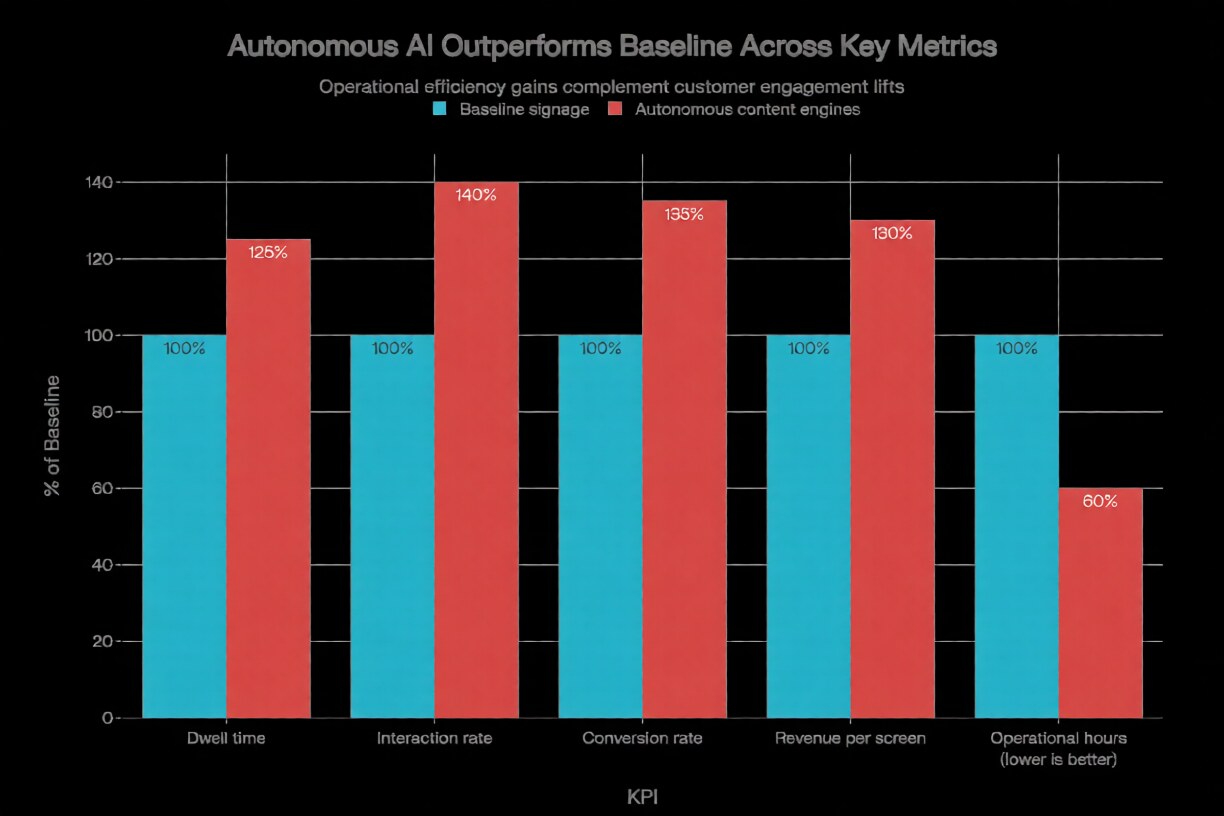
Autonomous AI Outperforms Baseline Across Key Metrics
Incrementality Testing Methods
Spatial holdout testing
A portion of the screens run manual content while the rest use the AI engine. Performance differences isolate the AI’s contribution.
Temporal A/B testing
The same screens alternate between AI-driven and manual logic over time, removing location bias.
Pre and post-analysis with synthetic controls
Historical performance is used to estimate what would have happened in the absence of AI, enabling counterfactual analysis.
These methods move measurement beyond “did engagement go up” to “what value did AI actually add?”
Key Use Cases Across Industries
Autonomous content engines are not industry-specific. Their impact varies by context.
Retail
- Real-time promotions triggered by foot traffic and inventory
- Dynamic pricing and offer prioritization
- Automated clearance messaging based on stock velocity
QSR and Restaurants
- Menu boards that adapt to weather, time of day, and kitchen load
- Automatic promotion of high-margin items during peak hours
- Reduced staff intervention during rush periods
Transportation and Public Spaces
- Predictive wayfinding that adapts to congestion and delays
- Context-aware messaging during service disruptions
- Improved passenger flow and reduced confusion
Hospitality
- Guest-tier personalization without identity tracking
- Event-driven content across lobbies, venues, and amenities
- Automated upsell messaging based on occupancy patterns
Corporate and Workplace
- Role-based internal communications
- Time-sensitive announcements without manual updates
- Consistent messaging across large campuses
Implementation Best Practices
AI Inference Architecture: Edge vs Cloud vs Hybrid
Choosing where AI runs is one of the most important architectural decisions in 2026.
| Architecture | Where AI Runs | Advantages | Best Use Cases | Tradeoffs |
| Edge inference | On-device media players | Low latency, privacy-friendly, works offline | High-traffic retail, real-time personalization | Higher hardware cost |
| Cloud inference | Centralized servers or APIs | Easier updates, lower device cost | Corporate comms, experimentation | Network dependency, latency |
| Hybrid | Edge for decisions, cloud for training | Balance of control and performance | Enterprise-scale deployments | Higher complexity |
In regulated or security-sensitive industries, hybrid or on-premises architectures are often non-negotiable due to data residency and compliance requirements.
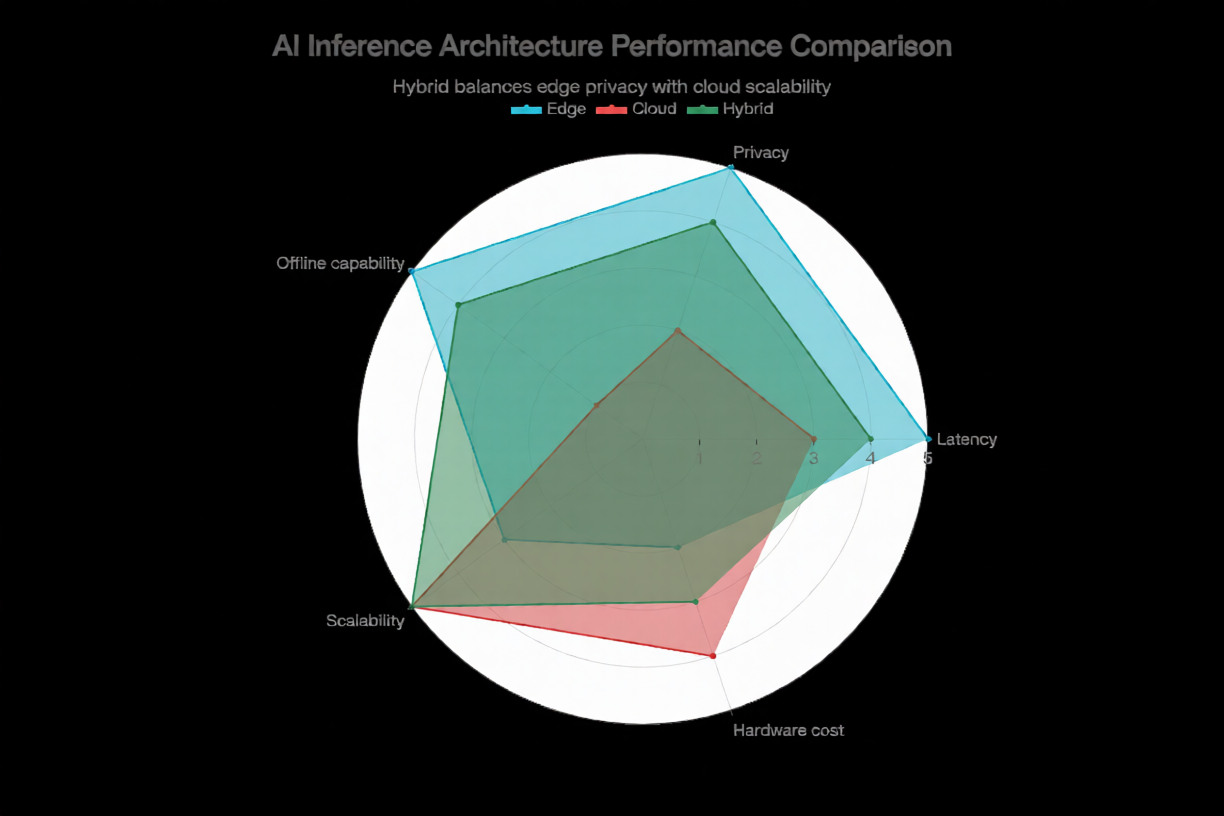
AI inference architecture performance comparison
API-First and Modular Architecture
Modern autonomous signage systems rely on API-first design. This allows predictive engines to integrate seamlessly with:
- CMS platforms
- POS systems
- ERP and inventory tools
- CRM and loyalty platforms
- IoT sensors and building systems
Modularity ensures that AI components can evolve independently without forcing full platform migrations.
Minimum Viable AI Governance Controls
Autonomy requires control. Enterprises deploying agentic systems now expect governance by default.
Minimum Viable AI Governance Checklist
- Role-based access control with least-privilege permissions
- Content approval workflows for AI-generated or AI-adjusted assets
- Full audit trails of AI decisions, deployments, and overrides
- Model version tracking and rollback capability
- Anomaly alerts for unexpected behavior or policy violations
- Incident response plans and kill-switches for rapid rollback
Governance is not about slowing AI down. It is about making autonomy safe and accountable.
Download the AI Governance Checklist and establish safe, accountable autonomy for your digital signage network.
Common Challenges and Solutions
Data Quality and Signal Reliability
Predictive systems are only as good as the data they ingest. Poor signals lead to poor decisions. Successful deployments prioritize:
- Clean integrations
- Consistent data definitions
- Ongoing monitoring of input quality
Privacy-by-Design Patterns for Predictive AI
Autonomous personalization does not require surveillance.
Effective privacy-forward systems use:
- Edge-based processing so raw data never leaves devices
- Anonymous demographic estimation
- Federated learning for aggregated model improvement
- Ephemeral data processing without long-term storage
- Clear opt-in signage in camera-enabled areas
- Data minimization aligned with regulatory requirements.
This approach satisfies both regulatory expectations and consumer trust.
Bias and Transparency
AI decisions must be explainable. Modern systems expose:
- Why a piece of content was selected
- Which signals influenced the decision
- Confidence levels associated with predictions
Bias detection and human oversight remain essential, especially in regulated or sensitive environments.
Common FAQs
What is predictive AI in digital signage?
Predictive AI in digital signage uses machine learning to forecast which content will perform best on a given screen at a specific moment based on audience, context, and historical outcomes.
What is an autonomous content engine?
An autonomous content engine is a software system that continuously analyzes signals, predicts outcomes, selects or generates content, and deploys it automatically across screens while learning from performance.
Is AI-driven digital signage privacy-safe?
Yes, when implemented with privacy-by-design patterns such as edge-based processing, anonymous analytics, federated learning, and strict data minimization, AI signage can personalize without surveillance.
How is agentic AI different from regular AI personalization?
Agentic AI does not just recommend content; it takes action by autonomously changing playlists, triggering campaigns, and adjusting schedules based on live conditions and learned behavior.
From Screens to Autonomous Communication Systems
By 2026, digital signage will no longer be defined by screens or content playlists. It is determined by autonomous communication systems that continuously sense, decide, act, and learn.
The convergence of predictive AI, generative AI, and agentic execution marks a permanent shift. Organizations that adopt autonomous content engines gain:
- Faster response to changing conditions
- Higher engagement and revenue efficiency
- Lower operational friction
- Scalable governance and control
What comes next is deeper convergence with IoT, spatial computing, and extended reality. But the foundation is already here.
Digital signage has moved from being programmed to being intelligent and self-directed. Those who embrace this shift in 2026 will set the standard others follow.