

Attribution for Digital Signage: How to Measure Revenue, Lift, and Multi-Touch Impact
Digital signage attribution is not about estimating impressions. It is about proving revenue impact through integrated data systems, causal measurement, and multi-touch modeling.
Digital signage attribution is the process of linking screen content exposure to measurable business outcomes such as revenue, conversions, or behavioral changes. It is achieved by integrating signage systems with data sources like POS, CRM, and analytics platforms to track the impact of screen-driven interactions.
Across enterprise environments, signage networks are increasingly being evaluated against the same standard applied to digital channels: measurable performance. When revenue impact cannot be demonstrated, budgets are reduced, channels are deprioritized, and investment is redirected toward platforms that can prove attribution. For signage to scale as a strategic channel, attribution must be established as a core operational capability.
What Is Attribution in Digital Signage?
Digital signage attribution is the process of linking exposure to screen-based content to downstream outcomes, such as purchases, conversions, or behavioral changes. Unlike traditional measurement approaches, attribution requires integrating signage systems with point-of-sale (POS), customer relationship management (CRM), and analytics platforms.
Within modern environments, attribution is not based on assumptions. It is derived from data connections between content delivery and business outcomes, allowing signage to be measured in the same way as other performance channels.
Why Traditional Signage Measurement Fails
For many years, signage performance has been measured using proxy metrics.
These include:
- impressions
- estimated reach
- screen uptime
- content playback frequency
While these metrics provide visibility into operational activity, they do not measure business impact.
Studies show that 76% of consumers take action after exposure to digital out-of-home media, yet most signage systems cannot connect that action to transaction-level outcomes. This gap highlights the limitation of impression-based measurement.
Impressions Do Not Equal Revenue
A screen impression indicates that content was displayed. It does not indicate that a purchase was made, a behavior was influenced, or a conversion occurred.
Without a connection to transaction data, impressions remain disconnected from revenue outcomes.
No Closed-Loop Measurement
Traditional signage systems operate in isolation from enterprise data systems. Content is delivered to screens, but downstream actions are not tracked or attributed back to that exposure.
This creates a measurement gap, preventing performance verification.
Siloed Systems
In many organizations, signage operates separately from marketing, analytics, and sales systems. POS data exists in one environment, CRM data in another, and signage content in a third.
Without integration, attribution becomes impossible.
The Signage Attribution Ladder™
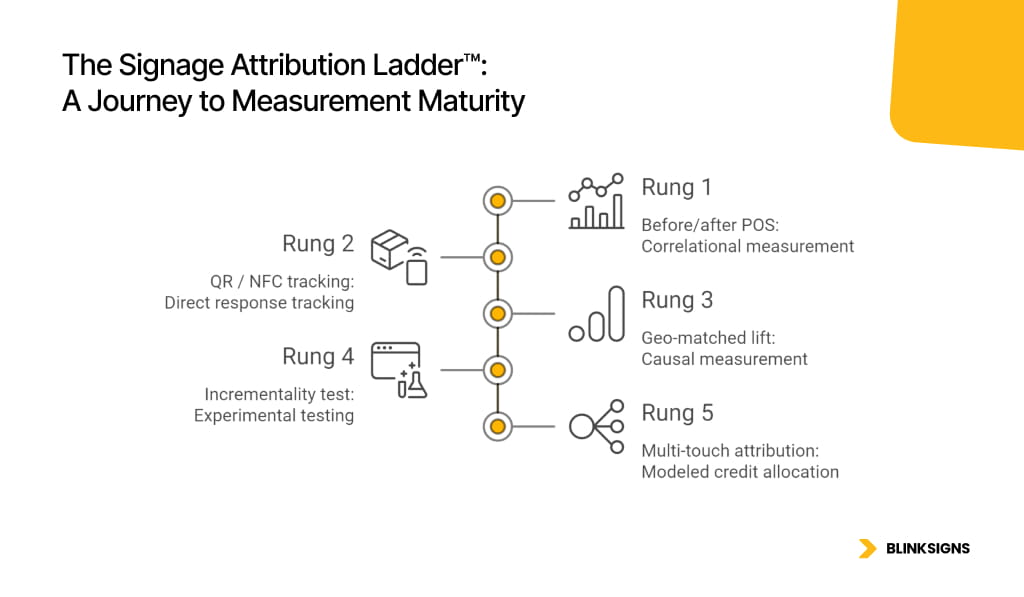
The Signage Attribution Ladder™
A Journey to Measurement Maturity
Attribution maturity within signage networks can be structured through a five-level framework.
| Rung | Method | Measurement Type | Data Required | Signage Application |
| 1 | Before/after POS | Correlational | POS | Single-location campaign |
| 2 | QR / NFC tracking | Direct response | CMS + web | Menu boards, endcaps |
| 3 | Geo-matched lift | Causal (geo) | Footfall + POS | Multi-location retail |
| 4 | Incrementality test | Experimental | CRM + holdout | Enterprise campaigns |
| 5 | Multi-touch attribution | Modeled | CDP + CMS | Omnichannel retail |
Most organizations operate at Rung 1 or 2 and describe their measurement as attribution. In reality, these levels represent correlational measurement, not causal insight. True attribution begins at Rung 3, where lift is measured through controlled comparison.
As maturity increases, attribution evolves from simple observation to causal testing and modeled credit allocation, allowing signage to be evaluated with the same rigor as digital media channels.
Key Metrics That Actually Matter
- Revenue generated from screen-driven campaigns
- Sales lift compared to baseline performance
- Conversion rate after exposure to signage
- Dwell time and engagement with displays
- Incremental impact compared to control groups
These metrics represent the shift from activity-based measurement to outcome-based measurement.
Revenue provides direct evidence of business impact. Sales lift indicates whether performance exceeds baseline expectations. Conversion rates connect exposure to action. Dwell time reflects engagement, while incrementality isolates the true effect of signage from other variables.
Across retail environments, signage has been shown to drive an average sales lift of +14%, with ROI ranging from $5–$6 per $1 invested when attribution is properly implemented.
Attribution Models Explained for Signage
| Model | How It Works | Best For Signage |
| Last-touch | Credits final interaction | QR/NFC campaigns |
| First-touch | Credits initial exposure | Awareness displays |
| Time-decay | More credit near conversion | POS signage |
| U-shaped | 40/40/20 distribution | Mixed campaigns |
| Shapley Value | Mathematical distribution | Omnichannel retail |
Each attribution model distributes credit differently across the customer journey.
Simpler models, such as last-touch and first-touch, provide directional insight but fail to capture the full influence of signage across multiple interactions. More advanced approaches, such as time-decay, U-shaped, and Shapley Value models, allow attribution to be distributed across multiple touchpoints, including physical screens and digital channels.
Measuring Sales Lift and Incrementality
Sales lift represents the increase in performance observed after signage exposure. However, a lift alone does not confirm causation.
Incrementality must be measured to determine whether the observed lift was actually caused by signage.
Incrementality Formula
Incrementality % = (Test Conversion Rate − Control Conversion Rate) ÷ Test Conversion Rate × 100
This formula isolates the portion of performance attributable directly to signage activity.
Methodology Requirements
To ensure accuracy, incrementality testing must follow a controlled experimental design:
- A minimum of 10% of locations must be assigned to a control group
- Store clusters must be matched by geography, volume, and demographic profile
- Signage content must be paused in the control group
- A test period of at least four weeks must be maintained
- POS revenue must be compared across test and control locations
Real-World Evidence
A January 2026 retail study demonstrated that 88% of revenue generated during signage campaigns was truly incremental, rather than the result of purchase acceleration or overlapping promotions.
This finding establishes incrementality testing as the gold standard for signage attribution.
Multi-Touch Attribution Across Physical and Digital Channels
75% of companies now use multi-touch attribution models — yet very few have incorporated physical signage as a measurable touchpoint within those systems.
In programmatic DOOH environments, such as programmatic DOOH networks, exposure data is already timestamped and location-tagged at the impression level, allowing direct integration into attribution models.
Customer journeys usually involve multiple interactions.
A typical journey may include:
- exposure to in-store signage
- follow-up mobile search
- website visit
- final purchase
Within this sequence, signage functions as one of several touchpoints.
Multi-touch attribution models distribute credit across these interactions.
For signage near the point of purchase—including endcaps, checkout displays, and QSR menu boards—a time-decay model is typically applied, as exposure occurs immediately before conversion.
For awareness-driven placements such as entrances or lobby displays, a U-shaped model is more appropriate, assigning credit to both initial exposure and final interaction.
In enterprise environments with integrated CDP data, Shapley Value models provide the most defensible allocation by mathematically distributing credit across all recorded touchpoints.
In enterprise environments, signage exposure can be logged through CMS systems using timestamped and location-tagged data. This data can then be connected to digital interactions and transaction records, allowing signage to be incorporated into broader attribution models.
As a result, physical screens can be treated as measurable touchpoints within omnichannel attribution systems.
How API-Driven Signage Enables Real Attribution
Attribution is only possible when data systems are connected.
Modern signage networks rely on API-driven architecture to integrate content delivery with enterprise data systems.
Through API integrations:
- POS systems provide transaction data
- CRM systems provide customer interaction data
- Analytics platforms provide behavioral insights
- CMS platforms provide exposure logs
This integration creates a closed-loop measurement system that directly links content exposure to outcomes.
Without API-driven infrastructure, attribution remains theoretical. With integration, it becomes operational.
How Signage Connects to POS, CRM, and CDP Systems
Attribution becomes operational only when signage systems are integrated with enterprise data infrastructure.
Within modern environments, digital signage is no longer treated as an isolated display system. Instead, it is positioned as a connected node within a broader data ecosystem that includes point-of-sale systems, customer relationship management platforms, and customer data platforms (CDPs).
Through API-driven architecture, the following data flows are established:
- Screen exposure data is captured within the CMS
- Transaction data is recorded within POS systems
- Customer interaction data is stored within CRM platforms
- Identity and behavioral data are unified within CDPs
When these systems are connected, a closed-loop attribution model is created. Content displayed on screens can be linked directly to customer actions and revenue outcomes.
Organizations implementing data-connected signage infrastructure can therefore measure performance with the same level of precision applied to digital channels.
Privacy, Identity Resolution, and Data Clean Rooms
As attribution capabilities expand, privacy requirements must also be addressed.
Third-party cookies have been deprecated, and regulations such as CCPA and CPRA have imposed strict limitations on how customer identity data can be used. As a result, attribution must be executed through privacy-safe mechanisms.
Data clean rooms have emerged as the standard solution.
Platforms such as InfoSum and LiveRamp allow organizations to connect datasets without exposing personally identifiable information.
Within signage attribution workflows, the process is structured as follows:
- CMS logs screen impressions with timestamps and location metadata
- Data is securely ingested into a clean room environment
- Purchase data from POS or loyalty systems is matched against exposure data
- Identity resolution is performed using anonymized identifiers
- Attribution models are applied to calculate impact
Through this approach, attribution can be executed in a way that is both privacy-compliant and analytically robust.
This infrastructure enables multi-touch attribution and incrementality testing to be legally and operationally viable at enterprise scale.
Measurement Infrastructure Signal
The expansion of measurement infrastructure across out-of-home environments has further strengthened attribution capabilities.
The expansion of Nielsen’s out-of-home measurement to 100% of the United States in 2025 has established standardized exposure data at the national scale. This development enables geographically matched attribution studies for signage networks, with the same level of measurement rigor previously limited to television and digital channels.
As a result, signage attribution is no longer constrained by fragmented measurement systems. It can now be executed using standardized methodologies aligned with broader media measurement frameworks.
ESG Insight — Measurement Infrastructure Convergence
Operators building Scope 2 carbon reporting infrastructure can reuse the same screen-level data pipelines for revenue attribution. One measurement architecture can support both ESG compliance and marketing performance optimization.
Real-World Attribution Use Cases

Digital signage Use Cases
Attribution frameworks become most valuable when applied to real operational environments. The following use cases demonstrate how measurement can be implemented across industries.
For retail media network operators, attribution at Rung 4 and Rung 5 provides the measurement foundation required to monetize in-store media inventory at scale.
Retail — Incrementality at Scale
In a January 2026 empirical retail study, signage campaigns were evaluated using controlled test and control store groups.
By comparing conversion rates across matched locations, it was determined that 88% of revenue generated during the campaign was incremental.
This result demonstrates that attribution at Rung 4 of the Signage Attribution Ladder™ — incrementality testing — can isolate true causal impact.
QSR / Automotive — High-Impact Lift
In a deployment involving automotive retail environments, a campaign implemented through targeted screen placements achieved a +314% increase in sales performance.
This level of lift is typically associated with high-intent environments where content is aligned with customer decision points.
In this scenario, attribution can be mapped to Rung 3 and Rung 4 methodologies, where lift is measured against the baseline and validated through controlled testing.
Banking — Controlled Environment Conversion
In a branch lobby signage study, digital displays were used to promote credit card sign-ups.
A +2% increase in application rates was observed across test locations.
Although the percentage increase appears modest, within financial services environments, this level of uplift represents significant incremental revenue.
This example aligns with Rung 3 attribution, where controlled environments allow causal relationships to be measured accurately.
Multi-Location Enterprise — Network-Level Lift
Across large retail networks, signage deployments have demonstrated 25–32% increases in sales performance when integrated with operational data systems.
At this scale, attribution must be executed through a combination of geo-matched testing and multi-touch modeling.
This aligns with Rungs 3-5 of the attribution ladder, where both causal measurement and modeled attribution are required.
How to Build an Attribution System for Your Signage Network
Attribution should not be implemented as a reporting feature. It must be designed as a system.
A structured implementation framework includes the following stages:
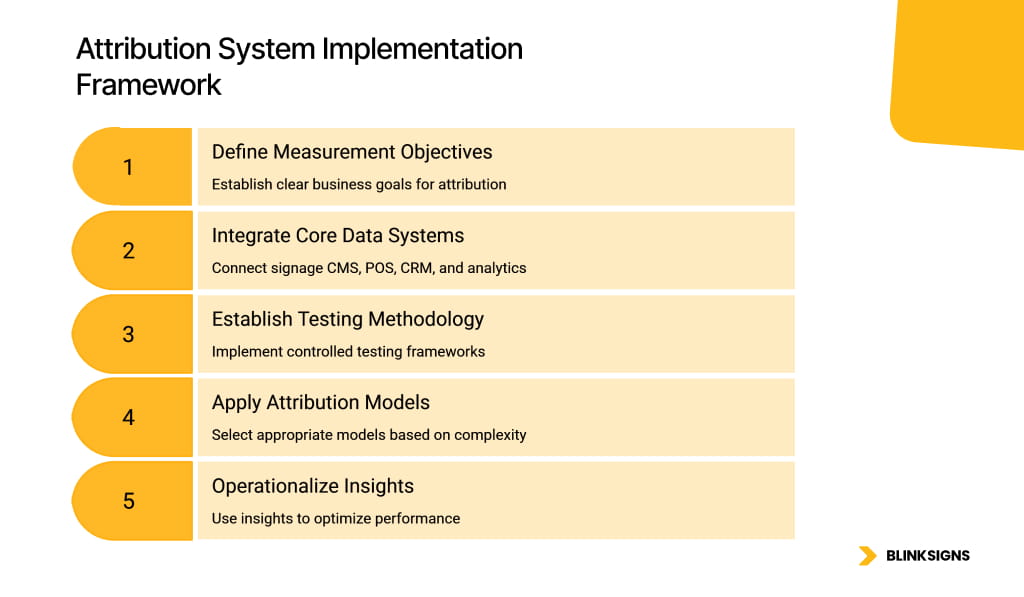
Attribution System Implementation Framework
Step 1: Define Measurement Objectives
Clear business objectives must be established. These may include:
- revenue growth
- conversion rate improvement
- customer engagement
- campaign performance
Measurement frameworks must align with these objectives.
Step 2: Integrate Core Data Systems
Integration must be established between:
- signage CMS
- POS systems
- CRM platforms
- CDPs and analytics systems
Without integration, attribution cannot be executed.
Step 3: Establish Testing Methodology
Controlled testing frameworks must be implemented.
This includes:
- test and control groups
- geo-matching
- baseline measurement
- defined test periods
This step enables accurate measurement of incrementality.
Step 4: Apply Attribution Models
Attribution models must be selected based on use case complexity.
- Simple campaigns may use last-touch or first-touch models
- Complex journeys require multi-touch or Shapley-based models
Model selection determines how credit is distributed across interactions.
Step 5: Operationalize Insights
Attribution insights must be used to optimize performance.
This includes:
- adjusting content strategies
- reallocating budget
- refining targeting
- improving campaign design
Attribution must drive decisions, not just reporting.
Is Your Signage Network Measurable?
As signage networks scale, the gap between operational activity and measurable performance widens. The following questions can be used to assess attribution readiness before implementing a formal measurement framework.
However, as networks expand, the need for measurable performance becomes unavoidable.
The following questions can be used to assess readiness:
- Can screen exposure be linked to transaction data?
- Are POS and CMS systems integrated?
- Are controlled tests being executed across locations?
- Are attribution models applied to customer journeys?
- Is revenue impact measured beyond impressions?
- Do data rather than assumptions drive optimization decisions?
If several of these conditions are not met, attribution capability remains limited.
Frequently Asked Questions
What is attribution in digital signage?
Attribution in digital signage refers to the process of connecting screen content exposure to measurable outcomes such as revenue, conversions, or behavioral changes through integrated data systems.
How do you measure ROI for digital signage?
ROI is measured by connecting screen exposure to revenue outcomes using POS data, calculating sales lift, and isolating incremental impact through controlled testing.
What is incrementality in signage attribution?
Incrementality measures the portion of performance attributable to signage, after accounting for baseline activity and external influences. It is calculated by comparing the test and control groups.
Can digital signage drive measurable revenue?
Yes. When integrated with POS and CRM systems, signage can be directly linked to transaction data, allowing revenue impact to be measured and optimized.
What is multi-touch attribution for signage?
Multi-touch attribution distributes credit across multiple interactions in the customer journey, including both physical and digital touchpoints such as signage, mobile, and web channels.
The Future of Signage Attribution
Digital signage is no longer evaluated solely on visibility. It is evaluated based on its ability to influence measurable business outcomes.
As enterprise systems become more integrated and attribution methodologies mature, signage networks that rely on impressions and playback metrics will continue to lose budget allocation.
In contrast, networks that implement closed-loop measurement, execute incrementality testing, and apply multi-touch attribution models will establish signage as a revenue-generating channel.
For enterprises operating at scale, attribution is not an advanced capability. It is a baseline requirement for sustained investment and growth.
If your signage cannot be attributed, it cannot be optimized. If it cannot be optimized, it cannot scale as a revenue channel.