
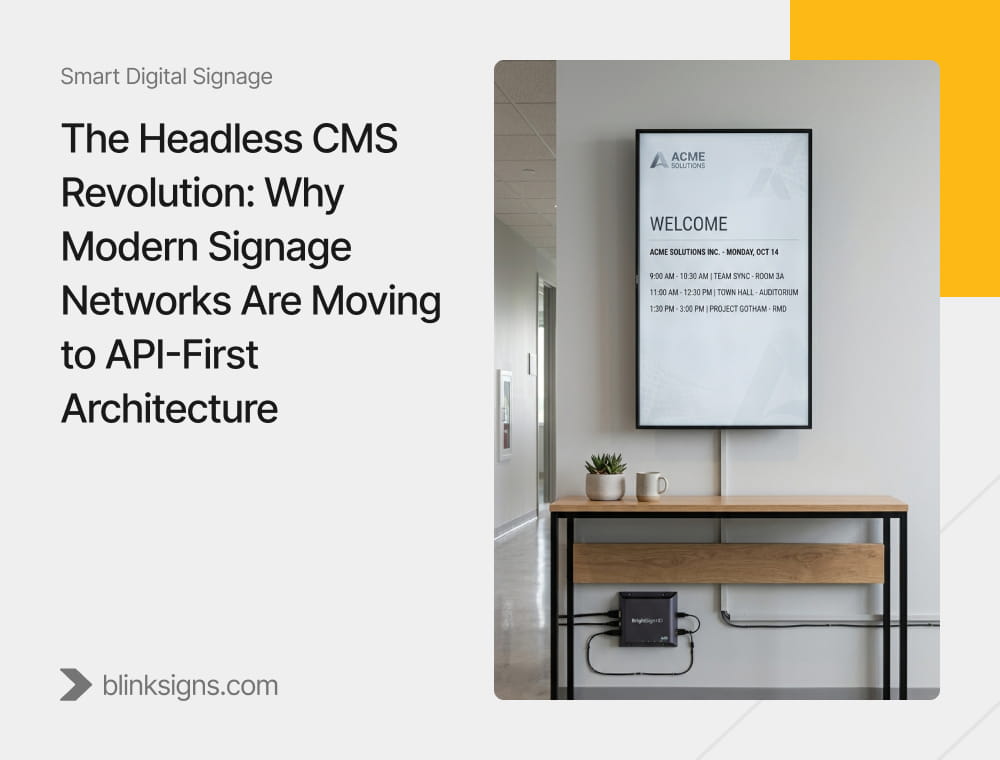
The Headless CMS Revolution: Why Modern Signage Networks Are Moving to API-First Architecture
Digital signage networks were originally designed as publishing systems. Content was created within centralized content management systems (CMS), scheduled into playlists, and distributed to screens as static visual updates. For many years, this model proved sufficient. Scheduled media rotations could display promotional messaging, announcements, and informational graphics without requiring deep integration with other enterprise systems.
However, the role of digital signage has changed significantly.
Modern organizations now operate within interconnected digital ecosystems where real-time data, enterprise platforms, and cloud infrastructure drive operational decisions. Screens are increasingly expected to display live pricing, operational dashboards, inventory alerts, event schedules, and performance metrics. Static publishing workflows are no longer sufficient to support these expectations.
Traditional signage CMS platforms were not designed for this level of dynamic integration. In many legacy systems, the content repository and presentation layer remain tightly coupled, resulting in rigid templates, slow update cycles, and limited integration capabilities.
This limitation has led to a growing architectural shift across the digital signage industry.
Organizations deploying modern screen networks are increasingly adopting headless CMS platforms and API-first infrastructure, in which structured content is stored centrally and distributed to displays via APIs.
Under this model, screens are no longer treated as isolated endpoints. Instead, they operate as connected interfaces within a broader digital ecosystem.
Digital signage networks are no longer isolated screen systems. They are connected content platforms powered by APIs, real-time data, and cloud infrastructure.
Understanding this architectural transition has become essential for operators managing multi-location screen networks, enterprise display systems, and data-driven signage environments.
What Is a Headless CMS for Digital Signage?
A headless CMS for digital signage is a content management architecture in which the backend content repository is separated from the screen presentation layer and delivered via APIs. This allows signage networks to distribute structured content to displays, kiosks, and digital endpoints in real time without relying on rigid CMS templates.
In a traditional CMS environment, the platform that stores content also manages its screen rendering. The same system manages layout templates, display logic, and scheduling mechanisms. While this architecture simplifies initial deployment, it also limits long-term flexibility.
A headless CMS removes this dependency.
Under a headless model, the CMS functions solely as a centralized content repository. Content is stored in structured formats and made available through APIs. Screen applications retrieve that content independently and render it according to their presentation logic.
In practical terms, the CMS serves as the central content hub, while the displays function as independent presentation layers.
For signage operators, this decoupled architecture introduces several advantages:
- content can be reused across multiple screen formats
- screen applications can evolve without modifying the CMS
- external systems can deliver real-time data to displays
- updates can be triggered automatically rather than scheduled manually
These capabilities form the foundation of modern API-driven digital signage networks.
Why Traditional Signage CMS Is Holding Networks Back

Traditional CMS Limits Your Signage Network’s Potential.
Traditional signage CMS platforms were developed during a period when most display networks delivered static content. Screens were updated periodically, and limited integration with external systems was required.
As networks expand and data-driven messaging becomes more common, structural limitations within traditional CMS platforms become increasingly apparent.
Rigid Template Structures
In many legacy signage platforms, screen layouts are controlled by predefined templates embedded directly in the CMS. These templates determine how media assets are displayed and how content updates are managed.
While this model functions adequately for static playlists, it becomes restrictive when operators attempt to integrate dynamic data sources such as inventory systems, weather feeds, or analytics dashboards.
Because the CMS controls the presentation layer, changes to screen experiences often require modifications to the platform itself.
Manual Content Scheduling Bottlenecks
Most traditional signage platforms rely on manual scheduling workflows. Content must be uploaded, assigned to playlists, and distributed across screen groups through administrative interfaces.
As display networks grow to include hundreds or thousands of screens, manual scheduling introduces operational friction. Promotional updates, emergency messaging, or operational announcements may require extensive coordination across multiple locations.
This process becomes increasingly inefficient as networks scale.
Limited Integration with Business Systems
Perhaps the most significant limitation of legacy signage platforms is their inability to integrate directly with enterprise systems.
Modern organizations operate using platforms such as POS systems, ERP software, CRM platforms, and analytics tools. When signage systems cannot communicate directly with these platforms, screens remain disconnected from the operational data driving the business.
A retail organization may struggle to synchronize pricing updates across digital displays. Corporate dashboards may require manual updates to reflect performance metrics. Event schedules may need to be updated manually even when the data already exists elsewhere within the organization.
These limitations are not merely workflow inefficiencies. They represent architectural constraints that prevent signage networks from participating in modern digital infrastructure.
API-First Architecture — The Engine Behind Modern Signage Networks
The MACH Framework and Its Role in Modern Signage Infrastructure
The rise of headless CMS platforms has been closely aligned with a broader enterprise architecture model known as MACH.
MACH refers to four architectural principles:
- Microservices architecture
- API-first infrastructure
- Cloud-native deployment
- Headless system design
Within a MACH environment, software platforms are structured as modular services that communicate through APIs. Specialized functions are handled by separate components rather than being bundled into one monolithic system.
For digital signage networks, this model offers important advantages.
Microservices architecture enables the independent development and scaling of components like content management, device management, analytics, and scheduling. With API-first infrastructure, each component can be seamlessly connected to external enterprise systems.
Through cloud-native CMS deployment, content can be distributed efficiently across geographically dispersed networks. Through headless architecture, presentation layers can be customized without requiring structural changes to the CMS itself.
This combination enables signage infrastructure to operate within a composable architecture, where systems are selected and connected based on operational needs rather than vendor-imposed constraints.
In more advanced environments, signage can also be positioned within a broader digital experience platform (DXP) strategy, where content, data, and interfaces are orchestrated across multiple digital endpoints rather than screens alone.
Real-Time Data Integration — From Static Screens to Live Intelligence
One of the most visible benefits of API-first architecture is the ability to integrate real-time data into display environments.
When screens retrieve content via APIs, the information presented to viewers can respond dynamically to changes in business systems.
For example, in a retail environment, pricing updates generated in a point-of-sale system can trigger immediate updates across every digital display in a store network. Promotional messaging can automatically adjust based on inventory levels or time of day.
Corporate communications networks can also benefit from this architecture. Performance dashboards displayed on internal screens can retrieve live data directly from analytics platforms, ensuring that employees receive accurate operational insights.
Within hospitality environments, event schedules and room assignments can be retrieved from booking systems, allowing wayfinding displays to update automatically as schedules change.
Through API-driven infrastructure, screens become live operational interfaces connected to business intelligence systems.
Key Benefits of Moving to Headless CMS for Signage Networks
- Real-time data integration across all screen endpoints
- Multi-screen scalability without performance degradation
- Omnichannel content reuse from a single content hub
- Faster deployment with framework-agnostic development
- Seamless integration with enterprise systems (ERP, POS, IoT, CRM)
Each of these benefits reflects a structural improvement in how digital signage networks are operated and scaled.
Through real-time data integration, screens can respond automatically to operational changes rather than depending on manual scheduling workflows. Pricing changes, inventory events, service alerts, or internal communications can trigger content updates.
Through API-driven distribution and content delivery networks (CDNs), screen networks can scale across multiple locations without creating bottlenecks inside the CMS. Performance can therefore be maintained even as deployments grow more complex.
By reusing omnichannel content, a single structured content hub can support screens, kiosks, internal dashboards, and other digital interfaces. This reduces duplication and improves content consistency across environments.
Through framework-agnostic development, screen experiences can be built using modern frontend technologies without being constrained by CMS-defined templates. Greater flexibility is therefore made available to internal teams and implementation partners.
By integrating directly with ERP systems, POS platforms, IoT devices, and CRM systems, signage networks can be incorporated into the organization’s broader operational infrastructure rather than functioning as disconnected media channels.
Traditional CMS vs Headless CMS for Digital Signage
Traditional CMS platforms tightly couple content management and screen presentation within the same system. While this model may be sufficient for smaller deployments, limitations are often introduced as networks expand and integration requirements increase.
Headless CMS architecture separates content storage from screen rendering, allowing each layer to evolve independently and scale more efficiently.
| Feature | Traditional CMS | Headless / API-First CMS |
| Content delivery | Single-channel, template-locked | Omnichannel, API-distributed |
| Data integration | Manual/static | Real-time via REST or GraphQL APIs |
| Template flexibility | Rigid, CMS-defined | Fully custom, framework-agnostic |
| Scalability | Limited, linear cost growth | Enterprise-grade, horizontal scaling |
| Development model | CMS controls the frontend | Frontend is fully decoupled |
| Update speed | Scheduled / manual | Instant, automated, trigger-based |
| Enterprise integration | Minimal | ERP, POS, IoT, CRM native |
The strategic implication is straightforward.
When signage networks are expected to support live data, distributed operations, and enterprise integrations, traditional CMS models tend to create friction. Headless, API-first architecture is increasingly adopted because it allows signage to operate as connected infrastructure rather than as a static publishing layer.
How API-First Architecture Changes Signage Operations
The most important impact of API-first architecture is operational rather than technical.
When screens are connected directly to enterprise systems via APIs, signage networks become active components of the organization’s information infrastructure rather than passive display channels.
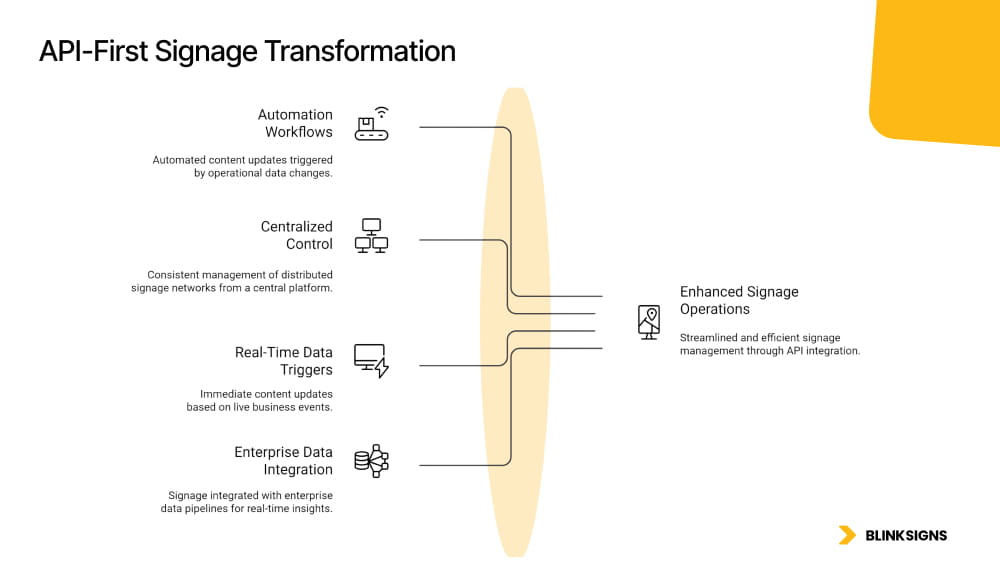
API-First Signage Transformation
Automation Workflows
Within traditional systems, content updates are often handled manually. Media must be uploaded, playlists must be adjusted, and screen groups must be updated through administrative workflows.
Through API-first infrastructure, these processes can be automated.
Content updates can be triggered automatically when operational data changes, allowing promotions, alerts, dashboards, and announcements to be updated without manual intervention.
Centralized Control Across Distributed Networks
Large signage deployments often span multiple cities, regions, or time zones. Manual coordination across these environments can create significant complexity.
Through API-driven management, multi-location signage networks can be controlled through centralized platforms where content rules, governance policies, and automation logic are applied consistently across the network.
This improves operational efficiency while preserving brand consistency.
Real-Time Data Triggers
When integrations are established with business systems, screen content can be updated in real time when a relevant event occurs.
A price adjustment within a POS platform, a change in inventory within an ERP system, or a new alert within an operational dashboard can trigger immediate content updates across all relevant displays.
This allows screens to reflect live business conditions rather than delayed manual updates.
Integration with Enterprise Data Pipelines
The most transformative shift is introduced when signage is connected directly to enterprise data pipelines.
Displays can retrieve information from analytics platforms, CRM systems, ERP systems, IoT devices, and operational databases, enabling screen networks to serve as real-time endpoints within the broader business ecosystem.
This is where API-first architecture creates its greatest strategic value. Signage is no longer treated as a separate communication layer. It is integrated into the systems that drive the organization itself.
Real-World Use Cases — API-First Signage in Action
The benefits of the headless CMS architecture become evident when signage networks connect directly to enterprise systems. Once screens are integrated with operational data sources, display environments are transformed from static communication tools into dynamic information interfaces.
Across industries, API-first infrastructure is being used to automate messaging, synchronize content with operational data, and improve the scalability of screen networks.
Organizations deploying API-driven signage networks across retail, corporate environments, hospitality venues, and public infrastructure can explore these deployments in our case studies to understand how modern screen ecosystems are being implemented in practice.
Retail: Dynamic Pricing and Inventory-Driven Promotions
Retail environments represent one of the most powerful applications of API-first signage infrastructure.
Within traditional systems, pricing updates must often be scheduled manually across digital displays. Promotional graphics must be redesigned and redistributed whenever product availability or pricing changes.
When screens are integrated with point-of-sale systems and inventory databases, content updates can be triggered automatically through APIs. If pricing changes within the POS system, every relevant display within the store network can be updated immediately.
This approach allows promotional messaging to be synchronized with live inventory levels, product availability, and pricing rules.
As a result, retail signage becomes a data-driven merchandising interface rather than a static promotional display.
Corporate Communications: Real-Time KPI Dashboards
Corporate organizations increasingly rely on digital signage to communicate operational insights across offices, campuses, and facilities.
Traditional signage deployments often require manual updates to display performance metrics or executive communications.
When integrated through APIs, screen content can retrieve data directly from business intelligence dashboards, analytics platforms, or CRM systems.
Operational dashboards displayed across corporate offices can therefore update automatically as performance metrics change.
This capability transforms corporate signage networks into live operational dashboards, providing employees with immediate visibility into company performance.
Hospitality: Dynamic Wayfinding and Event Information
Hotels, conference centers, and entertainment venues frequently rely on digital signage to guide visitors through complex environments.
Event schedules, meeting room assignments, and guest information can change throughout the day. Within traditional CMS systems, each of these changes may require manual updates across multiple displays.
Through headless architecture, event data can be retrieved directly from event management platforms and booking systems. When schedules change, updated information is automatically reflected on wayfinding displays.
This automation ensures that visitors receive accurate guidance while reducing the operational workload required to maintain screen content.
Smart Cities and Transit Systems
Public infrastructure environments require highly responsive display systems.
Transit stations, airports, and municipal networks must communicate schedule changes, service alerts, and emergency messages across large-screen networks.
Through API integrations, signage displays can be connected directly to transportation management platforms, weather data feeds, and public safety systems.
This architecture allows public displays to function as real-time information interfaces, capable of responding immediately to operational changes or emergency notifications.
Migration Path — From Traditional CMS to Headless Signage
For many organizations, digital signage networks have been built over years of incremental deployment. Existing CMS platforms, screen hardware, and operational workflows often remain deeply embedded within the organization.
A transition to headless architecture, therefore, does not typically occur all at once. Instead, a phased modernization strategy is usually adopted.
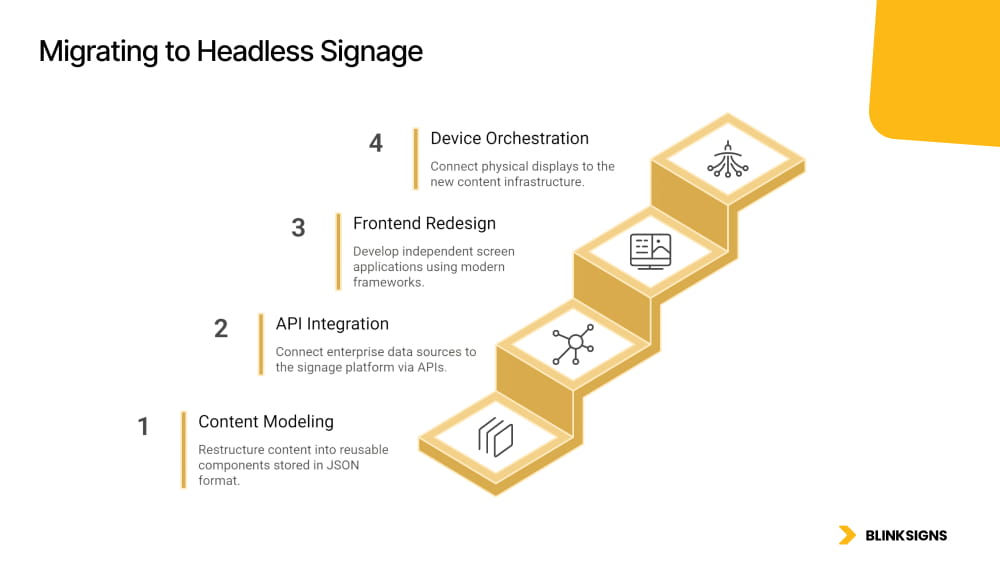
Migrating to Headless Signage
Step 1: Content Modeling
The first stage involves restructuring how content is stored and managed.
Traditional CMS platforms frequently store media in presentation-focused formats. In a headless environment, content must be structured into reusable components.
Promotions, announcements, or operational messaging can be organized into data fields such as product name, pricing, images, descriptions, or scheduling parameters.
Structured content in headless CMS platforms is typically stored and delivered in JSON format, allowing screen applications to parse and render data independently of the CMS presentation layer.
This structured approach enables content reuse across screens, applications, and other digital channels.
Step 2: API Integration
After content structures have been defined, the next step is to connect enterprise data sources to the signage platform.
Common integrations include:
- POS systems for pricing updates
- ERP systems for inventory data
- CRM platforms for marketing messaging
- analytics platforms for performance dashboards
- IoT sensors for environmental data
Through APIs, these systems are directly connected to the signage CMS, enabling operational data to trigger automated content updates.
Step 3: Frontend Redesign
Within headless architecture, screen presentation layers are separated from the CMS.
Instead of relying on CMS templates, screen applications are developed independently using modern frameworks such as React, Vue, or Node-based environments.
Content is retrieved from the CMS through APIs and rendered dynamically on screen applications.
This decoupled design allows display experiences to evolve without modifying the CMS infrastructure.
Step 4: Device Orchestration
The final stage involves connecting physical display devices to the new content infrastructure.
Screens retrieve structured content via APIs and content delivery networks, ensuring efficient distribution across large-screen deployments.
At this stage, the signage network operates as a fully integrated API-driven system capable of scaling across multiple locations and environments.
Migration doesn’t have to be all-or-nothing.
A phased API-first transition lets operators modernize screen by screen, system by system — without disrupting live network operations.
How to Evaluate an API-First Signage CMS Platform
As interest in headless architecture grows, many vendors claim to support API-enabled signage systems. However, not all platforms provide the same level of flexibility or scalability.
Organizations evaluating modern signage platforms should consider several architectural criteria.
Organizations assessing modern infrastructure options can review the Blinksigns platform architecture to understand how API-first signage environments are designed for enterprise deployments.
API Documentation and Developer Tooling
True API-first platforms provide comprehensive developer documentation, including clearly defined endpoints, authentication frameworks, and software development kits.
Strong developer tooling ensures that integrations with enterprise systems can be implemented efficiently and maintained over time.
Integration Ecosystem
The value of API-driven signage infrastructure is directly connected to its integration capabilities.
Platforms should support seamless connections with enterprise systems, including:
- POS platforms
- ERP systems
- CRM platforms
- marketing automation tools
- analytics dashboards
- IoT devices
These integrations allow signage networks to participate directly in operational workflows.
Real-Time Content Delivery
Modern screen networks require low-latency content distribution. Platforms should support real-time updates supported by scalable cloud infrastructure and content delivery networks.
Scalability and Deployment Architecture
Large screen deployments may include hundreds or thousands of displays distributed across geographic regions.
API-first platforms should support horizontal scaling to ensure system performance remains stable as the network grows.
Security and Reliability
Enterprise signage systems must operate with strong security controls and reliable uptime.
Authentication frameworks, role-based access controls, and service-level agreements should all be evaluated carefully.
API-first platforms also enable automated proof-of-play reporting, allowing operators to verify that content has been delivered and displayed across every screen endpoint without manual auditing.
Is Your Signage Network Ready for the API-First Shift?
A headless, API-first architecture is not mandatory for every signage deployment. Smaller networks with simple scheduling needs and limited integrations may operate efficiently on a traditional CMS. The shift becomes valuable when content must move across channels, connect to live business systems, or scale across complex multi-location environments.
However, as signage networks expand, the operational advantages of API-first infrastructure become increasingly significant.
Organizations evaluating modernization efforts may consider the following questions:
- Are live data feeds required on display screens?
- Are manual content updates becoming difficult to manage across locations?
- Is the network expected to scale significantly in the coming years?
- Are integrations with enterprise systems planned or required?
- Are customized screen applications being requested by internal teams?
- Are operational dashboards or automated messaging workflows being deployed?
If several of these questions are answered positively, an API-first architecture may represent the next stage in the evolution of the organization’s signage infrastructure.
Organizations interested in exploring modern signage infrastructure can request a platform walkthrough to see how API-driven networks operate in real deployments.
Frequently Asked Questions
What is a headless CMS for digital signage?
A headless CMS for digital signage separates the content repository from the screen presentation layer. Content is stored centrally and delivered through APIs, allowing displays to retrieve structured data dynamically rather than relying on rigid CMS templates.
What is API-first architecture in digital signage?
API-first architecture is a system design in which all platform capabilities are exposed via application programming interfaces. Screens, applications, and enterprise systems communicate with the platform through APIs, enabling real-time data integration and automated content workflows.
How does headless CMS improve digital signage operations?
Headless CMS improves operations by enabling automated updates, real-time data integration, and scalable screen deployments. Screens can respond dynamically to operational data rather than relying on manually scheduled media playlists.
Is a headless CMS better than a traditional CMS for signage?
Headless CMS is typically better suited for large or complex signage networks that require integrations with enterprise systems or dynamic content workflows. Traditional CMS platforms may still be sufficient for smaller deployments with simple scheduling requirements.
Does implementing a headless signage CMS require developers?
Initial implementation of a headless CMS typically involves development work because screen applications are built independently from the CMS. However, once deployed, content management interfaces can be used by non-technical operators to manage messaging and media assets.
The Future of Signage Networks Is API-Driven
Digital signage is evolving from a static communication medium into a connected digital infrastructure.
As organizations integrate operational systems, analytics platforms, and real-time data sources into their display environments, traditional CMS architectures are increasingly unable to support modern requirements, driving demand for more flexible, scalable API-driven solutions that can adapt to these evolving needs.