
Programmatic DOOH Explained: A Complete Guide for Brands, Franchises, and Operators
Why Programmatic DOOH Matters in 2026
Programmatic digital out-of-home is no longer an emerging channel. In 2026, more than 30 percent of total DOOH ad spend is transacted programmatically, with forecasted year-over-year growth exceeding 18 percent. Industry experts, including major DSPs and the Interactive Advertising Bureau, say more businesses are adopting programmatic DOOH in retail, transit, and event spaces because brands want more flexible planning and more precise results.
Campaigns that once required weeks of manual booking can now go live in hours. Budgets can be reallocated mid-flight. Creativity can activate only when specific contextual conditions are met. Agencies increasingly expect the same automation, optimization, and reporting standards from outdoor media that they receive from digital channels.
Programmatic DOOH has moved from innovation to infrastructure.
This guide explains not just how to buy programmatic DOOH, but how to build, monetize, govern, and measure it across distributed screen networks.
It is written for three audiences:
- Brands and agencies looking to activate flexible, data-driven campaigns
- Franchises and multi-location operators seeking to monetize digital screen networks
- Technology and operations teams are responsible for integrating DSPs, SSPs, and CMS systems.
Most articles focus on buying mechanics. This guide covers the entire operational ecosystem.
What Is Programmatic DOOH?
Programmatic digital out-of-home (pDOOH) is the automated buying, selling, and delivery of advertising on digital screens through real-time bidding and data-driven activation. Unlike traditional DOOH, where placements are booked manually and fixed for weeks, programmatic DOOH allows advertisers to define targeting conditions such as time, location, weather, or venue type, and ads are delivered automatically when those conditions are met.
This definition distinguishes pDOOH from both traditional outdoor and direct-buy DOOH.
Traditional OOH vs DOOH vs Programmatic DOOH
| Dimension | Traditional OOH | DOOH (Direct Buy) | Programmatic DOOH |
| Booking Process | Manual, weeks in advance | Manual, days in advance | Automated campaigns can go live in hours |
| Flexibility | Fixed for full duration | Limited scheduling changes | Dynamic, condition-based activation |
| Targeting | Location + broad demographics | Location + daypart | Real-time contextual triggers such as weather, events, and venue type |
| Pricing Model | Flat fee | CPM or flat fee | Real-time bidding CPM or programmatic guaranteed |
| Measurement | Estimated impressions | Logged impressions | Logged impressions plus attribution modeling |
| Who Manages | Media planner | Planner + operations | DSP automation |
Programmatic DOOH does not replace digital out-of-home media. It transforms how inventory is accessed, optimized, and measured.
How Programmatic DOOH Actually Works
At its core, programmatic DOOH connects advertiser demand to screen supply through automated marketplaces.
Simplified End-to-End Flow
Brand sets campaign → DSP applies targeting rules and budget → Ad exchange connects DSP to SSP → SSP matches available screens → Winning bid selected → Creative delivered to CMS → Screen plays ad → Impression logged → Reporting and attribution delivered to brand dashboard
This simplified flow captures the entire system. Below is the deeper breakdown.
The Six Key Players in the Programmatic DOOH Ecosystem
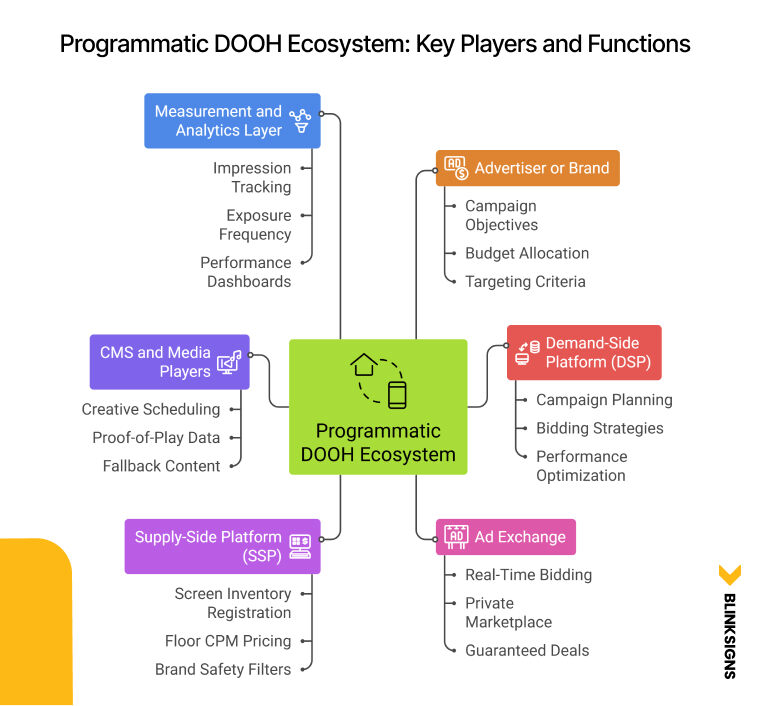
Programmatic DOOH Ecosystem_ Key Players and Functions
1. Advertiser or Brand
Defines:
- Campaign objectives
- Budget allocation
- Targeting criteria
- Creative assets
Brands define rules rather than manually selecting individual screens.
2. Demand-Side Platform (DSP)
The DSP enables brands to:
- Plan campaigns across multiple screen networks
- Set bidding strategies
- Apply targeting rules
- Optimize performance in real time.
The DSP replaces manual insertion orders with automated buying logic.
3. Ad Exchange
The exchange acts as the marketplace where:
- DSP demand meets SSP supply
- Real-time bidding occurs
- Private marketplace and guaranteed deals are transacted.
It enables dynamic allocation of inventory.
4. Supply-Side Platform (SSP)
Screen network owners use the SSP to:
- Register screen inventory
- Define available impressions
- Set floor CPM pricing
- Apply brand safety filters.
- Manage deal IDs
Operators expose their inventory through the SSP layer.
5. CMS and Media Players
The content management system:
- Receives creative from the SSP
- Schedules playback
- Logs proof-of-play data
- Ensures fallback content if feeds fail
Media players must support real-time updates and impression logging.
Without CMS-level integration, programmatic cannot function reliably.
6. Measurement and Analytics Layer
Tracks:
- Impressions
- Exposure frequency
- Attribution signals
- Performance dashboards
Measurement transforms programmatic DOOH from awareness-only media into accountable performance media.
Benefits of Programmatic DOOH for Brands
Programmatic DOOH for Brands
Flexible Buying Without Long-Term Commitments
Programmatic DOOH allows brands to:
- Launch campaigns within hours
- Adjust targeting mid-flight
- Pause underperforming placements
- Access multiple screen networks from one buying interface
This flexibility aligns DOOH with modern digital planning cycles.
Trigger-Based Contextual Targeting
Creative can activate based on contextual signals such as:
- Weather thresholds
- Event schedules
- Time-of-day windows
- Geographic proximity
For example:
- Coffee ads appear when the temperature drops below a defined threshold
- QSR breakfast messaging activates during morning commute hours
- Retail promotions trigger within a defined radius of store locations.
These contextual triggers increase relevance without requiring individual-level tracking.
Privacy-First Targeting in 2026
Unlike mobile retargeting strategies that rely on device-level tracking, programmatic DOOH targeting in 2026 uses contextual and aggregated signals such as time, location, weather, venue type, and event data. This structural advantage makes programmatic DOOH more privacy-compliant than many audience-based digital channels, reducing regulatory risk while maintaining relevance.
As data regulations tighten globally, this privacy-aligned structure becomes a competitive advantage for brands and agencies.
Real-Time Optimization
Programmatic buying allows advertisers to:
- Shift budget toward higher-performing zones
- Optimize by time window.
- Increase bids for premium inventory.
- Pause low-performing placements
Campaigns are no longer static commitments.
Omnichannel Integration
Programmatic DOOH now operates inside broader digital ecosystems.
When programmatic DOOH inventory is located in retail stores, it integrates directly into retail media network strategies.
Brands can coordinate messaging across DOOH, mobile, connected TV, and in-store screens, aligning physical exposure with digital retargeting and performance measurement.
Programmatic DOOH is no longer simply a buying tactic. It is the automation layer that connects demand and supply across distributed screen networks.
Benefits for Franchises and Multi-Location Operators
Most programmatic DOOH content focuses on how brands buy media. The larger long-term opportunity sits with operators who control distributed screen networks.
Franchises and multi-location businesses often already operate:
- Digital menu boards
- Lobby and waiting area screens
- Checkout displays
- Digital promotional signage
Programmatic DOOH enables these networks to become monetizable advertising assets without requiring manual sales for every campaign.
Three Monetization Models for Franchise Networks
1. Corporate-Owned Inventory Model
- Headquarters controls SSP integration
- 100 percent of revenue flows to corporate
- Franchisees benefit from subsidized operational costs.
Best suited for corporate-owned or tightly controlled brand environments.
2. Revenue-Share Model
- HQ manages programmatic relationships.
- Revenue split between corporate and franchisees, often 60/40 or 70/30
- Franchisees receive passive income.
Best suited for large franchise systems with distributed ownership.
3. Hybrid Model: National + Local
- National brands access network-wide inventory via private marketplace
- Local advertisers purchase directly through franchisees.
- Revenue is shared in accordance with the governance agreement.
Best suited for networks balancing centralized brand control with local flexibility.
Governance Framework for Franchise Programmatic DOOH
| Governance Element | Centralized | Hybrid | Decentralized |
| Ad Approval | HQ | HQ sets categories, franchisee approves local | Franchisee within brand guidelines |
| Revenue Ownership | HQ | Revenue split | Franchisee |
| Screen Content Ratio | HQ sets network-wide | HQ minimum with local flexibility | Franchisee determines |
| SSP Integration | HQ integrates once | HQ integrates, franchisee opts in | Individual integrations |
| Best For | Corporate-owned locations | Large franchise networks | Independent operators |
Programmatic automation does not remove control. It introduces structured governance.
Brand Protection Mechanisms
Franchise networks can maintain strict brand safety standards through:
- Category block lists excluding competitors, alcohol, or political ads
- Creative approval workflows requiring HQ validation
- Floor pricing to prevent low-value placements
- Private marketplace deals are restricted to approved advertisers.
- Screen time caps limit advertising to 20–30 percent of total content.
Automation strengthens enforcement rather than weakening it.
Real-World Franchise Deployment Example
A multi-location QSR client partnered with BlinkSigns to modernize its screen network and monetize programmatic DOOH inventory. At over 60 locations, BlinkSigns integrated digital checkout and menu board screens into a programmatic supply-side platform and structured the inventory with a 70 percent brand content to 30 percent paid advertising ratio.
Using a private marketplace to pre-approve select CPG and local advertiser demand, the network delivered consistent fill rates of approximately 50 percent.
It achieved an average programmatic CPM of $15–$20. On a 12-month basis, this configuration generated an average of $65,000 per location in programmatic revenue, with revenue shares allocated 70 percent to franchise owners and 30 percent to the corporate network, helping offset roughly 35 percent of annual digital signage operational costs.
This example illustrates realistic fill rates, CPM expectations, and revenue sharing in a programmatic DOOH monetization scenario that aligns with typical operator experiences today.
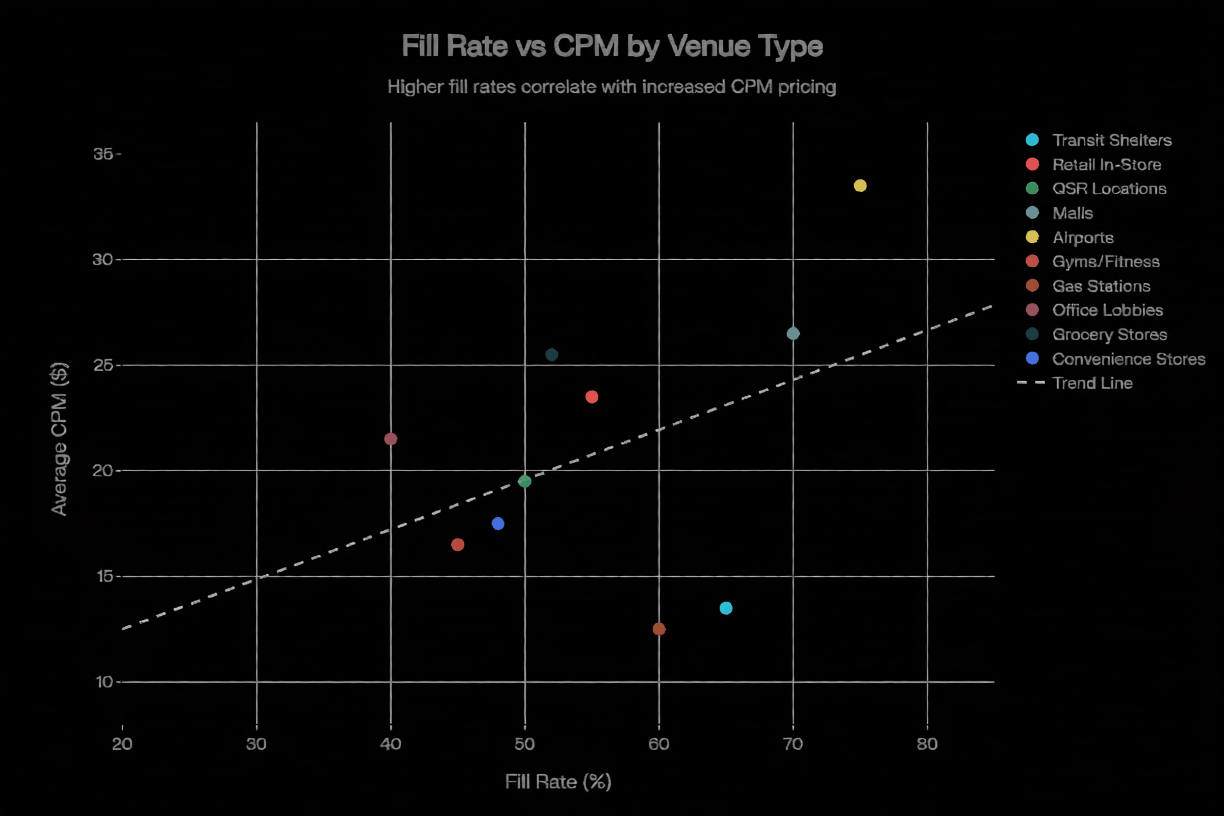
Fill rate vs CPM by venue type
Technology Requirements for Operators
Before onboarding to programmatic supply platforms, operators should assess technical readiness.
Pre-Integration Checklist
CMS Compatibility
- Supports SSP integration via API
- Accepts third-party creative formats
- Logs proof-of-play with timestamp and screen ID.
- Provides fallback content
SSP Selection
- Choose a supply partner.
- Register inventory metadata
- Define packages by location and format.
- Set floor CPM pricing
Ad Server Considerations
- Larger networks may require priority management.
- Direct deals may need hierarchy over open auction
Media Player Requirements
- Real-time update capability
- Stable connectivity
- Sufficient creative storage
- Remote monitoring
Optional Data Integrations
- Weather APIs
- Event calendars
- POS or inventory feeds
- Aggregated mobility data
Simplified SSP Integration Flow
- Select SSP
- Register inventory
- Integrate CMS API
- Test creative delivery
- Launch pilot campaign
- Open to a private marketplace or an open auction.
When combined with predictive AI, programmatic DOOH can dynamically optimize which creative appears in which zone at what time based on real-time performance signals. Learn more in Predictive AI for Digital Signage: How Autonomous Content Engines Will Reshape 2026.
Pricing Models and Revenue Structures
Operator Revenue Models
| Model | Typical Revenue Share | Best Use |
| Open Auction | 50–70% to the operator | Filling unsold inventory |
| Private Marketplace | 60–80% to the operator | Premium placements |
| Programmatic Guaranteed | 70–85% to the operator | Predictable revenue |
| Direct via Programmatic | 80–90% to the operator | Enterprise commitments |
Typical CPM ranges:
- $10–$20 for general inventory
- Higher for premium venues
Fill rate expectations:
- 30–60 percent for new networks
- 60–85 percent for mature networks
Networks generating fewer than 500,000 impressions per month may face limited demand.
Brand Investment Benchmarks
| Inventory Type | Typical CPM | Minimum Budget |
| Transit | $8–$15 | $5,000 |
| Retail In-Store | $15–$30 | $10,000 |
| Mall or Airport | $20–$40 | $15,000 |
| Digital Billboards | $10–$25 | $5,000 |
Recommended pilot strategy:
- Two-week campaign
- Three to five markets
- $5,000 to $10,000 test budget
- Evaluate store visit lift or brand search lift.
- Scale if ROI exceeds 3:1
Measurement and Attribution in 2026
Programmatic DOOH has significantly improved measurement transparency.
1. Proof-of-Play Logging
Each ad logs timestamp, duration, and screen ID.
2. Device ID Matchback
Anonymized exposure zones matched to cross-channel behavior.
3. Store Visit Lift
Exposed versus control group comparison using aggregated mobility data. Typical lift ranges from 10 to 30 percent.
4. Sales Matchback
For in-store environments, impressions matched to POS transactions to measure incremental sales lift.
5. Marketing Mix Modeling
Integration into MMM frameworks with typical ROI coefficients between 1.2 and 1.8.
Common Misconceptions
Misconception 1: Programmatic Means Loss of Control
Operators retain floor pricing, category exclusions, and approval workflows.
Misconception 2: Programmatic Replaces Direct Sales
It complements direct deals and increases overall yield.
Misconception 3: Only Large Brands Benefit
Private marketplaces allow mid-sized and regional advertisers to participate.
Misconception 4: Programmatic Requires Replacing Your CMS
Most modern CMS platforms support SSP integration via API or plugin. The integration connects your existing system to the programmatic supply chain without requiring full replacement.
Misconception 5: Programmatic Requires Sharing Personal Data
Targeting relies on contextual and aggregated signals, not personally identifiable information.
2026 Playbook: How to Get Started
For Brands: 4-Week Launch Plan
Week 1: Define objectives and select DSP
Week 2: Set targeting parameters and upload creative
Week 3: Launch pilot campaign
Week 4: Analyze performance and optimize
For Operators: 90-Day Onboarding
Month 1: Audit screen network and select SSP
Month 2: Integrate CMS and define inventory packages
Month 3: Launch pilot campaigns and refine fill rate
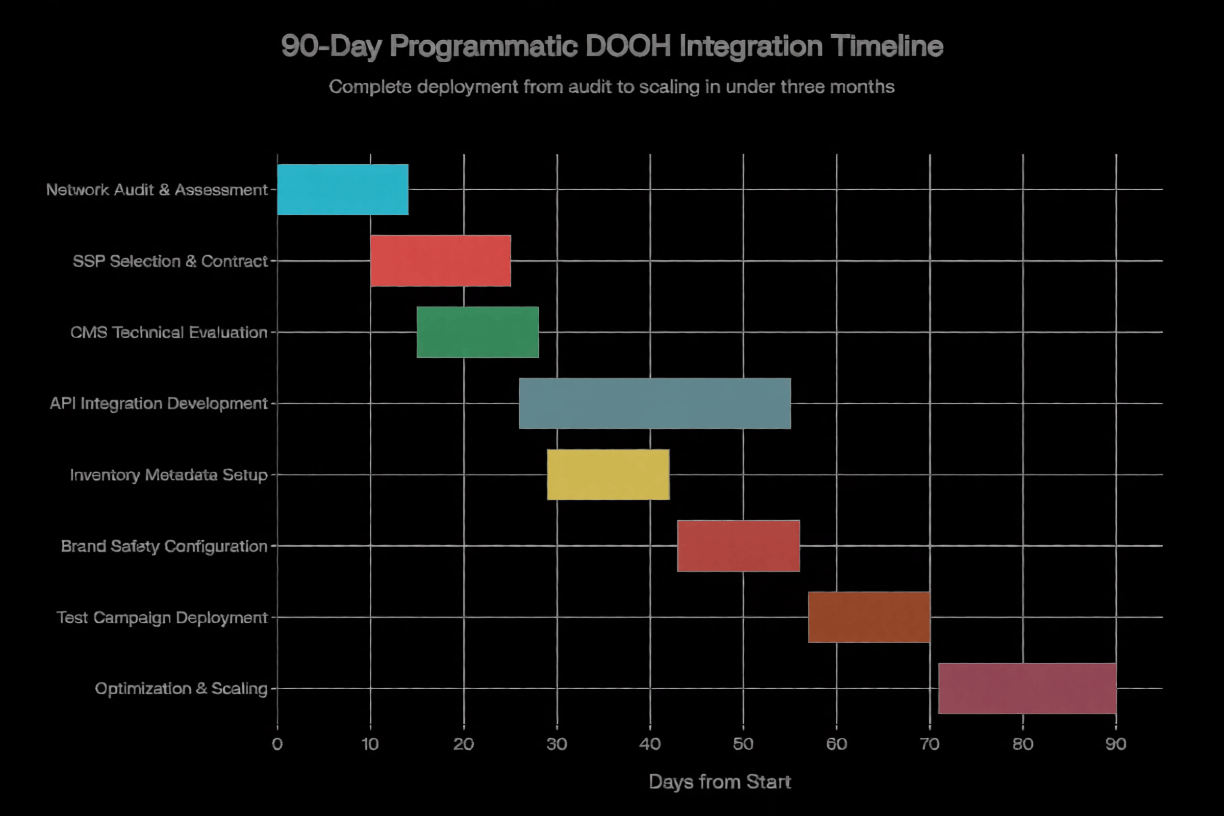
90 day Programmatic DOOH integration timeline
For Franchises: 6-Month Pilot to Scale
Months 1–2: Align HQ and franchisees on governance
Month 3: Integrate CMS with SSP
Months 4–5: Run pilot across select locations
Month 6: Scale network-wide with standardized reporting
Conclusion
Programmatic DOOH is no longer simply a buying mechanism. It is the automation infrastructure connecting screen networks, advertisers, and measurement systems.
For brands, it delivers flexibility and measurable performance.
For operators, it unlocks scalable monetization.
For franchises, it enables revenue growth without sacrificing governance.
Operators who can deliver superior measurement, maintain brand safety at scale, and integrate in-store screens into omnichannel retail media ecosystems will gain a competitive advantage as programmatic pipes become commonplace.
In 2026, programmatic DOOH is foundational infrastructure for serious screen networks.