
Retail Media Networks for Signage: Turning Your Displays Into Revenue-Generating Ad Inventory
From Screens to Retail Media Networks
For years, in-store digital signage has been treated as a support layer. Screens displayed promotions, menus, wayfinding, and operational messaging. Valuable, yes. Monetized, rarely.
That assumption no longer holds in 2026.
Retailers are rapidly expanding retail media networks, transforming owned digital touchpoints into structured advertising channels sold directly to brands. While much of the conversation has centered on e-commerce sites and mobile apps, one of the most potent and underutilized assets sits inside physical stores.
If you already operate digital screens, you already own unmonetized advertising inventory.
Major retailers such as Kroger, Walmart, Carrefour, and Tesco are accelerating in-store retail media investments because physical environments offer advantages that digital channels cannot match. These include proximity to purchase, category adjacency, and closed-loop sales measurement tied directly to transactions.
Digital signage is no longer just a communication tool. It is becoming a media business.
What Is an In-Store Retail Media Network?
An in-store retail media network is a retailer-owned advertising channel that uses digital displays, first-party shopper data, and ad technology to sell targeted media placements to CPG brands and agencies inside physical stores. Unlike traditional digital signage, which displays only retailer content, or third-party DOOH networks owned by outdoor operators, in-store retail media networks turn retailers into media owners who monetize their own screens.
This definition reflects how RMNs are understood by buyers, analysts, and platforms in 2026.
What Are Retail Media Networks for Signage?
What Is a Retail Media Network?
A retail media network is a retailer-owned ecosystem that allows brands to buy advertising placements across the retailer’s digital properties. These typically include websites, mobile apps, off-site digital media, and physical stores.
In an in-store retail media network, digital signage becomes a monetized channel within that ecosystem.
In an in-store retail media network, the retailer is the media owner, not the advertiser. This is a fundamental shift. Instead of buying third-party DOOH inventory from outdoor operators, retailers monetize their own screens by selling placement to CPG brands, just as they sell shelf space. The store becomes both the physical environment and the advertising channel.
This distinction determines who controls pricing, data access, targeting logic, and measurement standards.
How In-Store Retail Media Extends Your RMN
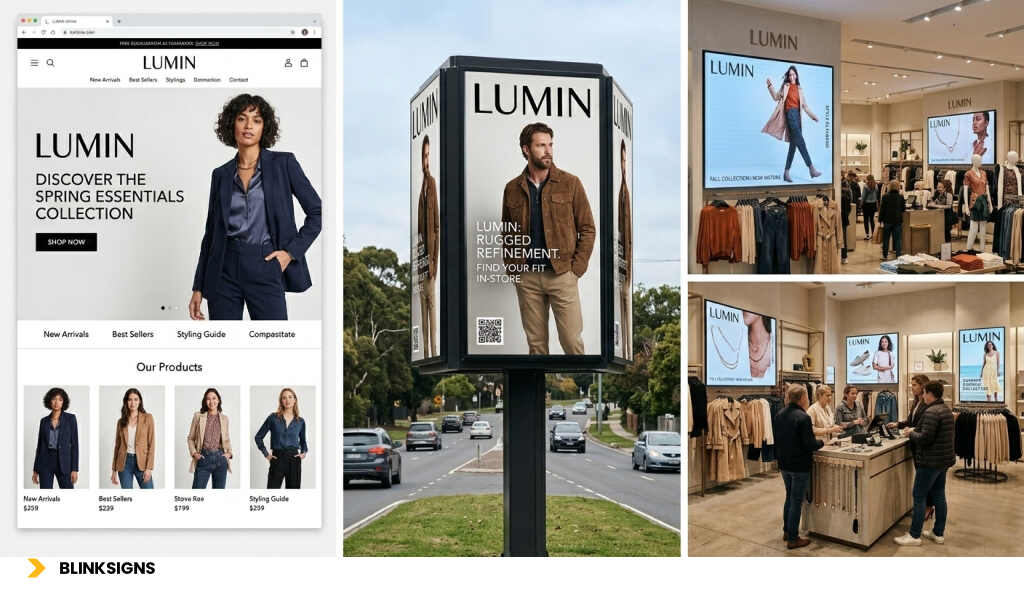
Retail Media Networks to Enhance Shopping Experience
Modern retail media networks are built on three connected pillars:
- On-site media
Sponsored listings and placements on e-commerce properties.
- Off-site media
Retailer first-party data is activated across external digital channels.
- In-store media
Digital screens inside physical locations are sold as advertising inventory.
In-store retail media completes the loop. It brings retail press to the exact moment of physical consideration, where shoppers are making purchase decisions in real time.
Signage vs DOOH vs Retail Media Networks: Key Differences
| Dimension | Traditional Digital Signage | DOOH Network | Retail Media Network (In-Store) |
| Who owns the screens? | Retailer or venue | Media company or operator | Retailer as media owner |
| Who sells ad space? | Not sold, internal use | DOOH operator | Retailer |
| Targeting capability | Time-based scheduling | Location and daypart | First-party shopper data, POS, category behavior |
| Sales model | Cost center | CPM and programmatic | Direct sales, sponsorships, programmatic |
| Measurement | Internal engagement | Impressions and modeled attribution | Closed-loop sales lift and ROAS |
| Content mix | 100 percent retailer content | 100 percent paid ads | Mixed utility and paid media |
| Buyer perspective | Not applicable | Reach and frequency | Proximity to purchase and data |
| Examples | Wayfinding, menus | Outdoor media owners | Kroger, Walmart, Carrefour |
How retail media networks differ from traditional signage and DOOH: retailers move from content operators to media owners.
This comparison clarifies why in-store RMNs are not an extension of signage and not a subset of DOOH. They are a distinct media model.
Designing Your In-Store Retail Media Network
Start With Screen Zones, Not Software
High-performing in-store retail media networks start with physical planning, not ad tech.
Screens should be designed as zones, each aligned to a specific stage in the shopper journey:
- Entrance zones for awareness and brand storytelling
- Main aisles for category discovery and consideration
- End-caps and specialty departments for product influence
- Checkout and self-checkout for conversion and impulse decisions
Not all zones carry equal value. Entrance and checkout screens typically command premium pricing due to consistent traffic and high dwell time.
Mapping Shopper Journeys to Ad Products
Once zones are defined, they can be translated into media products.
Retailers should think in terms of:
- Awareness inventory
- Consideration inventory
- Conversion inventory
This mapping allows inventory to be packaged in a way brands immediately understand, reducing friction in sales conversations and media planning.
Balancing Shopper Experience and Ad Load
Retail media succeeds only if it respects the in-store experience.
Mature networks maintain a precise balance between:
- Shopper utility content, such as pricing, wayfinding, and promotions
- Paid brand content aligned with category and context
Many retailers target a 60 to 70 percent utility content ratio, with governance rules covering category eligibility, frequency caps, and creative standards. This protects trust while preserving monetization.
Real-World In-Store RMN Deployments in 2026
- Kroger Precision Marketing
More than 2,800 stores with screens at entrances, end-caps, and self-checkout. Measurement tied to loyalty and basket-level data.
- Walmart Connect In-Store
Large-format TV walls and self-checkout inventory integrated with Walmart’s demand-side platform for omnichannel activation.
- Carrefour Links
Multi-country in-store retail media network across Europe with category sponsorships and proximity-based triggers.
- Tesco Media & Insight
In-store screens and audio are packaged with Clubcard data for audience segmentation and sales lift reporting.
These examples show that in-store retail media networks are operating at scale today, not in pilot mode.
Turning Screens Into Sellable Ad Inventory
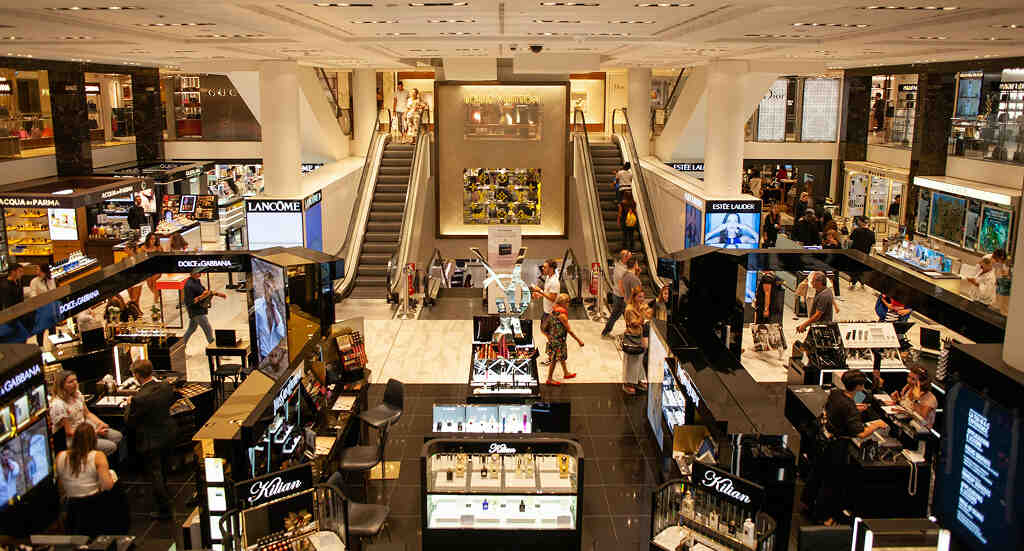
Advertising screens in retail areas
Design and zoning create potential. Revenue comes from turning that potential into clear, repeatable media products that buyers can plan against.
From Screens to Media Products
Retailers should define inventory in concrete terms that answer four buyer questions:
- Where does the ad appear?
- How often does it appear?
- Who sees it?
- What outcome does it drive?
Every day, in-store media products include:
- Entrance video wall loop slots
- Category end-cap exclusives
- Aisle-level shelf screen loops
- Self-checkout conversion takeovers
- Seasonal storewide sponsorships
Each product should be standardized, named, and documented so it can be sold consistently across stores.
Example Media Products: Copy-Ready Templates
Product 1: Entrance Awareness Loop
- Format: 15-second video within a 90-second loop
- Location: Main entrance digital wall across all stores
- Frequency: Rotates approximately 40 times per hour during store hours
- Audience: All shoppers entering the store
- Pricing: $25 CPM or $1,500 per week per store
- Measurement: Zone impressions and basket lift for exposed shoppers
Product 2: Category End-Cap Sponsorship
- Format: Dedicated 30-second loop with brand exclusivity
- Location: End-cap screen within a specific category aisle
- Frequency: Continuous during store hours
- Audience: Shoppers browsing the category
- Pricing: $3,000 to $5,000 per month per store
- Measurement: Category sales lift and units per basket versus control stores
Product 3: Self-Checkout Conversion Screen
- Format: 10-second full-screen takeover at transaction completion
- Location: All self-checkout terminals
- Frequency: Every third transaction
- Audience: High-intent shoppers at the point of sale
- Pricing: $35 CPM or $2,000 per week per store
- Measurement: Add-to-basket rate, coupon redemption, QR scans
These templates can be dropped directly into a retailer’s media kit and used to launch pilots quickly.
Pricing Models and Revenue Expectations
In-store retail media pricing typically blends multiple models:
- CPM pricing for impression-based inventory
- Flat weekly or monthly fees for guaranteed presence
- Category sponsorships with exclusivity
- Omnichannel bundles that include web, app, and in-store placements
In-store inventory often commands premium pricing because it sits closest to the moment of purchase and supports closed-loop measurement. Through 2026, this segment is expected to grow faster than off-site RMN inventory even when total screen counts are lower.
Direct Sales Versus Programmatic Demand
Most retailers begin with direct sales through trade marketing and joint business plans with CPG partners. This allows tighter control over placements and pricing.
As networks mature, retailers layer in programmatic demand using private marketplace deals and guaranteed access. This approach increases fill and yield without opening premium inventory to open auctions.
Best practice is a hybrid model:
- Direct sales for high-impact and exclusive placements
- Programmatic access for standardized units and incremental demand
The Technology Stack: Connecting Signage to the RMN Ecosystem
Core Building Blocks of an RMN-Ready Stack
An in-store RMN does not require a complete platform replacement, but it does require the right components working together:
- Digital signage CMS to control screens and content behavior
- An ad server to manage decisioning and impression tracking
- DSP and SSP connections for programmatic access
- POS, inventory, and shopper data integrations for targeting and reporting
The CMS controls the canvas. The ad server controls monetization. Data gives the inventory value.
How the Components Work Together: Data and Decision Flow
Simplified flow
Brand campaign → Ad server with targeting rules → Queries anonymized shopper and inventory data → Selects highest value creative → Sends creative to CMS → Screen displays ad → Impression logged → POS data matched to exposed shoppers → Sales lift, and ROAS reported to brand
This flow helps marketing, IT, and procurement align on roles, integrations, and vendor requirements.
Data and Privacy Considerations
Retail media depends on first-party data, but in-store environments require strict safeguards. Best practices include:
- Aggregated and anonymized shopper signals
- No personally identifiable information
- Transparent data governance and retention policies
- Transparent shopper disclosures were required.
Privacy-safe design is now a buying requirement for brands, not just a compliance checkbox.
Measurement: Proving Revenue and Lift
What Brands Expect From In-Store Retail Media Reporting
Brands buying in-store inventory expect reporting that connects exposure to outcomes. Standard deliverables include:
- Impressions and reach by zone
- Frequency and dwell proxies
- Category and basket-level sales lift
- Units per basket and attach rate
- Return on ad spend
Retailers that standardize these metrics reduce friction in buying conversations and accelerate repeat spend.
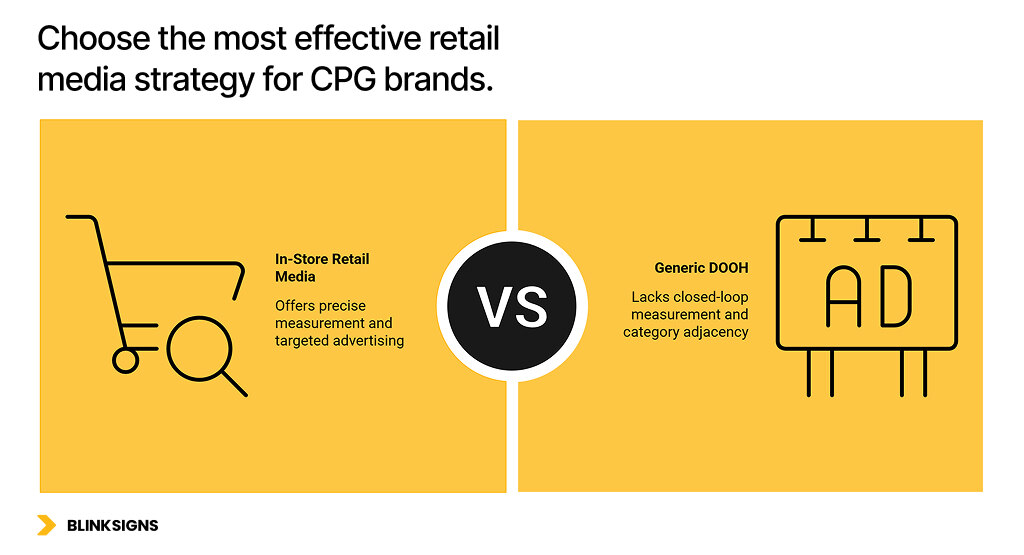
Why CPG Brands Prioritize In-Store Retail Media Over Generic DOOH
Autonomous Content Engine Cycle
In-store retail media offers four advantages that generic DOOH cannot match:
- Closed-loop measurement
Exposure can be tied directly to transaction and basket data, enabling precise incrementality analysis.
- Category adjacency
Ads appear in the exact aisle or department where products are shelved, influencing shoppers during the consideration stage.
- Proximity to purchase
Messaging reaches shoppers seconds before decisions are made, not minutes or hours earlier.
- First-party retailer data
Targeting leverages transaction history, loyalty data, and basket behavior rather than location alone.
These advantages explain why in-store retail media is the fastest-growing RMN segment in 2026, despite a slight overall decline in screen counts.
Connecting In-Store Screens to Omnichannel Performance
In-store retail media increasingly operates as part of a unified plan:
- In-store exposure supports web and app campaigns
- Loyalty data links physical and digital behavior.
- Incrementality testing and marketing mix models quantify cross-channel lif.t
For deeper guidance on closed-loop attribution and multi-touch measurement, connect this framework to your dedicated attribution content within the same cluster.
2026 Playbook: How to Launch a Retail Media Network From Existing Signage
Phase 1: Audit and Design
- Inventory existing screens and formats.
- Map shopper journeys and traffic patterns.
- Identify high-value zones, such as entrances and checkout areas.
- Define governance rules and content ratios.
Phase 2: Package and Pilot
- Create a minimal media kit with standardized ad units.
- transparent pricing and reporting expectations.
- Pilot with one to three anchor CPG partners.
- Measure lift and refine packaging.
Phase 3: Scale and Automate
- Expand to more stores and categories.
- Introduce programmatic access where appropriate.
- Standardize reporting and operations.
- Align internal teams around media ownership.
Retailers that make their RMN easy to buy and easy to measure will capture disproportionate demand.
Download the RMN Technology Integration Checklist and ensure your retail media launch is technically sound before go-live.
FAQ: Retail Media Networks for Digital Signage
What is a retail media network for digital signage?
It is a retailer-owned advertising channel that monetizes in-store screens using shopper data and ad technology.
How do retailers make money from in-store screens?
By packaging placements as ad products and selling them directly or programmatically to brands.
What is the difference between DOOH and retail media?
DOOH is owned and sold by third-party operators, while retail media is owned and sold by retailers using their own data.
How do brands buy in-store retail media inventory?
Through direct retailer agreements, private marketplaces, or guaranteed programmatic deals.
How is ROI measured for in-store retail media?
Using impressions, sales lift, basket impact, and return on ad spend with first-party data.
From Screens to a Durable Revenue Engine
In-store retail media networks allow retailers to monetize attention without compromising the shopper experience.
By treating signage as structured ad inventory, retailers gain pricing power, data control, and measurable revenue. In 2026, the advantage belongs to organizations that operate their stores like media platforms, not just places to display content.