
Sustainability in Digital Signage: Energy Efficiency, E-Paper Screens, and Carbon Reduction
Sustainability in digital signage is not a screen feature. It is a network design discipline.
That distinction matters because the biggest sustainability gains in enterprise signage rarely come from a single display specification. The design, scheduling, powering, and governance of a network across hundreds or thousands of screens determines its sustainability. In the US market, that matters even more now, as climate disclosure and energy compliance pressure are increasingly operational, not just reputational.
California’s SB 253 requires certain companies to report their direct and indirect greenhouse gas emissions starting on August 10, 2026, while SB 261 mandates these companies to release reports on climate-related financial risks beginning January 1, 2026. In terms of purchasing, ENERGY STAR’s Displays Version 8 includes signage displays, and displays that meet ENERGY STAR standards are likely to comply with FEMP’s 1-watt low-standby requirement for displays
Sustainable digital signage is the practice of designing and operating screen networks to minimize energy consumption and carbon emissions by selecting screen technology, implementing centralized power management, optimizing content efficiency, and optimizing network architecture rather than relying solely on individual device specifications.
Why sustainability now matters for large screen networks
A signage network quickly becomes an energy management issue. A 500-screen deployment with an average draw of 150 watts per display running 16 hours per day consumes about 438,000 kWh annually, or 438 MWh. Under the GHG Protocol, purchased electricity is a Scope 2 emissions source, meaning signed electricity can become a reportable and reducible operating footprint.
EPA also notes that electricity-related emissions should be converted using eGRID regional or national average output rates, which is exactly why network carbon accounting needs to be location-aware, not generic.
The US regulatory pressure is now strongest at the state level, especially in California. SB 253 applies to companies doing business in California with annual revenues over $1 billion and, under CARB’s approved climate transparency regulation, sets August 10, 2026, as the first-year reporting deadline, with first-year reporting including Scope 1 and Scope 2 emissions.
SB 261 applies to companies with over $500 million in annual revenue doing business in California and requires climate-related financial risk reporting by January 1, 2026, and biennially thereafter.
That makes signage unusually important for enterprise sustainability teams. Unlike many operational emissions sources, display networks are centrally controllable. Runtime can be shortened. Brightness can be tuned. Device classes can be swapped. Static communications can migrate to ultra-low-power formats. In other words, signage is not just a reporting burden. It is one of the cleaner Scope 2: levers an enterprise can actually redesign.
The US regulatory stack that every enterprise signage team should understand

Corporate compliance / reporting environment
The strongest sustainability article in this category cannot stop at “ESG matters.” It has to map the actual compliance stack.
California is now the most important reference point. SB 253 requires large companies in the state to report their greenhouse gas emissions, and CARB’s 2026 regulations confirm when they need to report Scope 1 and Scope 2 emissions for the first time.
SB 261 also requires companies to disclose climate-related financial risks starting January 1, 2026. Together, these laws create a strong sense of urgency for retailers, REITs, universities, hospitality groups, and businesses with multiple locations in California
At the energy-efficiency layer, ENERGY STAR’s Display Specification Version 8 applies to signage displays, not only desktop monitors. EPA’s signage display pages highlight that ENERGY STAR-certified signage displays are more efficient and run cooler.
FEMP procurement guidance indicates that buyers can trust all ENERGY STAR-certified products to use no more than 1 watt of standby power. That matters in federal, university, public-sector, and contractor environments, where procurement rules matter as much as operating costs.
California Title 24 adds another practical layer. For enterprise operators in California, large display systems are increasingly integrated into broader building-energy conversations, especially where brightness control, scheduling, and demand-responsive operations intersect with facility management. That makes signage less of an isolated AV purchase and more of a building systems decision.
One more note belongs here because enterprise readers will know it: the SEC’s climate disclosure rule is not the right primary anchor in 2026. The SEC voted in March 2025 to end its defense of the climate-related disclosure rule, and the rule remains in litigation limbo rather than serving as a reliable active driver. California law is the stronger and more usable operational anchor for this article.
How much energy does digital signage actually use?
Most sustainability conversations in signage become vague because they never quantify usage. That is a mistake.
A realistic enterprise technology table looks like this:
| Display technology | Typical power use |
| 55” LCD commercial display | 120-180 W |
| 75″ LCD display | 250-350 W |
| LED video wall tile | 100-150 W per tile |
| OLED display | 150-250 W |
| microLED display | 90-150 W equivalent brightness range |
| e-paper display | Under 1 W when static |
The precise draw varies by brightness, content, ambient light, panel generation, and operating mode, but the planning implication is simple: most enterprise networks are still dominated by LCD and LED, which means runtime policy matters almost as much as hardware selection.
The Carbon Cost per Screen
Carbon cost per screen = screen wattage × runtime hours × screen count × regional emission factor
EPA’s eGRID data shows that the same level of electricity use produces very different CO2 emissions across subregions. According to EPA’s published summary data, CAMX, which covers much of California, shows a CO₂ output rate of about 428.5 lb/MWh, while ERCT, covering Texas, shows a rate of about 733.9 lb/MWh. EPA’s 2025 greenhouse gas factors hub lists the US average at about 771.5 lb CO2 per MWh based on eGRID2023.
That means a 500-screen network using 438 MWh annually looks very different by location. In California, that profile produces roughly 85 metric tons of CO2 using the CAMX rate. Using the current EPA national average, the same network lands around 154 metric tons. In a dirtier power region, the same hardware and same runtime can produce materially more. The planning lesson is clear: enterprises should not model signage carbon with a single nationwide factor when they operate across multiple utility regions.
A category-defining approach is carbon attribution by screen group. Instead of estimating a single portfolio total, operators can calculate carbon at the regional, store class, or display group level. This enables smarter decisions on where to prioritize e-paper migration, where brightness adjustments yield the largest savings, and where runtime reductions deliver the fastest emissions cuts.
The Sustainable Screen Network Model
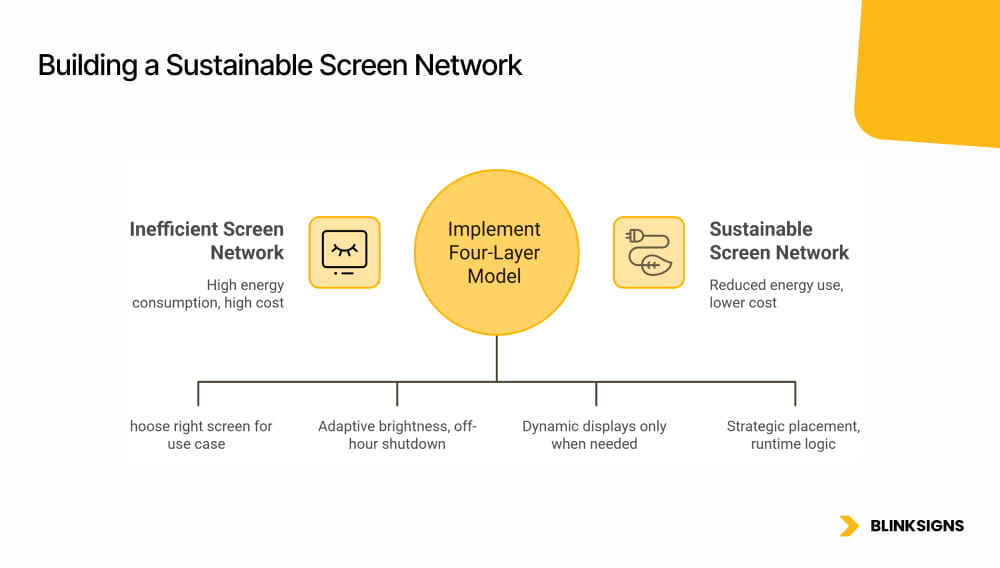
Building a Sustainable Screen Network
A sustainable screen network can be understood through a four-layer model:
Layer 1: Screen technology selection
The first sustainability decision is not “which screen is best?” It is “which screen is right for this use case?”
LCD remains the practical default for much indoor enterprise signage because it balances cost, brightness, and deployment maturity. LED video walls remain appropriate for high-impact, long-view, or daylight-heavy environments. OLED can deliver visual quality, but power use and burn-in considerations limit its sustainability case in many commercial signage scenarios.
MicroLED is increasingly relevant because it promises better efficiency than OLED at high brightness and is moving toward broader enterprise viability in flagship and lobby environments. E-paper is the breakout low-energy category because it can deliver static messaging at near-zero steady-state power. The sustainability mistake is not choosing one technology over another. It is using the wrong technology for the content behavior and environment.
Layer 2: Centralized power management
Energy efficiency in signage is often won or lost here.
If a network uses modern commercial displays but leaves brightness high all day, runs screens long after business hours, and ignores sleep states, the procurement choice will not save it. Centralized power management includes adaptive brightness, off-hour shutdown, wake schedules, occupancy-aware operation, and policy-based exceptions for critical displays. For multi-location operators, this is the layer that scales.
It is also the layer that connects directly to utility demand response programs. PJM’s 2026/2027 Base Residual Auction cleared at the cap of $329.17 per MW-day, and PJM’s own auction reporting confirms that number. That implies significant annual value for curtailable load. A signage network is not a huge demand response asset by itself, but at enterprise scale, it becomes meaningful.
A 500-screen network at 150 watts per screen equals 75 kW of total connected load. If 30 percent of that load is enrolled as flexible demand response capacity, that is 22.5 kW, or 0.0225 MW. At PJM pricing, that works out to roughly $2,700 per year; a 5,000-screen estate scales to about $27,000 annually, before more advanced optimization.
That reframes sustainability for facilities and operations leaders. It is no longer just lower cost. It is a controllable load with monetization potential.
Layer 3: Content efficiency
This is the most overlooked layer in the entire category.
Not every message deserves a dynamic display. Not every screen needs motion. Not every update requires high refresh behavior or full-day runtime. Content design changes energy use by influencing the appropriate screen type, refresh frequency, brightness requirements, and schedule.
This is where e-paper becomes strategically important, not just technically interesting. Room signs, meeting schedules, shelf-edge labels, wayfinding, compliance notices, and timetable-style communications often do not need LCD or LED at all. When those use cases run on higher-power displays, the network incurs an energy penalty for content that does not require it.
Layer 4: Network architecture
This is the most important layer and the one that most competitors skip.
A sustainable network is designed through choices about screen density, placement strategy, runtime logic, message hierarchy, and control architecture. One oversized network with redundant displays and unnecessary uptime can erase the gains from efficient hardware. A better-designed network with fewer, better-placed, better-controlled displays can materially reduce both energy use and carbon output without reducing communication effectiveness.
A well-designed network with fewer, better-controlled displays can materially reduce both energy use and carbon output without reducing communication effectiveness.
E-paper screens and ultra-low-power signage
E-paper deserves its section because it is one of the few true step-change technologies in signage sustainability.
Its core advantage is straightforward: power is required mainly when content changes, not continuously while the message remains on screen. That makes it fundamentally different from emissive or backlit display technologies.
The best enterprise use cases are static or slowly changing information environments: meeting room signs, desk booking, corporate directories, hospital wayfinding, shelf labels, menu cards with infrequent updates, and selected transit information. In those environments, e-paper can move a signage conversation from “lower power” to “near-zero steady-state power.”
Its limitations are just as important. E-paper is not a universal answer to sustainability. Refresh is slow. The video is limited. Color performance is still evolving, even as second-generation color e-paper improves. For high-motion, high-brightness, or high-impact promotional surfaces, LCD, LED, or microLED remains the more appropriate option.
Use e-paper for static or slowly changing content, while reserving LCD or LED for high-motion or high-impact signage.
Solar-Powered Signage: Already a Real Deployment Model
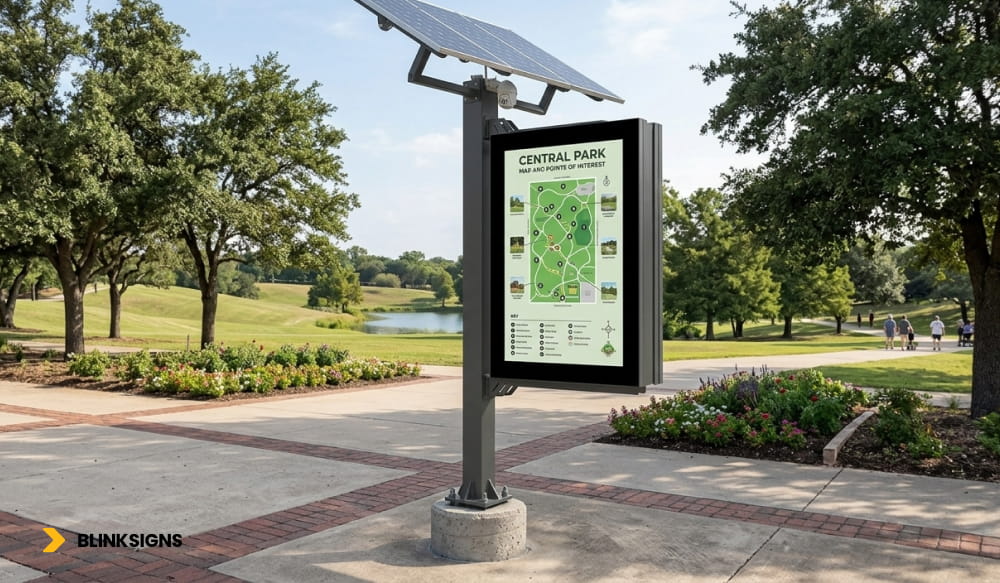
Solar-Powered Signage
Solar-powered signage is often presented as a future concept. In reality, it is already operational across several transportation and infrastructure environments in the United States.
The viability of solar signage depends on one simple factor: power demand. Conventional LCD or LED displays consume too much energy for reliable off-grid operation. E-paper displays, however, require power primarily when content changes rather than continuously during operation. This disadvantage makes them well-suited for solar deployments paired with battery storage.
Several transit authorities in the United States have already deployed solar-powered information displays using this model. Systems combining solar panels, batteries, and ultra-low-power reflective displays can operate independently of the electrical grid. In transit environments, this architecture supports bus arrival displays, wayfinding kiosks, and stop-level information boards without requiring trenching or new electrical infrastructure.
The sustainability implications are twofold. First, energy consumption drops dramatically because the display technology itself is efficient. Second, the deployment avoids electricity consumption entirely because the energy source is local and renewable.
For enterprises managing large campuses, logistics hubs, or outdoor retail environments, solar-powered signage offers an additional sustainability lever beyond traditional power optimization.
Power Management Strategies for Large Screen Networks
Hardware efficiency alone often fails to realize the sustainability potential of a digital signage network fully. The largest operational improvements come from centralized power policies that control when screens run and how much power they consume.
Three strategies consistently produce the largest reductions.
Adaptive brightness control
Commercial displays are typically installed at brightness levels far higher than necessary for indoor environments. Many screens operate at 500-700 nits, even though comfortable indoor viewing requires much less.
Adaptive brightness systems use ambient light sensors or scheduled adjustments to reduce brightness when environmental lighting conditions permit. Lower brightness directly reduces electricity consumption and can extend panel lifespan.
Scheduled runtime management
Many signage networks operate screens well outside their useful hours. Retail displays may run overnight even when stores are closed. Corporate lobby displays may run continuously, even with minimal traffic, after evening hours.
Centralized scheduling policies allow displays to power down automatically when locations are closed or when traffic falls below meaningful thresholds.
Even modest runtime adjustments can significantly reduce annual energy consumption across a large network.
Content-aware power optimization
Certain content types require higher brightness, refresh rates, or animation frequency. Others do not.
Operational policies can assign different display behaviors based on content category. Static informational content can run at lower brightness settings or be displayed on reflective displays, such as e-paper. Promotional content may remain on LCD or LED displays but operate during shorter runtime windows.
When content strategy and power policy are coordinated, energy efficiency becomes part of the content workflow rather than an afterthought.
Demand response participation
Demand response programs represent an additional operational opportunity.
Electric grids periodically experience peak demand events during which utilities request temporary reductions in electricity consumption. Commercial facilities that participate in demand response programs receive financial compensation for reducing load during these periods.
Central control enables digital signage networks to respond quickly. During peak events, displays can reduce brightness, enter sleep mode temporarily, or pause nonessential content playback.
As discussed earlier, even partial participation can generate measurable revenue for large networks. While the energy reductions during any single event are short-lived, participation demonstrates grid responsiveness and can contribute to broader sustainability initiatives.
Real-World Carbon Reduction Examples
Several real deployments demonstrate how sustainability strategies for signage translate into measurable outcomes.
Retail shelf-edge electronic labels
Large US retailers such as Walmart, Target, and Kroger have invested heavily in electronic shelf labeling systems. These displays replace printed price tags with small digital displays connected to centralized inventory and pricing systems.
From a sustainability perspective, electronic shelf labels deliver two benefits. First, they eliminate the recurring waste associated with printed labels. Second, many shelf-edge displays operate using ultra-low-power reflective display technologies, dramatically reducing electricity consumption compared to traditional digital displays.
The result is a retail communications system that reduces both operational waste and energy usage.
Device scheduling optimization
Research from enterprise device management platforms has shown that automated power scheduling can significantly reduce energy consumption in signage systems. In one widely cited example, a financial institution reduced its display energy costs by roughly 40 percent after implementing device scheduling and power policies.
Although the study originated outside the United States, the methodology translates directly to US deployments. The lesson is straightforward: runtime governance often produces larger sustainability gains than hardware upgrades alone.
Solar transit information displays
Transit systems in several major US cities have deployed solar-powered passenger information displays using reflective display technologies. Because these displays require minimal energy to update schedules or route information, they can operate reliably using solar power and battery storage.
These installations demonstrate how sustainability and infrastructure efficiency can align. Solar signage reduces energy use, avoids grid electricity consumption, and eliminates the need for costly electrical connections at every installation point.
Designing Low-Carbon Screen Networks
For enterprises managing hundreds or thousands of displays, sustainability ultimately becomes an architecture problem.
Several architectural decisions influence the long-term carbon footprint of a signage network.
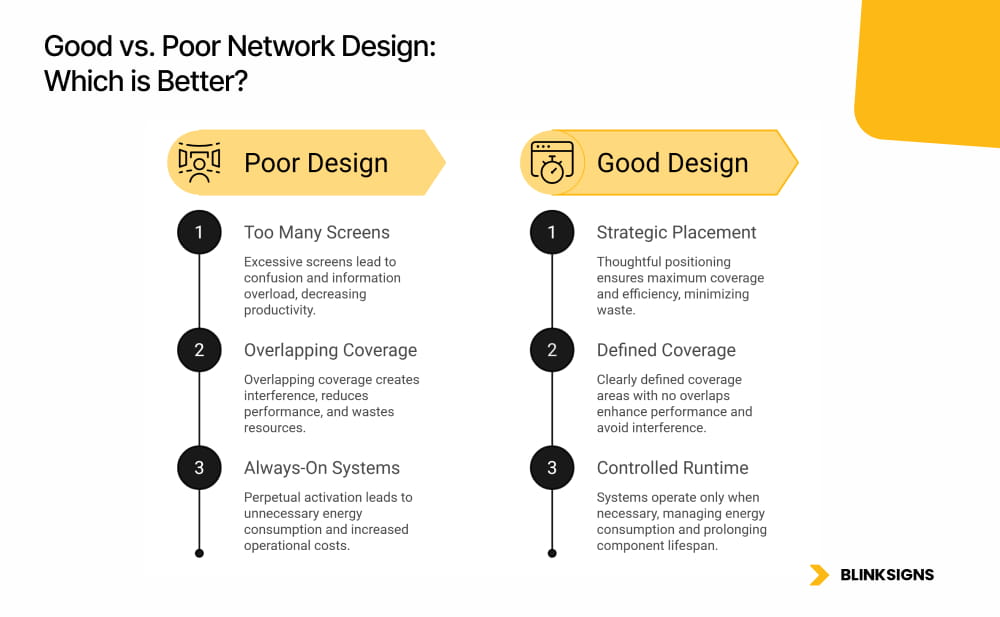
Good vs. Poor Network Design_ Which is Better_
Screen density and placement
Many early signage deployments expanded organically. Location by location, they added screens without a cohesive strategy for placement or coverage. Over time, the process can create redundancy, where multiple displays deliver similar messages in overlapping physical areas.
A network designed for sustainability evaluates whether every display is necessary. Reducing redundant displays often delivers immediate energy savings without affecting communication effectiveness.
Runtime governance
Large enterprises often operate across multiple time zones and business models. A corporate campus may operate during business hours, while retail locations operate evenings and weekends.
Network-level runtime policies should reflect those differences. Centralized scheduling ensures that displays operate only when they deliver value.
Display segmentation
Grouping displays by location type, content type, or audience allows organizations to apply different power policies to different screen groups.
For example:
- lobby displays may operate extended hours
- Internal communications displays may run only during office hours.
- Warehouse information boards may operate during shift windows.
Segmentation enables more granular energy optimization across the network.
Integration with building energy systems
As building energy management systems become more sophisticated, signage networks increasingly integrate with facility-level controls.
This integration enables dynamic responses to building occupancy patterns, peak energy events, and facility-wide sustainability goals. When displays participate in broader energy management policies, they become part of the building infrastructure rather than a standalone AV system.
Future Trends in Sustainable Digital Signage
The sustainability profile of digital signage will continue evolving as new technologies emerge.
Several trends are particularly important.
AI-driven brightness optimization
Traditional brightness scheduling relies on fixed schedules or simple ambient light sensors. Newer systems combine environmental sensing with machine learning to adjust brightness based on traffic patterns, viewing distance, and environmental conditions.
This allows displays to operate at lower power levels without reducing visibility for viewers.
Grid-connected demand response automation
As smart grid technologies expand, commercial buildings are increasingly able to respond automatically to grid signals indicating peak demand.
Future signage systems may integrate directly with these signals, automatically reducing power consumption during grid stress events without manual intervention.
Second-generation color e-paper
Color e-paper displays have historically suffered from limited brightness and color saturation. Recent developments from manufacturers are significantly improving color performance, making reflective displays more viable for retail promotional environments.
As color capabilities improve, more categories of signage content may migrate from emissive displays to reflective displays.
MicroLED adoption
MicroLED technology combines many of the brightness advantages of LED with improved energy efficiency and panel durability. While still relatively expensive, microLED displays are expected to become more common in flagship retail locations, corporate lobbies, and other high-impact environments over the next several years.
As manufacturing scales and costs decline, microLED could become a major component of energy-efficient high-brightness signage.
Frequently Asked Questions
How much power does a digital signage network use?
Energy consumption depends on display size, brightness, runtime, and network scale. A typical 55-inch commercial LCD consumes between 120 and 180 watts. A network of 500 such displays running 16 hours per day can consume roughly 438 megawatt-hours of electricity annually.
What is the carbon footprint of digital signage?
Carbon emissions from signage networks depend on electricity consumption and the regional grid’s carbon intensity. Using EPA emission factors, the same network can produce significantly different emissions depending on where it operates.
What is e-paper digital signage?
E-paper displays use reflective technology that consumes power primarily when the displayed content changes. Because they require almost no energy to maintain a static image, they are among the most energy-efficient display technologies available.
How can I make a digital signage network more energy efficient?
The most effective strategies include reducing display runtime, implementing adaptive brightness policies, selecting appropriate display technologies for each use case, and optimizing network architecture to eliminate redundant screens.
What are Scope 2 emissions in digital signage?
Scope 2 emissions represent indirect greenhouse gas emissions from purchased electricity. Because digital signage displays consume electricity, their energy use contributes to Scope 2 emissions in corporate carbon accounting frameworks.
Sustainability as Network Design
Digital signage sustainability is often framed as a hardware conversation. In reality, it is a systems problem.
The most efficient display cannot compensate for poor runtime policies, which can lead to excessive energy consumption and waste. A low-power device cannot offset a network that operates continuously without purpose, especially if the content displayed is not relevant or engaging to the audience. Sustainable digital signage emerges when technology selection, power management, content strategy, and network architecture work together.
For enterprises operating hundreds or thousands of screens, this approach transforms sustainability from a marketing claim into an operational advantage. Energy consumption falls, carbon reporting becomes easier, and the screen network becomes a controllable part of the organization’s broader infrastructure strategy.
In that sense, sustainable digital signage is not simply about reducing electricity use. It is about designing communication networks that deliver value while respecting the energy systems that power them, including optimizing resource allocation and minimizing environmental impact throughout their lifecycles.