
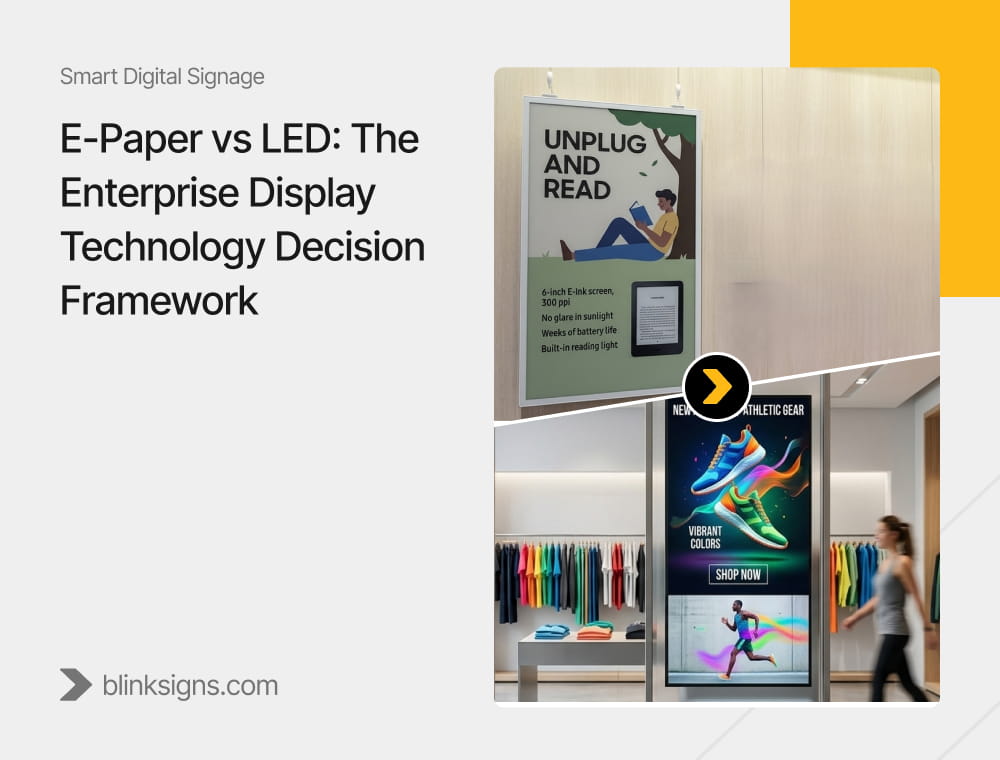
E-Paper vs LED: The Enterprise Display Technology Decision Framework
The question is not which display technology performs better. The technology is correct for the system you are building.
E-paper vs LED displays do not compete on a feature checklist. They operate in different layers of a screen network. One is designed for persistence with near-zero power. The other is designed for motion, real-time data, and continuous visibility. These are not alternatives on the same spectrum. They are different components serving different roles inside an enterprise deployment.
The most common failure pattern is not technical. It is structural. Display decisions are often made as procurement choices, influenced by vendor familiarity, pricing pressure, or visual preference. That approach disconnects hardware from how the network actually operates. The result is predictable: overspending in low-change environments, performance gaps in high-frequency use cases, and unnecessary infrastructure complexity across locations.
BlinkSigns approaches display selection as a system architecture decision, not a product decision. Routing is based on how the network behaves, not on how the screen looks.
This article defines that routing logic. It maps display technology to the variables that actually determine fit: content velocity, deployment conditions, connectivity model, governance requirements, and total lifecycle cost.
The right display technology is not the one with better specifications. It is the one that aligns with the system’s operating model.
What Is E-Paper in a Digital Signage Context?
E-paper, often called E-ink, is a bistable display technology that consumes power only when content changes. Once an image is rendered, it remains visible without continuous power.
This makes E-paper fundamentally different from LED or LCDs, which require constant power to maintain brightness and motion.
The implication is not visual. It is operational.
Why E-Paper displays Are Rising in Enterprise Signage
The growth of E-paper Screens are not driven by novelty. It is driven by structural shifts in how enterprises deploy and manage screen networks:
- Rising energy costs across large estates
- ESG and carbon reporting requirements
- Expansion of multi-location deployments
- Increased demand for low-maintenance systems
E-paper display aligns with these constraints because it reduces:
- power consumption
- installation complexity
- operational overhead
The Display Technology Decision Matrix
Display technology should be selected based on use case, not preference.
| Use Case | E-Paper Fit | LED/LCD Fit | Decision Logic |
| Static pricing | Ideal | Over-engineered | No need for continuous refresh |
| Compliance signage | Ideal | Acceptable | Low update frequency favors E-paper |
| Wayfinding (simple) | Limited | Strong | Requires readability and periodic updates |
| Dynamic advertising | Not suitable | Ideal | Motion and frequent updates are required |
| Real-time dashboards | Not suitable | Required | Continuous data refresh |
| Workplace communication | Conditional | Strong | Depends on update frequency |
This matrix establishes a simple principle:
Display technology selection is a routing decision based on content behavior.
The Refresh Frequency Threshold Model
The primary variable in display selection is not resolution, brightness, or color depth. It is content velocity.
The Refresh Frequency Threshold Model routes display technology based on how often content changes.
| Content Update Frequency | Recommended Technology | Operational Reason |
| Real-time (seconds) | LED only | E-paper display cannot sustain this refresh cycle |
| Sub-minute | LED only | Refresh lag creates visible failure |
| Every 1–4 hours | LED preferred | Sync delay introduces risk |
| Every 4–12 hours | Hybrid | Either viable depending on context |
| Daily | E-paper preferred | Power and cost advantages emerge |
| Weekly or less | E-paper optimal | Maximum lifecycle efficiency |
| Static | E-paper dominant | No ongoing power requirement |
Key Insight
A screen that updates its content once per day has no operational requirement for continuous refresh. Using LED in that scenario introduces cost and infrastructure complexity without delivering functional value.
When E-Paper Is the Correct Choice
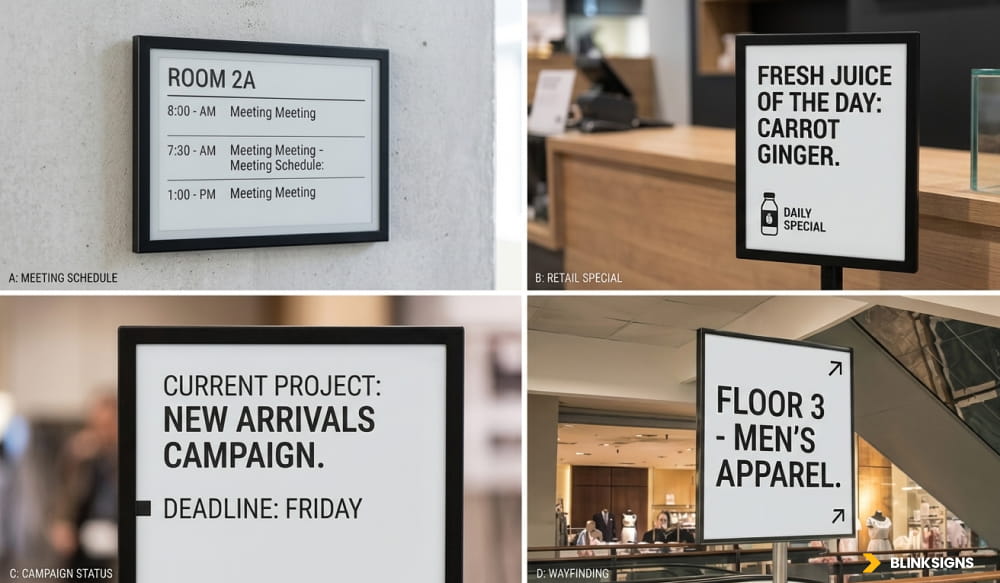
E-paper for different industries
E-paper display is the architecturally correct choice when content updates infrequently, infrastructure access is limited, and lifecycle efficiency outweighs the need for dynamic visuals.
The following environments consistently meet these conditions:
- Retail shelf labels and pricing displays
- Meeting room booking panels
- Compliance and regulatory signage
- Office directories
- Static informational displays
When E-Paper Should Not Be Used
E-paper screen should not be used in environments where content must update frequently or respond in real time.
The following scenarios require an LED or LCD:
- Video playback or animation
- Real-time dashboards
- High-frequency promotional content
- Interactive or touch-driven displays
The E-Paper Failure Mode: What Happens When It Is Used Incorrectly
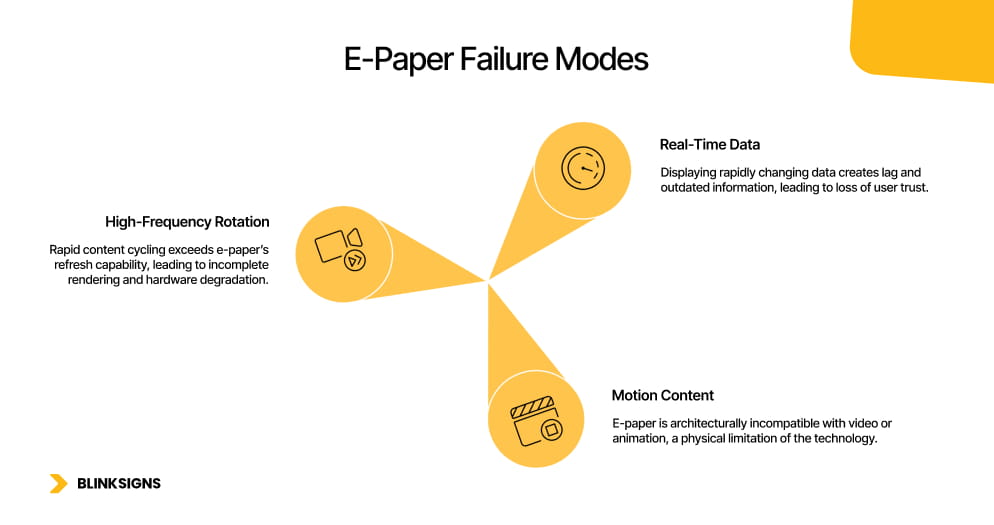
Incorrect deployment does not result in reduced performance. It results in system failure.
Failure Mode 1: Real-Time Data on E-Paper
Attempting to display rapidly changing data creates lag, incomplete refresh cycles, and outdated information. The display becomes unreliable, leading to a loss of user trust.
Failure Mode 2: Motion Content on E-Paper
E-paper is architecturally incompatible with video or animation. This is a physical limitation of the technology, not a configuration issue.
Failure Mode 3: High-Frequency Content Rotation
Rapid content cycling exceeds e-paper’s refresh capability, leading to incomplete rendering and accelerated hardware degradation.
Key Principle
These failures occur when an LED content model is incorrectly applied to an E-paper deployment.
E-Paper Failure Modes
The Power Consumption Model
Power consumption is where E-paper screens deliver its most measurable advantage.
| Metric | LED/LCD | E-Paper | Advantage Margin |
| Continuous power draw | High | None | E-paper |
| Idle power | Constant | Zero | E-paper |
| Annual energy usage | 40–100 kWh | 4–10 kWh | ~90% reduction |
| Operating cost | Higher | Minimal | E-paper |
| Battery / solar capability | No | Yes | E-paper |
ESG Insight
At scale, E-paper displays eliminates tens of thousands of kilowatt-hours annually across large deployments. This is not a marginal efficiency gain. It is a measurable ESG and cost optimization lever.
The Connectivity Requirements Model
Display choice determines network architecture requirements.
| Connectivity Factor | E-Paper | LED/LCD |
| Connection type | Periodic sync | Continuous connection |
| Bandwidth requirement | Minimal | High |
| Offline capability | Strong | Weak |
| CMS sync model | Scheduled updates | Real-time streaming |
| API integration dependency | Low | High |
Key Insight
E-paper’s offline persistence is a deployment advantage. Content remains visible without an active connection, making it suitable for remote locations and environments with restricted connectivity.
Deployment Impact of Display Choice
Display technology selection directly affects deployment speed, infrastructure complexity, and rollout timelines.
How Display Technology Choice Affects Deployment Velocity
| Deployment Factor | E-Paper | LED/LCD |
| Installation complexity | Low | High |
| Cabling requirements | None or minimal | Extensive |
| Electrical permitting | Not required | Required in many cases |
| Site readiness | Minimal | Full infrastructure |
| Deployment speed | Faster | Slower |
| Maintenance frequency | Low | Moderate |
| Scalability | High for static deployments | High for dynamic environments |
Key Insight
Battery-powered E-paper deployments remove electrical dependencies, eliminate cabling requirements, and reduce site preparation. In multi-location rollouts, this can accelerate deployment timelines significantly compared to LED-based systems.
Governance Constraints by Display Type
Display technology directly shapes how content is controlled, approved, and audited across a network.
E-paper reduces governance complexity because content changes less frequently. LED systems increase governance overhead by enabling continuous updates, real-time triggers, and dynamic content rotation.
Governance Comparison
| Governance Dimension | E-Paper | LED/LCD |
| Content approval frequency | Low | High |
| Governance overhead | Minimal | Significant at scale |
| Audit trail complexity | Simple | Complex |
| Emergency override capability | Limited | Immediate |
| Dynamic content control | Restricted | Full |
Key Insight
E-paper simplifies governance by limiting the frequency of changes. This is valuable in compliance-driven environments where content stability is required.
However, environments that depend on immediate updates must rely on LED or a hybrid deployment.
The Hybrid Display Network Architecture
Most enterprise environments should not choose a single display technology. They should route each screen type to the correct technology.
Hybrid Architecture Model
| Screen Zone | Recommended Technology | Governance Level |
| Entrance and lobby displays | LED | Global control |
| Promotional and advertising screens | LED | Regional control |
| Real-time dashboards | LED | Integration-driven |
| Shelf labels and pricing | E-Paper | Regional flexibility |
| Meeting room panels | E-Paper | Local control |
| Compliance signage | E-Paper | Strict global control |
| Outdoor informational displays | Context-dependent | Regional control |
This architecture routes each screen type based on content velocity and governance requirements, ensuring both performance and operational efficiency.
The TCO Comparison Model
Cost differences between E-paper and LED extend beyond the initial purchase. They compound across the lifecycle of the deployment.
Five-Year Cost Comparison (Per Screen)
| Cost Category | LED | E-Paper |
| Hardware | $600–$1,200 | $400–$900 |
| Energy consumption | $150–$500 | $4–$50 |
| Installation | $200–$500 | $50–$150 |
| Maintenance | $300–$600 | $100–$200 |
| Replacement cycle | $300–$600 | $150–$300 |
| Total Cost | $1,550–$3,400 | $704–$1,600 |
CFO Insight
At 500 screens deployed in static or low-refresh environments, the five-year TCO gap between LED and E-paper exceeds $900,000. This is not a specification preference. It is a capital allocation decision that belongs in the procurement business case.
Enterprise Decision Checklist
Display technology should only be selected after validating operational conditions.
Required Evaluation Criteria
- Define content refresh frequency
- Classify screens by use case
- Evaluate environmental conditions
- Assess power availability
- Determine connectivity requirements
- Map governance requirements
- Calculate lifecycle cost
- Identify deployment constraints
- Define hybrid architecture zones
- Validate integration dependencies
Decision Rule
Display technology selection must follow the operational definition. Choosing hardware first introduces inefficiencies that propagate across deployment, governance, and cost layers.
Frequently Asked Questions
What is the main difference between E-paper and LED displays?
The main difference is how they consume power and update content. E-paper screen uses power only when content changes and is suited for static or low-frequency updates. LED requires continuous power and supports dynamic, real-time content.
When should enterprises use E-paper displays?
E-paper should be used when content changes infrequently, and operational efficiency is a priority. Typical use cases include pricing displays, compliance signage, directories, and meeting room panels.
When is LED a better choice than E-paper?
LED is required when content must update frequently, display motion, or respond in real time. It is the correct choice for advertising, dashboards, and interactive environments.
Can E-paper and LED be used together?
Yes. Hybrid deployments are the most effective approach in enterprise environments. Each technology should be used in the zones where it aligns with content behavior and operational requirements.
How does display choice affect deployment speed?
Display choice directly affects deployment timelines due to infrastructure requirements. E-paper deployments eliminate cabling and electrical work, allowing faster rollout across locations. LED deployments require power installation, structural setup, and permitting, which can extend timelines by several weeks in multi-location rollouts.
What are the cost benefits of E-paper?
E-paper reduces the total cost of ownership by lowering energy consumption, simplifying installation, and reducing maintenance costs. Over five years, cost reductions can exceed 50 percent in environments with low refresh requirements.
Does E-paper require a constant internet connection?
E-paper does not require continuous connectivity. It retains content without power and updates through periodic sync cycles, making it suitable for environments with limited or intermittent network access.
What are the limitations of E-paper displays?
E-paper cannot support video, real-time updates, or high-frequency content changes. It is not suitable for dynamic or interactive applications.
Is E-paper suitable for outdoor use?
E-paper performs well in bright environments and can be used outdoors in many cases, but deployment conditions must be validated based on temperature, exposure, and durability requirements.
What is the most important factor when choosing display technology?
The most important factor is the refresh frequency of the content. The Refresh Frequency Threshold Model™ ensures that display technology aligns with operational requirements rather than visual preference.
Conclusion
E-paper and LED are not interchangeable technologies. They are designed for different operational conditions.
Organizations that treat display selection as a routing decision:
- reduce lifecycle cost
- simplify deployment
- align governance
- improve system performance
Organizations that treat it as a preference decision:
- overbuild infrastructure
- increase operational complexity
- create long-term inefficiencies
Final Principle
The correct display technology is not the one with better specifications. It is the one that aligns with how the system operates.