
Real-Time Personalization: How AI Adapts Signage Content Based on Audience Behavior
Real-time personalization in digital signage is not a feature you enable. It is a system that must be architected correctly, or it fails silently.
Across retail stores, airports, healthcare environments, and corporate campuses, digital displays are expected to perform like modern digital channels. Audiences no longer respond to static messaging. They expect relevance. When a screen shows the same content to every viewer regardless of context, it is not neutral. It is a missed conversion opportunity repeated thousands of times per day.
The industry response has been predictable. Vendors claim AI-powered personalization. Platforms advertise smart content. Yet most deployments struggle to deliver measurable impact. The reason is structural. Personalization is not created solely by software. It emerges from the coordination of sensors, edge computing, machine learning models, decision logic, content systems, governance controls, and attribution frameworks.
This article defines how real-time personalization actually works at a system level. It explains how audience signals are captured and interpreted, how AI makes sub-second content decisions, why latency and infrastructure determine feasibility, and how enterprise deployments must be governed and measured to prove ROI.
The goal is not to describe a feature. It is to define the architecture required to make personalization operational, scalable, and provable.
What is real-time personalization in digital signage?
Real-time personalization in digital signage uses AI and behavioral data to dynamically adapt on-screen content based on audience presence, demographics, and environmental signals. Displays respond within milliseconds to changing viewer conditions, improving relevance, engagement, and conversion outcomes without storing personal data.
How does AI adapt signage content in real time?
AI adapts signage content by detecting audience signals such as presence, demographics, and dwell time, then using machine learning models to score and select the most relevant content variant within a sub-second window. In production systems, this is processed at the edge to minimize latency and maintain privacy compliance.
Personalization Is Not a Feature. It Is a System.
Real-time personalization is not a feature you toggle on or off. It is a system you architect, or it fails.
Most organizations approach AI signage as a software decision. A CMS is selected, an “AI feature” is enabled, and a pilot is launched. Three months later, engagement metrics plateau. The issue is not the model. The issue is the system.
Personalization is a coordinated infrastructure that spans physical sensing, edge computation, model inference, decision logic, content delivery, governance rules, and attribution tracking. If any layer is misaligned, the system degrades silently.
This distinction changes how vendors are evaluated and how deployments are designed. A platform that rotates content without proving business impact is not a personalization system. It is a scheduling engine with better branding.
What Real-Time Personalization Actually Means

Static digital signage VS Adaptive digital signage
Real-time personalization is defined by sub-second, AI-driven content decisions based on live audience signals, not pre-programmed triggers.
It is frequently confused with simpler approaches:
- Dayparting: content changes based on time, with no audience awareness
- Weather triggers: contextual but not behavioral
- Playlist rotation: randomized, not adaptive
- Rule-based conditionals: binary logic without learning
True personalization requires the system to detect who is present, interpret that signal, evaluate content options, and render the optimal variant before the viewer consciously registers a change. In practice, this means operating within a latency threshold of roughly 500 milliseconds.
Personalization Mode Comparison
| Type | Trigger | Intelligence | Latency | Best Use Case |
| Static | Manual update | None | N/A | Compliance, fixed messaging |
| Scheduled | Time-based | None | N/A | Predictable traffic patterns |
| Rule-Based | Single condition | Low | Minimal | Weather or proximity triggers |
| AI-Personalized | Multi-signal | High | <500ms | High-traffic, varied audiences |
| Generative AI | Context + audience | Highest | 1–3 sec | Premium experiential environments |
The choice between these modes is not a feature preference. It is an architectural decision driven by traffic volume, audience diversity, content depth, and infrastructure capability.
How Real-Time Personalization Works: Signal → Screen Flow
Real-time personalization is best understood as a continuous system, not a single action. The complete flow from audience detection to content display follows a structured sequence:
AUDIENCE ENTERS VIEWING ZONE
↓
[ CAPTURE LAYER ]
Cameras · Sensors · POS · Proximity Signals
↓
[ EDGE PROCESSING ]
Demographic inference · Dwell time analysis · Attention signals
↓
[ DECISION ENGINE ]
Rules engine → ML scoring → Conflict resolution
↓
[ CONTENT DELIVERY ]
CMS templates → Display network → Screen update
↓
[ PROOF-OF-PLAY ]
Content logs · Performance signals · Audit data
↓
[ FEEDBACK LOOP ]
Engagement data → Model retraining → System optimization
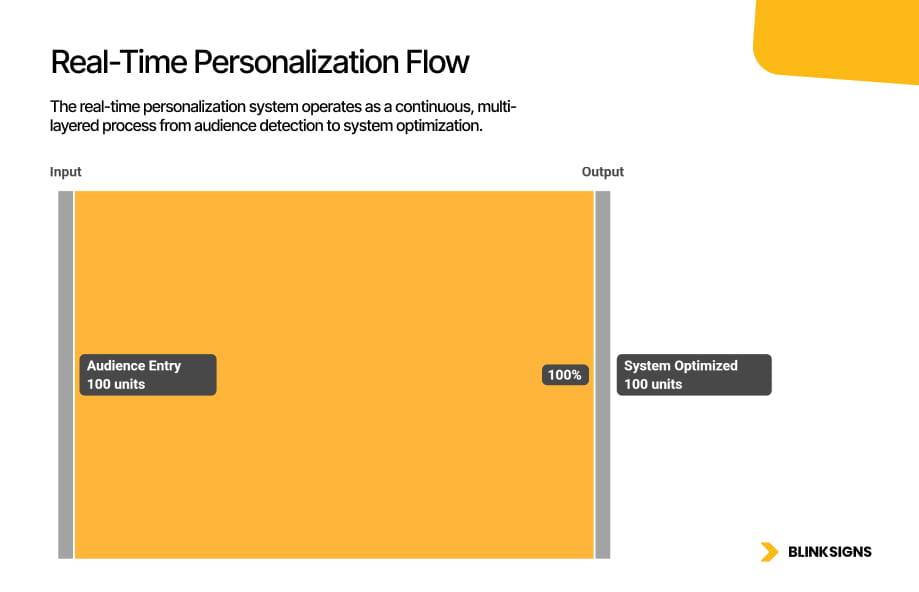
Real-Time Personalization Flow
Each step has its own latency constraints, data requirements, and operational dependencies. Removing any layer does not degrade performance gradually. It breaks the system entirely.
The Real-Time Personalization Stack™
The system can be formalized as the Real-Time Personalization Stack™, a four-layer architecture that connects physical audience signals to on-screen decisions at scale.
Real-time personalization is defined by sub-second, AI-driven content decisions based on live audience signals. The Stack™ is the infrastructure that enables those decisions.
| Layer | Name | Function | Components |
| Layer 1 | Capture Layer | Detect audience and environment | Cameras, IoT sensors, POS integration, proximity signals |
| Layer 2 | Processing Layer | Convert raw data into usable signals | Edge AI inference, computer vision, demographic estimation |
| Layer 3 | Decision Layer | Select optimal content in real time | Rules engine, ML scoring models, conflict resolution |
| Layer 4 | Delivery Layer | Execute and verify content display | CMS templates, display orchestration, proof-of-play |
Each layer has distinct failure modes. A system missing any one of them is not incomplete. It is non-functional in production.
This is where BlinkSigns operates differently. The full lifecycle, from hardware commissioning and sensor calibration to AI deployment and performance tracking, is controlled as a single system rather than fragmented across vendors.
How AI Reads Audience Behavior
The system’s intelligence depends on how accurately it interprets audience signals. These signals fall into two categories.
Behavioral Signals (Audience-Driven)
| Signal | Source | Interpretation |
| Presence | Camera or sensor | Viewer detected in range |
| Demographics | Computer vision | Age range and gender estimate |
| Dwell Time | Frame analysis | Engagement depth |
| Gaze Direction | Eye-tracking inference | Active attention vs glance |
| Group Composition | Object detection | Individual vs group context |
| Sentiment | Facial analysis | Positive or neutral response |
Environmental Signals (Context-Driven)
| Signal | Source | Interpretation |
| Time of Day | System clock | Behavioral patterns |
| Weather | External API | Contextual relevance |
| Crowd Density | Sensor fusion | Content format adjustment |
| Purchase Context | POS/CDP | Category affinity |
Most deployments begin with a minimal signal stack: presence, demographics, and dwell time. Additional signals are layered in as data confidence improves.
From Signal to Screen: The Decision Engine
The Decision Layer converts raw intelligence into action. It is composed of three coordinated components.
1. Rules Engine
Hard constraints define what cannot be overridden.
- Compliance messaging must always display in regulated zones
- Restricted content must follow time or location rules
- Brand guidelines must remain intact
2. ML Scoring Model
The system evaluates all available content options against the current audience signal and selects the highest-performing variant based on historical data.
3. Conflict Resolution
When multiple triggers compete, a priority hierarchy determines which signal takes precedence. Without this layer, the system produces inconsistent and confusing outputs.
This is the least visible part of the system and the most common failure point in production deployments.
Why Real-Time Personalization Is Technically Hard
Most content in this space avoids this reality. It should not.
The Latency Constraint
Strict timing thresholds define real-time performance:
- Under 300 milliseconds → true real-time
- 300–1000 milliseconds → perceived real-time
- 1–3 seconds → noticeable delay
- Over 3 seconds → broken experience
Cloud-based systems introduce network delays, making true real-time adaptation difficult. Edge processing removes that delay by executing inference locally.
The Infrastructure Requirement
Real-time systems depend on:
- On-device AI inference
- Optimized hardware (GPU or edge chipset)
- Local decision execution
- Minimal network dependency
Without this, personalization becomes reactive instead of responsive.
The Model Degradation Problem
AI models trained in one environment degrade when deployed in another. A model trained on one retail demographic will not perform identically in a different region or industry.
Production systems require continuous retraining using real-world engagement data. Without it, performance declines gradually and often goes unnoticed until results stagnate.
Privacy-First AI and Compliance Architecture
Is AI audience analytics in digital signage compliant?
Yes, when the system is architected for compliance from the start. Real-time personalization can operate without storing or transmitting identifiable data by processing signals locally and retaining only anonymized outputs.
Privacy is not a policy layer. It is a system constraint that shapes how data flows through the entire architecture.
The Compliance Reality
Enterprise deployments must align with:
- GDPR (EU): restricts biometric data processing without consent
- CCPA (California): governs data usage and opt-out rights
- BIPA (Illinois): strictest biometric regulation with legal enforcement
The key distinction:
- Biometric identification → restricted
- Anonymized demographic inference → generally permissible
The Compliant Architecture Model
A production-grade system follows this pattern:
- Video is captured at the device level
- AI processes frames locally using edge inference
- Only anonymized signals are generated (for example, age range or dwell time)
- Raw imagery is discarded immediately
- No identity is stored, matched, or tracked
- Aggregated signals are transmitted for analytics
- Full audit logs are maintained
This model allows personalization while remaining compliant across jurisdictions.
“Systems that attempt to retrofit privacy after deployment fail. Systems designed with privacy at the architectural level scale.”
Governance: Controlling Personalization at Scale
How do enterprise brands control AI-driven content decisions?
Enterprise AI signage requires a governance system that defines what can be shown, who controls it, and how decisions are audited across locations.
Without governance, personalization introduces risk:
- Brand inconsistency
- Regulatory violations
- Franchise conflicts
The Core Governance Question
When thousands of AI-driven decisions are made daily:
- Who defines the rules?
- Who approves exceptions?
- How are decisions verified?
The Three Governance Pillars
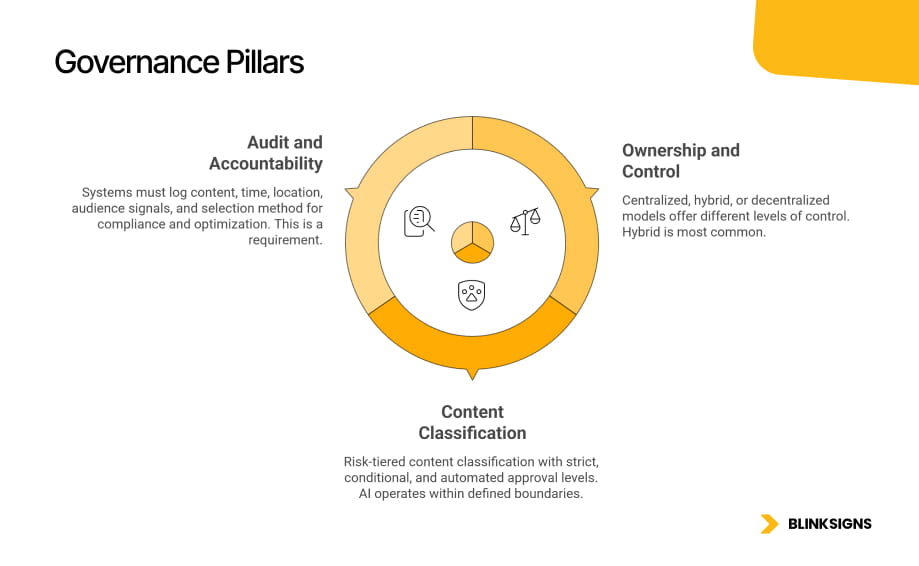
Governance Pillars
1. Ownership and Control
- Centralized model: maximum brand consistency
- Hybrid model: corporate control with local flexibility
- Decentralized model: requires strict automation and guardrails
Most enterprise deployments operate in a hybrid model.
2. Risk-Tiered Content Classification
| Tier | Content Type | Control Level |
| Tier 1 | Legal, regulatory | Strict approval required |
| Tier 2 | Promotions, pricing | Conditional approval |
| Tier 3 | AI-selected variants | Fully automated |
This structure allows AI to operate within defined boundaries rather than operate with unrestricted autonomy.
3. Audit and Accountability
Every system must log:
- What content was shown
- When and where it appeared
- What audience signal triggered it
- Whether it was AI-selected or manually scheduled
This is not optional. It is required for:
- Compliance
- Performance analysis
- Continuous optimization
Multi-Location Governance Reality
For distributed brands, governance must operate across:
- Hundreds of screens
- Multiple regions
- Different regulatory environments
This requires:
- Multi-tenant CMS architecture
- Hierarchical permissions
- Central rule enforcement with local flexibility
A flat system cannot scale personalization. A governed system can.
Measuring ROI: From Engagement to Revenue
Does personalized signage actually drive revenue?
Yes, but only when measured correctly.
Most systems stop at engagement metrics. Enterprise systems require causal attribution.
The Attribution Ladder
| Level | Metric | What It Measures | Method |
| Level 1 | Impressions | Audience reach | Sensor-based counting |
| Level 2 | Attention | Dwell time | Before/after comparison |
| Level 3 | Engagement | Interaction rate | Event tracking |
| Level 4 | Conversion | Sales lift | POS correlation |
| Level 5 | Attribution | Incremental revenue | Controlled testing |
Incrementality Testing (Gold Standard)
This method isolates the actual impact of personalization:
- Split locations into test and control groups
- Run AI personalization in the test group
- Maintain static or rule-based content in the control group
- Measure performance differences
- Attribute lift to personalization
This answers the critical question:
Would the outcome have happened without personalization?
If the answer is no, the system is generating real value.
Proof-of-Play: The Missing Layer
Before ROI can be trusted, delivery must be verified.
A complete system log:
- Screen ID
- Content variant
- Timestamp and duration
- Triggering the audience signal
This creates the audit trail required for both internal reporting and external validation.
This is where platforms like BlinkSigns differentiate, by connecting content delivery directly to measurable outcomes through system-level visibility.
Where Personalization Works Best
High-performance deployments share three conditions:
- High and variable foot traffic
- Sufficient dwell time (typically 8+ seconds)
- Clear decision or purchase intent
Ideal Environments
- Retail environments
- Quick service restaurants
- Airports and transit hubs
- Healthcare waiting areas
- Corporate experience centers
These environments combine audience diversity with measurable outcomes.
Where Personalization Fails
Personalization does not fail randomly. It fails predictably when conditions are misaligned.
| Scenario | Root Cause | Correct Approach |
| Low traffic | Insufficient data signals | Use static or scheduled content |
| Compliance zones | Content must remain fixed | Disable AI variation |
| Homogeneous audience | No variance to optimize | Use rule-based triggers |
| Poor sensor placement | Incorrect data capture | Conduct a proper site survey |
| No edge infrastructure | High latency | Deploy edge AI |
| Limited content | Low variation | Expand content library |
| No governance | Uncontrolled decisions | Implement a governance model |
Deploying AI in the wrong environment reduces performance instead of improving it.
Personalization Readiness Checklist
Before deployment, validate system readiness:
- Minimum 100+ daily viewers per screen
- Average dwell time above 8 seconds
- 15–20 content variants per segment
- Edge AI infrastructure available
- Governance model defined
- Compliance architecture validated
- Baseline metrics established
If multiple conditions are unmet, the system is not ready for AI. It requires infrastructure first.
Why Most AI Signage Deployments Fail Without Infrastructure
The failure pattern is consistent:
- Software is implemented without hardware readiness
- Sensors are deployed without intelligence models
- CMS is configured without orchestration logic
The misconception:
- Software = system
- Sensors = intelligence
- CMS = personalization
None of these is true.
Real-time personalization requires simultaneous coordination across all layers.
This is where BlinkSigns operates differently. The system is deployed as an integrated infrastructure, not assembled from disconnected components.
The Future: Autonomous Signage Networks
The next evolution is not better personalization. It is an autonomous system.
Emerging capabilities include:
- AI-generated creative in real time
- Continuous optimization through feedback loops
- Federated learning across distributed networks
- Automated budget allocation across displays
These systems will:
- Plan content
- Adapt content
- Measure performance
- Optimize outcomes
with minimal human intervention.
The organizations that lead this shift will not be those that adopted AI early. They will be those who built the infrastructure, governance, and measurement systems required to support it.
Final Position
Real-time personalization is not a feature. It is an operational system.
The difference between success and failure is not the AI model. It is:
- Infrastructure readiness
- Governance control
- Compliance design
- Measurement capability
Organizations that treat personalization as a system build a scalable advantage.
Organizations that treat it as a feature run pilots that never scale.
FAQs
What is real-time personalization in digital signage?
It is the use of AI to dynamically adapt content based on live audience behavior and environmental signals, enabling displays to respond instantly to changing conditions.
How does AI adapt signage content?
AI detects audience signals such as demographics and dwell time, then selects the most relevant content using machine learning models within milliseconds.
Is AI signage compliant with privacy laws?
Yes, when designed with edge processing and anonymized data handling, it aligns with GDPR, CCPA, and BIPA requirements.
Does personalized signage increase sales?
Yes. Controlled testing consistently shows measurable lift in engagement and revenue compared to static content.
What is required to implement AI personalization?
A complete system including sensors, edge AI, decision logic, governance controls, and attribution tracking.
Where does personalization fail?
In low-traffic environments, compliance zones, homogeneous audiences, and systems without proper infrastructure or governance.
What is the difference between rule-based and AI signage personalization?
Rule-based systems respond to predefined single conditions — time, weather, proximity. AI personalization evaluates multiple audience signals simultaneously using machine learning, adapting probabilistically rather than following a fixed set of rules.
Does real-time signage require internet connectivity?
Not in edge AI deployments. On-device processing allows real-time personalization to continue during network outages. Cloud-dependent systems lose adaptive capability when connectivity drops.
Conclusion
Real-time personalization in digital signage is often presented as an innovation. In practice, it is an operational discipline.
The difference between a successful deployment and a failed pilot is not the presence of AI. It is the presence of a complete system. Sensors must capture accurate signals. Edge infrastructure must process them within milliseconds. Decision engines must resolve competing inputs. Governance models must control what is allowed to display. Attribution systems must prove that the outcome justified the investment.
When these layers are aligned, personalization becomes a measurable growth lever. Engagement increases because content is relevant. Conversion improves because messaging aligns with intent. Performance becomes visible because every interaction is tracked and validated.
When these layers are missing, the system fails. It breaks. Content becomes inconsistent, latency becomes visible, compliance risk increases, and ROI becomes unprovable.
This is the dividing line in the market. Organizations that treat personalization as a feature experiment. Organizations that treat it as infrastructure build long-term advantage.
BlinkSigns operates at this infrastructure layer. By integrating physical deployment, AI processing, governance frameworks, and performance tracking into a single system, personalization is not only delivered but controlled, measured, and scaled across environments.
The future of signage is not static displays or even reactive systems. It is autonomous networks that continuously adapt, learn, and optimize. The organizations that will lead that transition are not those that adopted AI earliest, but those that built the architecture required to support it.
Real-time personalization is not about smarter screens. It is about building systems that make every screen accountable.