
Window Graphics Cost Guide: What Affects Storefront Window Decal and Vinyl Pricing
Window graphics can turn storefront glass into branding, promotion, privacy, wayfinding, seasonal messaging, or business identification. They may be as simple as door lettering with store hours, or as detailed as a full storefront window package with printed vinyl, perforated graphics, privacy film, and campaign messaging across multiple windows.
Window graphics cost depends on more than the decal itself. The final quote can be affected by window size, coverage area, vinyl type, opacity, perforation, design complexity, inside or outside application, removal of old graphics, surface preparation, installation access, landlord criteria, permit review where required, and whether the project covers one window, one storefront, or multiple locations.
This guide explains what affects commercial window graphics pricing, how to choose the right window graphic type, why product-only decal pricing can differ from professionally planned storefront graphics, and what buyers should prepare before requesting an estimate.
Who is this window graphics cost guide for?
This guide is for business owners, retail teams, restaurant operators, franchise teams, property managers, facilities teams, marketing teams, and multi-location brands comparing storefront window graphics, decals, clings, vinyl lettering, perforated window film, and privacy graphics.
It is especially useful if you are asking one of these questions:
- How much do window graphics cost?
- What type of window graphic do I need?
- What is the difference between decals, clings, vinyl lettering, and perforated graphics?
- Should the graphic go inside or outside the glass?
- Will old vinyl removal affect the quote?
- Do window graphics need landlord approval?
- Can one design work across multiple storefronts?
- Are window graphics part of a larger storefront signage package?
A window graphics project should be planned around the storefront, message, glass condition, visibility goal, approval path, and update cycle, not only around the lowest decal product price.
How much do window graphics cost?

Channel Letters of Verizon
Window graphics cost depends on window size, coverage area, vinyl type, opacity, perforation, design complexity, installation location, inside or outside application, removal of old graphics, surface preparation, landlord criteria, permit review where required, and whether the project includes one decal, one storefront, or a multi-location rollout.
A small door decal has a different scope than full storefront window graphics, perforated window vinyl, privacy film, seasonal promotional graphics, window lettering, or a coordinated retail window campaign.
The better question is not only, “How much do window graphics cost?” The better question is:
What type of window graphic does the storefront need, and what scope is included in the quote?
A window graphics quote may include design coordination, print production, vinyl cutting, material selection, installation, removal of old graphics, surface preparation, multi-window layout planning, landlord review support, permit review where relevant, and replacement planning for seasonal or campaign graphics.
Buyers should confirm whether the quote includes only the printed product or the full window graphics project.
What counts as window graphics?
Window graphics are signs, decals, films, lettering, or printed visuals applied to glass surfaces for business branding, advertising, privacy, wayfinding, promotions, or storefront presentation.
Common window graphic types include:
- Cut vinyl lettering
- Printed window decals
- Clear window decals
- Opaque window decals
- Perforated window graphics
- Frosted or privacy vinyl
- Window clings
- Door vinyl
- Seasonal campaign graphics
- Full storefront window packages
A retail store may use perforated window graphics for promotional visibility. A restaurant may use door vinyl for hours, window graphics for pickup messaging, and seasonal decals for offers. A clinic or office may use frosted privacy vinyl. A franchise may need a repeatable window graphics package across many locations.
What is a window graphics package?
A window graphics package is a coordinated set of glass-applied signs and visuals across one storefront or multiple storefronts. It may include door hours, window lettering, privacy film, promotional panels, perforated graphics, brand messaging, and seasonal campaign elements.
A package can cost more than a single decal because it may involve multiple windows, different materials, design coordination, removal of old vinyl, installation access, landlord criteria, and consistency across locations.
For buyers, the key question is whether they need one decal or a complete storefront window system.
What type of window graphic is best for your storefront?
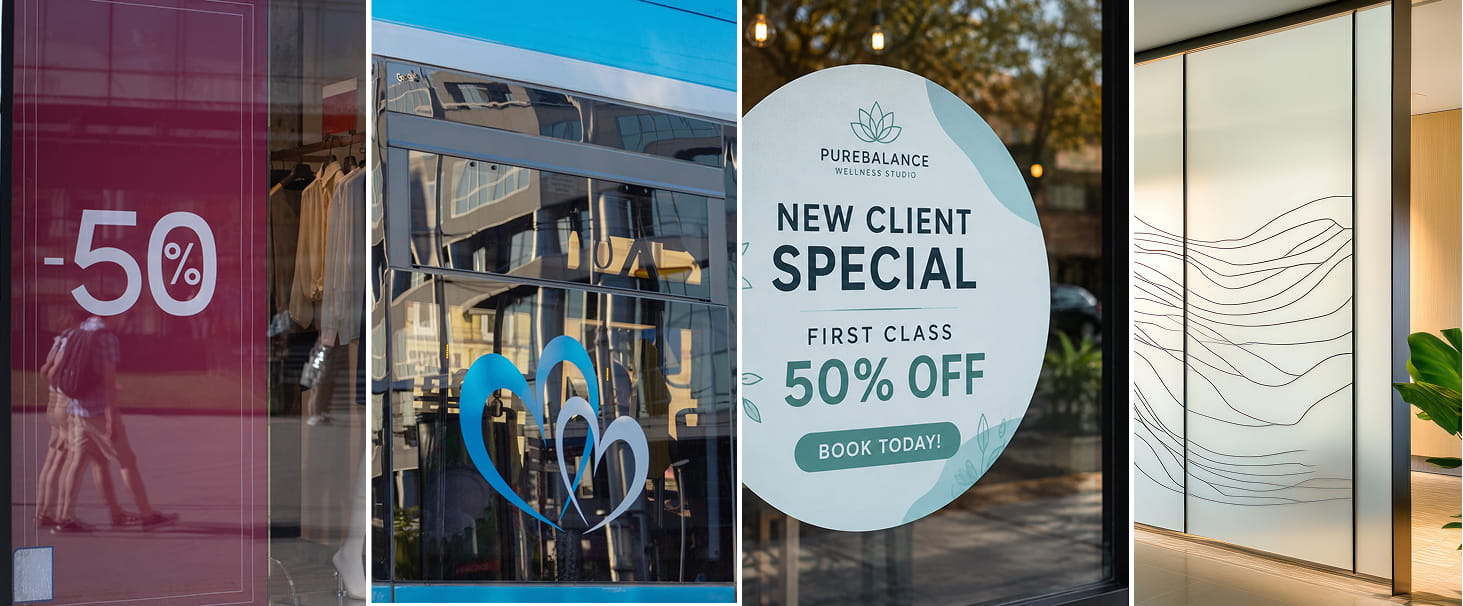
Custom window graphics range from promotional decals and transit wraps to decorative frosted privacy films.
The best window graphic type depends on the message, visibility goal, privacy need, glass size, storefront layout, campaign duration, landlord rules, and whether the graphic is intended to be permanent, semi-permanent, or temporary.
| Window graphic type | Best fit | What affects cost |
| Cut vinyl lettering | Store hours, door text, contact details, simple logos, suite information | Letter size, quantity, color count, weeding complexity, installation location |
| Printed window decals | Logos, promotions, seasonal messages, brand graphics, storefront visuals | Graphic size, print area, color, contour cut, material choice, design complexity |
| Perforated window graphics | Storefront advertising with outside visibility and some interior visibility | Window size, coverage area, print quality, application side, and visibility goals |
| Frosted or privacy vinyl | Offices, clinics, salons, conference rooms, privacy zones | Coverage area, pattern, glass size, cut complexity, design layout, and access |
| Window clings | Temporary promotions, events, short-term campaigns, removable messaging | Size, removability, reusability, surface condition, campaign duration |
| Full storefront window package | Retail stores, restaurants, franchises, campaigns, privacy plus branding | Multiple windows, design coordination, removal needs, installation, consistency |
👉Pinpoint whether your glass dimensions, removal labor, or multi-pane alignments will increase project scope by downloading the free Window Graphics Campaign Planning Matrix ⤦
A window graphic type should be selected for the purpose. Vinyl lettering is useful for simple information. Printed decals support brand visuals or promotions. Perforated graphics work well when the business wants exterior advertising while preserving some interior visibility. Frosted vinyl supports privacy. Clings may fit temporary campaigns. A full storefront package is usually better when multiple window surfaces need to work together.
Why do window graphics quotes vary so much?
Window graphics quotes vary because the term “window graphics” can refer to very different projects. One quote may be for a small door decal. Another may be for cut vinyl lettering across several panes. Another may be for full-color perforated graphics over a storefront. Another may include design, old vinyl removal, surface preparation, professional installation, landlord review, and multi-location rollout planning.
A window graphics quote may change based on:
- Glass size
- Number of windows
- Coverage area
- Vinyl type
- Print complexity
- Number of colors
- Contour cutting
- Privacy requirements
- Perforation
- Inside or outside application
- Old vinyl removal
- Adhesive cleanup
- Surface condition
- Installation height
- Storefront access
- Landlord criteria
- Permit review where required
- Multi-location consistency
👉Ensure your vendor bid clearly breaks down vinyl grades, contour cutting, surface prep, and installation labor by downloading our free Window Graphic Type Comparison Worksheet ⤦
A product-only decal order may appear inexpensive because it does not include site measurement, glass condition review, installation, removal of old graphics, surface prep, or storefront package planning. A commercial storefront window graphics quote may include those variables because the goal is not only to print a decal but also to ensure the graphics fit the property, brand, visibility needs, and installation conditions.
The buyer should ask:
Does this quote cover only the printed decal, or does it cover the full window graphics project?
What is the difference between window decals, clings, vinyl lettering, and perforated graphics?
Window decal terminology can be confusing because buyers may use “window sticker,” “window decal,” “window vinyl,” “window cling,” and “window graphic” interchangeably. In commercial signage, these terms usually refer to different materials, use cases, and expectations.
What is a window decal?
A window decal is a graphic applied to glass. It may include a logo, a promotion, a message, an image, or a design. Decals may be clear, opaque, printed, contour-cut, or designed for indoor or outdoor viewing, depending on the material and project requirements.
What is vinyl lettering?
Vinyl lettering is cut from vinyl rather than printed as a full graphic panel. It is commonly used for store hours, door text, phone numbers, suite numbers, websites, simple logos, and clean business identification.
What is a window cling?
A window cling is generally used for temporary or removable messaging. Clings are often selected for events, short-term offers, seasonal campaigns, or temporary storefront messaging. They may not fit every long-term exterior use case.
What are perforated window graphics?
Perforated window graphics use printed material with small openings that can allow some visibility through the glass from inside while displaying graphics outward. They are commonly used for storefront advertising, retail campaigns, privacy, and large window coverage.
What is frosted or privacy vinyl?
Frosted or privacy vinyl creates a translucent effect that can obscure views while still allowing light to pass through. It is often used in offices, clinics, salons, conference rooms, reception areas, and storefronts that need privacy without completely blocking the view through the glass.
Do window graphics go inside or outside the glass?
Window graphics may be planned for inside-glass or outside-glass applications, depending on the material, visibility goal, storefront conditions, exposure, and reading direction. This choice should be clarified before production because it can affect how the artwork is printed, how the graphic is viewed, and whether the material is suitable for the intended application.
Inside-glass graphics may be considered when the business wants the graphic protected from exterior exposure, when the glass allows proper visibility from outside, or when the storefront conditions support that approach. Outside-glass graphics may be considered when the material type, visibility goal, perforation, or surface conditions make exterior placement more appropriate.
This guide does not provide installation instructions. The application method should be confirmed during project planning based on material, glass condition, storefront use, and professional installation requirements.
How does window coverage affect cost and visibility?
Window coverage affects both cost and storefront experience. A small door decal uses less material and less design space than a full-window retail promotion. A partial coverage design can support branding while preserving visibility into the store. A full coverage design can create a stronger advertising surface but may affect natural light, interior visibility, and local or landlord rules.
Buyers should think about window coverage in terms of purpose:
- Small coverage for hours, logos, or contact information
- Partial coverage for promotions, branding, or privacy accents
- Perforated coverage for exterior messaging with some interior visibility
- Frosted coverage for privacy in offices, clinics, salons, or meeting areas
- Full storefront coverage for campaigns, openings, renovations, or high-impact promotions
Coverage should be planned around the customer approach path. A window graphic that looks good up close may not be legible from a parking lot or the road. A graphic that works for a promotion may not be appropriate for long-term privacy or branding.
Are window graphics good for retail stores and restaurants?
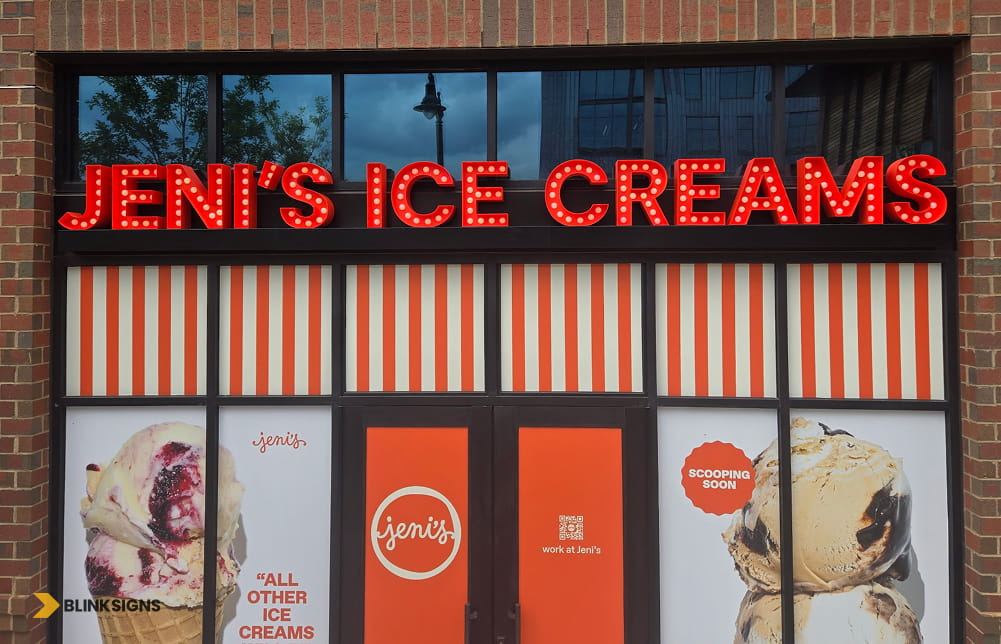
Window and door vinyl graphics for Jeni’s ice creams
Window graphics are often useful for retail stores and restaurants because they can support promotions, hours, pickup messaging, privacy, seasonal campaigns, product categories, hiring messages, and brand personality.
For retail stores, window graphics can support visual merchandising, seasonal offers, sale messaging, new product launches, privacy, and storefront branding. They can work alongside channel letters, cabinet signs, blade signs, and other exterior signage.
For restaurants and cafes, window graphics can support business hours, takeout messaging, delivery pickup, menu-adjacent communication, privacy, seasonal offers, and brand atmosphere. They can also enhance evening visibility when paired with illuminated storefront signage. However, window graphics should not be treated as a replacement for a primary exterior sign when building identification is needed.
Window graphics are usually best when they support the storefront sign strategy rather than compete with it.
Do window graphics require permits or landlord approval?
Window graphics may require landlord or property manager approval, a permit review, or both, depending on the property, jurisdiction, window coverage, sign rules, zoning district, storefront location, and whether the graphics are temporary or permanent.
Not every window graphic requires the same level of review. Small door lettering may have a different approval path than full-window graphics, illuminated displays behind glass, extensive promotional coverage, or graphics used in shopping centers, malls, downtown districts, or design-controlled properties.
Landlord or property rules may affect:
- Window coverage percentage
- Approved materials
- Temporary campaign duration
- Promotional messaging
- Brand colors
- Removal requirements
- Installation method
- Maintenance expectations
Buyers should not assume window graphics are always permit-free or approval-free. The safest approach is to confirm property and local requirements before production.
For related planning, see the storefront sign cost guide and sign permit cost guide.
What hidden window graphics costs should buyers check?
Window graphics quotes can be difficult to compare because one quote may include only the printed decal. In contrast, another may include design coordination, measurement review, removal of old vinyl, surface preparation, installation, landlord review, and multi-location campaign planning.
Before approving a quote, buyers should ask what is included, what is excluded, and what could change after the storefront glass is reviewed.
| Buyer question | Why it matters |
| Is design included? | Template-based graphics and custom brand layouts are different scopes |
| Is installation included? | Product-only orders may not include professional installation |
| Is old vinyl removal included? | Removing old adhesive, film, or decals can affect the scope |
| Is surface prep included? | Glass condition affects appearance, alignment, and adhesion |
| Is the inside or outside application specified? | Reading direction, exposure, and material choice can differ |
| Is color matching included? | Brand graphics may require file review, color review, and material selection |
| Is landlord approval included? | Leased spaces may have window coverage, promotional, or signage rules |
| Are permit requirements checked? | Some jurisdictions regulate window coverage or storefront signage |
| Is multi-location consistency included? | Franchises may need consistent sizing, design, and rollout planning |
| Are replacement or seasonal updates considered? | Promotional graphics may need planned removal or refresh cycles |
The safest quote comparison question is:
Does this quote cover only the window graphic product, or does it cover the full storefront window graphics project?
What affects window graphic installation cost?
Window graphic installation costs depend on glass size, number of panes, installation height, access conditions, removal of old vinyl, surface preparation, inside or outside application, storefront hours, weather exposure, material type, and whether the graphics must align across multiple windows.
A small door decal may have a simple installation scope. A full storefront window package may require more planning because the graphics need to align across glass panels, mullions, doors, sightlines, and customer approach paths.
The installation scope may be affected by:
- Number of windows
- Window height and width
- Glass condition
- Old decal or film removal
- Adhesive residue
- Surface preparation
- Indoor or outdoor application
- Storefront access
- Door and entry traffic
- Sidewalk or pedestrian areas
- Weather conditions
- After-hours installation needs
- Multi-window alignment
- Multi-location rollout timing
A window graphics quote should clarify whether installation is included or quoted separately. It should also clarify whether removal, surface preparation, after-hours work, access coordination, and multi-window alignment are included.
When should old window graphics be removed or replaced?
Old window graphics should be reviewed when they are faded, peeling, bubbling, cracked, outdated, misaligned, damaged, no longer brand-compliant, or tied to an expired campaign.
Window graphics may also need replacement when the business changes hours, updates branding, launches a new campaign, changes tenants, renovates the storefront, or wants a cleaner window presentation.
Common reasons to remove or replace window graphics include:
- Faded colors
- Peeling edges
- Bubbles or lifting
- Adhesive residue
- Outdated promotions
- Rebrand or logo update
- Tenant change
- Seasonal campaign change
- Damaged vinyl
- Window replacement
- Poor visibility from outside
- Privacy needs changing
- Landlord or property rule changes
Is old vinyl removal always simple?
No. Old vinyl removal can vary depending on the material, adhesive, exposure, age, glass condition, installation side, and whether the graphic was temporary or long-term. A quote should clarify whether removal and surface preparation are included before new graphics are installed.
To learn how specialized heating and residue solvents protect underlying glass and paint, review our guide to safe vehicle and vinyl wrap removal techniques.
How should retail stores use window graphics?

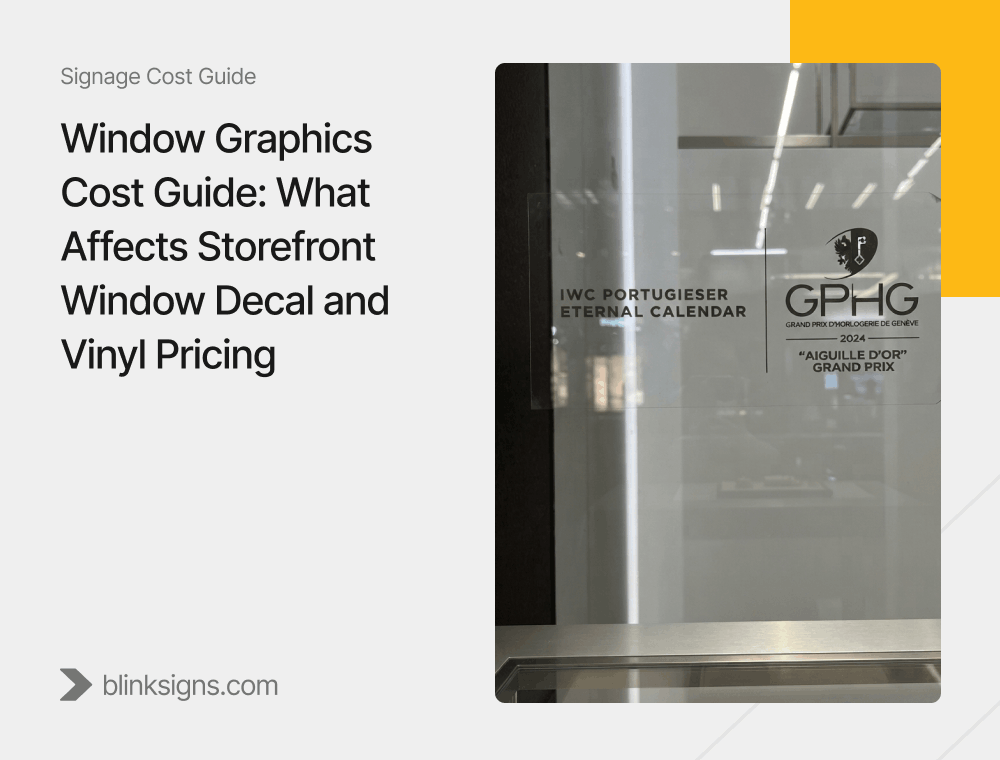
IWC Schaffhausen Window Graphics
Retail stores can use window graphics for promotions, sale messaging, product categories, seasonal campaigns, privacy, new arrivals, hiring messages, and brand storytelling.
A retail window graphic should support the storefront sign strategy, not compete with it. The main storefront sign helps customers identify the business. Window graphics can support the message customers see after they notice the storefront.
Retail buyers should think about:
- What customers need to notice first
- Whether the window graphic supports a campaign or long-term brand message
- How the graphic looks from the sidewalk, parking lot, or drive aisle
- Whether interior visibility still matters
- How often will the promotion change
- Whether the graphic should be temporary, semi-permanent, or long-term
- Whether the design needs to repeat across multiple stores
BlinkSigns portfolio insight: retail graphics need campaign discipline
Retail environments often need both consistency and flexibility. A brand may need one long-term storefront identity, plus seasonal graphics, promotional windows, and temporary campaign messaging.
For retail and multi-location brands, window graphics should be planned with replacement cycles in mind. A graphic designed for a seasonal offer should not be treated like permanent signage. A long-term privacy or branding film should be planned differently from a short-term sale decal. Check out our work for IWC Schaffhausen, and Verizon in retails space.
How should restaurants and cafes use window graphics?

Wingstop_Vinyl Graphics
Restaurants and cafes can use window graphics for hours, pickup messaging, delivery information, seasonal offers, menu-adjacent communication, privacy, hiring messages, and brand atmosphere.
Window graphics can be especially useful when the storefront needs to communicate quickly to customers who are walking by, picking up food, entering the restaurant, or looking for the correct door.
Restaurant and cafe buyers should consider:
- Whether customers need pickup or delivery instructions
- Whether window graphics should support privacy or ambiance
- Whether the restaurant operates at night
- Whether the graphic should work with illuminated signage
- Whether food photography, brand messaging, or simple lettering is more appropriate
- Whether old promotional graphics need to be removed before the new campaign
Are window graphics enough for a restaurant storefront?
Usually, window graphics support the storefront, but they do not replace the need for a primary exterior sign when clear building identification is required. Restaurants often use window graphics alongside channel letters, blade signs, awnings, cabinet signs, or illuminated storefront signage. Check out our work for WingStop franchise signage
How should offices, clinics, and service businesses use window graphics?

StoreLocal Storage Vinyl window graphics by BlinkSigns
Offices, clinics, salons, schools, and service businesses often use window graphics for privacy, identification, professionalism, wayfinding, and customer confidence.
Frosted or privacy vinyl can help obscure treatment rooms, offices, consultation areas, conference rooms, or reception zones while still allowing light through the glass. Cut vinyl lettering can support suite numbers, hours, credentials, service categories, or entry information.
Professional service buyers should consider:
- Privacy needs
- Glass size
- Interior visibility
- Brand tone
- Door and suite identification
- Reception area appearance
- Accessibility and wayfinding needs
- Landlord criteria
- Long-term maintenance expectations
For clinics, offices, and professional services, the best window graphics are often clean, durable, and aligned with the building environment rather than highly promotional.
How should multi-location brands plan window graphics?
Multi-location window graphics should be planned as a rollout system, not as one decal repeated everywhere. Even when the campaign creative is the same, each location may have different window sizes, glass conditions, landlord criteria, local rules, door layouts, access conditions, and customer approach paths.
A franchise, restaurant group, retail chain, healthcare network, or regional service brand must balance national creative assets with unique glass mullion dimensions. Corporate rollout managers should align these retail window kits with The Franchise Signage Playbook.
Multi-location buyers should prepare:
- Brand standards
- Campaign artwork
- Storefront photos
- Window measurements by location
- Door and entry layouts
- Old graphic status
- Landlord criteria
- Desired installation timing
- Seasonal campaign dates
- Location-by-location exceptions
- Replacement or removal plan
Why does multi-location consistency matter?
Window graphics are highly visible, and inconsistent sizing, placement, or messaging can make a rollout feel uneven. A campaign may use the same creative, but the layout may need to adapt to different window widths, door positions, mullions, glass panels, and local approval rules.
The goal is flexible consistency. The graphics should look like one brand system while still fitting each storefront.
How does BlinkSigns help plan window graphics?
BlinkSigns helps commercial buyers plan window graphics by considering the business type, storefront layout, window sizes, messaging goals, material needs, landlord criteria, installation conditions, campaign timing, and multi-location consistency.
A window graphics project may involve more than printing a decal. It may require choosing between cut vinyl, printed decals, perforated graphics, privacy film, clings, door vinyl, or a full storefront window package.
BlinkSigns supports window graphics planning through:
- Project planning
- Design coordination
- Material and graphic type coordination
- Fabrication coordination
- Installation coordination
- Old graphic replacement planning
- Storefront package planning
- Multi-location rollout support
- SignTrax project visibility
The goal is to help buyers move from a vague request, such as “we need window decals,” to a clearer scope that matches the storefront, campaign, brand, approval path, installation conditions, and replacement cycle.
What should buyers prepare before requesting a window graphics estimate?
A better window graphics estimate starts with better project information. Buyers do not need to know every material or installation detail before requesting a quote, but they should provide enough information to clarify the likely scope.
Before requesting a window graphics estimate, prepare:
- Property address
- Business type
- Storefront photos
- Window measurements, if available
- Door measurements, if door vinyl is needed
- Desired graphic type, if known
- Logo files or artwork files
- Brand colors or brand guidelines
- Campaign message
- Temporary or long-term use
- Inside or outside visibility goal
- Privacy needs
- Existing window graphics photos
- Old vinyl removal needs
- Landlord criteria, if available
- Desired installation timeline
- Number of locations, if multi-site
The most useful photos show the full storefront, individual window panes, door glass, existing graphics, mullions, nearby signs, customer approach path, and any glass areas that should remain uncovered.
For multi-location projects, each site should be documented separately. One design system can guide the rollout, but each storefront may need its own measurements, layout adjustments, landlord review, and installation planning.
👉Gather your window measurements, door layouts, and landlord rules accurately using our step-by-step Window Graphics Quote Prep Checklist⤦
***Pricing, landlord, permit, installation, and visibility note***

This guide is provided for buyer education and baseline planning. It is not legal advice, code interpretation, installation instruction, material performance guarantee, landlord approval guidance, or a substitute for professional review.

Final window graphics cost depends on window size, coverage area, vinyl type, opacity, perforation, design complexity, application side, glass condition, removal of old vinyl, surface preparation, installation access, landlord criteria, permit review (where required), campaign duration, and approved specifications.

Landlord approval may be required for leased spaces, shopping centers, malls, plazas, office parks, and franchise-controlled properties. Permit review may be required depending on jurisdiction, window coverage, sign rules, promotional duration, storefront location, zoning district, and project scope.

Window graphics should not be assumed to guarantee foot traffic, sales, visibility, privacy, or long-term durability. Visibility and durability depend on design, material, glass condition, exposure, maintenance, location, and approved specifications.
FAQ
How much do window graphics cost?
Window graphics costs depend on window size, coverage area, vinyl type, opacity, perforation, design complexity, application side, removal of old graphics, surface preparation, installation access, landlord criteria, permit review where required, and whether the project covers one window, one storefront, or multiple locations.
What is included in a window graphics quote?
A window graphics quote may include design coordination, print production, vinyl cutting, material selection, installation, removal of old graphics, surface preparation, multi-window layout planning, landlord review support, permit review where relevant, and replacement planning.
What is the difference between window decals and window graphics?
Window graphics is the broader term for commercial signage. Window decals are one type of window graphic. A full window graphics project may include decals, vinyl lettering, perforated graphics, privacy film, clings, door vinyl, and storefront branding.
What is the difference between window decals and window clings?
Window decals usually use adhesive or printed vinyl material, while window clings are often used for temporary or removable messaging. The right option depends on duration, surface, visibility goal, and whether the graphic needs to be reusable or long-term.
Are perforated window graphics good for storefronts?
Perforated window graphics can be useful when a business wants exterior-facing advertising while preserving some interior visibility and light. They are often used for retail promotions, privacy, storefront branding, and campaign messaging.
What is frosted window vinyl used for?
Frosted window vinyl is often used for privacy, offices, clinics, salons, conference rooms, reception areas, and professional storefronts. It can reduce visibility through glass while still allowing light to pass through.
Should window graphics go inside or outside the glass?
Window graphics may be planned for inside-glass or outside-glass applications, depending on the material, visibility goal, exposure, glass condition, storefront use, and reading direction. The application method should be confirmed before production.
Do window graphics require landlord approval?
Window graphics may require landlord approval depending on the property, lease terms, window coverage, promotional messaging, installation method, and storefront rules. Leased spaces and shopping centers often require review.
Do window graphics require permits?
Some window graphics may require permit review depending on jurisdiction, coverage area, sign rules, promotional duration, storefront location, zoning district, and whether the graphics are temporary or permanent. Requirements vary.
Can old window graphics be removed and replaced?
Yes, but the scope of removal depends on the old material, adhesive, age, glass condition, exposure, and installation side. Quotes should clarify whether removal and surface preparation are included.
Why do window graphics quotes vary so much?
Quotes vary because projects differ by size, number of windows, vinyl type, design complexity, coverage, removal needs, installation access, landlord criteria, permit review, and whether the quote includes only the printed product or the full project.
Are window graphics good for restaurants?
Yes. Restaurants can use window graphics for hours, pickup messaging, delivery information, seasonal offers, privacy, brand atmosphere, and menu-adjacent communication. They often work best alongside a primary exterior sign.
Are window graphics good for retail stores?
Yes. Retail stores can use window graphics for promotions, product categories, sale messaging, privacy, seasonal campaigns, hiring messages, and brand storytelling. They can support visual merchandising and storefront identity.
How should franchises plan window graphics?
Franchises should plan window graphics on a site-by-site basis while maintaining brand standards. Each location may have different window sizes, landlord criteria, glass conditions, door layouts, local rules, installation access, and campaign timing.
How does BlinkSigns help with window graphics?
BlinkSigns supports window graphics planning through project planning, design coordination, material and graphic type coordination, fabrication coordination, installation coordination, old graphic replacement planning, storefront package planning, multi-location rollout support, and SignTrax project visibility.
Conclusion
Window graphics costs depend on more than just the printed decal. The final scope may include design coordination, material selection, production, installation, removal of old vinyl, surface preparation, landlord review, permit review where required, multi-window alignment, campaign planning, and future replacement needs.
The best window graphic is not always the largest or most colorful option. It is the graphic system that fits the storefront, business type, message, glass condition, visibility goal, privacy need, approval path, installation conditions, and update cycle.
Retail stores, restaurants, offices, clinics, salons, franchises, and multi-location brands all use window graphics differently. One location may need simple door vinyl. Another may need perforated storefront graphics. Another may need frosted privacy film. Another may need a coordinated campaign rollout across many storefronts.
BlinkSigns helps commercial buyers plan window graphics with clearer coordination across design, materials, production, installation, old graphic replacement, storefront planning, multi-location visibility, and SignTrax project tracking. Before requesting a window graphics estimate, buyers should gather storefront photos, window measurements, artwork files, message goals, landlord criteria, existing graphic details, timeline, and number of locations.