
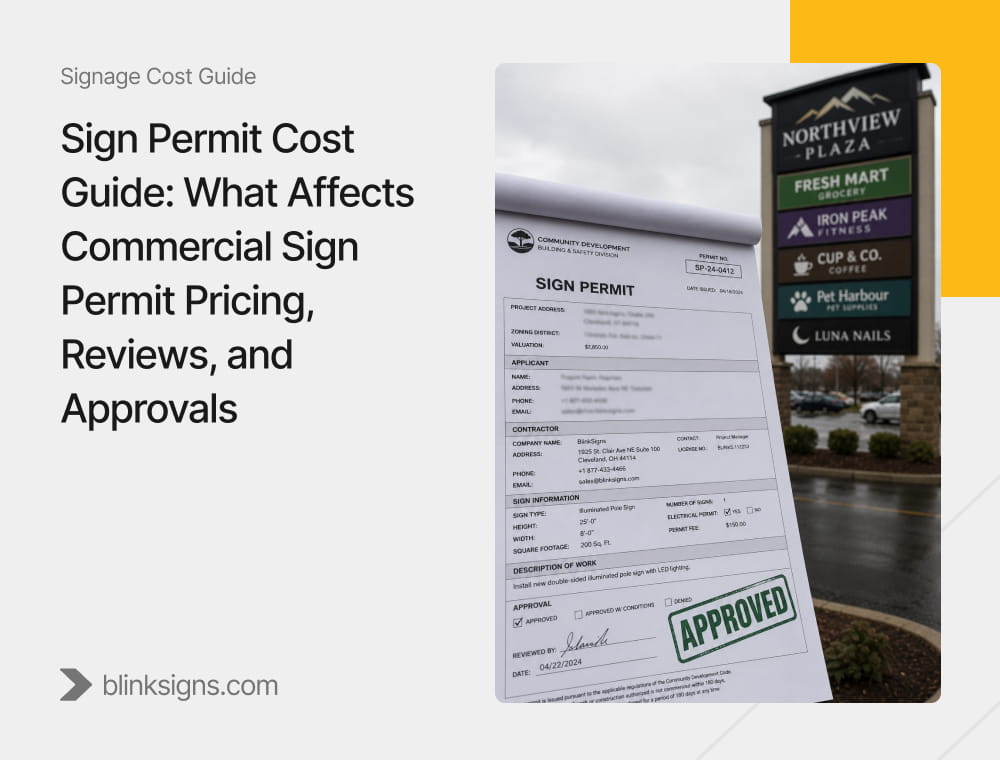
Sign Permit Cost Guide: What Affects Commercial Sign Permit Pricing, Reviews, and Approvals
Commercial sign permitting is one of the most confusing parts of signage budgeting because buyers often expect the permit to be a simple filing fee. In reality, a sign permit can affect the approved size, placement, illumination, mounting location, design documentation, installation timing, landlord approval, historic review, inspection steps, and final project scope.
A commercial sign permit is not just a form. It is a planning variable that can influence the sign before it is fabricated, before it is installed, and sometimes after the reviewing authority requests revisions.
This guide explains what affects sign permit costs, how government permit fees differ from permit support costs, why permitting timelines vary, and what buyers should prepare before requesting a commercial sign estimate.
How much does a sign permit cost?
Sign permit costs depend on the jurisdiction, sign type, size, illumination, mounting location, zoning district, property type, landlord requirements, historic district status, and whether additional drawings, engineering review, electrical documentation, revisions, inspections, or variance requests are required.
Some projects may involve a simple permit filing. Larger exterior signs, illuminated signs, monument signs, pylon signs, blade signs, digital displays, and signs in historic or high-traffic districts may require more documentation and review.
Buyers should separate four different permit-related cost categories:
| Permit-related category | What it means | Why it matters |
| Government permit fee | Fee charged by the city, county, municipality, or authority having jurisdiction | This fee varies by location, sign type, size, valuation, or review category |
| Permit support cost | Project support required to prepare forms, drawings, submittals, and communication | This is different from the government fee |
| Documentation cost | Required drawings, site plans, elevations, sign details, or technical documents | More complex signs may require more documentation |
| Revision or resubmission cost | Updates are required if the reviewing authority requests changes | Revisions can affect the budget and timeline |
A universal public price for commercial sign permits is not reliable because permit rules and fee structures vary by municipality. One jurisdiction may charge by sign area. Another may charge by sign type. Another may separate zoning review, building review, electrical permits, illuminated sign review, or variance applications into different categories.
The most useful question is not only, “What is the permit fee?” The better question is, “What permit-related scope is included in this sign quote, and what is treated as a pass-through fee or separate item?”
What sign permit pricing actually includes
Sign permit pricing can include more than the filing fee paid to the local authority. Depending on the project, it may include research, drawings, application preparation, landlord coordination, municipal filing support, revision support, inspection coordination, and documentation updates.
| Permit scope item | What it means | Buyer note |
| Code and zoning review support | Review of local sign rules, zoning limits, sign type, and placement criteria | Helps identify whether the proposed sign appears aligned with known requirements before submission |
| Application preparation | Completing required forms and organizing required submittal documents | Application requirements vary by jurisdiction |
| Sign drawings | Drawings showing sign size, face area, placement, mounting height, illumination, and related details | Required drawings may differ by sign type |
| Site plan or elevation | Property or building documentation showing where the sign will be installed | Common for exterior wall signs, freestanding signs, and projecting signs |
| Landlord coordination | Support around property criteria, tenant sign rules, or approval letters where relevant | Landlord approval may be needed before municipal filing |
| Permit filing support | Coordination with the reviewing authority or submission portal, where applicable | Filing method and documentation rules vary by municipality |
| Revision support | Updates requested after review, such as size, placement, materials, or documentation changes | Revisions can affect both scope and schedule |
| An engineering review is required where applicable | Structural or electrical review required by code, landlord, or project conditions | Depends on sign type, height, size, weight, projection, and local rules |
| Inspection coordination | Coordination around required inspection steps before or after installation | Inspection requirements vary by jurisdiction |
| Variance or appeal support | Additional process when the proposed sign does not meet the standard code. Additional process when the proposed sign does not fit the standard code | Approval is not guaranteed, and fees may be separate |
Not every quote includes every permit-related item. Some quotes may include permit support but exclude government fees. Others may include government filing fees as pass-through costs but exclude revisions, engineering review, variance support, or landlord resubmissions.
Buyers should ask for a clear explanation of permit-related inclusions and exclusions before approving a sign project.
Permit fees vs. permit support costs
The most important distinction in permit costs is between the government permit fee and the permit support cost.
The government permit fee is the amount charged by the reviewing authority. This may be set by a city, county, township, municipality, planning department, building department, or other authority having jurisdiction. It may be based on sign type, square footage, valuation, illumination, review category, location, or another local rule.
Permit support cost is different. It refers to the work required to prepare, coordinate, submit, revise, and manage the permit package for the signage project. This work can include drawings, forms, site details, communications, documentation updates, and coordination with property or municipal reviewers.
| Cost category | What it means | Buyer note |
| Government permit fee | Fee charged by the local authority for filing, review, inspection, or approval in a category | Usually varies by jurisdiction, sign size, sign type, valuation, illumination, or review category |
| Permit support | Vendor or project-support work to prepare and organize permit documents | May include application coordination, drawings, forms, and review communication |
| Drawing or documentation cost | Required sign drawings, site plans, elevations, sign details, or related documentation | More complex signs may require more documentation |
| An engineering review is required where applicable | Project-specific structural or electrical review required by code, landlord, or authority | Depends on sign type, height, size, projection, weight, and local rules |
| Revision or resubmission support | Updates needed if the reviewing authority requests changes | May affect both cost and timeline |
| Inspection-related coordination | Coordination around required inspections before or after installation | Requirements vary by jurisdiction |
| Variance or appeal support | Additional process when the desired sign does not fit the standard code | Outcomes and timelines are not guaranteed |
This table should be used when comparing quotes. A quote that says “permits included” may mean one of several things. A quote that says “permits included” may mean one of several things. A quote that says “permits included “may mean one of several things. It may include permit support but not government fees. It may include the first filing but not revisions. It may include a standard application but not variance support. It may include local filing coordination, but not engineering review where required.
Buyers should ask vendors to define the permit scope in writing.
📋 Audit Your Permit Quotes: Avoid unexpected municipal filing fees and clarify vendor submittal support by downloading our Free Cabinet Sign Quote Comparison Worksheet↴
Sign permit cost by sign type
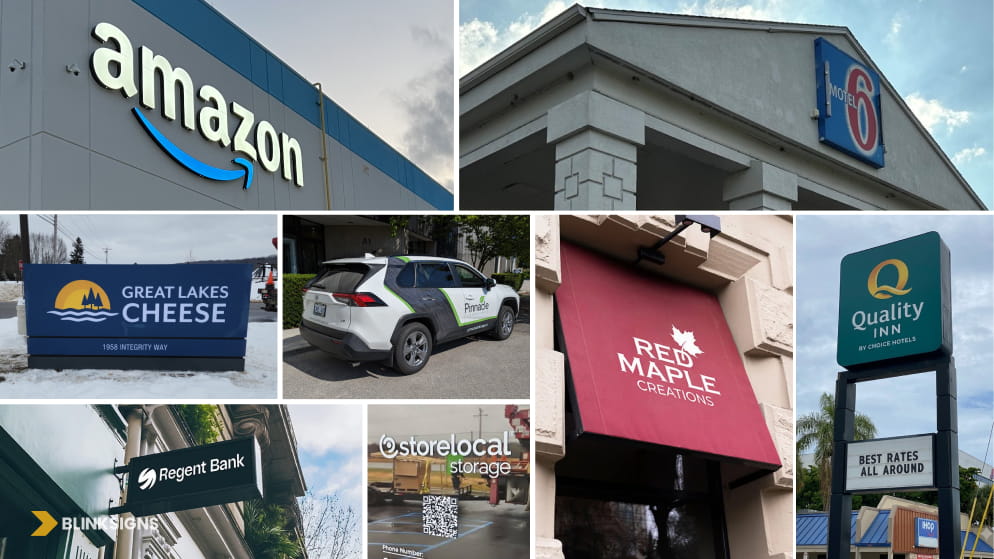
A showcase of diverse custom signage solutions for retail, hospitality, and corporate spaces.
Different sign types are reviewed differently because they create different planning questions. A wall sign is not reviewed the same way as a freestanding monument sign. A blade sign may raise questions about projection and clearance. A digital sign may raise questions about brightness, animation, operating hours, and zoning.
| Sign type | Permit considerations | Main review factors | Buyer note |
| Channel letters | Often reviewed as wall signage | Sign area, illumination, placement, raceway, landlord criteria | Permit rules can vary by tenant frontage and zoning. Evaluate complete fabrication and layout metrics in our Channel Letter Sign Cost Guide. |
| Cabinet signs | Wall-mounted or freestanding cabinet signs may require review | Size, illumination, placement, and electrical documentation | Fabrication must strictly align with approved municipal dimensions. Learn more about box sign budgeting in our Cabinet Sign Cost Guide. |
| Monument signs | Freestanding signs often involve site review | Setbacks, height, landscaping, electrical access, visibility triangle | Site placement and driveway setbacks impact approvals. Explore structural parameters in our Monument Sign Cost Guide. |
| Pylon signs | Taller roadside signs often face broader review | Height, sign area, structure, illumination, zoning, road frontage | May require more documentation than standard wall signs. Review scope drivers in our Pylon Sign Cost Guide. |
| Blade signs | Projecting signs may need clearance and projection review | Projection distance, sidewalk clearance, bracket, historic district | Public access areas can add requirements. Explore our detailed Blade Sign Cost Guide to evaluate projection brackets |
| Awning signs | Signage on fabric or structural awnings may be regulated | Text size, placement, projection, material, building attachment | Landlord rules often matter |
| Window signs | The window coverage percentage may regulate it | Coverage, opacity, illumination, zoning, storefront visibility Coverage, opacity, illumination, zoning, storefront visibility | Rules vary widely by municipality. |
| Digital signs | Often reviewed separately from static signs | Brightness, animation, dwell time, operating hours, and zoning. Brightness, animation, dwell time, operating hours, and zoning Brightness, animation, dwell time, operating hours, and zoning | Buyers should not assume digital signage is allowed by default |
| Temporary signs | May require separate temporary permits | Duration, size, placement, event use, safety | Temporary does not always mean permit-free |
Permit costs should not be estimated solely from sign type. The same type of sign can require different reviews in different jurisdictions. The same type of sign can require different reviews in different jurisdictions. A channel letter sign in one city may require a standard wall sign permit. In contrast, a similar sign in another jurisdiction may require landlord approval, illuminated sign documentation, electrical review, or revisions based on frontage rules.
The sign type is the starting point. The jurisdiction, property, zoning, illumination, mounting location, and approval path determine the real permit scope.
What changes the sign permit estimate?
A sign permit estimate can change when project details are confirmed. The most common permit variables include jurisdiction, sign size, sign type, illumination, zoning district, property frontage, mounting height, projection distance, historic district status, landlord criteria, engineering review, and variance requirements.
| Cost driver | Why does it change the permit scope |
| Jurisdiction | Every municipality can define sign permits, fees, documents, and review categories differently |
| Sign size | Larger signs may trigger different fee categories or additional review |
| Sign type | Wall signs, monument signs, pylon signs, blade signs, awning signs, digital signs, and temporary signs are often treated differently |
| Illumination | Illuminated, LED, neon, and digital signs may require additional documentation or review |
| Zoning district | Commercial, industrial, mixed-use, historic, downtown, and special districts may have different rules |
| Property frontage | Some codes calculate the allowed sign area from tenant frontage, building frontage, or road frontage |
| Mounting height | Higher or elevated signs may require additional documentation or clearance review |
| Projection distance | Projecting signs may be reviewed for clearance, sidewalk impact, and public access |
| Historic district status | Design board or landmark review may add process, documentation, and timeline risk |
| Landlord criteria | Property approval may be needed before municipal review |
| An engineering review is required where applicable | Structural or electrical documentation may be required for certain signs |
| Variance request | Signs outside standard code may require a separate process with no guaranteed outcome |
These variables also explain why a permit-related line item can change after initial quoting. If the project starts as a standard wall sign but later becomes an illuminated projecting sign, the permit scope may change. If a landlord requests a design revision before municipal filing, documentation may need to be updated. If the reviewing authority asks for additional drawings, the timeline and support scope may change.
Permit planning should begin before fabrication, not after the sign is already produced.
📥 Evaluate Municipal Risk: Identify whether your sign's projection, height, or historic district status will trigger engineering reviews by downloading the Free Cabinet Sign Cost Driver Matrix↴
Why do signage permits affect project timelines?
Sign permits can affect project timelines by introducing review steps outside the direct control of the buyer, sign company, fabricator, or installer. Local authorities, landlords, property managers, historic boards, inspectors, and utility or electrical reviewers may all affect the schedule depending on the project.
A sign project may move through several steps:
| Review step | What can happen |
| Initial project review | Sign type, size, placement, illumination, and property details are collected |
| Landlord or property approval | Leased properties may require approval before municipal submission |
| Permit documentation | Drawings, applications, site plans, and supporting details are prepared |
| Municipal submission | The application is filed with the reviewing authority |
| Pre-screen or completeness review | The authority may check whether the application includes the required materials |
| Full review | The sign is reviewed against zoning, sign code, building, illumination, or other local criteria |
| Revision request | The authority may ask for changes, clarification, or additional documents |
| Approval or denial | Approval may allow the project to proceed; denial may require redesign, variance, or appeal |
| Installation scheduling | Installation is scheduled once required approvals and site readiness are confirmed |
| Inspection where required | Some jurisdictions may require inspection before or after installation |
Not every project requires every step. A simple wall sign may move through a shorter review path. A pylon sign, monument sign, blade sign, digital display, illuminated sign, or historic district sign may require more steps.
Timeline risk can come from:
| Timeline variable | Why it matters |
| Missing documents | Incomplete applications can delay review |
| Landlord approval delays | Property review may be needed before municipal filing |
| Review backlog | Local departments may have different processing times |
| Revisions | Design or documentation changes can add review cycles |
| Historic board meetings | Boards may meet on scheduled dates rather than rolling timelines |
| Variance hearings | Appeal or variance processes may require additional calendars |
| Inspection scheduling | Final inspection may affect completion timing |
| Multi-location filing | Each jurisdiction may move at a different pace |
Buyers should avoid tying installation dates too tightly, as this can lead to assumptions. Approval timelines and outcomes vary by jurisdiction, project type, and review path.
Sign permit requirements by installation location.
Where the sign is installed affects permit review. A sign mounted flat to a storefront wall creates different questions than a freestanding sign near a roadway, a blade sign over a sidewalk, or a roof sign above a building line.
| Installation location | Common permit considerations |
| Wall sign | Sign area, placement, tenant frontage, illumination, raceway, landlord criteria |
| Freestanding sign | Setbacks, height, landscaping, foundations, visibility, road frontage |
| Projecting or blade sign Projecting or blade sign | Projection distance, sidewalk clearance, bracket, public access, and historic review |
| Roof sign | Height, structural review, zoning limits, visibility, special restrictions |
| Awning or canopy sign | Text size, canopy structure, illumination, projection, building attachment |
| Window sign | Window coverage percentage, opacity, illumination, storefront transparency |
| Interior sign | Usually lower permit exposure unless tied to code-required signage or public occupancy rules. Check our ADA Sign Cost Guide and the official U.S. Access Board ADA Signage Guidelines to review compliance rules. |
| Vehicle graphics | Usually not treated like fixed building signage, but local advertising or fleet rules may still apply |
| Temporary sign | Duration, placement, size, event use, safety, and temporary permit rules |
Wall signs
Wall signs may include channel letters, cabinet signs, dimensional letters, wall panels, tenant signs, and illuminated storefront signs. Permit review may consider sign area, wall placement, tenant frontage, raceway use, illumination, and landlord criteria.
Freestanding signs
Freestanding signs include monument, pylon, post-and-panel, and roadside property signs. Permit review may consider setbacks, height, foundations, landscaping, visibility triangles, road frontage, and electrical access.
Projecting signs
Projecting signs include blade signs, bracket signs, hanging signs, and flag-style storefront signs. Permit review may consider projection distance, sidewalk clearance, sign height, bracket design, public right-of-way impact, and historic district status.
Window signs
The percentage of window coverage, opacity, illumination, material, or storefront visibility requirements may regulate window signs. Rules vary widely, especially in downtown, retail, and mixed-use areas.
Illuminated sign permit factors
Illuminated signs often require additional permitting because they introduce lighting, electrical coordination, visibility, brightness, operating hours, and sometimes neighborhood-impact considerations. This can apply to channel letters, cabinet signs, monument signs, pylon signs, blade signs, awning signs, digital displays, neon signs, and LED signs.
Some jurisdictions may separate sign permits, zoning review, building review, and electrical permits into different fee or documentation categories. In other cases, illumination details may be reviewed within the main sign permit. Buyers should not assume that the sign permit and the electrical permit are the same item. Buyers should not assume that the sign permit and electrical permit are the same item.
| Illuminated sign factor | Why it may affect permitting |
| Lighting type | LED, neon, fluorescent legacy systems, external lighting, and digital displays may be reviewed differently |
| Brightness | Some jurisdictions regulate brightness or glare |
| Operating hours | Certain signs may have limits on when they can be illuminated |
| Electrical documentation | Illuminated signs may require electrical details or a separate review |
| Digital display behavior | Animation, scrolling, flashing, video, and dwell time may be regulated |
| External lighting | Gooseneck or spotlight placement may be reviewed for glare or building attachment |
| Historic district rules | Illumination style, color, brightness, and materials may be reviewed |
| Canopy or awning lighting | Some municipalities have changed rules around illuminated canopy or awning signs over time |
LED signs
LED illumination may be reviewed as part of the sign permit, electrical documentation, or a separate local review category. For digital LED displays, brightness, animation, message duration, operating hours, and zoning district may be important.
Neon signs
Traditional neon may be reviewed for illumination type, electrical documentation, historic district compatibility, brightness, color, and sign placement. In some districts, neon may be preferred for historic character. In others, it may require additional review.
Digital displays
Digital signs can trigger broader review than static illuminated signs. Review may address brightness, message changes, animation, flashing, dwell time, proximity to roads, district restrictions, and operating hours.
Changing illumination rules
Sign codes and illumination rules can change over time. Some municipalities have changed illumination rules for canopy and awning signage in recent years, including reversing prior restrictions after enforcement patterns became inconsistent. For buyers, this means local rules should be checked during the current project, not assumed from older information.
Monument and pylon sign permit factors

Examples of custom commercial exterior signs, including monument sign and street pole banners.
Monument and pylon signs often require broader permit review than standard wall signs because they are freestanding, roadside-facing, and tied to site placement.
Permit review for monument and pylon signs may involve zoning, setbacks, height, sign area, landscaping, foundations, illumination, road frontage, visibility, and property access.
| Review factor | Monument sign | Pylon sign |
| Height | Usually lower profile, but still regulated | Often more heavily regulated due to height |
| Setbacks | Important for property lines and driveways | Important for roads, visibility, and property boundaries |
| Sign area | May be tied to property frontage or zoning | Often tied to frontage, road type, or zoning |
| Foundation or base | May require documentation depending on design | May require more extensive review depending on height and structure |
| Illumination | Internal or external lighting may be reviewed | Illuminated faces and electrical access may be reviewed |
| Landscaping | Often relevant to monument placement | May be relevant depending on the site plan |
| Visibility triangle | Important near driveways and intersections | Important near roadways and entry points |
| Roadside rules | May affect placement near streets or highways | Often more relevant for tall roadside signs |
Monument signs
Monument signs are often installed near property entrances, driveways, medical campuses, office parks, schools, churches, hotels, shopping centers, and multi-tenant properties. Permit review may focus on size, height, setbacks, landscaping, illumination, base materials, and placement.
A monument sign that appears simple visually may still require site plan review if it affects driveways, landscaping, sidewalks, utilities, or visibility near an entrance.
Pylon signs
Pylon signs are taller freestanding signs used for roadside visibility. Permit review may consider height, sign area, structure, illumination, road frontage, zoning district, setbacks, and installation conditions.
Because pylon signs may be visible from greater distances and located near roads or highways, they often require more documentation than smaller wall signs.
Blade sign and projecting sign permit factors
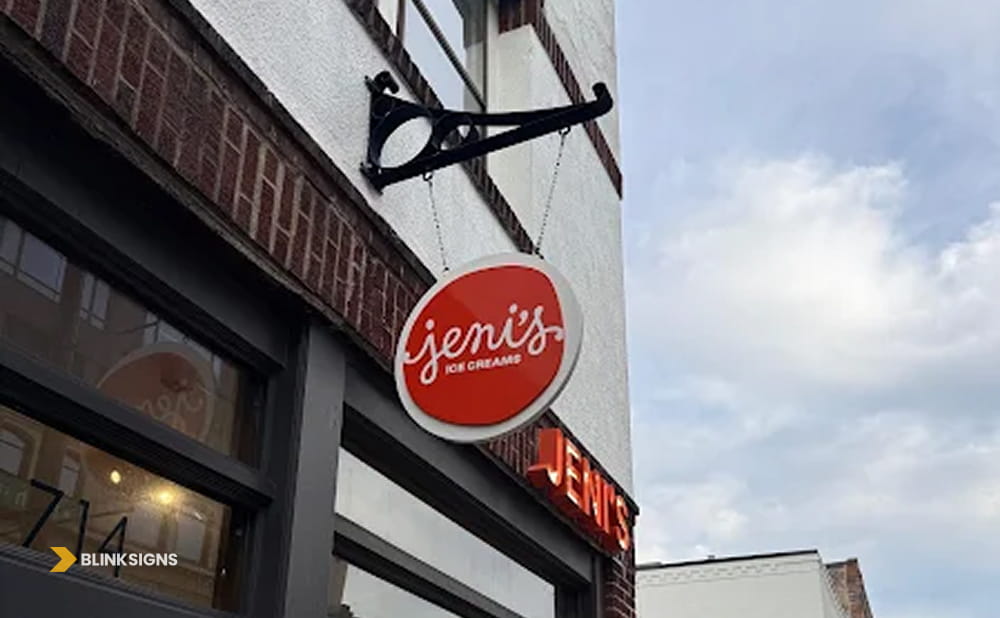
A modern hanging blade sign designed to increase pedestrian visibility and store appeal.
Blade signs and projecting signs often require specific review because they extend outward from the building facade. They may project over private walkways, public sidewalks, retail corridors, restaurant patios, or other pedestrian areas.
Permit review may consider projection distance, clearance above grade, bracket design, sign area, illumination, facade placement, historic district status, and right-of-way impact.
| Review factor | Why it matters |
| Projection distance | Local code may limit how far the sign can extend from the building |
| Clearance height | Signs over sidewalks may need a minimum clearance above pedestrian areas |
| Bracket design | Visible brackets may be reviewed for structure, appearance, or historic compatibility |
| Public right-of-way | Signs near public sidewalks or streets may require additional access review |
| Illumination | LED, neon, or external lighting may require additional review |
| Historic district | Materials, color, lighting, and bracket style may be reviewed |
| Facade placement | The sign may need to fit within approved storefront zones |
| Sidewalk access | Installation may require a separate sidewalk or traffic coordination |
Blade signs are common in downtown streets, pedestrian corridors, entertainment districts, restaurants, hospitality environments, and older retail areas. Many of these locations have additional design or public access requirements.
Buyers should confirm the projection and clearance rules before finalizing blade sign dimensions.
Channel letter and cabinet sign permit factors
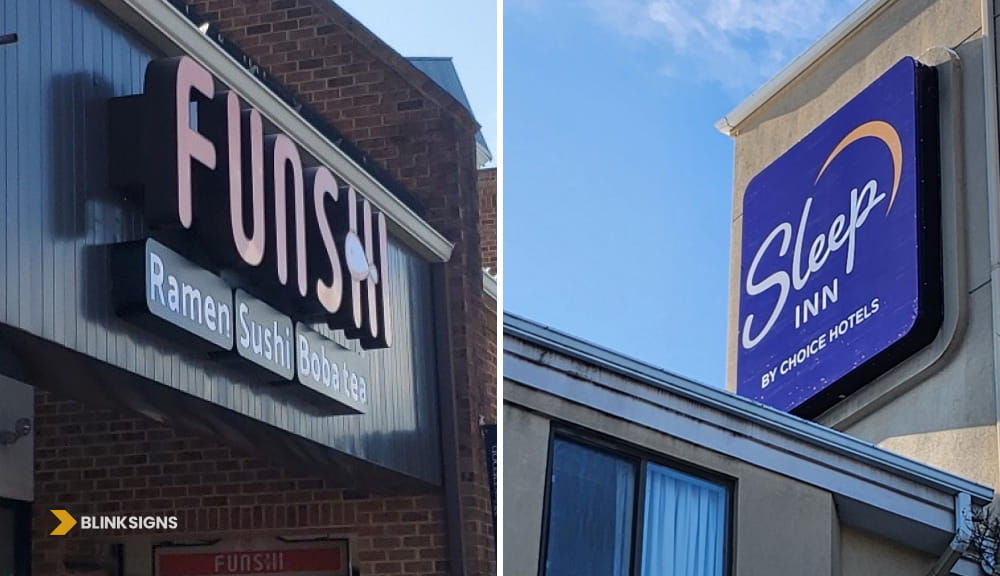
High-impact exterior building signs tailored for restaurants, hotels, and retail storefronts.
Channel letters and cabinet signs are among the most common exterior business sign types, but they are not always reviewed the same way. A channel letter sign may be reviewed as individual wall-mounted letters, while a cabinet sign may be reviewed as a single sign body. Both can be affected by sign area limits, illumination rules, landlord criteria, facade placement, electrical documentation, and local code definitions.
A buyer may view these signs as simple storefront identification. Still, the reviewing authority may evaluate them based on frontage, sign area, zoning district, lighting, mounting location, tenant space, and whether the sign is new, refaced, relocated, or replacing an existing sign.
| Permit factor | Channel letters | Cabinet signs |
| Sign area | May be calculated by letter height, logo area, raceway dimensions, or overall sign envelope | May be calculated by cabinet face dimensions or total sign area |
| Illumination | Front-lit, halo-lit, or non-illuminated letters may be reviewed differently | Internally illuminated cabinets may require lighting and electrical documentation |
| Raceway use | Raceway-mounted letters may affect appearance and landlord approval | Not usually applicable unless the cabinet is part of a larger mounting system |
| Facade placement | Letter placement may need to fit within a sign band or approved wall area | Cabinet placement may be limited by sign band, tenant frontage, or wall area |
| Landlord criteria | Shopping centers may restrict letter height, color, raceway use, or illumination | Property criteria may define cabinet dimensions, face material, and lighting |
| Replacement scope | Replacing existing letters may still require review if size, illumination, or placement changes | Replacing a face may be treated differently from replacing the full cabinet |
| Electrical review | Illuminated letters may require electrical documentation or separate electrical coordination | Illuminated cabinets may require electrical documentation, service access, or inspection |
Channel letter permits
Channel letter permit review often focuses on sign size, letter height, wall placement, illumination, raceway use, and tenant frontage. Some jurisdictions may calculate allowed sign area based on the area around each letter, while others may use the overall sign envelope or a formula tied to building frontage.
Landlord criteria may also affect channel letters. A shopping center may require a raceway, prohibit raceways, limit letter height, restrict colors, or require specific illumination methods. These property rules may apply before municipal submission.
Buyers should confirm whether the approved design includes the letter height, logo size, raceway, lighting type, and exact facade placement before fabrication begins.
Cabinet sign permits
Cabinet sign permit review may focus on the cabinet face size, wall placement, illumination, electrical details, and whether the cabinet is wall-mounted, monument-mounted, pylon-mounted, or replacing an existing cabinet.
A face replacement may be a lower scope than a full cabinet replacement if the existing sign structure remains permitted and usable. However, if the cabinet size, lighting, placement, or mounting changes, the project may still require permit review. Requirements vary by jurisdiction and property conditions.
Buyers should ask whether the quote assumes a replacement face, a cabinet retrofit, or a full new permitted sign.
Historic districts, design boards, and landmark review
Signs in historic districts, landmark zones, architectural review corridors, downtown districts, entertainment districts, or special design areas may require additional review beyond a standard sign permit. This review may be handled by a historic preservation commission, design review board, architectural committee, landlord, or other local authority.
Historic review does not only affect the permit fee. It can affect design direction, materials, colors, illumination, projection, bracket style, placement, documentation, review meetings, revisions, and approval timing.
| Review area | What may be reviewed |
| Sign shape | Whether the sign profile fits the building and streetscape |
| Sign size | Whether the scale is compatible with the property and district |
| Materials | Painted metal, wood, glass, acrylic, neon, or other materials may be reviewed |
| Illumination | Traditional neon, LED, and LED neon-style lighting, brightness, and operating hours may be reviewed |
| Color | Some boards may encourage or require district-appropriate colors. Some boards may encourage or require district-appropriate colors |
| Bracket design | Visible brackets, hardware, and finishes may be reviewed for projecting signs |
| Placement | Sign location on the facade may need to align with the historic architecture |
| Mounting method | Some buildings may restrict penetrations or visible hardware |
| Documentation | Renderings, elevations, material samples, or photos may be requested |
Why a historic review can affect cost
Historic review can affect cost because it may require more design coordination, additional drawings, material research, presentation documents, meeting attendance, or revision rounds. If a board requests a different material, color, illumination method, bracket, or sign size, the design and fabrication scope may change.
Historic review can also affect the schedule. Some boards meet only on set dates. Missing a submission deadline may move the project to a later review cycle.
Historic approval is not guaranteed.
Historic district review outcomes are not guaranteed. A design that appears acceptable to the buyer, landlord, or sign company may still require revision after review. Buyers should confirm whether the property is in a historic district before approving fabrication or installation timelines.
Neon and historic districts
Traditional neon may be considered appropriate in some historic or entertainment districts due to its visual character and its historic association with storefront signage. LED neon-style lighting may also be reviewed if the district evaluates materials, brightness, color, or authenticity. Requirements vary by jurisdiction and review board.
The safest approach is to treat illumination as a review item rather than an assumption.
Variances, appeals, and nonconforming signs
A sign variance or appeal may be needed when the desired sign does not meet local code requirements. This can happen when a sign exceeds allowed size, height, projection, illumination limits, placement rules, setback requirements, frontage calculations, or digital display restrictions.
A variance is not a routine permit. A variance is not a routine permit. It is a separate review path that may require additional documentation, public notice, board review, hearings, justification, fees, revisions, and additional time.
| Situation | Why a variance or appeal may be considered |
| Oversized sign | The desired sign exceeds the allowed sign area or height |
| Projection issue | Blade sign projects farther than standard code allows |
| Setback conflict | The freestanding sign is too close to a road, property line, or driveway |
| Illumination restriction | Lighting type, brightness, or operating hours conflict with local rules |
| Digital display restriction | Animation, brightness, dwell time, or location may not meet code |
| Historic district concern | Design does not fit board expectations or district criteria |
| Nonconforming existing sign | The existing sign was allowed previously, but does not fit the current code |
| Site hardship | Property layout creates unusual visibility, frontage, or placement conditions |
Variance and appeal fees
Variance, appeal, or special review fees may be separate from standard permit fees. Depending on the jurisdiction, these fees may be non-refundable even if the variance is not granted. Buyers should treat variance and appeal costs as risk-bearing process costs, not as guarantees of approval.
Approval is not guaranteed.
A variance request can be approved, denied, modified, or continued for additional review. A board may approve a smaller version of the requested sign, require a different placement, restrict illumination, or request additional documentation.
No sign company, landlord, or consultant can guarantee a variance outcome.
Nonconforming signs
A nonconforming sign is generally an existing sign that does not meet current rules but may have been allowed under older code or prior approvals. Nonconforming signs can create uncertainty during replacement, repair, reface, relocation, or changes in illumination.
In some jurisdictions, changing a nonconforming sign may trigger a new compliance review. In others, limited maintenance or face replacement may be handled differently from full replacement. Requirements vary widely.
Codes and enforcement can change.
Sign codes and enforcement practices can change over time, including in ways that affect illumination rules. A design that does not fit current code may be worth revisiting if local rules are updated, though no future approval can be assumed or guaranteed.
This is especially important for buyers planning signs around illuminated awnings, canopy signs, digital displays, neon, blade signs, and other categories that municipalities may revisit over time.
Hidden permit costs and quote exclusions
Permit-related costs are often misunderstood because some items are government fees, while others are project support, documentation, review, revision, or coordination costs. Buyers should ask direct questions before comparing quotes.
| Buyer question | Why it matters |
| Are government permit fees included? | Filing fees may be pass-through costs rather than part of the base quote |
| Is permit support included? | Preparing forms, drawings, and submissions may be quoted separately Preparing forms, drawings, and submissions may be quoted separately |
| Are revisions included? | Local review may require design or documentation updates |
| Is landlord approval included? | Leased properties may require landlord approval before municipal filing |
| Is the engineering review included where required? | Larger, elevated, projecting, or freestanding signs may need additional review |
| Are electrical permits included? | Some jurisdictions may separate electrical permits from sign or zoning permits |
| Are inspection fees included? | Some jurisdictions require inspections or additional review steps |
| Are variance or appeal fees included? | Signs outside standard code may require a separate process with no guaranteed outcome |
| Are variance fees refundable? | Some jurisdictions may treat variance or special review fees as non-refundable |
| Are resubmission fees included? | Some authorities may charge additional fees for revised submissions |
| Are surveys or site plans included? | Some signs may require scaled site plans or property information |
| Are historic review documents included? | Historic boards may require renderings, material samples, elevations, or photos |
| Are multi-location permit filings included? | Each location may require a different filing path and documentation package |
This table should be used before quote approval. A permit line item that looks simple may not include revisions, variance support, landlord resubmissions, electrical documentation, engineering review where required, or additional review cycles.
Multi-location permit planning
Multi-location sign permitting is more complex than single-location permitting because different jurisdictions, landlords, zoning districts, historic districts, frontage calculations, illumination rules, and review timelines may govern each site.
A franchise, retail chain, restaurant group, hospitality brand, healthcare network, storage company, or regional service business may use the same sign design across many properties. That does not mean the same permit path will apply everywhere.
| Multi-location variable | Why it matters |
| Jurisdiction | Each city or county may have different sign rules and fee structures |
| Zoning district | Commercial, mixed-use, industrial, historic, and special districts may differ |
| Landlord criteria | Shopping centers and leased properties may apply their own sign standards |
| Tenant frontage | Allowed sign area may depend on the tenant or building frontage |
| Existing signs | Refacing, replacement, and new installation may be treated differently |
| Illumination | LED, neon, cabinet lighting, and digital signs may trigger different reviews |
| Sign type | Wall signs, blade signs, pylons, monuments, and window signs may require different documents |
| Permit timeline | Each jurisdiction may review applications on a different schedule |
| Revision requests | Local reviewers may request different changes from site to site |
| Inspection requirements | Some jurisdictions may require final inspection or documentation after installation |
Why standardized signs still need local permit review
A national brand may standardize colors, materials, logo size, letter height, cabinet depth, illumination, and placement rules. But local code may still require changes. One location may approve the standard sign package. Another may require smaller letters, different lighting, a raceway, reduced window coverage, a shorter pylon sign, or a modified blade sign projection.
Multi-location permit planning must balance national brand consistency with hyper-local zoning code. Corporate managers should align these workflows with The Franchise Signage Playbook for institutional deployment rules.
Permit readiness by location
Before filing permits across multiple sites, buyers should confirm permit readiness for each property.
| Readiness item | Why it helps |
| Property address confirmed | Identifies the correct jurisdiction and zoning context |
| Site photos available | Helps confirm facade, existing signs, and installation location |
| Landlord criteria collected | Reduces rework before municipal submission |
| Sign type confirmed | Helps identify review category |
| Sign dimensions confirmed | Supports drawings and sign area calculations |
| Electrical status known | Helps determine whether electrical documentation may be needed |
| Historic status checked | Helps identify design board or landmark review risk |
| Existing sign status documented | Helps determine whether the project is new, replacement, reface, or repair |
| Timeline requirements captured | Helps manage opening dates, rebrands, and rollout schedules |
Rollout permit tracking
For multi-location programs, the permit process should be tracked by site. A single master sign package may require many local submissions, each with its own status, revision history, approval path, and installation dependency.
This is why permit planning should be included early in franchise and regional rollout strategy.
How BlinkSigns supports sign permitting
BlinkSigns supports commercial sign projects with planning, design coordination, fabrication coordination, permitting support where relevant, installation coordination, maintenance planning, multi-location rollout support, and SignTrax project visibility.
Permit requirements depend on confirmed site conditions, local code, landlord criteria, sign type, sign size, illumination, historic district status, engineering review where required, and approved specifications.
BlinkSigns can help buyers think through:
| Permit support area | Buyer benefit |
| Project planning | Helps identify whether permitting may affect scope, timeline, or documentation |
| Sign-type review | Helps connect the sign format with likely permit considerations |
| Drawing coordination | Helps organize sign details, elevations, and site-related documentation |
| Landlord criteria review | Helps align the sign concept with property requirements where relevant |
| Permit support where relevant | Helps coordinate documentation for local review, subject to jurisdictional requirements |
| Revision coordination | Helps manage requested updates when reviewing authorities ask for changes |
| Installation alignment | Helps connect permit approval status with installation planning |
| Multi-location visibility | Helps track site-by-site requirements across rollouts |
| SignTrax visibility | Supports project visibility across planning, production, permitting, and coordination stages |
BlinkSigns does not treat permitting as an afterthought. Permit planning affects budget clarity, production timing, installation readiness, and buyer expectations.
Approval timelines, permit outcomes, variance outcomes, inspection results, and jurisdictional requirements are under the control of the reviewing authority and cannot be guaranteed.
How to prepare for a sign permit estimate
A more accurate estimate of permit-related costs starts with better project information. Buyers do not need to know every local rule before requesting a quote, but they should provide enough information to help clarify the likely permit path.
Before requesting a sign permit estimate, gather the following details.
| Information to prepare | Why it helps |
| Property address | Helps identify jurisdiction and zoning context |
| Property type | Retail, restaurant, office, healthcare, hospitality, industrial, school, or shopping center status may affect the review |
| Owned or leased status | Helps determine whether landlord approval may be needed |
| Landlord sign criteria | Helps align sign design with property rules |
| Sign type | Channel letters, cabinet sign, monument sign, pylon sign, blade sign, window sign, awning sign, or digital display |
| Interior or exterior | Helps identify permit exposure |
| Illuminated or non-illuminated | Helps determine lighting and electrical review needs |
| Static, neon, LED, digital, or temporary Static, neon, LED, digital, or temporary | Helps classify review category |
| Estimated sign size | Helps evaluate the sign area and allowed dimensions |
| Mounting height | Helps identify clearance or structural review needs |
| Installation location | Wall, ground, window, blade, monument, pylon, awning, canopy, or roof location |
| Projection distance | Important for blade signs and projecting signs |
| Existing sign status | Helps clarify replacement, reface, repair, or new installation scope |
| Historic district status | Helps identify design board or landmark review risk |
| Zoning district, if known | Helps identify the sign code category |
| Permit application status | Helps avoid duplicate filing or incomplete handoff |
| Site photos | Helps support drawings, placement review, and application preparation |
| Drawings available | Helps determine documentation readiness |
| Electrical access known | Helps identify whether electrical documentation may be needed |
| Timeline requirement | Helps plan around openings, rebrands, or lease deadlines |
| Number of locations | Important for multi-location permit planning |
📝 Streamline Your Municipal Submission: Systematically collect site photos, tenant frontage figures, and landlord sign criteria using our step-by-step Cabinet Sign Quote Prep Checklist↴
**Pricing, permitting, legal, and approval note**

This guide is provided for baseline budgeting and buyer education. It is not legal advice, code interpretation, or a substitute for review by the authority having jurisdiction.

Final sign permit costs depend on jurisdiction, sign type, sign size, illumination, installation location, zoning district, property type, landlord criteria, historic district status, documentation requirements, electrical review, engineering review (where required), inspections, revisions, resubmissions, variances, and approved specifications.

Permit approvals, variance outcomes, appeal outcomes, inspection outcomes, review timelines, and code interpretations are not guaranteed. Requirements vary by jurisdiction and may change over time.

Electrical documentation and field work should be handled by qualified or licensed professionals where required. A structural or engineering review may be required depending on the sign type, size, height, projection, weight, mounting location, local code, and site conditions.
FAQ
How much does a sign permit cost?
Sign permit cost depends on the jurisdiction, sign type, sign size, illumination, mounting location, zoning district, property type, landlord requirements, historic district status, and whether drawings, electrical documentation, engineering review, revisions, inspections, or variance requests are required. A universal permit price is not reliable.
What is the difference between a permit fee and permit support?
The local authority charges a permit fee. Permit support refers to the work required to prepare, organize, submit, revise, and coordinate permit documents for the signage project.
Are government permit fees usually included in sign quotes?
Not always. Some quotes include permit support but treat government filing fees as pass-through costs. Some quotes include permit support but treat government filing fees as pass-through costs. Buyers should ask whether filing, inspection, resubmission, and variance fees are included or are separate.
Do all commercial signs need permits?
Not all signs require permits, but many exterior signs do. Requirements vary by jurisdiction, sign type, size, illumination, location, zoning district, and property type. Buyers should confirm local requirements before fabrication or installation.
Do illuminated signs require special permit review?
Illuminated signs may require additional review for lighting type, brightness, electrical documentation, operating hours, digital display behavior, or historic district compatibility. Some jurisdictions may separate sign permits and electrical permits.
Do window signs need permits?
Window sign rules vary widely. Some municipalities regulate window coverage percentage, opacity, illumination, material, or storefront transparency. Buyers should not assume window graphics are always permit-free.
Do temporary signs need permits?
Temporary signs may still require permits depending on size, duration, placement, event use, illumination, safety, and local code. Temporary does not always mean permit-free.
What is a sign variance?
A sign variance is a separate review path used when the desired sign does not meet code requirements. Variance approval is not guaranteed, and the process may require additional fees, documentation, hearings, revisions, or review time.
Are the variance or appeal fees refundable?
Variance, appeal, or special review fees may be non-refundable depending on the jurisdiction, even if approval is not granted. Buyers should confirm the fee rules before starting the process.
Can an existing nonconforming sign be replaced?
Sometimes, but requirements vary. A nonconforming sign may have been allowed under older rules but may not meet current code. Replacement, relocation, reface, repair, or illumination changes may trigger a new review, depending on the jurisdiction.
How do historic districts affect sign permits?
Historic districts may require review of sign shape, size, placement, materials, illumination, color, bracket design, and mounting method. Review outcomes and timelines are not guaranteed.
Why do sign permits affect project timelines?
Permits can add review steps such as landlord approval, documentation preparation, municipal filing, completeness review, full review, revision requests, variance hearings, inspections, or historic board meetings.
Can permit timelines be guaranteed?
No. Permit timelines depend on jurisdiction, review backlog, project type, documentation completeness, revisions, inspections, board schedules, and local approval processes. Timelines cannot be guaranteed.
How should multi-location brands plan sign permits?
Multi-location brands should expect site-by-site permit variation. Each location may have different jurisdictional rules, landlord criteria, zoning districts, frontage calculations, illumination limits, historic status, and review timelines.
How does BlinkSigns help with sign permitting?
BlinkSigns helps commercial buyers with project planning, design coordination, documentation support, permitting support where relevant, revision coordination, installation alignment, multi-location visibility, and SignTrax project tracking. Approval outcomes and timelines remain subject to the reviewing authority.
Conclusion
The cost of a sign permit is not a universal number. It depends on the jurisdiction, sign type, sign size, illumination, installation location, zoning district, property type, landlord criteria, historic district status, documentation requirements, electrical review, engineering review (where required), revisions, inspections, variances, and local approval processes.
The most important buyer distinction is the difference between government permit fees and permit support costs. The reviewing authority charges government fees. Permit support includes the work required to prepare applications, drawings, site documentation, revisions, resubmissions, and coordination.
Permitting also affects timelines. A sign project may require landlord approval, municipal filing, completeness review, full review, revisions, inspections, historic review, variance hearings, or site-specific documentation before installation can proceed.
For multi-location brands, permit planning should be treated as a location-by-location process. Standardized sign packages still need local review for code, landlord rules, zoning districts, illumination, frontage calculations, historic status, and installation conditions.
BlinkSigns helps commercial buyers plan sign projects with clearer coordination across design, fabrication, permitting support where relevant, installation planning, maintenance considerations, multi-location visibility, and SignTrax project tracking. Before requesting a permit-related estimate, gather the property address, sign type, sign size, illumination details, landlord criteria, historic district status, existing sign information, site photos, drawings, timeline requirements, and number of locations.