
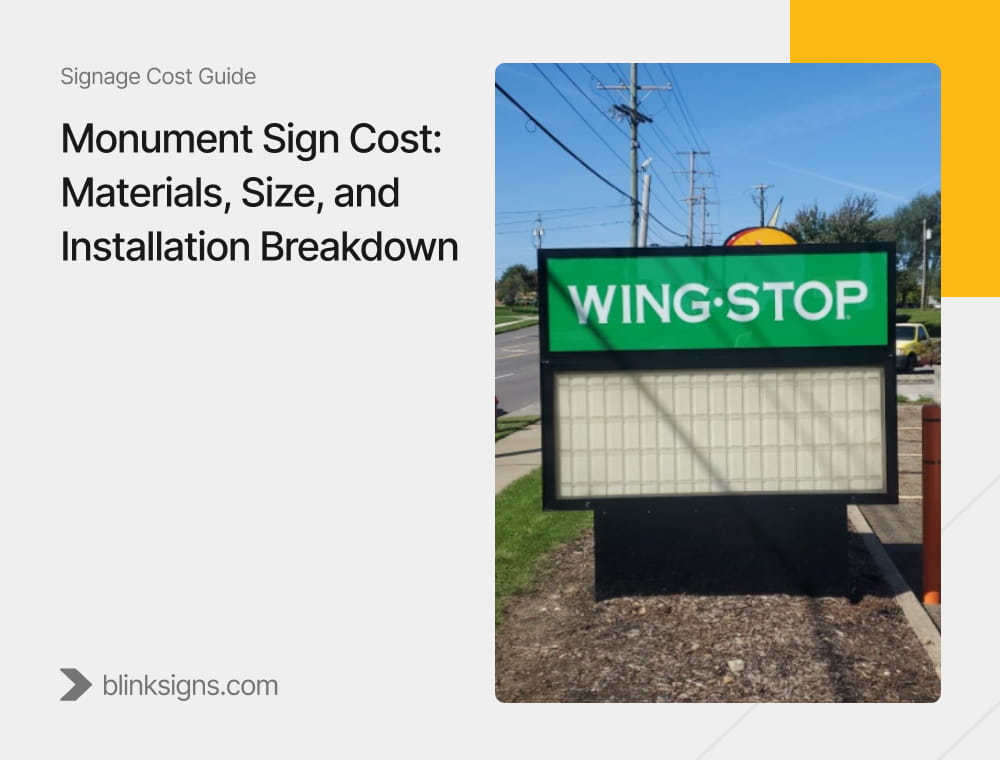
Monument Sign Cost: Materials, Size, and Installation Breakdown
How much does a monument sign cost?
Monument sign projects typically range from $5,000 for a simple post-and-panel or aluminum cabinet sign to $65,000+ for custom brick or masonry builds. Most single-tenant illuminated monument sign projects fall in the $10,000 to $30,000 planning range before foundation work, electrical, permitting, and installation conditions are factored in. LED and digital monument signs carry a separate planning range, typically $15,000 to $100,000+, depending on display size, pixel pitch, and electrical infrastructure. Every project estimate depends on scope, site conditions, and local authority review.
At BlinkSigns, monument sign budgets are built around the full project scope: site survey, design, permitting, foundation coordination, fabrication, installation, and long-term maintenance planning, not just the sign face.
Monument signs are one of the most important exterior sign types covered in the broader commercial signage cost guide because they often serve as permanent brand landmarks for properties, campuses, retail centers, healthcare facilities, self-storage locations, schools, churches, hospitality properties, and corporate entrances. Unlike a wall sign or a temporary exterior panel, a monument sign is usually built into the site itself, which means the budget may include structure, ground conditions, electrical access, visibility requirements, landscaping, and permitting.
That is why monument sign pricing should not be treated as a simple product cost. A buyer may see a sign face, a cabinet, a brick base, a digital display, or tenant panels, but the full project estimate may also include excavation, concrete footing, anchor hardware, utility coordination, engineering documentation where required, installation equipment, electrical trenching, and long-term service access.
This guide explains what affects monument sign cost, how material choices change the planning range, what should be included in a professional quote, and how to prepare for a more accurate project-specific estimate.
What Is a Monument Sign?
A monument sign is a permanent ground-level exterior sign structure, usually placed near a road, driveway entrance, campus entrance, retail plaza, business park, medical facility, self-storage property, church, school, hotel, or corporate property entrance. Unlike a wall sign, it is not mounted directly to the building. It is freestanding and built close to the ground, often with a base, cabinet, masonry structure, or architectural frame.
Monument signs are commonly used when a business or property needs strong visibility from the road while also creating a more established and architectural impression. They can be simple post-and-panel signs, aluminum cabinet structures, brick or stone monument signs, internally illuminated signs, LED message centers, multi-tenant signs, or renovated structures with updated faces and panels.
A monument sign differs from a pylon sign because a pylon sign is usually taller, pole-mounted, and designed for higher visibility at greater distances. A monument sign is typically lower, wider, and more integrated with the property entrance or landscape. It is also different from a wall sign because it may involve site work, foundation planning, electrical routing, zoning review, and installation conditions that do not apply to building-mounted signage.
Every monument sign is custom-designed for the site. There is no off-the-shelf price for a universal monument sign because each project depends on the property layout, sign size, visibility goal, material selection, foundation requirements, electrical access, local sign code, landlord or property manager criteria, and installation environment.
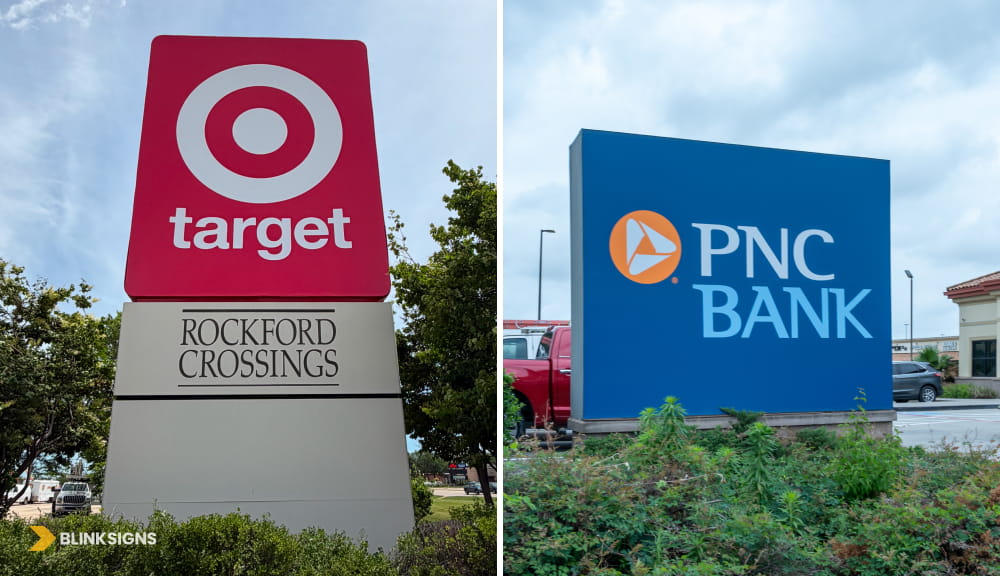
Monument Signs for Target and PNC Bank
Monument Sign Cost by Type and Material
The table below provides typical planning ranges for monument sign types. These ranges are intended only for early budgeting. Final project estimates may vary by sign size, materials, foundation requirements, electrical access, permitting, engineering documentation where required, installation conditions, and local authority review.
| Monument Sign Type | Typical Planning Range | Best For | Main Cost Drivers | Complexity Level |
| Post and panel monument sign | $3,000 to $10,000+ | Smaller businesses, simple entrances | Panel size, posts, materials, installation | Medium |
| Aluminum cabinet monument sign | $5,000 to $20,000+ | Retail, offices, service businesses | Cabinet size, faces, lighting, base | High |
| Brick or masonry monument sign | $15,000 to $65,000+ | Campuses, healthcare, and property entrances | Masonry, foundation, stone or brick, skilled labor | Critical |
| Illuminated monument sign | $10,000 to $50,000+ | Road visibility, retail, multi-tenant sites | LEDs, electrical access, cabinet, permits | High |
| LED or digital monument sign | $15,000 to $100,000+ | Schools, churches, retail centers, roadside | Display size, resolution, software, and electrical | Critical |
| Multi-tenant monument sign | $10,000 to $75,000+ | Shopping centers, office parks, medical plazas | Tenant panels, cabinet size, illumination, updates | Critical |
| Monument sign renovation | Custom quoted | Rebrands, property updates, and face replacement | Existing structure condition, retrofit scope, and code review | Medium to High |
- Post-and-panel monument signs usually sit toward the lower end of the planning range because they use simpler materials, lighter structures, fewer architectural details, and less complex fabrication than masonry or illuminated monument signs. The estimate can still change based on panel size, post material, finish quality, ground conditions, installation access, and whether permits or site preparation are required.
- Aluminum cabinet monument signs often sit in the mid-range because they combine a fabricated structure with sign faces, dimensional graphics, lighting options, and a base. The project estimate can change based on cabinet size, face material, illumination type, mounting structure, electrical access, and whether the sign is single-sided or double-sided.
- Brick or masonry monument signs usually require a higher planning range because they involve heavier materials, skilled labor, foundation planning, masonry construction, architectural finishes, and more site coordination. The estimate can change based on brick, stone veneer, stucco, concrete, sign height, foundation depth, local soil conditions, and whether the municipality requires structural documentation.
- Illuminated monument signs add scope because they require lighting components, electrical access, wiring, service planning, and, sometimes, electrical permit review. The range can change based on whether the sign uses internal illumination, external lighting, LED modules, backlit letters, or a cabinet-style illuminated face.
- LED or digital monument signs require a broader planning range because they are both a technology component and a sign component. Display size, pixel pitch, brightness requirements, software, electrical infrastructure, structural support, ventilation, and local rules around animation or brightness can all affect the project estimate.
- Multi-tenant monument signs cost more when tenant panels, changeable faces, illuminated cabinets, hierarchy rules, and future update needs are included. These signs are common in shopping centers, office parks, medical plazas, mixed-use properties, and business parks, where tenant names may change over time and serviceability is a concern.
Monument sign renovation is custom quoted because the estimate depends on the condition of the existing structure. A refacing project may involve new panels, vinyl, paint, or tenant inserts. At the same time, a larger retrofit may require LED upgrades, cabinet replacement, masonry repair, code review, or full removal and replacement if the existing structure is no longer suitable.
Pricing Note: The ranges in this guide are provided for budget planning only. Final monument sign estimates depend on project scope, sign type, materials, foundation requirements, illumination, electrical access, permitting, engineering, site preparation, installation conditions, and local authority review.

Some sign companies use a per-square-foot pricing range for monument signs, often $150 to $400+, depending on complexity. This can help with early budgeting, but it should not replace a project-specific estimate, as foundation, electrical, material, permitting, and site conditions can significantly shift the final scope.
What Affects Monument Sign Cost?
The cost of the monument sign is shaped by more than the visible sign face. A professional quote should account for the full project environment, including the property layout, ground conditions, foundation needs, materials, illumination, electrical access, permit path, installation access, and long-term maintenance expectations.
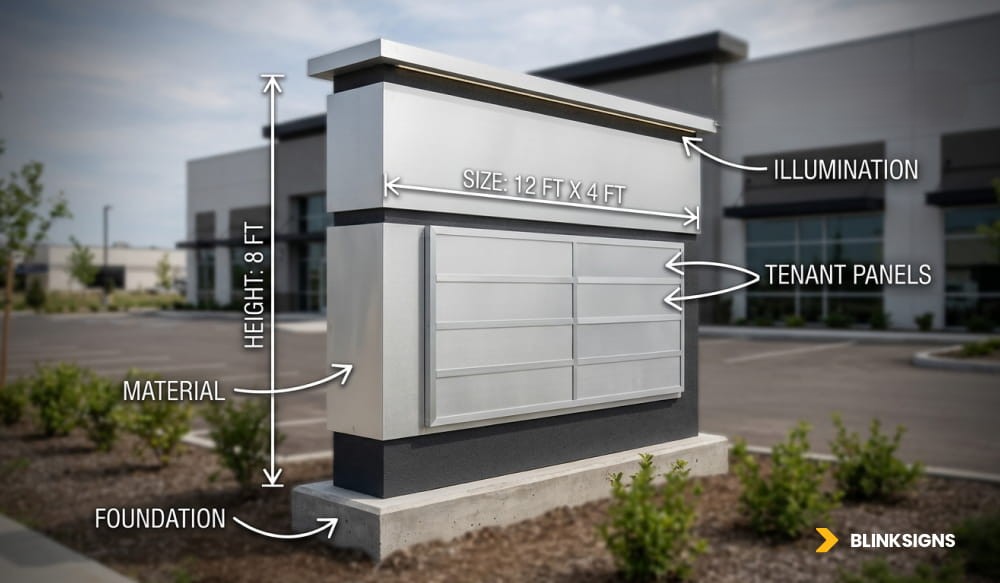
Factors affecting monument sign costs
Size, Height, and Visibility Requirements
Size is one of the most important cost drivers of monument signs. Larger signs require more material, more fabrication time, a stronger internal structure, more substantial installation planning, and sometimes more extensive zoning review. Height and width also affect visibility, especially when the sign must be readable from a road, driveway entrance, parking area, or high-traffic corridor.
Visibility requirements should be considered early. A small sign may work for a low-speed entrance, but a property on a wider road or set back from traffic may need larger dimensions, stronger contrast, better illumination, or a more prominent placement. These choices can affect materials, structure, permitting, and installation.
Local sign codes may also limit height, sign area, setback distance, illumination, and placement. A larger sign may require additional review from the local authority having jurisdiction, especially if it affects visibility triangles, setbacks, landscaping, or road-facing placement.
Material Selection
Material selection affects both upfront cost and long-term performance. Monument signs may use aluminum cabinets, steel frames, acrylic faces, polycarbonate faces, HDU foam-core panels, brick, stone veneer, stucco, concrete, dimensional letters, routed panels, vinyl graphics, or LED components.
Aluminum cabinet signs are common for commercial properties because they provide a clean, fabricated structure with flexibility for lighting, face replacement, and brand graphics. HDU foam-core signs can create an architectural look with lower weight than full masonry. Still, material eligibility should be confirmed during the code and criteria review, as some municipalities, landlords, or development districts may have durability or appearance requirements.
Brick, stone veneer, stucco, and masonry structures often create the strongest architectural presence. Still, they can also increase the project estimate because they involve heavier materials, foundation planning, skilled labor, site preparation, and long-term finish considerations.
The right material depends on the property type, brand image, local code, landlord criteria, climate exposure, maintenance expectations, and budget. A self-storage facility, healthcare campus, retail center, and corporate entrance may each require a different material strategy.
Foundation and Site Preparation
Foundation and site preparation are major factors in the variation in monument sign quotes. Unlike wall signs, monument signs are built into the site, which means the project may require excavation, concrete footing, steel supports, anchor bolts, rebar, utility checks, soil review, landscaping coordination, and base construction.
Ground conditions matter. Stable soil, clear access, and an open installation area can make the project more straightforward. Compacted soil, underground utilities, irrigation lines, landscaping, sidewalks, driveways, slopes, poor drainage, or limited equipment access can add complexity.
Climate can also influence planning. In freeze-thaw regions, footing depth and foundation design may need to be adjusted to account for local conditions. In wind-sensitive areas, the sign structure may need to account for wind load and local engineering expectations. Some municipalities require engineering documentation for signs exceeding certain height or area thresholds. Requirements vary by jurisdiction and should be confirmed with the local authority.
Site preparation should be addressed before fabrication begins. If the foundation, utilities, electrical path, landscaping, or installation access are not understood early, the final project estimate may change later.
Illumination and Electrical Access
Illumination changes both the cost and the complexity of a monument sign. A non-illuminated sign is usually simpler than an internally illuminated cabinet, an externally lit monument, an LED message center, or a digital monument sign.
Internally illuminated monument signs may require LED modules, power supplies, wiring, translucent faces, service access, and electrical permit review. Externally illuminated signs may use ground-mounted lighting or architectural fixtures, which can require separate electrical planning and careful placement to avoid glare or uneven visibility.
LED and digital monument signs add another layer of scope. They may require display hardware, control software, brightness planning, electrical infrastructure, ventilation, structural support, and compliance with local rules around animation, message frequency, and nighttime brightness.
Electrical access should be clarified in the quote. If power is already available near the sign location, the project may be more straightforward. If trenching, conduit, panel coordination, or electrical upgrades are needed, the project estimate can change significantly.
Tenant Panels and Changeable Components
Multi-tenant monument signs require planning beyond the first installation. Tenant panels, replaceable faces, name hierarchy, logo sizes, illumination zones, and future tenant updates can all affect the project estimate.
A retail center, office park, medical plaza, or mixed-use property may need a structure that supports tenant changes over time. If the sign is designed without serviceability in mind, future updates can become more expensive or disruptive.
The number of tenant panels also affects cost. More panels may require a larger cabinet, more illumination, more face material, a stronger structure, and a more careful layout. A professional quote should clarify whether tenant panels are included, how they are fabricated, how they can be replaced, and whether future updates are easy to manage.
Permitting, Zoning, and Engineering
Permitting is a major part of monument sign planning because these signs are usually permanent exterior structures. Local rules may control height, width, sign area, setback distance, lighting, landscaping, visibility triangle, and placement near roads or entrances.
Some monument sign projects may require a building permit or structural review when a new foundation, a larger structure, an expanded electrical scope, or engineered footing is involved. Requirements vary by jurisdiction and should be confirmed with the local authority.
Engineering documentation may also be required in some cases. Some municipalities require engineering documentation for signs exceeding certain height or area thresholds. Requirements vary by jurisdiction and should be confirmed with the local authority.
Permit timelines can also affect the project schedule. If the first submission requires revisions, the project may need updated drawings, revised dimensions, alternate placement, or additional documentation before approval.
Installation Equipment and Access
Installation access can affect the project estimate, as monument signs often require equipment, site coordination, and careful placement. Depending on the sign type, installation may involve lifts, cranes, concrete equipment, excavation tools, traffic control, parking lot access, or coordination with landscaping crews.
A site with open access and stable ground is easier to install than a location near traffic, utilities, slopes, sidewalks, landscaped areas, or restricted parking. If the sign must be installed after hours or during a limited access window, labor planning may change.
Some monument sign projects may require installation, site work, foundation, electrical trenching, or permitting costs beyond fabrication. In many planning scenarios, these items can materially change the project estimate, especially when foundation work, electrical access, or site restoration is involved.
Renovation, Refacing, or Full Replacement
Not every monument sign project requires a completely new structure. In some cases, an existing monument sign can be refaced, repainted, resurfaced, retrofitted with updated lighting, or updated with new tenant panels.
Renovation can be a practical option when the existing structure is sound, the base is stable, the sign still complies with local requirements, and the brand update does not require a completely different size or structure. Refacing may involve new sign faces, vinyl graphics, dimensional letters, tenant panels, or cabinet updates.
Full replacement may be more appropriate when the existing structure is damaged, structurally outdated, poorly located, noncompliant with current requirements, or unable to support the new brand design. A site survey is the starting point for this decision because structural conditions, code requirements, brand standards, and project economics all affect the right path.
Brick, Masonry, HDU Foam, or Aluminum: What Is the Difference?
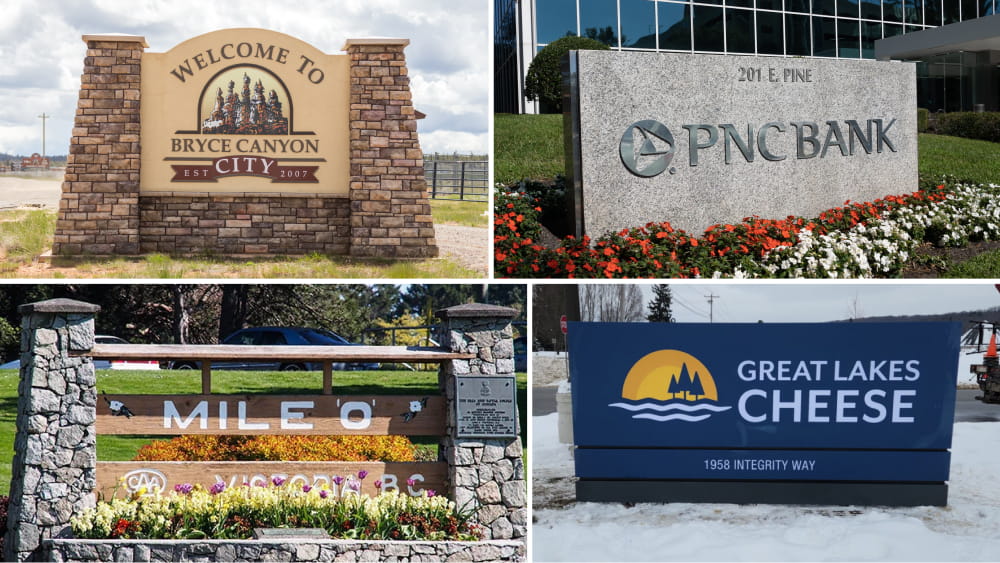
Brick, masonry, HDU and Aluminum monument signs
Material choice is one of the biggest reasons monument sign costs vary. The right material affects the upfront project estimate, foundation requirements, installation complexity, perceived quality, maintenance needs, and long-term appearance.
A post-and-panel monument sign is usually the simplest structure. It is often used for smaller businesses, property entrances, temporary-to-permanent branding needs, or sites that need clear identification without a large architectural base. The estimate can change based on panel size, post material, finish quality, sign height, and site conditions.
An aluminum cabinet monument sign is one of the most common commercial options because it balances durability, brand flexibility, illumination options, and serviceability. Aluminum cabinets can support acrylic or polycarbonate faces, dimensional lettering, vinyl graphics, and internal lighting. Retail centers, office buildings, service businesses, and single-tenant commercial properties often use them.
HDU foam-core monument signs can create an architectural appearance with less weight than full masonry. They may be shaped, textured, or finished to imitate the appearance of dimensional materials, depending on the design and local criteria. Material eligibility should be confirmed during the code and criteria review, as some municipalities, landlords, or development districts may have material, durability, or architectural appearance requirements.
Brick, stone veneer, stucco, and masonry monument signs usually create the strongest architectural presence. These signs are often used for healthcare properties, corporate campuses, upscale retail centers, schools, churches, hospitality properties, and property entrances where the sign is expected to feel permanent and integrated with the landscape. They often require more foundation planning, skilled labor, site coordination, and long-term maintenance consideration.
Multi-tenant monument signs add another layer of planning because they must accommodate multiple business names. Tenant panel count, hierarchy, cabinet size, illumination, update access, and the expected frequency of tenant changes shape their cost. A sign for a retail plaza or medical office complex should be designed so that future panel changes can be handled without disrupting the entire structure.
LED and digital monument signs usually carry the widest planning range because the display is both a sign component and a technology system. Display size, pixel pitch, brightness, software, ventilation, electrical infrastructure, structural mounting, and local rules around animation or message changes can all affect the estimate.
The simplest way to compare monument sign materials is this: aluminum and post-and-panel signs usually offer greater budget control; HDU can provide architectural styling with less structural weight; masonry provides a more permanent architectural presence; and LED or digital systems add communication flexibility but require more electrical, software, and service planning.
Monument Sign Installation Cost: What to Budget Beyond the Sign
A monument sign quote should not be judged solely by fabrication cost. Monument signs are installed into the property, which means the final project may include site work, foundation coordination, electrical access, equipment, permitting, and restoration work.
Some monument sign projects may require installation, site work, foundation, electrical trenching, or permitting costs beyond fabrication. In many planning scenarios, these items can materially change the project estimate, especially when foundation work, electrical access, or site restoration is involved.
A straightforward installation on a clear, accessible site with stable ground is usually easier to plan than one near traffic, sidewalks, irrigation lines, underground utilities, landscaping, slopes, or restricted-access areas. The more complex the site, the more important the survey becomes.
Foundation work is one of the most important installation variables. A small post-and-panel sign may require a simpler footing, while a larger masonry, illuminated, or digital monument sign may require more substantial foundation planning. Some municipalities require engineering documentation for signs exceeding certain height or area thresholds. Requirements vary by jurisdiction and should be confirmed with the local authority.
Electrical trenching can also change the project estimate. If the sign location is far from an available power source, the project may require trenching, conduit, wiring, coordination with a licensed electrician, or panel review. For LED or digital signs, the electrical infrastructure should be reviewed early, as power requirements, brightness, software, and service access may affect the scope.
Permit fees and review requirements may vary by municipality. Some projects may only require sign permit review, while others may involve electrical, building, structural, zoning, or landlord approval. Some monument sign projects may require a building permit or structural review when a new foundation, a larger structure, an expanded electrical scope, or engineered footing is involved. Requirements vary by jurisdiction and should be confirmed with the local authority.
Landscaping restoration is another commonly missed line item. If installation requires excavation, footing work, electrical trenching, or sign removal, the area may need soil replacement, plant replacement, mulch, concrete repair, irrigation coordination, or surface restoration after the sign is installed.
A complete quote should clarify what installation includes, what site work is assumed, and which conditions could change the project estimate.
What Should Be Included in a Monument Sign Quote?
A monument sign quote should explain the full project scope, not only the visible sign structure. This is especially important because monument signs can involve design, material selection, foundation work, permitting, electrical planning, installation equipment, and future maintenance access.
A complete monument sign quote should clarify:
| Quote Item | Why It Matters |
| Site survey and field measurements | Confirms sign location, visibility, ground conditions, installation access, and site constraints |
| Design proof and dimensions | Shows the proposed sign size, layout, materials, colors, tenant panels, and placement |
| Material specifications and grade | Clarifies whether the sign uses aluminum, masonry, HDU, acrylic, polycarbonate, steel, stone veneer, stucco, or other materials |
| Foundation assumptions | Identifies footing, base, anchor, support, and site preparation assumptions |
| Masonry or cabinet specifications | Defines the structure, cabinet, base, faces, panels, and architectural finishes |
| Electrical scope | Clarifies lighting, LED modules, digital display needs, wiring, conduit, power access, and service access |
| Permit filing support | Shows whether sign permits, electrical permits, or related filings are included or itemized separately |
| Engineering documentation is required | Clarifies whether structural drawings or engineering documents are included when required by the jurisdiction |
| Installation labor and equipment | Identifies labor, lifts, cranes, excavation equipment, access requirements, and schedule assumptions |
| Landscaping or site restoration | States whether restoration after excavation, trenching, or demolition is included or excluded |
| Warranty terms | Explains what is covered after installation, where applicable |
| Maintenance and refacing planning | Helps the buyer understand future service, tenant panel updates, LED service, and refacing options |
Two quotes can look very different because one may include a broader scope, while the other may exclude major items from the initial number. Buyers should compare what is included before comparing the final estimate.
A professional quote should also identify exclusions clearly. If demolition of the old sign, foundation removal, landscaping restoration, electrical trenching, permit resubmissions, engineering documents, or tenant panel updates are not included, those items should be stated before the project is approved.
Hidden Costs That Can Change a Monument Sign Quote
Monument sign projects can change when site conditions, code requirements, property rules, or installation needs are discovered after the first estimate. The most common hidden costs are not random. They usually come from a missing scope.
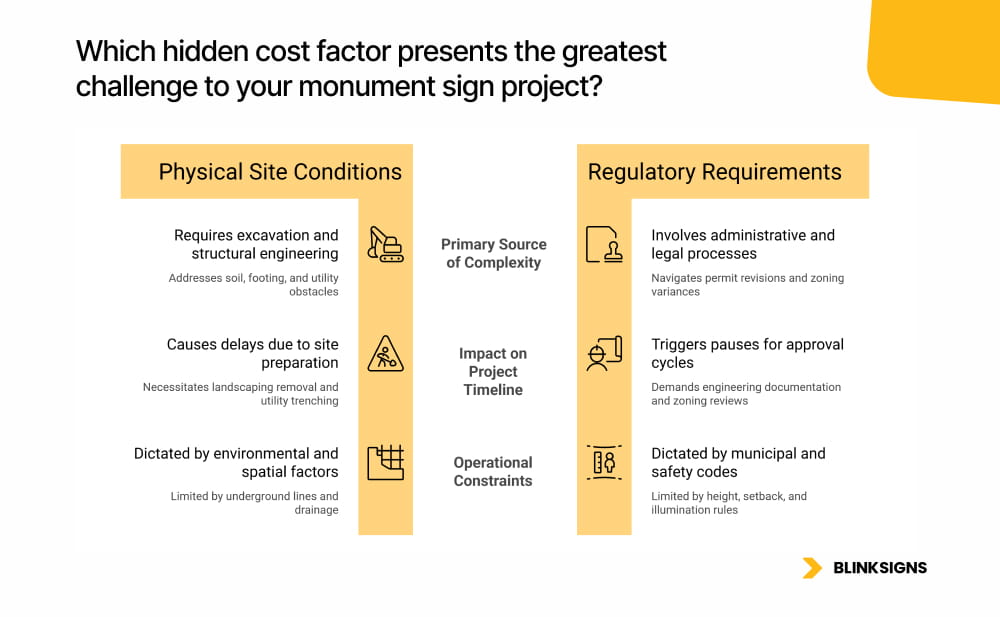
Which hidden cost factor presents the greatest challenge to your monument sign project_
Demolition of an existing sign: If an old monument sign must be removed, the project may require demolition, hauling, disposal, foundation removal, wall or base cleanup, and site restoration.
Soil or footing conditions: Soft soil, poor drainage, slopes, freeze-thaw conditions, or unstable ground can affect foundation planning. Some sites may need deeper or engineered footings.
Underground utilities: Irrigation lines, electrical lines, gas lines, communication lines, or other underground utilities may affect where the sign can be installed and how excavation is handled.
Landscaping removal and restoration: Existing plants, mulch, stone beds, irrigation systems, grass, sidewalks, curbs, or concrete surfaces may need to be removed, protected, or restored after installation.
Electrical trenching: If power is not available near the sign location, conduit and wiring may need to be run from another area of the property. Longer runs can increase project complexity.
Permit revisions or zoning variance applications: If the proposed sign does not meet local rules around height, area, setback, illumination, or placement, revisions may be required before approval.
Engineering documentation: Engineering documents may be required in some municipalities for signs above certain size or height thresholds, or when foundation and structural conditions require additional review.
Tenant panel changes: Multi-tenant monument signs may need to be updated if tenant names, logo sizes, hierarchy, or panel counts change after fabrication begins.
LED display software or service: Digital monument signs may include software, control systems, service agreements, brightness settings, message scheduling, or future module replacement needs.
After-hours or traffic-controlled installation: Sites near roads, driveways, schools, hospitals, retail entrances, or busy parking areas may require special scheduling, traffic control, or restricted access planning.
Long-term service access: A sign that is difficult to reach after installation can cost more to maintain. Service access should be planned before the sign location and structure are finalized.
The best way to prevent hidden costs is to define the project scope before fabrication begins. A site survey, code review, electrical review, and property criteria review can help identify these variables early.
Monument Sign Lifespan and Maintenance Planning
Monument signs are designed for long-term exterior use. Lifespan depends on material selection, installation quality, climate exposure, electrical components, and maintenance frequency.
A monument sign should be treated as a long-term property asset, not a one-time purchase. The structure, faces, lighting, tenant panels, landscaping, and electrical components may each have different service needs over time.
Masonry and stone structures often provide long-term architectural presence, but they may still require inspection, cleaning, mortar attention, surface repair, or landscaping maintenance. Aluminum cabinets and fabricated structures may require refinishing, face replacement, repainting, or hardware service depending on climate exposure and wear.
HDU foam-core, acrylic faces, polycarbonate faces, vinyl graphics, dimensional letters, tenant panels, and sign faces may each carry different service intervals. These should be treated as separate maintenance planning items rather than one single lifecycle event.
LED displays and digital components require their own planning. Display modules, power supplies, software, control systems, ventilation, and brightness settings may need service or replacement over time. Buyers should understand these service needs before approving a digital monument sign.
Refacing an existing monument structure is usually on a smaller scale than full replacement because the structure is already in place. However, the structure must be evaluated first. If the base, frame, cabinet, foundation, or electrical system is not suitable, a deeper renovation or replacement may be more appropriate.
Maintenance planning should account for face condition, electrical components, structure inspection, masonry or cabinet condition, landscaping, tenant panel updates, and service access. This reduces the risk of treating future repairs as unexpected emergencies.
Renovation, Refacing, or Full Replacement: Which Is Right?
Not every monument sign needs to be replaced. In many cases, an existing structure can be updated through refacing, repainting, resurfacing, LED retrofit, tenant panel replacement, or partial renovation.
Refacing usually means replacing the sign face, panel inserts, vinyl graphics, acrylic faces, or tenant panels while keeping the existing structure. This can be a practical option when the monument base, cabinet, frame, foundation, and electrical conditions are still sound.
LED retrofit may involve replacing older lighting components with newer LED technology. This can improve visibility, efficiency, and serviceability, but it may require an electrical or permit review, depending on the scope and jurisdiction.
Repainting or resurfacing can refresh aluminum, PVC, stucco, or fabricated monument signs when the structure is still usable but the appearance is outdated. This is often a shorter-scope update than a full replacement.
Tenant panel updates are common for retail plazas, office parks, medical plazas, and mixed-use properties. A well-designed multi-tenant monument sign should make panel updates easier as tenants change.
Partial renovation may involve replacing the cabinet, sign face, lighting, trim, or tenant panels while retaining the base or foundation. This depends on the condition of the existing structure and whether the updated design meets current requirements.
Full replacement may be needed when the existing monument sign is structurally compromised, poorly located, noncompliant, too small for the current brand, unable to support updated electrical components, or misaligned with the new property identity.
A site survey is the starting point for any decision between renovation and replacement. Structure condition, code requirements, brand standard changes, electrical access, foundation condition, and project economics all factor into the recommendation.
Monument Signs for Corporate Campuses, Healthcare, and Self-Storage
Monument signs are especially valuable for properties where they are part of the visitor arrival experience. Corporate campuses, healthcare facilities, self-storage locations, retail centers, hospitality properties, and multi-location operators often need more than a simple identification sign. They need a sign system that supports visibility, trust, wayfinding, and brand consistency.
For corporate campuses, monument signs often need to match architecture, landscape design, tenant hierarchy, and internal wayfinding systems. The sign may serve as the first branded touchpoint for employees, visitors, vendors, and partners.
For healthcare facilities, monument signs often support entrance identification, department navigation, campus wayfinding, and trust-building. These environments may also require careful coordination with accessibility, directional signage, patient flow, and property standards.
For self-storage facilities, monument signs are often used for high-visibility roadside branding, entrance identification, promotional visibility, and consistency across multiple facility locations. The sign may need to work with pylon signs, building signs, directional signs, and gate-area branding.
For multi-location operators, monument signs require consistent brand standards across different site conditions. One location may need masonry, another may need an aluminum cabinet, and another may need a digital display. The brand system must remain consistent while the site solution adapts to local conditions.
BlinkSigns supports this type of program planning through national signage program management, site review, permitting coordination, fabrication planning, installation coordination, and SignTrax project tracking.
How BlinkSigns Helps Plan Monument Sign Projects
Once these variables are understood, the real question is not which vendor quotes the lowest number. The more useful question is, ‘Which vendor can assess the site, define the foundation requirements, coordinate permitting, and plan a structure that performs for decades?’
BlinkSigns helps businesses plan monument sign projects around the full lifecycle, from first site review through installation and future maintenance.
Site survey and field measurements: BlinkSigns reviews the property, proposed sign location, visibility requirements, ground conditions, access, electrical availability, and installation constraints before finalizing the project scope.
Design and material recommendations: Monument signs should align with the brand, property architecture, visibility requirements, local criteria, and long-term maintenance expectations. BlinkSigns helps translate those requirements into practical design and material recommendations.
Permitting coordination: Local rules may vary by municipality, property type, and authority having jurisdiction. BlinkSigns helps coordinate the permit path so buyers can understand potential review steps before fabrication begins.
Foundation assessment and engineering coordination where required: Some projects may require additional foundation or engineering review based on sign size, structure, site conditions, or local requirements. BlinkSigns helps coordinate planning where applicable.
Fabrication and installation coordination: Monument sign projects may involve multiple steps, including structure fabrication, sign faces, lighting components, site preparation, delivery, equipment, and installation scheduling. BlinkSigns coordinates these steps to ensure the project moves with greater visibility.
SignTrax project tracking: Provides visibility across key stages, including survey, design, permitting, fabrication, installation, and sign-off. This is especially valuable for property portfolios and multi-location brands.
Maintenance and repair planning: Monument signs are long-term assets. BlinkSigns helps buyers plan for refacing, tenant panel changes, LED service, lighting repairs, cabinet repair, masonry repair, and ongoing maintenance needs.
⤷ Download our free Monument Sign Quote Checklist.pdf
How to Get an Accurate Monument Sign Estimate
A more accurate monument sign estimate starts with better site and project information. Before requesting a quote, prepare the details that help the signage partner understand the location, structure, approval path, and installation environment.
Monument Sign Quote Readiness Checklist
- Property photos from the road and entrance angle
- Desired sign location on the property
- Site plan or property plan, if available
- Approximate desired sign width and height
- Preferred material style, or open to recommendation
- Illumination preference, such as non-illuminated, externally lit, internally lit, or LED
- Tenant panel requirements, if multi-tenant
- Existing sign removal needed, yes or no
- City and municipality
- Landlord or property manager requirements
- Electrical access at or near the sign location
- Landscaping or site constraints
- Installation deadline or project timeline
- Number of locations, if multi-site
These details help identify foundation needs, electrical access, permitting requirements, landlord criteria, installation conditions, and potential hidden costs before the estimate is finalized.
Not sure which monument sign type fits your site, budget, or local sign code? BlinkSigns can review your location, zoning requirements, and project scope before preparing a formal estimate.
⤷ Request a Monument Sign Estimate
FAQ: Monument Sign Cost
Why do monument signs cost more than wall signs?
Monument signs often cost more than wall signs because they are freestanding exterior structures. They may require site work, foundation planning, excavation, electrical trenching, masonry or cabinet construction, permitting, installation equipment, and landscaping restoration. Wall signs are usually mounted to an existing building surface, while monument signs are built into the property.
What is the cheapest type of monument sign?
A post-and-panel monument sign is usually the lowest-scope type because it uses simpler materials, a lighter structure, and a simpler installation than masonry, illuminated, multi-tenant, or digital monument signs. Final cost still depends on size, materials, site conditions, permitting, and installation access.
Are brick or stone monument signs more expensive than aluminum?
Brick, stone veneer, and masonry monument signs often carry a higher project estimate than aluminum cabinet signs because they require heavier materials, skilled labor, foundation planning, site work, and architectural finishing. Aluminum cabinet signs may offer more budget control and easier face replacement, while masonry signs often provide a stronger, permanent architectural presence.
How much does an illuminated monument sign cost?
Illuminated monument signs often fall in the $10,000 to $50,000+ planning range, depending on size, material, lighting method, electrical access, permit requirements, and installation conditions. LED or digital monument signs carry a separate planning range because the display, software, electrical infrastructure, and local rules can significantly affect the project scope.
Do monument signs require permits?
Most permanent exterior monument signs require local sign permit review. Some may also require electrical, building permit, structural, zoning, or landlord approval, depending on the project. Requirements vary by municipality and should be confirmed with the local authority having jurisdiction.
Does a monument sign need a foundation?
Many monument signs require a footing, base, or foundation because they are freestanding exterior structures. The foundation requirement depends on sign size, material, height, soil conditions, wind exposure, and local code. Some municipalities may require engineering documentation for larger signs or signs above certain area thresholds.
What affects monument sign installation cost?
The cost of installing a monument sign is affected by foundation requirements, excavation, soil conditions, electrical trenching, utility locations, site access, equipment needs, traffic control, landscaping restoration, permit requirements, and installation timing. A site survey helps identify these variables before preparing a final estimate.
Can an existing monument sign be renovated?
Yes. An existing monument sign may be refaced, repainted, resurfaced, retrofitted with LED lighting, updated with new tenant panels, or partially renovated if the structure is sound and the updated design can comply with local requirements. A site survey is needed to determine whether renovation or full replacement is more appropriate.
How much does a multi-tenant monument sign cost?
Multi-tenant monument signs often fall within a broader planning range because costs depend on tenant panel count, cabinet size, illumination, hierarchy, material choice, future update needs, foundation requirements, and installation conditions. A retail center, office park, or medical plaza may also need a design that supports future tenant changes.
How long does a monument sign last?
Monument signs are designed for long-term exterior use. Lifespan depends on material selection, installation quality, climate exposure, electrical components, and maintenance frequency. Masonry, aluminum, HDU foam, LED components, tenant panels, and sign faces may each have different service intervals.
Can BlinkSigns manage monument signs across multiple locations?
Yes. BlinkSigns can support monument sign planning across multiple locations through site surveys, design standardization, permitting coordination, fabrication planning, installation coordination, SignTrax project tracking, and maintenance planning. This is especially useful for self-storage operators, healthcare groups, corporate campuses, retail portfolios, franchises, and multi-location brands.
Conclusion
Monument sign costs depend on more than just the sign face. Materials, size, foundation requirements, site preparation, illumination, electrical access, permitting, engineering documentation where required, installation conditions, renovation options, and long-term maintenance all shape the final project estimate.
The best way to budget for a monument sign is to define the full scope before approving the quote. A complete estimate should clarify the sign type, material, foundation assumptions, electrical scope, permitting responsibilities, installation requirements, and lifecycle planning.
BlinkSigns helps businesses plan monument sign projects with site-aware recommendations, permitting coordination, fabrication and installation support, SignTrax project visibility, and long-term maintenance planning.
Ready to plan a monument sign for your property, campus, facility, or multi-location brand? Request a monument sign estimate from BlinkSigns and receive a project-specific quote tailored to your site, visibility goals, material preferences, and local requirements.