
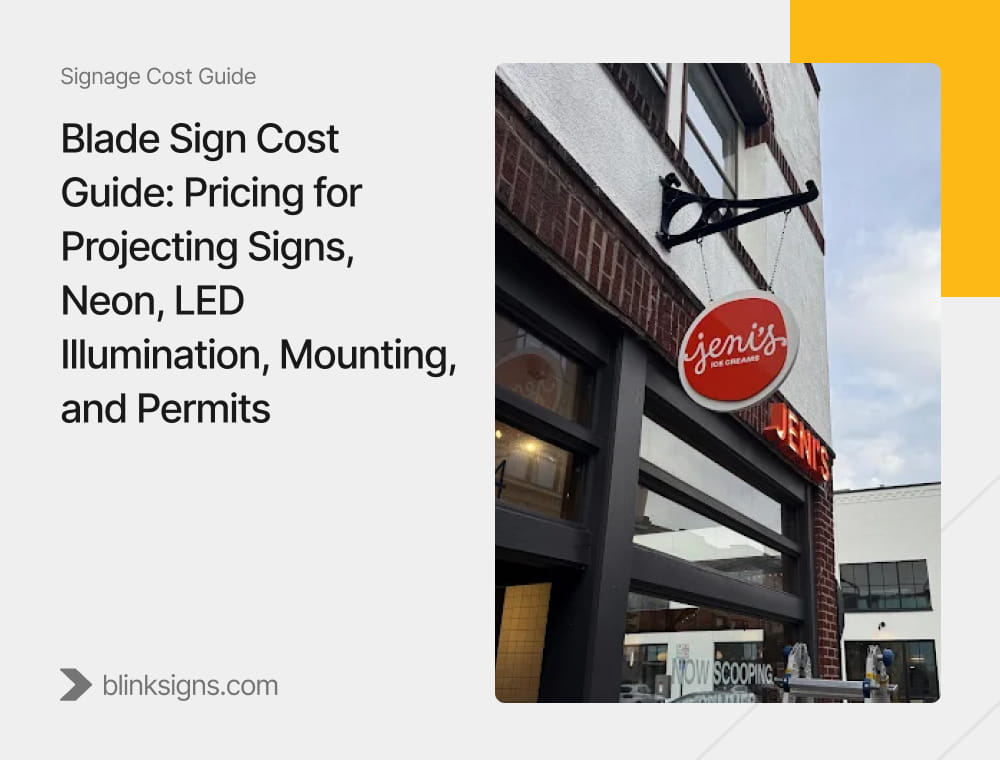
Blade Sign Cost Guide: Pricing for Projecting Signs, Neon, LED Illumination, Mounting, and Permits
Blade signs are among the most effective exterior sign formats for storefronts in pedestrian corridors, downtown streets, entertainment districts, restaurants, hospitality zones, retail centers, and mixed-use commercial areas. Unlike a flat wall sign that faces traffic from the front, a blade sign projects outward from the building facade so people walking or driving along the street can see the business before they reach the entrance.
That visibility advantage also makes blade signs more complex to price than many buyers expect. A blade sign is not only a sign face attached to a decorative bracket. It can involve a fabricated sign body, projection hardware, bracket mounting, facade review, illumination, electrical coordination, permits, sidewalk access, installation equipment, and service planning.
This guide explains what affects blade sign cost, why online product prices often differ from real installed project quotes, how traditional neon compares with LED neon-style lighting, and what buyers should prepare before requesting a project-specific estimate.
How much does a blade sign cost?
Blade sign projects can range from lower-scope non-illuminated bracket signs or face refreshes to higher-scope illuminated projecting cabinets, traditional neon accents, custom architectural blades, double-faced signs, and historic-district exterior signs. Final pricing depends on sign size, projection distance, mounting height, facade material, bracket design, illumination type, electrical access, permit requirements, installation access, and whether the sign is new, retrofitted, repaired, or replaced.
Because a blade sign project involves fabrication, mounting hardware, field coordination, and, in many cases, permit and electrical planning, buyers should evaluate quotes based on the total project scope rather than comparing a single flat rate. Separating factory fabrication pricing from bracket hardware, field installation labor, access equipment, electrical coordination, and municipal permitting provides a clearer path to an accurate estimate.
A lower-scope blade sign project may involve replacing the face of an existing projecting sign if the frame, bracket, and mounting condition remain usable. A higher-scope project may involve a new illuminated double-faced blade cabinet, custom bracket fabrication, historic district review, sidewalk access coordination, electrical planning, and installation at height.
The most useful way to budget is to identify the project type first, then confirm what the quote includes.
What blade sign pricing actually includes
A blade sign, also called a projecting sign, hanging sign, or bracket sign, is a commercial sign mounted perpendicular to a building facade. It is designed to be visible from along-the-street traffic rather than only from the front of the building.
A complete blade sign estimate may include several components.
| Blade sign component | What it means | Why does it affect the cost |
| Sign body | The main visible sign structure, such as a flat panel, illuminated cabinet, shaped form, routed face, or neon display | Affects fabrication method, material selection, weight, lighting, and visual appearance |
| Sign face or faces | The visible surface where the logo, lettering, or message appears | Affects substrate cost, graphics, durability, light transmission, and replacement planning |
| Projection bracket system | The hardware that extends the sign outward from the building | Affects projection distance, sign support, mounting complexity, and installation scope |
| Mounting interface | The connection point between the bracket and the building facade | Affects attachment planning based on facade material, wall condition, sign weight, and mounting height |
| Illumination components | LED modules, LED neon-style components, traditional neon tubes, power supplies, transformers, or external lighting, where specified | Affects fabrication, electrical coordination, service access, and maintenance planning |
| Electrical coordination | Planning around existing power, junction boxes, controls, or new electrical access where required | It can affect the project scope when suitable power is not already available near the sign location |
| Permits and approvals | Municipal permits, landlord criteria, historic review, or sidewalk access permissions, where applicable | Affects project timeline, design constraints, documentation, and approval risk |
| Field installation | Labor, access equipment, mounting, placement, and site coordination | Changes based on height, facade conditions, pedestrian traffic, equipment access, and local rules |
| Service access planning | Doors, removable faces, access panels, and component accessibility | Affects future maintenance, lighting service, and repair complexity |
A quote that covers only the sign body may appear lower than a fully installed project estimate. That does not mean the lower quote is more complete. It may simply exclude bracket hardware, installation, permits, electrical coordination, access equipment, or removal of an existing sign.
Buyers should ask vendors to clearly identify which items are included, excluded, or still to be confirmed after site review.
Blade sign price vs. fully installed project cost
One of the most common sources of confusion in commercial blade sign procurement is the difference between a fabrication-only price and a fully installed project cost.
A fabrication-only price usually covers the manufactured sign body. Depending on the vendor and scope, it may also include standard bracket hardware. It usually does not include field installation labor, lift or bucket truck access, electrical coordination, permit support, permit fees, sidewalk coordination, or old sign removal.
A fully installed project cost is broader. It may include design coordination, sign body fabrication, bracket hardware, mounting hardware, installation labor, access equipment, permit support, and selected site coordination items. It may still exclude pass-through permit fees, new electrical routing, wall remediation, support for historic board submissions, or after-hours installation unless those items are specifically listed.
| Quote type | What it may include | What may be excluded |
| Product-only or fabrication-only quote | Sign body, face, graphics, selected materials, and sometimes standard bracket hardware | Installation, permits, electrical coordination, access equipment, removal, wall repair, sidewalk coordination |
| Installation-only quote | Labor and equipment to install a sign already produced | Fabrication, design, permits, electrical work, removal, and custom bracket hardware |
| Fully installed project quote | Broader project scope including fabrication, installation, bracket hardware, access equipment, and selected coordination items | May still exclude permit fees, new electrical routing, wall remediation, after-hours work, or historic review support |
| Retrofit or repair quote | Updates to an existing blade sign, such as face replacement or lighting retrofit | Depends on existing frame, bracket, mounting condition, electrical access, and code requirements |
The gap between fabrication-only pricing and a real installed project quote can be meaningful when the project involves upper-story mounting, complex facade material, public sidewalk access, missing electrical power, historic review, or old sign removal.
Before comparing quotes, buyers should ask:
| Buyer question | Why it matters |
| Is this quote fabrication-only or fully installed? | Prevents product pricing from being compared with installed project pricing |
| Is bracket hardware included? | Brackets can be a separate cost layer, especially for custom projection signs |
| Is installation included? | Labor and equipment depend on height, access, and site conditions |
| Are permits included? | Permit support and permit fees may be handled differently |
| Is electrical coordination included? | New electrical routing may require separate qualified professionals |
| Is old sign removal included? | Removal, disposal, wall repair, and sealing may be separate |
| Is sidewalk or traffic coordination included? | Urban projects may require additional access planning |
The strongest blade sign quote is not always the one with the largest initial number. It is the quote that clearly defines scope, assumptions, exclusions, and site-specific requirements.
Don't Overpay for Installation,
Ensure your quote transparently accounts for access lifts, bracket hardware, and municipal filings by tracking bids.

▐ Download our free Signage Quote Comparison Worksheet ❯
Blade sign cost by project scope
Blade sign cost is best understood in the context of the project scope. A face refresh is not the same as a new illuminated blade cabinet. A traditional neon blade sign is not the same as an LED neon-style blade sign. A historic district blade sign can involve different review requirements than a standard commercial storefront sign.
| Project scope | Best-fit scenario | Main cost drivers | Buyer note |
| Face refresh | The existing projecting sign frame and bracket are usable, but the branding needs updating | Face size, graphics, substrate material, access height | Existing bracket and facade mounting conditions should be reviewed before committing to a reface |
| Non-illuminated bracket sign | Boutique retail, pedestrian streets, smaller storefronts, or properties with sufficient ambient lighting | Bracket style, face material, sign weight, mounting height | Lower-complexity option when nighttime illumination is not required or available |
| Illuminated blade cabinet | Restaurants, retail corridors, entertainment districts, hospitality venues | Cabinet depth, sign faces, LED modules, electrical access, bracket mounting | Electrical access and serviceability should be confirmed before finalizing fabrication dimensions |
| Traditional neon blade sign | Hospitality, entertainment venues, theatre districts, vintage or heritage branding | Glass tube fabrication, transformer access planning, tube protection, permits | Best treated as a specialty illuminated sign project requiring service planning |
| LED neon-style blade sign | Retail storefronts, franchise brands, and hospitality venues where neon aesthetics are desired | LED product type, face integration, power supply selection, service access | Useful when a neon-like visual appearance is desired using LED components |
| Historic district blade sign | Landmark districts, downtown corridors, entertainment preservation zones, and older commercial buildings | Design review requirements, material restrictions, color limits, projection limits, and approval timelines | Review outcomes and timelines are not guaranteed; confirm requirements before fabrication |
| Replacement blade sign | Damaged, outdated, noncompliant, or brand-misaligned projecting sign | Legacy removal, disposal, wall remediation, new fabrication, permits | Existing mounting conditions and facade integrity should be reviewed before the new installation begins |
| Multi-location rollout | Franchise chains, regional retail networks, hospitality brand programs | Brand standards, local code variation, landlord criteria, site-by-site conditions, scheduling | Multi-location planning may support fabrication consistency, while local permit and installation requirements still vary by site |
A scope-first comparison helps buyers understand why two blade sign quotes can differ even when the visible sign appears similar. The existing condition, mounting height, projection distance, illumination method, bracket design, and permit environment can change the estimate before fabrication even begins.
Blade sign cost by type
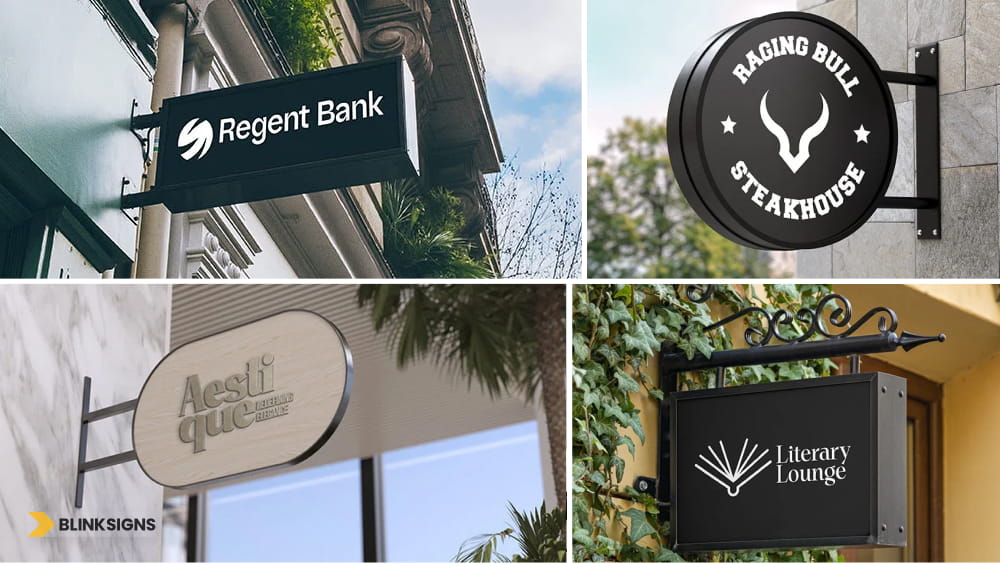
blade cabinet, Double-faced blade cabinet, Push-through letters, and architectural blade sign
Blade signs can be built in several formats. The type affects fabrication, visibility, illumination, mounting, service access, and long-term ownership.
| Blade sign type | Cost context | Planning note |
| Non-illuminated flat panel sign | Lower-complexity option with no internal electrical assembly | Best for storefronts with sufficient ambient lighting or daytime-only visibility needs |
| Projecting blade cabinet | Common illuminated storefront format using an enclosed sign body | Often planned with internal LED lighting, sealed faces, drainage, and service access |
| Double-faced blade cabinet | Back-to-back faces capture visibility from two directions of street traffic | May require internal reinforcement and a more robust bracket system, depending on sign size, projection distance, mounting height, and site review |
| Traditional neon blade sign | Specialty illuminated option using gas-discharge glass tube technology | Typically involves specialty fabrication, transformer planning, and service technician access; tube protection housing is often specified |
| LED neon-style blade sign | An LED component system designed to simulate the visual appearance of traditional neon | Provides neon-like aesthetics using LED components; final visual result should be reviewed against project standards |
| Push-through acrylic blade sign | Opaque face with CNC-routed dimensional characters filled with acrylic elements | Light may be directed through dimensional faces, edges, or both, depending on the specification |
| Custom architectural blade sign | Bespoke shape, profile, or material configuration for a branded environment | Requires design coordination and may require project-specific review depending on size, weight, and mounting |
| Hanging blade sign | Sign suspended from a decorative or structural overhead bracket rather than mounted on a wall-attached arm | Bracket attachment method, overhead structure, clearance, and site conditions are key planning variables |
The right blade sign type depends on the property, brand standards, viewing angle, pedestrian flow, illumination needs, local code, landlord criteria, facade material, and maintenance expectations.
For example, a boutique retail shop on a narrow downtown street may choose a non-illuminated bracket sign if ambient lighting is sufficient. A restaurant or hospitality brand may choose an illuminated double-faced blade cabinet for nighttime visibility. A theatre, bar, or heritage storefront may consider traditional neon or LED neon-style lighting depending on design intent, service needs, and local review requirements.
What changes the blade sign estimate?
A blade sign estimate can shift when design decisions and field conditions are confirmed. Projection distance, mounting height, facade material, sign weight, illumination type, electrical access, permits, historic review, and existing sign removal all affect the scope.
| Cost driver | Why does it change pricing | Project cost-effectiveness |
| Sign size and dimensions | Larger sign bodies require more material, larger faces, stronger brackets, and additional handling | Material consumption, shipping weight, and bracket hardware scale with dimensions |
| Projection distance | As the projection distance increases, the load transferred through the bracket and mounting points can increase and may require additional review | Bracket complexity and mounting hardware scope can increase with the projection span |
| Mounting height | Elevated facade or upper-story placement changes access requirements | May increase field labor, access equipment, and safety coordination requirements |
| Facade material | Wall substrates vary from concrete and brick to EIFS, metal panels, glass systems, and deteriorated masonry | Complex or fragile substrates may require custom attachment planning and project-specific review |
| Sign weight | Heavier signs place a greater load on the bracket, mounting points, and facade | May require upgraded brackets, additional anchoring review, or structural assessment |
| Illumination type | Neon, LED, external lighting, and combined systems carry different component profiles | Component count, wiring complexity, weatherproofing, and service planning vary by system |
| Electrical access | Illuminated signs need suitable power access and coordination | Missing or distant power may require separate electrical coordination by qualified professionals |
| Historic district or design review | Preservation boards may regulate materials, projection, color, lighting, or bracket style | Review cycles can affect design, timeline, and documentation requirements |
| Permit complexity | Local rules may affect sign size, height, projection, illumination, and placement | Additional documentation or review may affect the schedule and project scope |
| Existing sign removal | Legacy signs may require removal, disposal, sealing, or wall remediation | Old anchor holes, damaged facade areas, and disposal can add to the field scope |
The most important buyer takeaway is that blade sign cost is not only a function of square footage. A small sign with a difficult wall condition, missing electrical access, or historic district review can involve more coordination than a larger sign in a simpler site condition.
▐ Download our Projected Sign Cost Driver Matrix pdf ❯


to instantly pinpoint which facade conditions, projection lengths, and code reviews will swing your installation estimate from simple to complex.
Is a blade sign the same as a projecting sign?
In most commercial sign conversations, a blade sign and a projecting sign refer to the same general format: a sign mounted perpendicular to a building facade so it is visible from the street. Some buyers may also call it a hanging sign, bracket sign, flag sign, or projecting storefront sign.
The wording may change by region, vendor, or property manager, but the core cost variables are usually similar:
| Common term | What it usually means |
| Blade sign | A sign projecting outward from the building facade |
| Projecting sign | A general term for a sign mounted perpendicular to a wall |
| Hanging sign | Often, a sign is suspended from a decorative or structural bracket |
| Bracket sign | A sign supported by a visible bracket assembly |
| Flag sign | Sometimes used to describe a perpendicular sign visible from two directions |
| Projecting storefront sign | A storefront sign designed for along-the-street visibility |
Regardless of the term used, buyers should evaluate the sign body, bracket system, projection distance, mounting height, facade condition, illumination, electrical access, permits, installation access, and maintenance planning.
Blade signs vs. channel letters vs. cabinet signs
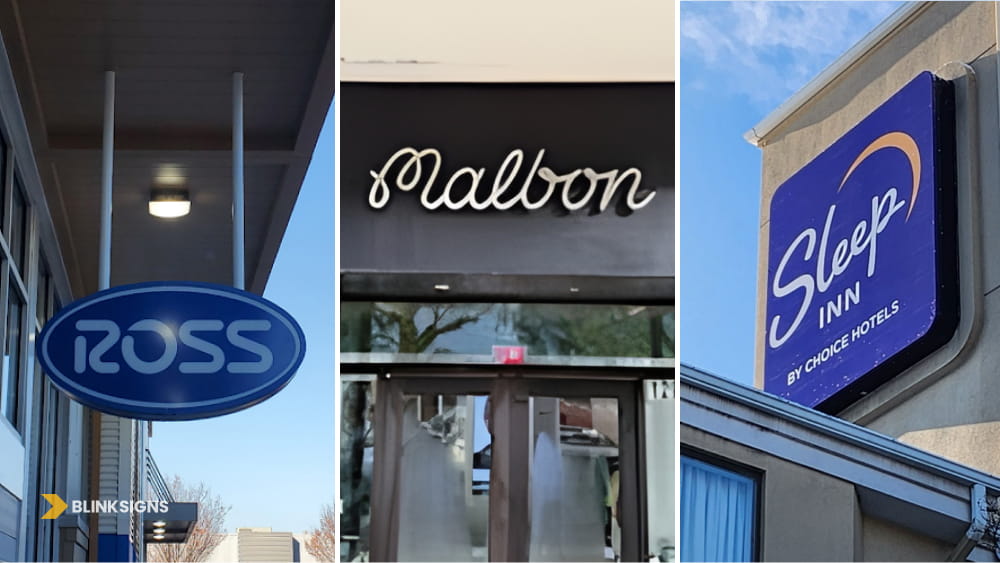
Blade sign for Ross, channel letters for Malbon and cabinet sign for sleep inn by BlinkSigns
Commercial buyers often compare blade signs, channel letters, and cabinet signs when planning exterior storefront visibility. These formats are related, but they solve different visibility problems.
Blade signs vs. channel letters
Channel letters are individually fabricated three-dimensional characters mounted directly to a building facade. They are usually designed for face-on visibility from the street, parking lot, or primary approach area.
A blade sign projects outward from the facade. It is designed to be visible to pedestrians and drivers moving along the street parallel to the building line. This makes blade signs especially useful in downtown retail streets, restaurant districts, entertainment corridors, and walkable commercial areas.
| Format | Visibility role | Planning considerations |
| Channel letters | Face-on building identification | Individual letters, wall layout, illumination, mounting, and electrical access |
| Blade sign | Along-the-street identification | Projection distance, bracket hardware, facade condition, sidewalk access, clearance |
| Both together | Combined storefront visibility | Useful when a business needs both front-facing and side-approach visibility |
A blade sign may reduce installation complexity for some storefronts, where a single projecting sign body better serves the location than individual wall-mounted characters. Final comparison depends on the brand design, facade, visibility goal, sign size, lighting, and local requirements.
For detailed wall-letter planning, see the Channel Letter Sign Cost Guide.
Blade signs vs. cabinet signs
A wall-mounted cabinet sign is usually installed parallel to the building facade. It may be illuminated or non-illuminated and often serves as the main storefront sign. A blade sign projects outward and serves a different viewing angle.
Many storefronts use both formats. A cabinet sign helps customers identify the business from the front. A blade sign helps customers notice the business as they walk down the street.
| Format | Best-fit visibility angle | Common use |
| Wall-mounted cabinet sign | Face-on approach | Retail storefronts, restaurants, service businesses, and sand hopping centers |
| Blade sign | Along-the-street approach | Downtown retail, hospitality, entertainment, pedestrian corridors |
| Pylon or monument sign | Roadside or property entry visibility | Shopping centers, plazas, hotels, gas stations, office parks |
For detailed enclosed sign planning, see the Cabinet Sign Cost Guide.
Traditional neon vs. LED neon-style blade signs
Neon is a major cost and design variable in blade sign planning, but it should be treated as an illumination option rather than the entire project category. A blade sign may be non-illuminated, internally illuminated with LEDs, externally lit, built with traditional glass neon, or designed with LED neon-style components.
Traditional neon and LED neon-style systems can both produce a neon-like visual effect, but they differ in fabrication, electrical planning, maintenance, service access, and suitability for historic districts.

Cost Analysis of led vs neon signs
| Factor | Traditional glass neon | LED neon-style lighting |
| Visual character | Classic gas-discharge glow with soft, organic light emission | Neon-like appearance using LED components; the visual result is similar but not identical to traditional gas neon |
| Fabrication method | Specialty glass tube bending, gas filling, and electrode sealing by trained artisans | Component-based LED assembly using flexible or rigid LED housing profiles |
| Electrical planning | Involves transformer selection, lead wire routing, and specialized electrical planning | Often planned around more common sign electrical components than traditional glass neon, though final requirements depend on product, design, and local code |
| Maintenance approach | Glass tubes and transformers may require specialty service, technicians | Power supplies and LED components may be serviced through standard sign service processes, depending on product and site conditions |
| Historic district suitability | May be preferred in some preservation contexts because of material authenticity and visual character | May require design review depending on district guidelines, color, brightness, material, and illumination rules |
| Environmental performance | Startup behavior and brightness can vary under some environmental conditions | LED systems may offer more consistent startup performance in many conditions, depending on product specifications and installation environment |
| Best-fit applications | Hospitality venues, entertainment districts, theatre corridors, nightlife branding, heritage storefronts | Retail storefronts, franchise programs, hospitality brands, modern commercial environments |
| Buyer planning note | Strong visual character, but specialty service planning and access requirements should be confirmed before specifying | Useful when neon aesthetics are desired, but the final visual result should be reviewed against project standards before finalizing |
The key distinction is that traditional neon is a glass-based gas-discharge technology that requires specialized fabrication and service planning. LED neon-style lighting uses LED components to approximate the appearance of neon. Neither option is automatically better. The correct choice depends on design intent, property context, historic district requirements, available service infrastructure, budget scope, and long-term service planning.
Projection distance, mounting height, and facade conditions
The structural environment of a blade sign installation is shaped by three connected site variables: how far the sign projects from the wall, how high above the ground it is mounted, and what the wall surface is made of. These details affect bracket planning, installation access, permit requirements, electrical access, and whether additional review may be needed before fabrication.
A blade sign may look simple from the sidewalk, but its installed scope can change significantly once projection distance, mounting height, facade condition, and local rules are confirmed.
Projection distance
Projection distance is the distance between the building facade and the outer edge of the blade sign. This matters because the sign is not mounted flat to the wall. It extends outward from the building, which means the bracket and mounting points carry the sign body away from the facade.
As the projection distance increases, the load transferred through the bracket and mounting points may increase, requiring additional review. A short projection sign on a small storefront creates a different planning profile than a larger blade cabinet extending farther from the facade.
Projection distance can affect:
| Projection factor | Why it matters |
| Bracket size | Longer projections may require a stronger or more customized bracket system |
| Sign weight | Heavier signs may increase the load at the mounting points |
| Wind exposure | Projecting signs can be exposed to lateral forces from the wind |
| Local code | Many jurisdictions regulate how far a sign may project from a building |
| Sidewalk clearance | The sign may need to meet clearance requirements above pedestrian areas |
| Installation access | Longer or heavier assemblies may affect equipment selection |
Buyers should confirm projection limits before finalizing sign dimensions, especially in downtown streets, historic districts, narrow sidewalks, shared retail corridors, and properties close to public rights-of-way.
Mounting height
Mounting height affects both visibility and the scope of installation. A blade sign installed near the first-floor storefront may be easier to access than one installed above an awning, canopy, second-floor wall, or multi-story facade.
Mounting height can affect:
| Height factor | Cost planning impact |
| Access equipment | Higher signs may require lifts, bucket trucks, or other equipment |
| Labor planning | Elevated installation can require additional site coordination |
| Safety perimeter | Installation over sidewalks, entrances, or drive lanes may require controlled access |
| Permit requirements | Some codes regulate minimum clearance above sidewalk grade |
| Service planning | Higher signs can be more expensive to inspect, clean, or repair later |
Many jurisdictions set clearance rules for projecting signs over sidewalks or public pedestrian areas. These requirements vary by municipality and should be confirmed during the permit review process.
Facade material and condition
The facade where the blade sign attaches is one of the most important cost factors. A bracket mounted to solid masonry is not planned the same way as a bracket mounted to EIFS, glass, metal panels, wood framing, or an older wall with unknown conditions.
Common facade conditions include:
| Facade type | Planning considerations |
| Poured concrete or CMU block | Often more straightforward than fragile or layered wall systems, but the attachment method still depends on the wall assembly |
| Brick masonry | Common in downtown corridors, but deteriorated mortar, hollow brick, or old repairs may require additional review |
| EIFS or Dryvit | Attachment planning usually needs to account for the structural layer behind the finish system, not the foam layer itself |
| Metal panel systems | May require coordination around cladding, warranties, hidden framing, and attachment points |
| Glass storefront or curtain wall | May require building-owner review and special planning because attachment options can be limited |
| Wood-framed storefront | Framing condition, moisture damage, and sheathing strength may affect the scope |
| Older or previously modified facade | Old anchor holes, patched areas, or water damage may affect installation planning |
Facade condition matters as much as facade type. A well-maintained brick wall may be easier to plan around than a damaged masonry wall. An older storefront may look usable from the outside while hiding rot, moisture intrusion, or weak backing behind the finish material.
For this reason, site photos and a site review are important before finalizing blade sign fabrication.
Permits, landlord rules, historic districts, and sidewalk access
Blade signs are often more regulated than flat wall signs because they project outward from the building. They may extend over sidewalks, pedestrian areas, private walkways, drive lanes, or city-controlled right-of-way. For that reason, permitting and approval requirements should be reviewed early.
A blade sign project may need to account for municipal sign permits, landlord criteria, historic district review, sidewalk access rules, illumination restrictions, clearance requirements, and installation scheduling limits.
Municipal sign permits
Many jurisdictions require a sign permit before a projecting blade sign can be installed or illuminated, and permit review may affect final fabrication details. Permit applications may require drawings that show sign size, projection distance, mounting height, clearance above grade, illumination method, and placement on the building.
Permit requirements may affect:
| Permit factor | What can influence it |
| Sign size | Allowed face area or total sign area |
| Projection distance | How far can the sign extend from the facade |
| Mounting height | Minimum clearance above sidewalks or pedestrian areas |
| Illumination | Lighting type, brightness, operating hours, or electrical documentation |
| Placement | Where the sign can be installed on the building |
| Structural documentation | Whether additional review is needed based on sign size, weight, or projection |
| Timeline | Review cycles, revisions, and approval timing |
Permit timelines vary by jurisdiction. Buyers planning around a storefront opening, rebrand, tenant move-in, or seasonal launch should begin documentation early where possible. Approval timelines and outcomes are not guaranteed.
Landlord and master sign criteria
For leased properties, the landlord or property manager may require that the sign criteria be met before municipal approval. A Master Sign Criteria document can regulate the sign type, projection distance, bracket style, face material, color, lighting, installation location, and approved dimensions.
Landlord approval does not replace municipal permit review. Both may be required. A sign can meet local code requirements but still fail property requirements if it does not meet the landlord’s criteria.
Buyers should request that the landlord sign the criteria early to reduce redesign risk.
Historic district and design review
Blade signs are common in older commercial corridors, theatre districts, restaurant streets, downtown blocks, and hospitality zones. Some of these areas fall within historic districts, landmark zones, architectural review corridors, or special design districts.
Historic review boards may address:
| Review area | Possible impact |
| Sign shape | Certain profiles may be preferred or restricted |
| Size and projection | Projection distance and face size may be limited |
| Face material | Painted metal, wood, glass, or other materials may be reviewed |
| Illumination | Traditional neon, LED neon-style lighting, brightness, color, or operating hours may be reviewed |
| Color palette | Period-appropriate or district-specific colors may be encouraged or required |
| Bracket design | Decorative brackets, finishes, and visible hardware may be reviewed |
| Placement | Location on the facade may be restricted |
Some districts may restrict illumination methods or require review of LED neon-style systems, traditional neon, color, brightness, and materials. Historic review timelines are not guaranteed, and approval outcomes vary by board and jurisdiction.
Buyers should confirm historic district status before approving design or fabrication.
Sidewalk and traffic access
Blade sign installation may require work over or near public sidewalks, restaurant patios, drive-thru lanes, curb lanes, parking areas, or storefront entrances. In some locations, this may require sidewalk closure permits, pedestrian protection plans, traffic control coordination, or after-hours scheduling.
Site access planning matters most in:
| Site condition | Why it matters |
| Busy sidewalks | May require pedestrian protection or off-peak work |
| Downtown streets | May require curb-lane access or city coordination |
| Drive-thru lanes | May require temporary lane control or after-hours scheduling |
| Narrow alleys | May limit lift or truck access |
| Covered walkways | May limit equipment movement |
| Shared retail entrances | May require tenant coordination |
These requirements should be discussed before quote approval, not discovered after fabrication.
Electrical access and illumination requirements
For illuminated blade signs, electrical access is a major planning variable. It affects the quote scope, installation coordination, permit documentation, and future service.
Many blade sign installation estimates assume suitable electrical access is already available near the mounting location. If new electrical routing is needed from the building’s electrical system to the sign location, that scope may require separate coordination by qualified electrical professionals. It should be priced independently from sign fabrication and installation.
Common illumination types
| Illumination type | Planning considerations |
| Internal LED cabinet lighting | Requires LED modules, power supplies, service access, and weather-resistant enclosure planning |
| Traditional glass neon | Requires specialty fabrication, transformer planning, tube protection, and service access |
| LED neon-style lighting | Uses LED components to create a neon-like appearance, with final requirements depending on product and design |
| External lighting | May use gooseneck lights, spotlights, or other exterior fixtures mounted separately |
| Non-illuminated sign | Avoids internal lighting components, but visibility depends on ambient lighting and operating hours |
LED blade cabinets
LED blade cabinets are commonly used for illuminated storefront signs. They may include LED modules, power supplies, translucent faces, sealed retainers, and service access points.
The design should account for how power supplies and internal components can be accessed later. Signs with removable faces or service doors may be easier to maintain than signs that require more complex disassembly.
Traditional neon blade signs
Traditional neon blade signs use gas-discharge glass tubes. They can create a distinctive visual character, especially for hospitality, theatre, entertainment, and heritage-inspired storefronts.
Traditional neon projects should be planned around glass tube protection, transformer placement, service access, weather exposure, and the availability of qualified neon service technicians in the market. In historic districts, traditional neon may also be subject to design review.
LED neon-style blade signs
LED neon-style blade signs use LED components to approximate the look of neon. They may be considered when a neon-like appearance is desired, but buyers should review the final visual result against brand standards before specifying.
LED neon-style systems are often planned around more common sign electrical components than traditional glass neon, though final electrical requirements depend on product, design, and local code.
External lighting
Some blade signs are externally lit with gooseneck fixtures, spotlights, or other luminaires. This approach may be used for painted metal signs, wood signs, dimensional panels, or traditional storefront aesthetics.
External lighting requires its own fixture placement, mounting, wiring coordination, glare review, and service access planning.
Hidden costs and quote exclusions
A blade sign estimate may exclude several field-layer items that affect the final installed cost. Buyers should ask about these items before comparing quotes.
| Possible exclusion | Why it matters |
| Bracket hardware | Some quotes include only the sign body, while brackets may be separate |
| Custom mounting plates | Larger or heavier signs may need custom hardware |
| Electrical work | New power routing may require separate qualified professionals |
| Permit fees | Government filing fees may be pass-through costs |
| Historic review support | Design board submission materials may be separate |
| Sidewalk closure | Public pedestrian areas may require permits or protection |
| Traffic control | Drive lanes or curb lanes may require coordination |
| Access equipment | Lifts, bucket trucks, cranes, or platforms may depend on height and site layout |
| After-hours work | Some sites require night or off-peak installation |
| Existing sign removal | Removal, disposal, patching, and sealing may be separate |
| Facade remediation | Old anchor holes, water damage, or deteriorated wall areas may require repair |
| Maintenance access planning | Service doors, removable faces, or future access may need to be specified |
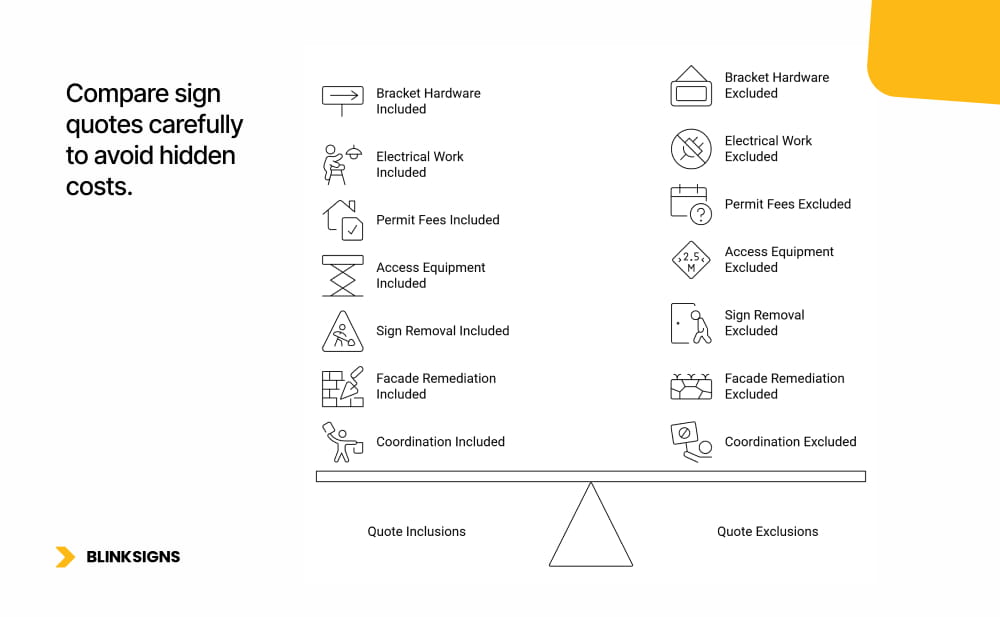
Compare quotes carefully to avoid hidden costs.
Bracket hardware
The bracket is not always included in a product-only blade sign quote. For small decorative signs, the bracket may be simple. For larger illuminated projecting signs, the bracket system can become a meaningful part of the project scope.
Buyers should ask whether the quote includes bracket hardware, mounting plates, anchors, decorative finishes, and any custom bracket fabrication.
Existing sign removal
If an old blade sign already exists, its removal should be clearly scoped. Old signs may leave holes, stained areas, damaged brick, exposed wiring, sealant failure, or moisture intrusion. Removal may also require disposal and surface repair.
A face refresh may be possible if the existing frame and bracket are usable. If the bracket, frame, or facade condition is poor, a larger replacement scope may be required.
Access equipment
Blade signs are often installed above sidewalks, storefronts, canopies, or drive lanes. Depending on the height and site access, the project may require a scissor lift, a bucket truck, a crane, or a specialized access plan.
Access equipment should be clearly listed as included, excluded, or to be determined.
Sidewalk, traffic, and after-hours coordination
Urban blade signs often require installation over or near pedestrian areas. If a city or property manager requires sidewalk closure, flaggers, pedestrian protection, or after-hours work, those items can affect the final estimate.
These are not fabrication costs. They are site-specific field coordination costs.
New blade sign vs. retrofit, repair, or replacement
Not every blade sign project starts from a blank wall. Some buyers need a new sign. Others need a face refresh, LED retrofit, repair, removal, or full replacement.
The correct project type depends on existing sign condition, bracket condition, mounting safety, brand requirements, permit status, electrical access, and local code.
| Project type | When it fits | Planning considerations |
| New installation | No existing blade sign exists at the location | Requires sign design, bracket planning, mounting review, permits, electrical access if illuminated, and installation |
| Face refresh | The existing frame and bracket are usable, but the branding needs updating | Existing face, retainer, bracket, gasket, and mounting condition should be reviewed |
| LED retrofit | Existing illuminated sign remains usable, but the lighting is outdated or failing | Existing wiring, service access, cabinet condition, and local requirements should be reviewed |
| Repair | The existing sign has limited damage or lighting issues | Repair scope depends on component availability, access, and condition |
| Full replacement | Existing sign is damaged, noncompliant, outdated, or unsuitable for new branding | Requires removal, disposal, facade review, new fabrication, permits, and installation |
| Multi-location update | Multiple locations need consistent blade sign updates | Brand standards must be balanced with local code, landlord criteria, and site conditions |
Face refresh
A face refresh may involve replacing the visible panel, graphics, acrylic, metal face, or other display surface while keeping the existing frame and bracket. This can be a lower-scope option if the existing structure remains usable.
Before approving a face refresh, buyers should confirm that the bracket is secure, the frame is in good condition, the retainers are usable, the face can be removed safely, and the sign remains compliant with current local requirements.
LED retrofit
An LED retrofit may be considered when an existing illuminated blade sign is structurally usable, but the lighting system is outdated, inefficient, or difficult to service. The scope may include removing older lighting components and installing LED modules and power supplies.
An LED retrofit should be reviewed against cabinet condition, electrical access, service access, local requirements, and whether the existing sign footprint remains acceptable.
Full replacement
Full replacement may be required when the sign body, bracket, mounting points, or facade condition no longer supports the intended update. This is common when a sign is damaged, heavily corroded, noncompliant, difficult to service, or too small for a new brand standard.
Replacement scope may include removal, disposal, surface repair, new sign fabrication, new bracket planning, permits, electrical coordination, and installation.
Blade sign maintenance and service planning
Blade sign ownership continues after installation. Buyers should consider service access, lighting maintenance, bracket inspection, face cleaning, weather exposure, and future repair needs before approving the design.
Maintenance needs vary by sign type. A non-illuminated flat panel has different service requirements than an illuminated blade cabinet, traditional neon sign, or LED neon-style sign.
| Maintenance area | Why it matters |
| Bracket inspection | Projecting signs rely on brackets and mounting hardware over time |
| Face cleaning | Dirt, road film, and weather exposure can affect appearance |
| Lighting service | LEDs, power supplies, neon tubes, transformers, or fixtures may require service |
| Weather seals | Gaskets, retainers, and access doors help protect internal components |
| Service access | Removable faces or service doors can make maintenance easier |
| Facade review | Old anchors, sealant, or wall condition may need periodic inspection |
| Impact or storm review | Weather events, vandalism, or impact may require inspection |
| Multi-location maintenance | Franchise and regional brands need consistent service planning |
LED power supply service
LED modules may operate for extended periods, but power supplies can be exposed to heat, moisture, electrical fluctuations, and service conditions. Power supply access should be considered during design.
Signs with accessible service doors or removable faces can be easier to service than signs with limited access.
Traditional neon service
Traditional neon requires specialty service planning. Glass tubes can break from impact, weather, or handling. Transformers may require service. Buyers specifying traditional neon should consider the availability of qualified neon service providers in the market.
Bracket and hardware inspection
Because blade signs project away from the facade, the bracket condition should be reviewed periodically. Visible fasteners, bracket arms, mounting plates, corrosion, and wall condition should be included in routine facility inspection.
Face cleaning and appearance
Blade signs are exposed to weather, road dust, pollution, and sunlight. Cleaning schedules depend on location, traffic, material, face type, and illumination. Regular cleaning can help preserve visibility and brand appearance over time.
Blade sign ROI and pedestrian visibility
A blade sign should be evaluated by its role in the customer journey. It is not simply an exterior decoration. It is often used to help pedestrians, drivers, and visitors notice a business as they move along the street.
A wall-mounted sign is usually read from the front. A blade sign is read from the side approach. That means it can support visibility in pedestrian corridors, downtown streets, entertainment districts, hospitality zones, and storefront rows where customers walk parallel to the building.
| Visibility factor | What buyers should evaluate |
| Pedestrian direction | Are customers approaching along the sidewalk rather than directly from the street? |
| Viewing distance | Can the sign be noticed before the customer reaches the entrance? |
| Sign contrast | Does the sign stand out from the surrounding storefronts and visual clutter? |
| Mounting height | Is the sign high enough for visibility while still meeting clearance requirements? |
| Illumination | Does the sign support visibility during operating hours? |
| Brand recognition | Is the logo, name, or message easy to read from the intended angle? |
| Competing signs | Does the street contain heavy visual clutter from other businesses? |
| Maintenance condition | Will lighting, cleaning, and face condition support long-term readability? |
At pedestrian speeds, earlier detection can give customers more time to notice, recognize, and decide whether to enter. The useful viewing distance depends on sign size, face contrast, mounting height, lighting level, sidewalk conditions, and surrounding visual clutter.
For buyers evaluating broader sign performance, the Signage ROI Model can help structure visibility assumptions, impression estimates, and comparison logic. For broader budget planning across exterior sign types, the Commercial Signage Cost Guide can provide additional context.
How BlinkSigns plans blade sign projects
BlinkSigns supports blade sign projects through project planning, design coordination, fabrication, permitting support where relevant, installation coordination, maintenance planning, multi-location rollout support, and SignTrax project visibility.
Final engineering, electrical, permitting, and installation requirements depend on confirmed site conditions, local code, landlord criteria, historic district requirements, and project scope.
BlinkSigns helps commercial buyers think through:
| Project area | Buyer benefit |
| Project planning | Clarifies whether the scope is a new sign, face refresh, LED retrofit, repair, replacement, or rollout |
| Design coordination | Aligns brand standards, sign type, projection, lighting, and visibility goals |
| Fabrication | Supports the sign body, face, bracket, and lighting production based on confirmed specifications |
| Permitting support where relevant | Helps organize documentation for local review, subject to jurisdictional requirements |
| Installation coordination | Helps align mounting, access, equipment, and site conditions |
| Electrical coordination where relevant | Helps clarify whether suitable power exists or separate electrical work is needed |
| Maintenance planning | Helps buyers consider service doors, removable faces, cleaning, and lighting access |
| Multi-location support | Helps balance brand consistency with local code, landlord criteria, and site conditions |
| SignTrax visibility | Supports project visibility across planning, production, and installation coordination stages |
BlinkSigns can help coordinate installation planning, access requirements, electrical coordination (where relevant), and sidewalk or site-access considerations through its national project support model. Approval timelines, permit outcomes, historic district review outcomes, and site-specific requirements depend on the reviewing authority and confirmed project conditions.
How to prepare for a blade sign estimate
A more accurate blade sign estimate starts with better project information. Buyers do not need every technical answer before starting the quote process, but helpful details can reduce uncertainty and clarify scope.
Before requesting a blade sign estimate, gather the following information.
| Information to prepare | Why it helps |
| Property address | Helps identify location, jurisdiction, and site context |
| Property type | Retail, restaurant, hospitality, entertainment, office, or service properties may require different planning |
| Owned or leased status | Determines whether landlord approval may be needed |
| Project type | Clarifies whether the project is new, a face refresh, repair, retrofit, replacement, or rollout |
| Desired sign type | Non-illuminated, illuminated LED, traditional neon, LED neon-style, double-faced, or custom |
| Estimated size | Helps frame the sign body, bracket, face, and installation scope |
| Projection distance | Helps determine bracket planning and code review needs |
| Mounting height | Helps estimate access equipment and clearance requirements |
| Facade material | Helps identify attachment planning concerns |
| Existing sign photos | Helps assess reuse, removal, retrofit, or replacement options |
| Electrical access | Helps clarify whether power exists near the mounting location |
| Landlord criteria | Helps align design with property rules |
| Historic district status | Helps identify review requirements before fabrication |
| Site access constraints | Helps plan around sidewalks, drive lanes, canopies, utilities, or restricted access |
| Timeline | Helps coordinate openings, rebrands, tenant moves, or rollout schedules |
| Number of locations | Important for franchise or regional rollout planning |
A buyer who provides site photos, storefront dimensions, existing sign information, landlord criteria, and known electrical details will usually receive a more useful scope discussion than a buyer who provides only a logo.
Get an Accurate Quote on the First Try: Gather your precise facade data, clearance heights, and power layout options effortlessly using our downloadable Signage Quote Prep Checklist.

▐ Download our free Signage Quote Prep Checklist ❯
***Pricing, permitting, structural, and electrical notes***

This guide is provided for baseline budgeting and buyer education. Final blade sign pricing depends on confirmed project scope, sign size, projection distance, mounting height, facade material, bracket design, illumination type, electrical access, permit requirements, installation access, site conditions, and approved specifications.

Permit approvals, zoning variance outcomes, historic district review outcomes, utility capacity, installation requirements, and project timelines are not guaranteed. Requirements vary by jurisdiction, property type, landlord criteria, building condition, local code, historic district rules, and project design.

All electrical components and field hookup work should be performed by qualified or licensed electrical professionals where required, in compliance with the National Electrical Code and applicable local codes. Structural review requirements for blade sign bracket systems depend on confirmed site conditions, projection distance, sign weight, mounting height, and local code requirements and are determined on a project-specific basis.
FAQ
What is a blade sign?
A blade sign is a commercial sign mounted perpendicular to a building facade so that it is visible from along-the-street traffic. It may also be called a projecting sign, bracket sign, hanging sign, or flag sign.
How is a blade sign different from a wall-mounted cabinet sign?
A blade sign projects outward from the building and is designed for side-approach visibility. A wall-mounted cabinet sign is installed parallel to the facade and is usually read from the front. Many storefronts use both formats.
What does a fully installed blade sign project include?
A fully installed blade sign project may include design coordination, sign body fabrication, bracket and mounting hardware, permit support, access equipment, installation labor, electrical coordination where relevant, and site-access planning. Buyers should confirm inclusions and exclusions in every quote.
Why is a blade sign quote higher than an online sign price?
Online sign prices often reflect product-only or fabrication-only pricing. A commercial blade sign project may also require bracket hardware, installation, access equipment, permits, electrical coordination, sidewalk access planning, and site-specific review.
How does projection distance affect blade sign cost?
As the projection distance increases, the load transferred through the bracket and mounting points may increase, requiring additional review. Projection distance can also be regulated by local code, especially near sidewalks and public rights-of-way.
What facade materials affect blade sign installation?
Brick, concrete, masonry, EIFS, Dryvit, metal panels, glass curtain walls, and wood-framed storefronts can all require different attachment planning. Damaged, older, or layered facade systems may require additional review.
What is the difference between traditional neon and LED neon-style blade signs?
Traditional neon uses gas-discharge glass tubes that require specialty fabrication and service planning. LED neon-style signs use LED components to approximate a neon-like appearance. The visual result is similar but not identical, and the best choice depends on design intent, service access, historic review, and project requirements.
Do blade signs require permits?
Many exterior blade signs require permits, especially when they project over sidewalks, include illumination, exceed certain size limits, or are located in historic districts. Permit rules vary by jurisdiction and should be confirmed before fabrication.
Do historic districts affect blade sign cost?
Yes, historic districts may require review of sign size, projection distance, face material, illumination method, color, bracket design, and placement. Review timelines and outcomes are not guaranteed.
Does a blade sign quote include electrical work?
Not always. Many blade sign estimates assume suitable electrical access is already available near the sign location. If new electrical routing is needed, that scope may require separate coordination by qualified professionals.
Can an existing blade sign be reused?
In many cases, an existing blade sign frame or bracket may be reused if it is structurally sound and suitable for the new sign face. The frame, bracket, mounting condition, retainers, gaskets, and electrical condition should be reviewed first.
When is a full-blade sign replacement needed?
Full replacement may be needed when the sign body, bracket, mounting points, facade condition, electrical components, or current sign size no longer support the intended update. Damage, corrosion, noncompliance, or major rebranding can also require replacement.
What hidden costs should buyers check?
Buyers should check for bracket hardware, custom mounting plates, electrical work, permit fees, support for historic review, sidewalk closure, traffic control, access equipment, after-hours work, old sign removal, facade repair, and maintenance access planning.
How should franchises plan blade sign rollouts?
Franchises should plan around brand standards, local code, landlord criteria, facade conditions, electrical access, installation access, permit timelines, and site-by-site variation. Multi-location planning can support consistency, but each location still needs to be reviewed.
How should the blade’s ROI be evaluated?
The sign’s visibility role should evaluate the ROI of the blade sign. Buyers should consider pedestrian direction, viewing distance, face contrast, mounting height, illumination, operating hours, brand recognition, and surrounding visual clutter. No sign should be assumed to guarantee traffic, revenue, or payback.
Conclusion
Blade sign costs depend on more than just the visible sign face. A complete estimate may include the sign body, face material, bracket system, projection distance, mounting height, facade condition, illumination, electrical access, permits, landlord criteria, historic district review, installation access, and long-term service planning.
The most useful way to compare blade sign quotes is first to identify the project scope. A face refresh, non-illuminated bracket sign, illuminated blade cabinet, traditional neon blade sign, LED neon-style blade sign, historic district sign, repair, replacement, and multi-location rollout each carry different planning requirements.
Buyers should compare quotes by what is included, what is excluded, and what still requires site-specific review. That approach helps reduce budget confusion and supports more accurate planning for storefronts, restaurants, hospitality venues, entertainment districts, retail centers, and multi-location brands.
BlinkSigns helps commercial buyers plan blade sign projects through project planning, design coordination, fabrication, permitting support where relevant, installation coordination, maintenance planning, multi-location support, and SignTrax project visibility. Before requesting an estimate, gather property details, site photos, desired sign type, approximate size, projection requirements, facade information, electrical access notes, landlord criteria, historic district status, and timeline requirements.