
ADA Sign Cost Guide: Pricing, Compliance, Installation, and Facility Planning
How much do ADA signs cost?
ADA signs typically range from approximately $45 to $250 or more per sign for standard permanent room identification, restroom, and accessible facility signs. Visual directional and informational signs vary in size, format, and mounting requirements. Custom signs with premium materials, specialty finishes, complex pictograms, or branded layered construction may be higher. The final estimate depends on the sign type, tactile and Braille requirements, material, size, quantity, custom branding, mounting, installation conditions, and whether the project requires an audit, a room-by-room message schedule, or a phased installation.
BlinkSigns budgets ADA signage as a comprehensive accessibility system, not just a collection of individual plaques. Facility scope, compliance review, sign scheduling, fabrication, installation, and future updates all affect the project estimate.
A catalog price can be useful when a facility needs a single standard replacement sign. Still, it does not reflect the full cost of planning and delivering an ADA signage program across an office, hotel, healthcare facility, school, campus, or multi-location portfolio.
A complete project may include facility review, room inventory, message verification, tactile treatment, Braille translation, custom design, material selection, installation, removal of existing signs, surface preparation, phased deployment, and final verification.
The section below describes each of the four pricing levels and explains when each applies.
What ADA Sign Pricing Actually Includes
There is no single ADA sign price because the phrase can refer to four different commercial scopes:
- A stock product purchased from a catalog
- A custom-fabricated sign
- A supplied and installed sign
- A complete facility-wide signage program
Each level includes varying amounts of planning, fabrication, installation, and project coordination.
Four Levels of ADA Signage Pricing
| Pricing Level | What It Includes | When It Applies |
| Product price | One manufactured stock sign with a standard message, size, material, and finish | Direct ecommerce purchase or replacement of one standard sign without installation |
| Custom fabrication price | Custom message, material, branding, tactile treatment, Braille translation and verification, specialty finish, or non-standard size | Branded sign systems, premium materials, custom messages, or non-standard specifications |
| Installed price | Sign, mounting hardware, installation labor, site access, surface preparation, existing sign removal, and surface repair where required | Permanent installation completed by a signage provider or qualified installer |
| Program price | Facility audit, room inventory, message schedule, compliance review, design system, proofs, Braille verification, fabrication, packaging, installation, final verification, replacement planning, and coordination | Full-facility projects, renovations, new construction, and multi-location rollouts |
A product price covers the physical sign. It does not include design, message verification, installation, removal, surface repair, freight, or project management.
A custom fabrication price adds the work required to produce a sign that does not use a standard catalog specification. This may include a custom room name, branded colors, specialty materials, layered construction, or a specific tactile fabrication method.
An installed price adds the labor and site requirements needed to mount the sign correctly. Installation conditions can change the estimate when existing signs must be removed, walls require repair, access is restricted, or work must be completed in phases.
A program price reflects the full system. It accounts for the planning and coordination required to identify every sign, confirm each message, manage proofs, organize production, deliver by floor or phase, install the signs, and verify completion.
Facilities comparing ADA signage with other commercial sign investments can also review the full commercial signage cost guide for a broader pricing context.
ADA Sign Cost by Type
The table below provides typical planning ranges for common ADA sign types. These ranges are intended solely for early budgeting. Final estimates depend on fabrication scope, materials, quantity, tactile and Braille requirements, installation, site conditions, and project complexity.
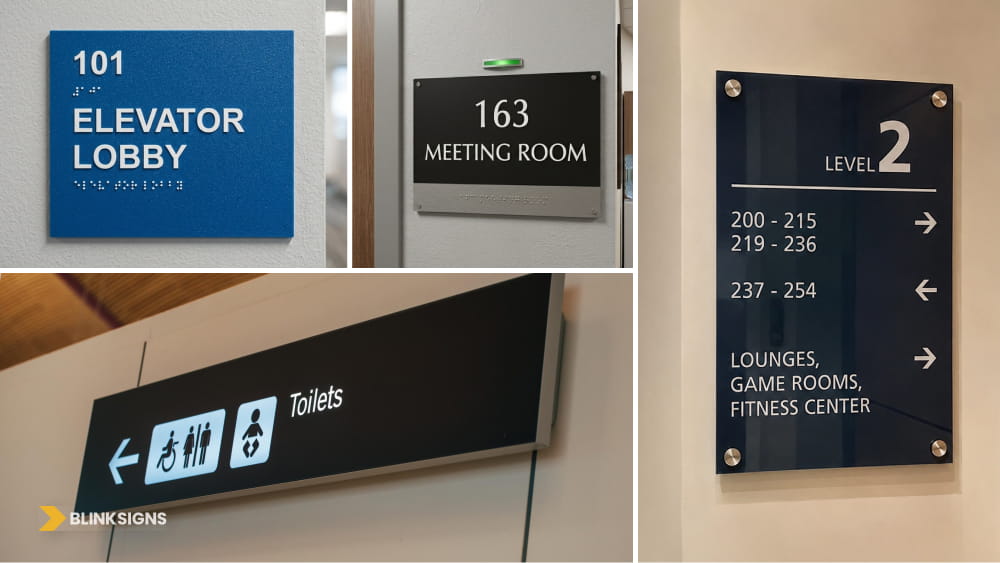
Different types of ADA Signs
| ADA Sign Type | Typical Planning Range | Best Suited For | Main Cost Drivers | Pricing Context |
| Standard room identification sign | $45 to $125+ | Offices, classrooms, storage rooms, staff areas | Message content, tactile text, Braille, material, size | Product and custom fabrication |
| Restroom ADA sign | $50 to $200+ | Public and employee restrooms | Pictogram, tactile text, material, finish, branding | Product and custom fabrication |
| Directional or informational sign | $75 to $250+ | Corridors, campuses, public facilities | Size, message length, arrows, and visual character requirements | Visual sign pricing varies by size and complexity |
| Elevator or stairwell sign | $100 to $300+ | Hotels, offices, healthcare facilities, multi-story buildings | Floor numbers, tactile content, code context, materials | Custom fabrication |
| Custom-branded ADA sign | $125 to $500+ | Premium offices, hotels, healthcare facilities, and campuses | Material, finish, logo integration, layered construction, and approval rounds | Custom fabrication |
| Facility-wide ADA sign program | Custom quoted | Healthcare, hotels, schools, offices, campuses | Quantity, audit, message schedule, installation, coordination | Program pricing |
| Replacement or retrofit program | Custom quoted | Renovations, rebrands, compliance corrections | Existing conditions, removal, remounting, message changes, phasing | Program pricing |
Standard room identification signs
Standard room identification signs often fall toward the lower end of the planning range when the message, size, material, and finish follow a repeatable system. The estimate can increase when the sign requires longer messages, custom sizes, premium materials, layered construction, or a small production quantity.
Permanent room and space identification signs may require tactile treatment where applicable. The exact scope depends on the sign content, location, and use.
Restroom ADA signs
Restroom sign pricing depends on the pictogram, tactile text, Braille, sign size, material, finish, and whether the sign complies with a standard or a branded specification.
Stock restroom signs are often less expensive than custom signs designed to match the environment of a hotel, healthcare facility, office, or franchise. Custom color systems, premium finishes, and branded material specifications require additional design development, proofing, and fabrication complexity, which shifts the cost toward the higher end of the planning range.
Directional and informational signs
Directional and informational signs are generally visual signs under the federal baseline and are not typically required to include tactile characters or Braille. Size, message length, arrows, mounting method, material, and the number of destinations often drive their cost.
A large campus directional sign may cost more than a small room sign, even though it does not require tactile fabrication, because of its size, layout, mounting, and visual complexity.
For a complete breakdown of which sign categories may require tactile treatment, see the ADA sign types guide.
Elevator and stairwell signs
Elevator and stairwell signage may require more complex messages, floor numbers, tactile content, symbols, or coordination with fire and life-safety requirements.
Pricing varies based on the number of floors, message structure, material, mounting conditions, and project-specific requirements. Multi-story properties may also need consistent sign families across elevators, stairwells, corridors, and exit routes.
For a complete breakdown of sign-category requirements, including stairwell and exit-route signage, see the ADA sign types guide.
Custom-branded ADA signs
Custom branded signs cost more because they require design development, material specification, proofing, approval rounds, and more complex fabrication.
Layered acrylic, architectural wood, painted aluminum, metal finishes, premium laminates, and custom color systems each carry different production requirements.
Custom brand design should be reviewed against applicable requirements for character form, finish, contrast, tactile treatment, and message content before fabrication begins.
Facility-wide ADA signage programs
A facility-wide program is custom quoted because the cost depends on the number of signs and the planning required to identify, produce, package, install, and verify them.
The budget may include:
- Facility audit
- Room inventory
- Message schedule
- Design system
- Proofing rounds
- Braille verification
- Fabrication
- Packaging by floor or phase
- Installation
- Final verification
- Replacement planning
Replacement and retrofit programs
Replacement programs vary because existing conditions differ from site to site. Some signs may be reusable, while others may require removal, remounting, new messages, updated finishes, or complete replacement.
The estimate can also change when existing signs leave holes, adhesive residue, paint differences, or surface damage that must be repaired before new signs are installed.
**Pricing Note:**
Ranges in this table are provided for planning purposes only. Final estimates depend on sign type, fabrication scope, materials, quantity, installation conditions, and project requirements. See the pricing and compliance note at the end of this guide.
What Changes the ADA Sign Estimate?
ADA sign pricing is shaped by both the individual sign specification and the wider project scope. The most important variables are tactile content, Braille, material, quantity, customization, audit scope, installation, and phasing.
| Cost Driver | Cost Impact |
| Tactile content | Adds specialized fabrication and proofing |
| Braille | Adds translation, production, and quality verification |
| Material and finish | Changes the fabrication method, durability, and appearance |
| Quantity | Affects setup cost, packaging, production, and installation |
| Custom branding | Adds design development, approval rounds, and proofing |
| Audit and sign the schedule | Adds planning but reduces omissions, rework, and change orders |
| Installation | Adds labor, mounting hardware, access, removal, and surface preparation |
| Phased installation | Adds coordination, separate packaging, and repeated mobilization |
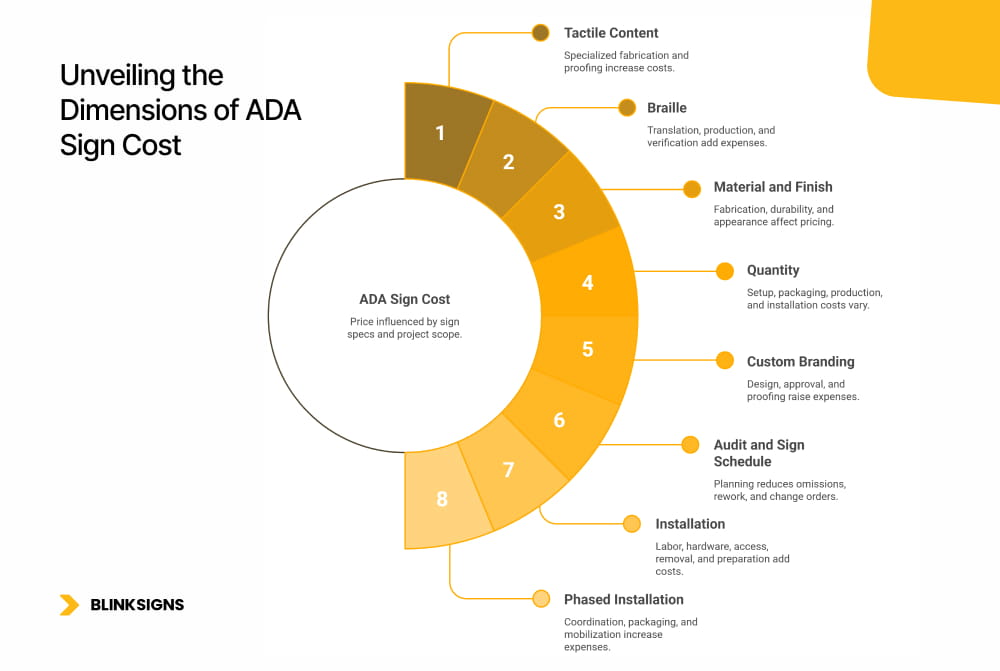
Unveiling the Dimensions of ADA Sign Cost
Tactile content
Raised characters require a different fabrication process from flat visual signs. The production method, character height, spacing, material, and finish must be defined before fabrication begins.
If tactile content is added late or the wrong sign category is selected during early planning, the sign may need to be redesigned and remanufactured.
Braille
Braille adds translation, production, proofing, and quality verification. Grade 2 Braille must accurately reflect the approved message.
If the room name changes after the proof has been approved, both the tactile text and Braille may need to be produced again. This is why message verification before fabrication is an important cost-control step.
Material and finish
Material choice affects fabrication, appearance, durability, cleaning, and long-term maintenance.
Standard acrylic signs carry a different cost profile from:
- Layered photopolymer
- Cast metal
- Painted aluminum
- Architectural wood
- Decorative laminates
- Premium tactile systems
The material should fit both the facility’s visual environment and its operational needs.
Quantity
Larger orders may yield more efficient setup and production economics, but the project as a whole still requires packaging, installation, and coordination.
Small reorders often cost more per sign because design setup, machine preparation, proofing, and shipping are distributed across fewer units.
A facility that orders ten missing signs after the primary project is complete may pay a higher unit cost than it paid during the original production run.
Custom branding
Custom branding adds design development and approval work. A branded sign system may require coordination across typography, color, pictograms, materials, finishes, and mounting hardware.
The more decision-makers involved in the approval process, the more proofing rounds may be required before fabrication can begin.
Audit and sign the schedule
A facility audit and a room-by-room message schedule add planning costs, but they can prevent more expensive problems later.
An accurate sign schedule helps prevent:
- Missing rooms
- Incorrect messages
- Duplicate signs
- Wrong materials
- Incorrect tactile treatment
- Installation confusion
- Small-batch reorders
For larger facilities, the sign schedule is one of the most important project documents because it connects room data, sign specifications, fabrication, and installation.
Installation
The installed price is higher than the product price because installation adds labor, mounting hardware, site access, surface preparation, removal of an existing sign, surface repair, scheduling, and verification.
Installation cost also changes when the facility remains occupied, mounting surfaces vary, or work must be completed outside normal hours.
For deeper technical information, see the ADA sign placement guide.
Phased installation
When projects are delivered in phases because of occupied facilities, construction staging, or tenant schedules, each phase requires separate packaging, scheduling, a return installer visit, and coordination with building access.
These requirements add project management and installation cost, even when the per-sign fabrication specification is identical across phases.
Standard vs. Custom Branded ADA Signs
ADA sign systems range from stock catalog products to fully customized architectural sign families.
The right option depends on the facility, brand standards, quantity, message-change frequency, material requirements, and budget.
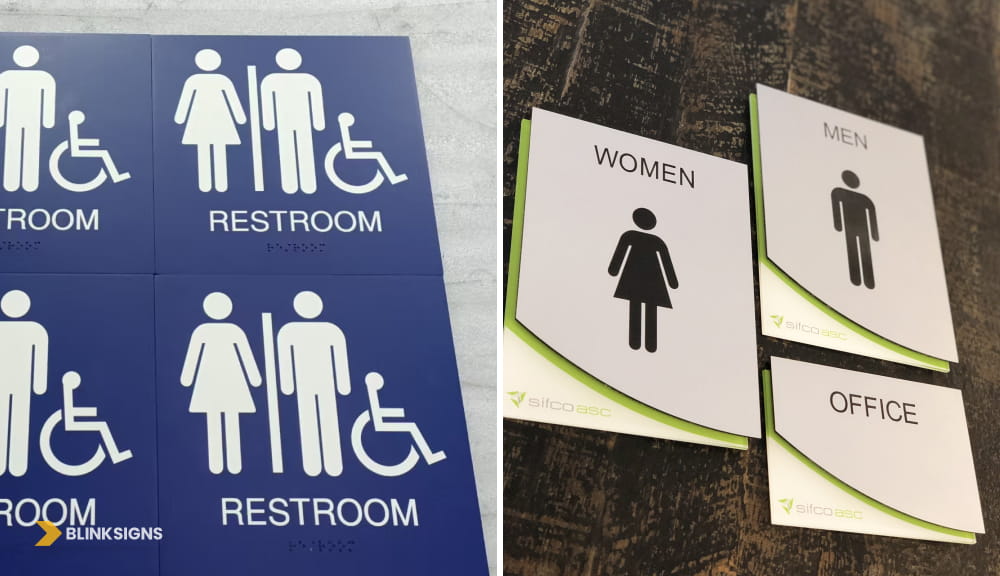
Standard vs custom ADA signs
Stock restroom and room signs
Stock signs use standard messages, sizes, colors, and finishes. They are generally the lowest-cost option and can work well when a facility needs a small number of common signs without custom branding.
Their limitations include:
- Limited color selection
- Limited material options
- Fixed dimensions
- Standard messages
- Limited integration with the surrounding environment
They are best suited for straightforward replacements or small projects where branding is not a major requirement.
Standard coordinated room ID systems
A coordinated system uses one repeatable specification across the facility. The signs may share the same material, size, colors, tactile method, and mounting style without incorporating a heavily customized brand design.
This approach gives offices, schools, clinics, and public facilities a consistent visual system without the design and fabrication cost of a premium custom family.
Custom-branded sign systems
Custom-branded systems are designed to reflect the facility or organization’s visual identity.
They may incorporate:
- Brand colors
- Custom material combinations
- Architectural finishes
- Layered construction
- Custom pictogram treatment
- Coordinated interior sign families
- Premium mounting systems
Custom signs usually require more design development, specification, proofing, and stakeholder approval.
They are common in:
- Hotels
- Healthcare campuses
- Premium office environments
- Corporate headquarters
- Franchise properties
- Multi-location brands
Custom brand design should be reviewed against applicable requirements for character form, finish, contrast, tactile treatment, and message content before fabrication begins.
For detailed fabrication requirements, see the ADA technical specifications guide.
Modular insert systems
Modular systems use a permanent sign frame or holder with replaceable message inserts.
The initial hardware cost may be higher than a basic fixed sign, but future message changes can be less expensive because the facility may only need to replace the insert rather than the full sign.
Modular systems can be useful for:
- Conference rooms
- Flexible offices
- Multi-tenant properties
- Facilities with frequent room-use changes
- Administrative spaces
The long-term value depends on how often messages change and whether the modular system is applied consistently across the facility.
How Quantity Changes the ADA Signage Budget
A facility-wide ADA signage budget is not calculated by multiplying one unit price by the number of rooms. Quantity affects design setup, production, quality control, packaging, freight, installation, and project management.
A project with twelve signs and a project with two hundred signs have different operational structures, even though the sign specifications appear similar.
Larger programs may produce more efficiently because the same approved design can be repeated across many signs. However, those programs also require more extensive scheduling, packaging, verification, and installation coordination.
Before requesting a facility-wide estimate, buyers should prepare an approximate count for the major sign categories.
Preliminary ADA sign count categories
Count or estimate:
- Permanent room identification signs
- Restroom signs
- Accessible facility signs
- Elevator signs
- Stairwell signs
- Areas of refuge
- Accessible entrances
- Directional decision points
- Branded or specialty sign locations
- Exterior accessibility signs, where applicable
The estimate does not need to be exact at the first quote stage. A facility that provides floor plans, an approximate room count, and a preliminary room list will usually receive a more accurate planning estimate than a facility that requests a quote without scope information.
For larger or more complex properties, a facility audit and room-by-room sign schedule may be needed before the final estimate is prepared.
What Is Included in a Facility-Wide ADA Signage Program?
A facility-wide ADA signage program is more than a bulk order of room signs. It integrates facility data, message accuracy, compliance review, design, fabrication, packaging, installation, and final verification into a single coordinated scope.
The program price depends on how much of this work is included. A quote that covers only fabrication is not equivalent to one that includes the complete audit-to-installation process.
Facility audit and site review
A facility audit documents the existing sign environment, identifies missing or outdated signs, reviews mounting conditions, and creates a working baseline for the project.
During a renovation, the audit may also identify which signs could remain in place and which should be replaced due to message changes, condition, mounting location, or confirmed project requirements.
Room-by-room inventory
The inventory identifies every permanent room and space included in the project.
It may document:
- Room name
- Room number
- Existing sign condition
- Proposed sign type
- Tactile treatment where applicable
- Pictogram
- Mounting location
- Project phase
Without a complete inventory, rooms can be omitted from the original production run. Discovering those omissions later can lead to separate production, freight, and installation costs.
Message schedule
An ADA sign schedule is the working document that maps each sign to its approved message, tactile treatment, Braille content (where applicable), material, finish, size, mounting location, quantity, and installation phase.
It connects facility planning, design, fabrication, packaging, and installation.
An accurate message schedule helps reduce:
- Message errors
- Missing rooms
- Duplicate signs
- Incorrect materials
- Braille remanufacture
- Installation confusion
- Change orders
For larger facilities, sign-schedule preparation is one of the most valuable cost-control steps in the project.
Compliance and code review
Federal ADA standards provide a baseline, but additional requirements may come from state codes, local building requirements, fire and life-safety rules, landlord criteria, architectural standards, or project-specific conditions.
The review determines which requirements apply to the confirmed sign content, location, and use. It should occur before the sign family is finalized and before fabrication begins.
The U.S. Access Board and ADA.gov publish the federal technical guidance that establishes the baseline for accessible signage in commercial facilities and public accommodations.
For a broader view of audits and implementation planning, see the ADA implementation guide.
Design system
The design system establishes the visual and fabrication rules for the complete sign family.
It may define:
- Character form
- Character size
- Pictograms
- Tactile fabrication method
- Braille layout
- Materials
- Finish
- Contrast
- Color
- Sign dimensions
- Mounting hardware
- Brand integration
A coordinated design system also makes future replacement and expansion easier because new signs can follow an established specification.
Proofing rounds
Proofing confirms the accuracy of the message, layout, sign type, tactile content, Braille, materials, colors, and quantities before production.
Corrections made during proofing are generally easier and less expensive than corrections made after fabrication. A project quote should clarify how many proofing rounds are included and how later changes will be handled.
Fabrication
Fabrication begins after the message schedule, specifications, and proofs have been approved.
The production method depends on:
- Sign type
- Material
- Tactile method
- Braille production
- Pictograms
- Layered construction
- Finish
- Quantity
- Custom branding
Quality control should confirm that each sign matches the approved schedule before packaging.
Packaging and delivery by phase
Large projects are easier to install when signs are organized by building, floor, wing, room sequence, location, or installation phase.
Unorganized bulk packaging can slow installation and increase the risk of mounting signs in the wrong locations.
Installation
Installation includes more than attaching a sign to a wall. The installer must confirm the approved location, mounting conditions, alignment, hardware, sign sequence, and project phase.
Depending on the facility, installation may also include:
- Removing existing signs
- Cleaning adhesive residue
- Patching mounting holes
- Preparing damaged surfaces
- Coordinating access to occupied areas
- Working during restricted hours
- Returning for later phases
For technical guidance on mounting, see the ADA sign placement guide.
Final verification
Final verification compares the completed installation with the approved sign schedule.
It confirms that:
- All scheduled signs were installed
- Messages match the approved schedule
- Signs are mounted at the intended locations
- Missing or damaged signs are documented
- The project is ready for sign-off
Replacement and maintenance planning
Facilities change over time. Rooms are renamed, tenants move, departments relocate, and signs become damaged.
A replacement plan establishes how future reorders will be handled, enabling the facility to preserve visual and fabrication consistency without recreating the entire sign system.
Why Two ADA Sign Quotes Can Look Completely Different
Two ADA signage quotes can describe the same facility while including very different scopes. A lower quote may cover only production, while a higher quote may include inventory, message verification, installation, project management, and final sign-off.
The right way to compare quotes is to compare scope before price.
| Quote Area | What a Complete Quote Should Clarify |
| Facility audit | Whether a site visit, existing-sign review, and condition assessment are included |
| Sign inventory | Whether a room-by-room count is prepared or supplied by the buyer |
| Message schedule | Whether a complete sign-by-sign content document is developed and approved |
| Design and proofing | Number of proofing rounds and how corrections are managed |
| Braille translation | Whether translation and verification are included or supplied by the buyer |
| Materials | Substrate, finish, tactile method, pictogram, and mounting specifications |
| Installation | Labor, mounting hardware, access conditions, and phasing |
| Existing sign removal | Whether removal and disposal are included |
| Surface repair | Whether patching, cleaning, painting, or restoration is included |
| Freight and packaging | Whether signs are organized and delivered by floor, wing, or phase |
| Change orders | How message changes, reorders, and additions are handled |
| Final verification | Whether installation review and project sign-off are included |
A quote that excludes audit, inventory, and message-schedule preparation may look less expensive initially. The buyer may still need to complete that work internally or add it later.
A quote that excludes installation may also omit mounting hardware, sign removal, surface preparation, access coordination, installer travel, return visits, and final verification.
These exclusions do not automatically make the quote unsuitable. The important issue is whether the buyer understands them before approving the project.
Hidden Costs and Change-Order Risks
Hidden ADA signage costs often stem from incomplete information, late changes, or unclear scope. Each issue creates a specific cost consequence.
Incorrect room names
If room names in the sign schedule do not match the names approved by the architect, building manager, or occupant, signs may need to be reordered after fabrication or installation.
Small-batch reorders often cost more per sign because design setup, machine preparation, proofing, shipping, and installation are distributed across fewer units.
Late architectural changes
If a room number, room name, or space use changes after the sign schedule has been approved and fabrication has started, the affected signs must be changed or remanufactured.
Changes made before approval generally affect only design and proofing. Changes made after production begins affect materials, labor, packaging, and potentially installation.
Missing sign inventory
If rooms or spaces are omitted from the original inventory, additional signs must be ordered after the main production run has closed.
The facility may then incur separate setup, production, freight, and installation costs.
Incorrect Braille translation
If Braille does not match the approved message, the sign must be remanufactured.
Braille verification during proofing reduces the risk of discovering the error after production or installation.
Wrong mounting locations
If a sign is installed at the wrong location or height, correcting the issue may require a return visit, remounting, and surface repair at the original installation site.
A documented installation plan and organized packaging can reduce placement errors.
Existing sign removal
If outdated or unsuitable signs must be removed before new signs are installed, removal and disposal add labor.
The wall may also require cleaning, patching, repainting, or other restoration before the replacement sign can be mounted.
Rush production
If the project must meet an accelerated occupancy, inspection, renovation, or opening deadline, fabrication and shipping may need to be expedited.
Compressed schedules can reduce normal review time and may carry premium production, freight, or installation costs.
Phased installation in occupied facilities
If the building remains occupied during installation, work may need to be coordinated by floor, wing, department, or operating schedule.
Repeated installer mobilization, restricted access, security coordination, and separate packaging can increase the project estimate.
Reinspection or replacement
If signs are later found to be incorrect, incomplete, damaged, or unsuitable for the confirmed project scope, replacement costs are added to the original program cost.
Early review, accurate schedules, proof approval, and final verification reduce this risk.
New Construction vs. Renovation
New construction and renovation projects require different budgeting assumptions.
| Factor | New Construction | Renovation |
| Room schedule | Usually available earlier from architectural plans | May require field verification because existing room uses can differ from the documents |
| Mounting surfaces | Generally defined in construction documents | Existing and variable, with unknown surface conditions possible |
| Existing sign removal | Usually not required | Often required, including disposal and surface restoration |
| Message changes | Lower cost when resolved before fabrication | More likely when existing room uses conflict with the new plans |
| Installation coordination | Aligned with the construction schedule and the general contractor | May require phasing, tenant coordination, or after-hours work |
| Rework risk | Lower when schedules are approved early | Higher when inventory, access, or room-use information is incomplete |
New construction
The most cost-efficient time to plan an ADA signage program for new construction is during design development, before room names and assignments are finalized.
Early coordination allows the team to estimate quantity, review sign categories, align the sign family with the architecture, confirm messages before fabrication, and coordinate installation with the construction schedule.
If signage planning begins close to occupancy, the project may face compressed proofing, production, and installation timelines.
Renovation
Renovation projects involve more uncertainty because existing conditions may not match the drawings or room lists available to the project team.
A field review can identify:
- Existing sign condition
- Changed room uses
- Missing signs
- Mounting surfaces
- Adhesive residue
- Wall damage
- Reusable signs
- Occupied-area constraints
A renovation estimate based only on old plans may miss conditions that affect removal, fabrication, or installation.

ADA Compliance_ New vs. Existing Buildings
ADA Signage Budgets by Facility Type
Different facilities create different sign counts, change patterns, materials, and installation conditions. Budgeting should reflect how the property operates, not only how many doors it contains.
Healthcare facilities
The primary budget driver in healthcare is room volume combined with frequent message changes.
Healthcare facilities may include patient rooms, procedure rooms, treatment areas, staff offices, restrooms, elevators, stairwells, department entrances, and wayfinding decision points.
Cost can increase when the project requires cleanable materials, specialized finishes, frequent room-use updates, occupied-facility phasing, infection-control coordination, or tactile surfaces that must withstand regular cleaning.
Wayfinding and room identification should be planned together so patients, visitors, and staff receive a consistent navigation experience.
Hotels and hospitality properties
The primary budget driver in a hotel is the combination of guest-room quantity and the range of sign types used across the property.
A hotel program may include guest-room numbers, restroom signs, elevator signs, stairwell signs, amenity identification, meeting-room signs, service-area signs, exit signs, and directional signs.
Premium lobby materials, brand standards, phased floor renovations, and custom room-number systems can increase the estimate.
A hotel renovating only part of the property may also need to coordinate new signs with existing sign families that remain in place.
Offices and multi-tenant properties
The primary budget driver in offices is change frequency.
Conference rooms are renamed, tenants move, departments relocate, and floor plans change. These updates can create recurring reorder needs.
A modular insert system may carry a higher initial cost but reduce future replacement expense when only the message changes.
Custom-branded systems may require additional approval whenever a new message is introduced, particularly in multi-tenant buildings where both the property owner and tenants have design standards.
Schools and campuses
The primary budget driver in schools and campuses is quantity across multiple buildings and sign categories.
A campus program may include classrooms, laboratories, administrative offices, restrooms, libraries, auditoriums, athletic facilities, residence halls, outdoor wayfinding, and building identification.
Cost can increase when the project includes bilingual or multilingual messaging, exterior materials, phased installation around academic terms, or a mix of new construction and renovation.
For broader navigation planning, see the wayfinding signage guide.
Multi-location brands
The primary budget driver for a multi-location brand is standardization across properties with different conditions.
A healthcare group, franchise system, property portfolio, or national operator may want one coordinated sign family, but each location may still have different:
- Wall materials
- Room names
- Building layouts
- Local requirements
- Installation access
- Existing signs
- Project schedules
Program planning must balance brand consistency with location-specific review.
Multi-Location ADA Signage Programs
Managing ADA signage across multiple properties differs from managing it in a single facility.
A single property may involve a single room inventory, a single message schedule, and a single installation plan. A portfolio program may require:
- Standardized sign specifications
- Location-specific inventories
- Multiple approval paths
- Coordinated fabrication
- Packaging by location
- Regional installation scheduling
- Location-level verification
- Standardized reorder processes
- Portfolio-wide maintenance planning
Multi-location buyers should evaluate program scope rather than focusing only on per-sign pricing.
BlinkSigns supports multi-location programs through national installer coordination and SignTrax project tracking. SignTrax can provide location-level visibility into survey, sign-schedule, fabrication, installation, and completion milestones across the portfolio.
For broader rollout planning, see national signage program management.
Facilities comparing investments across accessibility, wayfinding, and branding programs can also use the Commercial Signage ROI Worksheet to model lifecycle cost and long-term value.
How BlinkSigns Plans ADA Signage Projects
BlinkSigns approaches ADA signage as a coordinated facility system.
Depending on project scope, support may include:
Facility review
Reviewing the building type, room count, existing signs, floor plans, project schedule, and installation conditions.
Sign inventory
Creating or reviewing the room-by-room count needed to establish the project scope.
Message schedule development
Organizing sign messages, tactile treatment, Braille content where applicable, materials, quantities, mounting locations, and installation phases.
Compliance and code coordination
Reviewing the confirmed scope against applicable federal baseline requirements and identifying where state, local, building, fire, and life-safety, landlord, or project-specific requirements may also apply.
Design and material recommendations
Developing a coordinated sign family that considers accessibility, durability, cleaning, branding, update frequency, and facility environment.
Proofing
Confirming message accuracy, layout, materials, tactile content, Braille, pictograms, quantities, and specifications before fabrication.
Fabrication
Producing the approved sign family and organizing quality control around the message schedule.
Installation
Coordinating site access, packaging by phase, sign mounting, existing sign removal, surface preparation, and phased scheduling to ensure installation proceeds in the correct sequence within the confirmed project scope.
Verification
Reviewing the completed installation against the approved schedule and documenting outstanding items.
Maintenance and update planning
Establishing a consistent process for future room changes, replacement signs, damage, rebrands, and facility renovations.
For multi-location programs, BlinkSigns can coordinate national installation and track location-level progress through SignTrax.
⤷ Request a Channel Letter Sign Estimate │ ⤷ See the Full Commercial Signage Cost Guide
How to Prepare for an ADA Sign Estimate
A more accurate estimate starts with basic facility information. Buyers do not need a completed audit before the first conversation, but they should provide enough context to define the likely project scope.
Prepare the following:
- Facility type and primary use
- Approximate room or space count
- Number of floors
- New construction or renovation
- Floor plans or architectural drawings, if available
- Photos of existing signs, if replacement is being considered
- Room list or draft message schedule, if available
- Brand guidelines
- Preferred materials or finishes
- Installation required, yes or no
- Inspection, occupancy, or opening deadline
- Number of locations
Providing floor plans and an approximate room count helps BlinkSigns distinguish between a small replacement project and a facility-wide program.
➜] Download Our Free ADA Sign Budget Planner
Pricing and Compliance Note
The pricing ranges in this guide are provided for general budget planning only and should not be treated as fixed prices, guaranteed project costs, or final estimates. ADA signage costs depend on sign type, tactile and Braille requirements, materials, quantity, custom design, installation, site conditions, project schedule, and compliance scope.
Federal ADA standards provide a baseline for accessible signage, but state codes, local building requirements, fire and life-safety rules, landlord criteria, and project-specific conditions may also apply. Businesses should confirm current requirements with the appropriate authority, an architect, an accessibility professional, or a qualified signage provider before approving an ADA signage program.
FAQ: ADA Sign Cost
How much do ADA signs cost?
Standard permanent room identification, restroom, and accessible facility signs often fall within a planning range of approximately $45 to $250 per sign. Custom-branded signs, premium materials, elevator or stairwell signs, installed signs, and small production runs may cost more.
Facility-wide programs are custom quoted because the scope may include an audit, room inventory, message schedule, design, proofing, fabrication, packaging, installation, and final verification.
What is the difference between the product price and the installed price for ADA signs?
A product price covers one manufactured sign. It does not include mounting hardware, installation labor, site access, surface preparation, removal of the existing sign, or surface repair.
An installed price includes some or all of those site and labor requirements. The two prices are not equivalent and should not be used interchangeably when comparing quotes.
What is included in a full-facility ADA sign program?
A full-facility program may include:
- Facility audit
- Room-by-room inventory
- Message schedule
- Compliance and code review
- Design system
- Proofing
- Braille verification
- Fabrication
- Packaging by phase
- Installation
- Final verification
- Replacement planning
The exact scope should be clarified in the quote.
Which signs require tactile text and Braille?
Federal guidelines identify specific permanent room and space identification signs as requiring tactile treatment when provided.
Visual directional and informational signs are generally not required to include tactile characters or Braille under the federal baseline. Requirements depend on the sign’s content, location, and use.
See the ADA sign types guide for a complete breakdown by sign category.
What is an ADA sign schedule, and how does it affect cost?
An ADA sign schedule is a room-by-room inventory document that maps each sign to its message, tactile treatment, Braille content (where applicable), material, size, mounting location, quantity, and installation phase.
An accurate schedule reduces omissions, message errors, duplicate production, installation confusion, and change orders. Errors corrected during proofing generally cost less than errors corrected after fabrication.
BlinkSigns can include sign-schedule preparation as part of a facility signage program.
How much does Braille fabrication add to ADA sign cost?
Braille adds translation, production, proofing, and quality verification to the fabrication process.
The cost impact depends on message length, sign size, material, production method, quantity, and custom design.
There is no universal Braille surcharge that applies to every sign. Errors require remanufacture, which makes proof-stage verification important.
Why do custom ADA signs cost more?
Custom ADA signs require design development, material specification, approval rounds, and proofing before production.
Premium materials, specialty finishes, custom colors, logo integration, layered construction, and non-standard sizes increase fabrication complexity. These development costs are distributed across the quantity produced.
Does installation increase ADA sign cost?
Yes. Installation adds labor, mounting hardware, site access, surface preparation, and, in many cases, the removal of existing signs and surface repair.
The estimate depends on facility conditions, mounting surfaces, sign quantity, project phasing, and whether the building remains occupied during installation.
What hidden costs should facilities anticipate?
Common hidden costs include small-batch reorder fees when rooms are missed, or messages change after fabrication begins, surface repair when existing signs are removed, rush-production fees for compressed schedules, and additional installation visits for phased or incomplete scope.
An accurate room inventory and approved message schedule before fabrication begins can reduce most of these costs.
See the hidden costs and change-order risks section above for a detailed breakdown.
Can existing ADA signs be reused in a renovation?
Existing signs may be reused if their messages remain accurate, their condition is acceptable, their mounting locations remain suitable, and they meet the requirements applicable to the confirmed project scope.
Signs that are outdated, damaged, incorrectly mounted, or unsuitable for the new room use may need to be replaced.
A facility audit can identify which signs may remain and which should be included in the replacement program.
How should healthcare and hotel facilities budget for ADA signage?
Healthcare facilities should account for high room counts, frequent room-use changes, cleaning requirements, complex wayfinding, and installations in occupied areas.
Hotels should account for guest-room quantity, elevators, stairwells, amenities, service areas, premium public-area finishes, and phased renovations.
Both facility types benefit from program-level budgeting because the coordination, proofing, packaging, and installation scope extends beyond per-sign fabrication.
Can BlinkSigns manage ADA signage across multiple locations?
Yes. BlinkSigns supports multi-location ADA signage programs through standardized design coordination, location-specific review, national installer coordination, and SignTrax project tracking.
Multi-location buyers should plan at the program level rather than focusing solely on per-sign pricing, as installation conditions, room schedules, timelines, and applicable requirements can vary by property.