
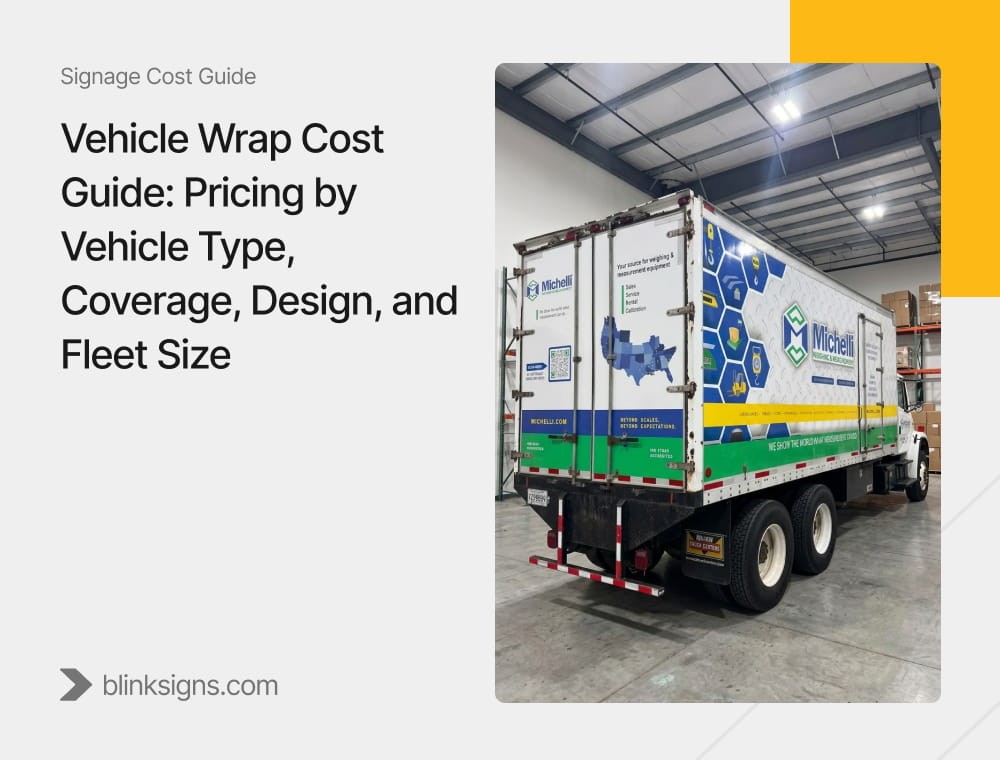
Vehicle Wrap Cost Guide: Pricing by Vehicle Type, Coverage, Design, and Fleet Size
How much does a vehicle wrap cost?
Vehicle wrap projects can range from approximately $200 or more for simple door decals and cut lettering to $2,500 or more for partial or full commercial wraps on vans, trucks, and fleet vehicles. Final vehicle wrap cost depends on coverage level, vehicle type, vinyl quality, laminate, design complexity, surface condition, removal needs, installation labor, installation schedule, and fleet quantity. A commercial wrap may also include brand design, vehicle template setup, proofing, production, installation coordination, and replacement planning.
BlinkSigns budgets vehicle wraps as mobile brand assets, not just printed vinyl. For fleets, the project scope may include brand standardization, vehicle templates, phased installation, multi-location coordination, SignTrax tracking, and future replacement planning.
A single vehicle wrap quote and a fleet wrap program quote are not the same type of estimate. One may cover a single van, pickup, trailer, or box truck. The other may include a coordinated rollout across multiple vehicles, vehicle types, locations, and installation windows.
This guide explains the cost factors behind business vehicle graphics so buyers can compare quotes by scope, not only by price.
What Vehicle Wrap Pricing Actually Includes
Vehicle wrap pricing can refer to several different scopes. A buyer asking for “vehicle wrap cost” may be pricing for a single door logo, a set of spot graphics, a partial wrap, a full commercial wrap, or a fleet branding program.
The first step is to identify the coverage level and the project’s business purpose.
Four Levels of Vehicle Wrap Pricing
| Pricing Level | What It Includes | When It Applies |
| Decal or cut-graphics price | Logo, phone number, website, service list, DOT number, or small vinyl graphics applied to selected areas | Basic business identification, service vehicles, local contractors, simple fleet labeling |
| Spot graphics price | Larger printed graphics placed on doors, sides, rear panels, windows, or selected brand zones | Businesses that need stronger visibility than simple decals without wrapping major panels |
| Partial wrap price | Printed vinyl covering selected sections of the vehicle, often sides, rear, lower panels, or high-visibility zones | Businesses that want a strong brand impact with a lower material and installation scope than a full wrap |
| Full wrap price | Printed vinyl covering most visible exterior painted panels, with laminate, trimming, finishing, and more installation labor | Maximum mobile visibility, high-impact commercial branding, premium fleet presentation |
| Fleet program price | Design standardization, vehicle templates, production batches, phased installation, multi-location scheduling, reorders, and replacement planning | Multi-vehicle fleets, franchise systems, regional operators, national brands, and mixed vehicle portfolios |
A decal price covers only a graphic scope. It should not be compared directly with a full wrap estimate.
A spot graphics price covers larger printed pieces placed on selected panels, such as door logos, rear graphics, or side-panel visuals, without wrapping the entire vehicle. It is a step up from simple cut lettering in both visual impact and production scope.
A partial wrap price depends on which panels are covered, how the design transitions across the vehicle, and whether windows or rear panels are included.
A full wrap price reflects more vinyl, more laminate, more installation time, and more finishing detail. It may or may not include roof coverage, door jambs, inner edges, removal of old graphics, or surface preparation for damaged or failing paint, unless those items are stated in the quote.
A fleet program price reflects the full operational scope. It may include a single brand system across vans, trucks, trailers, pickups, and service vehicles, with production and installation coordinated by location or phase.
Vehicle Wrap Cost by Coverage Level
Coverage level is one of the largest cost drivers in a vehicle wrap project. More coverage generally means more design work, more printed vinyl, more laminate, more installer time, more trimming, and more finishing.
The table below provides typical planning ranges for commercial vehicle graphics. These ranges are not final quotes. Actual pricing depends on confirmed vehicle type, coverage map, vinyl material, laminate, surface condition, design scope, installation location, and fleet size.
| Coverage Level | Typical Planning Range | Best Suited For | Main Cost Drivers |
| Door decals or cut lettering | $200 to $800+ | Basic business identification, phone number, logo, website, DOT numbers | Graphic size, vinyl type, quantity, number of doors, installation |
| Spot graphics package | $500 to $1,500+ | Service vehicles, small businesses, contractors, and local delivery vehicles | Graphic size, printed elements, design setup, panel placement, installation |
| Partial vehicle wrap | $1,000 to $3,500+ | Vans, pickups, SUVs, trailers, and service vehicles need strong visibility | Coverage percentage, vehicle size, design complexity, laminate, and install labor |
| Full commercial wrap | $2,500 to $7,000+ | Vans, trucks, box trucks, trailers, high-visibility fleet vehicles | Vehicle size, panel complexity, vinyl quality, laminate, trimming, finishing |
| Fleet wrap program | Custom quoted | Multi-vehicle fleets, franchises, regional or national operators | Vehicle count, vehicle mix, template setup, scheduling, production batches, and installation coordination |
| Wrap refresh or replacement | Custom quoted | Rebrands, old graphics updates, damaged wraps, vehicle turnover | Removal labor, adhesive residue, surface condition, new artwork, reinstallation |
Door decals and cut lettering
Door decals are the simplest commercial vehicle graphics option. They usually include a logo, phone number, website, licensing number, or short service description applied to doors or selected panels.
This is a strong option when the goal is basic identification rather than high-impact advertising. Cost can increase when the graphics use specialty vinyl, multiple colors, reflective material, or installation across several vehicles.
Spot graphics packages
Spot graphics create more visibility than basic decals without covering large vehicle panels. A package may include door logos, rear graphics, side-panel graphics, service icons, website URLs, and selected call-to-action elements.
Pricing depends on the size and number of printed pieces, the design layout, the vehicle panels involved, and whether installation is completed on one vehicle or across a small fleet.
Partial vehicle wraps
A partial wrap covers selected sections of the vehicle rather than most exterior panels. Common areas include the rear doors, lower side panels, rear quarter panels, or large side sections.
Partial wraps are often a good balance between visibility and budget. They can create a strong brand impact while using less material and requiring less installation time than a full wrap.
Cost changes when the design needs to blend into the vehicle paint color, wrap across curves, align with body lines, or coordinate with windows and rear panels.
Full commercial wraps
A full commercial wrap covers most visible exterior painted surfaces. It usually requires more design work, printed vinyl, laminate, surface preparation, trimming, installation time, and finishing.
The estimate should clarify what “full” includes. Some full wraps exclude the roof, door jambs, interior edges, bumpers, mirrors, or difficult recessed areas unless those items are specifically included in the scope.
Full wraps are often used when the vehicle needs to function as a high-visibility brand asset on routes, at job sites, in parking lots, or across service areas.
Fleet wrap programs
Fleet wrap pricing depends on both the per-vehicle wrap scope and the program structure.
A fleet program may include:
- Brand standard development
- Vehicle template setup
- Design adaptation across vehicle types
- Production batches
- Location-based installation scheduling
- Vehicle downtime planning
- Replacement graphics
- Reorder standards
- Project tracking
The larger and more mixed the fleet, the more important project coordination becomes.
Wrap refresh or replacement.
A wrap refresh may be needed when a company updates its branding, changes contact information, replaces vehicles, or removes old graphics.
Removal and replacement costs depend on the age of the existing graphics, the condition of the adhesive and paint, the vehicle surface, and whether the new design can reuse the previous layout.
Vehicle Wrap Cost by Vehicle Type
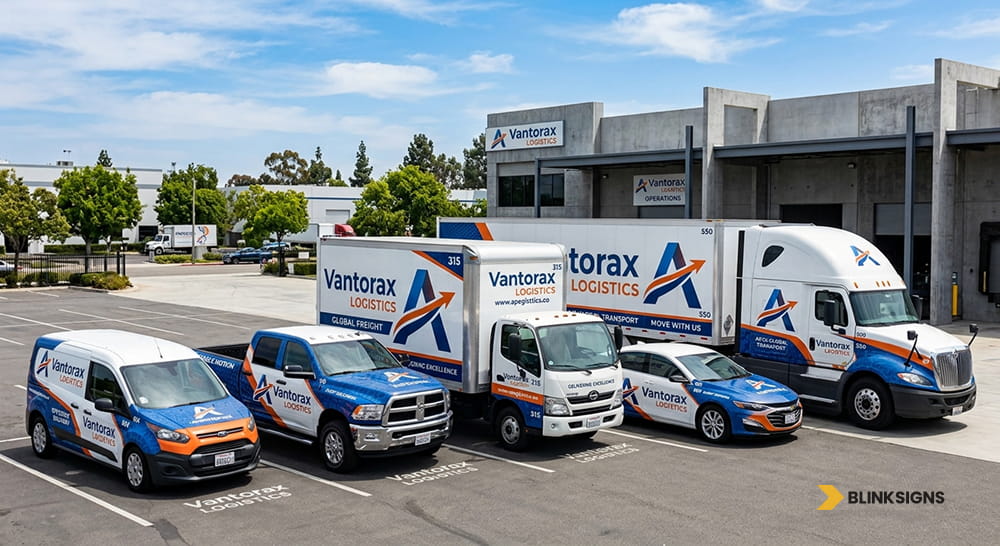
fleet program planning of different vehicles
Vehicle type affects cost because every vehicle has a different surface area, body shape, panel structure, height, curve pattern, window layout, and installation difficulty.
A small sedan and a high-roof cargo van are not equivalent wrap projects. A box truck may have flatter panels, but it also has a much larger surface area. A mixed fleet may require separate templates for every model and body style.
| Vehicle Type | Cost Complexity | Why It Changes the Estimate |
| Sedan or compact car | Lower | Smaller surface area, simpler panels, fewer large graphics zones |
| SUV or crossover | Medium | Larger sides, rear curves, more visible panels, and more installation time |
| Pickup truck | Medium | Cab, bed, tailgate, wheel wells, curves, and separate body sections |
| Cargo van | High | Large side panels, rear doors, curves, recesses, roof height, template accuracy |
| Sprinter or high-roof van | High | More vertical surface area, installer access needs, long panels, complex curves |
| Box truck | High | Large advertising surface, large printed panels, height access, rear door treatment |
| Trailer | Medium to high | Long side panels, panel condition, surface size, outdoor exposure, and install access |
| Mixed fleet | Highest | Multiple templates, varied layouts, batch planning, brand consistency across vehicle types |
Sedans and compact cars
Sedans and compact vehicles usually require less material than vans or trucks. The design area is smaller, and installation can be more straightforward when the vehicle has simple panel shapes.
Cost can still increase when the design includes full coverage, complex contouring, specialty finishes, or window graphics.
SUVs and crossovers
SUVs have larger sides and rear sections than compact cars, which gives brands more visibility but also increases material and installation time.
Rear curves, tailgates, handles, trim, and window layouts can affect how the graphics are designed and installed.
Pickup trucks
Pickup trucks require planning across the cab, doors, bed, tailgate, wheel areas, and rear sections.
A simple door decal package may be cost-effective for contractor vehicles, while a partial or full wrap can enhance job-site visibility.
Cost depends on whether the wrap covers only the cab, the bed, the tailgate, or the full visible vehicle.
Cargo vans and service vans
Cargo vans are among the most common commercial wrap vehicles because they offer large side panels and strong visibility.
They also require careful template work because doors, handles, curves, recesses, body lines, and rear panels must be planned accurately.
High-roof vans may also require additional installer access, longer installation time, and more careful panel alignment.
Box trucks
Box trucks offer excellent advertising space thanks to their large, flat sides and rear panels.
Cost increases due to the size of the printed panels, height access, installation time, and potential complexity with roll-up doors, seams, rivets, or rear hardware.
A box truck wrap should be scoped carefully so the quote clarifies whether the sides, rear, cab, doors, and any high areas are included.
Trailers
Trailer wraps depend on trailer size, panel condition, length, height, and intended use.
Outdoor exposure, road wear, surface material, and panel seams can affect both installation and long-term performance.
A trailer used every day on highways may require different materials and maintenance planning than one parked at events or used seasonally.
Mixed fleets
Mixed fleets require the most planning because a single design rarely fits every vehicle with adjustments.
A fleet may include sedans, pickups, cargo vans, trailers, and box trucks. Each vehicle type may need its own template and layout while maintaining the brand identity.
This is where fleet program planning becomes more valuable than one-off wrap pricing.
Commercial Vehicle Wraps vs. Color-Change Wraps
Commercial vehicle wraps and color-change wraps are often discussed together, but they serve different buyers and different goals.
A color-change wrap is usually cosmetic. A commercial vehicle wrap is a brand communication asset.
| Factor | Commercial Vehicle Wrap | Color-Change Wrap |
| Primary goal | Brand visibility, lead generation, route exposure, service identification | Cosmetic appearance or personal style |
| Design work | Logo placement, brand colors, calls to action, readability, contact details | Finish, color, texture, and surface coverage |
| Measurement | Calls, website visits, local visibility, fleet consistency, brand recall | Personal preference and appearance |
| Fleet use | Often standardized across multiple vehicles | Usually one vehicle |
| Quote drivers | Design, template setup, printed vinyl, laminate, installation, scheduling | Material finish, coverage, vehicle complexity, and installation |
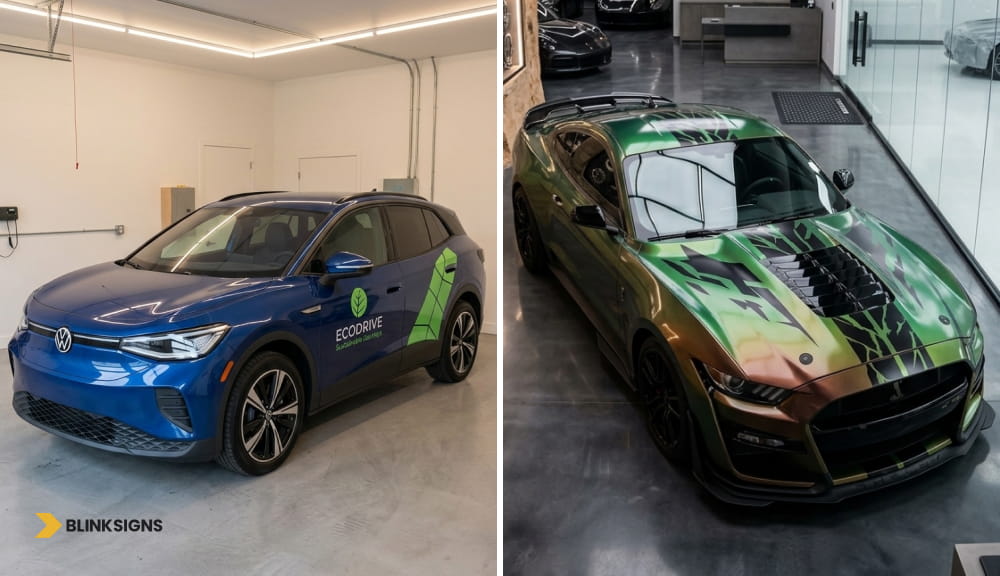
Branding Vehicle Wraps and Color Change Wraps
Commercial wraps must be readable in motion and recognizable from a distance. The design needs to consider where the vehicle travels, where it parks, how fast viewers see it, and which information should be visible first.
A strong business wrap usually prioritizes:
- Brand name
- Logo
- Core service
- Phone number
- Website
- Service area
- High-contrast layout
- Simple message hierarchy
Color-change wraps focus more on finish, appearance, and personal style. They may involve full coverage, specialty materials, or cosmetic finishes, but they are not usually built around business messaging, calls to action, or fleet standardization.
For BlinkSigns buyers, the commercial wrap path is usually the more relevant pricing model.
What Changes the Vehicle Wrap Estimate?
Design, materials, vehicle type, surface condition, installation complexity, and program scope shape vehicle wrap pricing.
| Cost Driver | Cost Impact |
| Coverage level | More coverage increases material, laminate, installation time, trimming, and finishing |
| Vehicle size and complexity | Larger or more complex vehicles require more material and installer time |
| Vinyl and laminate quality | Premium films and laminates can improve durability, finish, and performance |
| Design scope | Custom layouts, templates, proofing rounds, and brand adaptation add planning cost |
| Surface condition | Dirt, residue, dents, rust, old graphics, or failing paint can add prep time or risk |
| Removal needs | Old graphics or wrap removal adds labor before the new wrap can be installed |
| Installation environment | Shop installation, mobile installation, access, weather, and scheduling affect labor |
| Fleet quantity | Multiple vehicles may improve production efficiency, but add coordination and scheduling |
| Vehicle mix | Different makes, models, and body styles require separate templates and layout adjustments |
| Rush timelines | Compressed deadlines can increase production, shipping, and installation costs |
Coverage level
Coverage is the most visible cost driver. A door decal package uses less material and labor than a partial wrap, while a full wrap requires more printed vinyl, laminate, trimming, finishing, and installation time.
A buyer should confirm exactly which panels are included before comparing quotes.
Vehicle size and complexity
Larger vehicles usually require more material, but size is not the only factor. Curves, recesses, rivets, handles, windows, seams, and body lines can also increase installation complexity.
A smaller vehicle with complex curves may require more careful installation than a larger vehicle with simple flat panels.
Vinyl and laminate quality
Vehicle wraps are not priced only by square footage. Film quality, laminate, finish, print method, and expected use all affect cost.
Commercial wraps should be planned around the vehicle’s operating environment, not just the lowest material cost. Vehicles exposed to heavy sun, frequent washing, road wear, or long daily routes may require more careful vinyl material selection.
Design scope
Design can be a major part of the quote. A commercial wrap requires more than placing a logo on a vehicle photo.
Design scope may include:
- Brand review
- Vehicle template setup
- Layout concepts
- Readability planning
- Message hierarchy
- Proofing rounds
- Revision rounds
- Production file preparation
- Color consistency across vehicles
For fleets, the design may need to be adapted across multiple vehicle types while preserving one consistent brand system.
Surface condition
The vehicle surface affects installation quality and long-term appearance.
If a vehicle has dents, scratches, rust, oxidation, failing clear coat, adhesive residue, or old graphics, the installer may need extra preparation time. In some cases, the surface condition may need to be addressed before wrapping.
A wrap should not be treated as a repair for damaged paint. Surface condition should be reviewed before the quote is finalized.
Removal needs
If the vehicle already has decals, lettering, or an old wrap, removal may be required before new graphics are installed.
Removal cost depends on:
- Age of the graphics
- Adhesive condition
- Film type
- Vehicle paint condition
- Amount of coverage
- Labor required
- Residue cleanup
Old graphics that can be removed cleanly may require limited labor. Aged or brittle vinyl can take longer and may require more cleanup.
Installation environment
A controlled installation environment helps support better results. Dust, weather, temperature, access, lighting, and available space can all affect installation.
Shop installation is often preferred for complex wraps. Mobile or on-site installation may be possible for some projects, but it should be scoped based on vehicle type, weather exposure, available space, and schedule.
Fleet quantity and scheduling
More vehicles can create production efficiencies, but fleets also introduce scheduling complexity.
A fleet project may require:
- Vehicle availability planning
- Installation windows
- Driver coordination
- Location scheduling
- Batch production
- Replacement graphics
- Documentation
- Progress tracking
If vehicles are not available on the scheduled date, the timeline and installation cost may change.
Vehicle mix
A fleet of identical vans is simpler than one with sedans, pickups, cargo vans, box trucks, and trailers.
Different vehicle types require separate templates, layout adjustments, and production files. The design must remain consistent while adapting to different panel shapes, door and window sizes, and body sizes.
Rush timelines
Rush timelines can increase cost when design, proofing, printing, shipping, or installation must be compressed.
A rushed project also leaves less time to catch artwork errors, surface issues, missing vehicle information, or scheduling conflicts before production begins.
Full Wrap vs. Partial Wrap vs. Decals: How to Choose
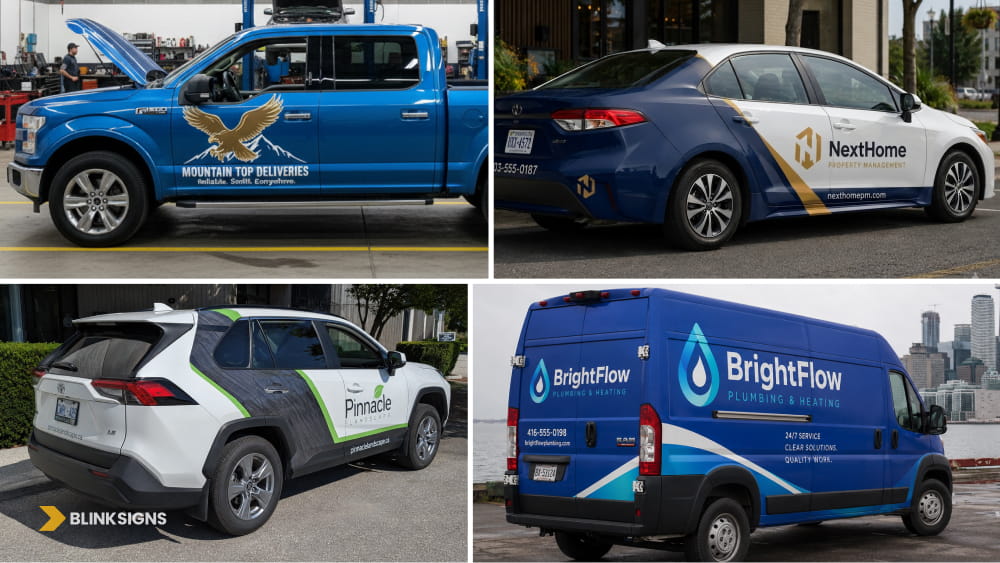
decals, spot wrap, partial wrap and full vehicle wrap
The best vehicle graphics option depends on visibility goals, budget, vehicle type, route activity, and the level of brand impact the business needs.
Choose decals when the goal is basic identification
Door decals or cut lettering can work well for businesses that need essential information displayed clearly.
They are useful for:
- Contractor vehicles
- Local service providers
- Compliance or fleet identification
- Small businesses with a limited budget
- Vehicles that do not require full advertising coverage
Decals are cost-efficient, but they create less visual impact than partial or full wraps.
Choose spot graphics when the vehicle needs stronger branding
Spot graphics are useful when a business wants more presence than door decals but does not need a full wrap.
They can include larger logos, rear-door graphics, website URLs, service lists, and selected printed visuals. This option can be effective for service vehicles, delivery vehicles, and small fleets that need a consistent brand appearance.
Choose a partial wrap when budget and visibility need to be balanced
Partial wraps are often the best middle ground for commercial vehicles. They can create strong visibility on the most important panels while controlling material and installation scope.
Partial wraps work well when:
- The existing vehicle color supports the design
- High-visibility panels can carry the message
- The business wants strong branding without full coverage
- The fleet needs consistency across several vehicle types
- Budget needs to stretch across multiple vehicles
Choose a full wrap when maximum visibility is the priority
A full wrap is appropriate when the vehicle is intended to function as a high-impact mobile brand asset.
Full wraps are often used for:
- Service vans
- Delivery vehicles
- Box trucks
- Trailers
- Franchise fleets
- Event vehicles
- High-traffic routes
The quote should define exactly which areas are included. Roofs, door jambs, inner edges, mirrors, bumpers, and complex recessed areas may be treated differently by different providers.
What Should Be Included in a Vehicle Wrap Quote?
A vehicle wrap quote should clarify the full scope of design, material, production, installation, and aftercare. Two quotes can appear similar while including very different levels of work.
| Quote Area | What a Complete Quote Should Clarify |
| Design | Whether design is included, the number of concepts, the revision rounds, and the proofing process |
| Vehicle template | Whether a make, model, year, and body-style template is included |
| Coverage map | Which panels are included and excluded, including roof, windows, bumpers, mirrors, and rear doors |
| Vinyl material | Film type, print method, finish, and suitability for the vehicle use case |
| Laminate | Whether laminate is included and what type is specified |
| Window graphics | Whether perforated window film is included and where it will be applied |
| Surface preparation | Cleaning, residue removal, old decals, and vehicle condition review |
| Removal | Whether old wrap or graphics removal is included or priced separately |
| Installation | Shop or on-site installation, labor, access, timing, and vehicle drop-off requirements |
| Fleet scheduling | Installation sequence, vehicle availability, location planning, and downtime expectations |
| Warranty and care | Material terms, artistry terms, cleaning guidance, and care instructions |
| Reorders | How replacement panels, damaged graphics, or new vehicles will be handled |
A complete quote should make the buyer confident about what is included, what is excluded, and what conditions could change the final estimate.
The most important principle is simple: compare scope before comparing price. A lower quote that excludes design, removal, laminate, surface prep, or installation coordination may not be less expensive once the complete project is considered.
Hidden Costs and Quote Exclusions
Vehicle wrap cost can change when the quote does not clearly define design, removal, surface preparation, installation conditions, or fleet scheduling. The most common budget surprises occur when the vehicle condition or project scope is not fully confirmed before production begins.
Old graphics or wrap removal
If a vehicle already has decals, lettering, or an old wrap, removal may be required before the new graphics can be installed.
Removal adds labor, and the cost depends on the age of the vinyl, the condition of the adhesive, the amount of coverage, the condition of the vehicle paint, and the amount of residue remaining after removal. Old or brittle vinyl can take longer to remove than newer graphics.
Adhesive residue and cleaning
If old graphics leave adhesive residue, the surface must be cleaned before new vinyl is installed.
Extra cleaning and prep time can increase the installation cost. If the residue is not removed correctly, the new graphics may not sit cleanly on the surface.
Poor paint condition
If the paint is peeling, oxidized, scratched, rusted, or failing, the wrap may not adhere properly or may not remove cleanly later.
A wrap should not be treated as a repair for damaged paint. Surface condition should be reviewed before the project is approved so the buyer understands any adhesion, appearance, or removal risks.
Dents, rust, and body damage
If the vehicle has dents, rust, deep scratches, or damaged panels, the wrap may show those imperfections after installation.
Body damage can also make trimming and finishing more difficult. In some cases, the vehicle may need repair before a high-quality wrap result is possible.
Late artwork changes
If the buyer changes the logo, phone number, website, colors, service list, or layout after proof approval, the design files may need to be revised.
If production has already started, artwork changes may also require reprinting panels, delaying installation, or creating additional material costs.
Missing vehicle information
If the make, model, year, roof height, wheelbase, trim, or body style is incorrect, the template may not match the actual vehicle.
Template errors can cause layout problems, panel misalignment, rework, and production delays. Fleet buyers should confirm vehicle data before design begins.
Vehicle availability issues
If a vehicle is not available at the scheduled installation time, the installation sequence may change.
Missed appointments can result in rescheduled installer visits, delayed batch completion, and additional coordination costs, particularly in fleet projects where multiple vehicles are being sequenced across locations.
Mixed vehicle fleets
If a fleet includes sedans, SUVs, pickups, vans, box trucks, and trailers, each vehicle type may require a separate layout.
The brand system must remain consistent while adapting to different body shapes, door styles, panel styles, window styles, and dimensions. This adds design and proofing work.
Rush production
If a wrap must be designed, printed, laminated, shipped, and installed on a compressed timeline, the project may require rush production or special scheduling.
Short timelines can increase cost and reduce the time available for proofing, vehicle condition review, and schedule coordination.
On-site installation constraints
If installation is performed outside a controlled shop environment, access, weather, lighting, dust, space, and temperature can affect the scope of work.
On-site installation may be possible for some projects, but it should be reviewed carefully before the quote is finalized.
Fleet Vehicle Wrap Costs
Fleet vehicle wrap costs are not just per-vehicle calculations. It is a program cost shaped by vehicle count, vehicle mix, design standardization, installation scheduling, location coordination, and long-term replacement planning.
A single van wrap may require a single design, template, production file, and installation date. A fleet wrap program may require the same brand system to be adapted across several vehicle types and installed in multiple phases or locations.
| Fleet Type | Planning Need | Main Cost Drivers |
| Small local fleet | One brand system across a few vehicles | Vehicle count, design reuse, local installation, scheduling |
| Regional fleet | Multiple vehicles across several branches or cities | Location coordination, install dates, vehicle availability, template variation |
| National fleet | Standardized branding across many markets | Multi-location scheduling, installer coordination, project tracking, replacement planning |
| Mixed vehicle fleet | Different vehicle types under one brand system | Separate templates, adjusted layouts, production batches, and brand consistency |
| Replacement vehicle program | New vehicles added over time | Reorder standards, stored artwork, matching prior graphics, and installation windows |
Small local fleets
A small local fleet may include a few vans, pickups, trailers, or service vehicles operating in one market.
The design can often be standardized across the fleet, but each vehicle still needs accurate measurements, template review, proofing, production, and installation scheduling.
Small-fleet buyers should confirm whether the quote includes all vehicles, design adaptations for each vehicle type, and installation sequencing.
Regional fleets
A regional fleet may operate across several branches, cities, or service areas.
Cost can change when vehicles are installed at different locations, drivers have different availability windows, or installation must be coordinated around operating schedules. Regional programs may also require multiple installation dates and separate delivery batches.
National fleet programs
A national fleet program requires a different level of coordination.
The buyer may need:
- Standardized design rules
- Vehicle-specific templates
- Location-level scheduling
- Multi-market installer coordination
- Production batches
- Progress tracking
- Replacement graphics
- Future vehicle onboarding
- Brand consistency across markets
BlinkSigns supports multi-location signage and fleet branding projects through coordinated installation planning and SignTrax project tracking. SignTrax helps provide visibility into project status across locations, production stages, installation milestones, and completion.
Mixed vehicle fleets
Mixed fleets are more complex because no single design fits every vehicle.
A business may have cargo vans, pickup trucks, trailers, SUVs, and box trucks in the same fleet. Each vehicle type needs a layout that fits its body shape while preserving the same brand identity.
This design adaptation is one of the reasons fleet wrap programs should be scoped as programs rather than as isolated single-vehicle purchases.
Replacement vehicle planning
Fleet wraps should account for vehicle turnover.
When vehicles are added, replaced, damaged, or rebranded, the company needs a repeatable process for producing matching graphics. Stored artwork, approved templates, color specifications, and reorder standards help reduce future production time.
SignTrax can help fleet managers track which vehicles have been wrapped, when graphics were installed, and when replacement planning may be needed.
Vehicle Wrap Lifespan and Maintenance
Vehicle wrap lifespan depends on material quality, laminate, installation quality, surface condition, climate exposure, washing method, parking conditions, road wear, and maintenance.
A wrap installed on a clean, well-prepared vehicle and maintained correctly is more likely to perform well than a wrap installed over poor paint, adhesive residue, or damaged panels.
What affects wrap service life?
Wrap performance can be affected by:
- Vinyl material quality
- Laminate type
- Surface preparation
- Installation quality
- Sun exposure
- Heat and humidity
- Snow, salt, or road debris
- Frequent washing
- Pressure washing
- Parking conditions
- Vehicle usage
- Cleaning chemicals
- Panel curves and recesses
The quote should clarify material and care expectations so the buyer understands how to maintain the wrap after installation.
Maintenance best practices
Vehicle wraps should be cleaned in accordance with the material and installer guidance provided for the project.
Common care recommendations may include gentle washing, avoiding harsh chemicals, limiting aggressive pressure washing, cleaning contaminants quickly, and inspecting edges or seams periodically.
For fleet buyers, maintenance guidance should be shared with drivers, operations teams, and branch managers so the graphics are cared for consistently across locations.
Removal timing
Wrap removal should also be planned.
Leaving vinyl on a vehicle far beyond its expected service window can make removal more difficult. Sun exposure, age, adhesive condition, and paint quality can all affect removal time and risk.
A fleet program should define how damaged or outdated graphics will be replaced to prevent the brand from becoming inconsistent over time.
Vehicle Wrap ROI and Mobile Brand Visibility
Vehicle wraps can create mobile brand exposure because vehicles are seen while driving, parked at job sites, sitting in traffic, or serving local routes. For many businesses, a wrapped vehicle becomes a moving brand asset that supports local awareness and service-area visibility.
However, vehicle wrap ROI should be modeled carefully. Impression estimates depend on route activity, traffic density, operating hours, parking locations, vehicle count, design readability, geography, and how often the vehicle is in public view.
A vehicle that travels through dense service areas every day may have greater exposure than one parked indoors or used only occasionally. A clear, readable wrap may also create more practical brand value than a visually busy design that is difficult to understand at a glance.
What to measure after a vehicle wrap project
Businesses can evaluate wrap performance by tracking:
- Branded search lift
- Direct website visits
- Phone calls
- QR code scans
- Promo-code usage
- Service-area inquiries
- Local lead source comments
- Fleet consistency
- Customer recall
- New customer source attribution at the point of intake
Vehicle wraps should not be judged only by installation cost. They should be reviewed as long-term brand assets that may support local awareness, route visibility, and sales enablement over time.
For deeper planning, use the Signage ROI Model or Commercial Signage ROI Worksheet to compare lifecycle cost, estimated exposure, and business value across signage investments.
How BlinkSigns Plans Vehicle Wrap Projects
BlinkSigns approaches vehicle wraps as commercial brand systems, not just vinyl installation projects.
Depending on the project scope, support may include discovery, design, proofing, production, installation, tracking, and future replacement planning.
Project discovery
The process begins by understanding the buyer’s goals, vehicle list, locations, timeline, budget expectations, brand requirements, and installation needs.
For fleet projects, discovery should also identify vehicle types, vehicle count, operating locations, driver schedules, and rollout timing.
Vehicle information review
Accurate vehicle details are essential before design begins.
Buyers should provide:
- Make
- Model
- Year
- Trim
- Wheelbase
- Roof height
- Body style
- Photos
- Existing graphics
- Surface condition notes
This information helps the design and production team prepare the right templates and identify potential installation issues early.
Brand and design planning
BlinkSigns can help translate a company’s brand into a vehicle-ready design system.
This may include logo placement, color treatment, typography, service messaging, call-to-action placement, rear visibility, side-panel readability, and layout consistency across vehicle types.
The goal is not only to make the vehicle attractive. The goal is to make the brand clear, readable, and consistent in real-world viewing conditions.
Proofing and approval
Proofing allows the buyer to review design placement, messages, colors, vehicle panels, coverage areas, and key contact information before production begins.
Approval should happen before printing and lamination. Changes after approval can create additional design, production, and scheduling costs.
Production
After approval, the graphics are printed, laminated, trimmed, organized, and installed.
For fleets, production may be batched by vehicle type, location, or installation phase.
Installation coordination
Installation coordination includes scheduling the vehicle, confirming the install location, preparing the surface, applying the graphics, trimming, finishing, and documenting completion.
Fleet installations may require phased scheduling to avoid removing vehicles from service all at once.
SignTrax project tracking
For fleet and multi-location programs, SignTrax can support project visibility across the rollout.
Location-level tracking can help teams monitor production status, installation timing, completion milestones, and replacement needs.
Replacement and rewrap planning
Commercial fleets change over time. Vehicles are added, retired, damaged, reassigned, or rebranded.
A strong wrap program keeps approved artwork, templates, specifications, and reorder rules available so future graphics can match the established brand system.
Request a Vehicle Wrap Estimate ↗
How to Prepare for a Vehicle Wrap Estimate
A more accurate vehicle wrap estimate starts with clear project information. Buyers do not need a final design before requesting a quote, but they should provide enough details to define the likely scope.
Prepare the following before requesting pricing:
- Number of vehicles
- Vehicle make, model, year, and trim
- Vehicle type, such as sedan, pickup, cargo van, box truck, or trailer
- Wheelbase and roof height, if applicable
- Photos of each vehicle
- Current vehicle color
- Existing graphics or old wrap, if any
- Desired coverage level
- Brand files, logo, colors, and fonts
- Required messaging, phone number, website, or service list
- Preferred installation location
- Required timeline
- Fleet locations
- Vehicle availability windows
- Whether removal is needed
- Whether future replacement graphics should be planned
For fleets, a vehicle spreadsheet can help organize the project. The sheet should include vehicle number, make, model, year, location, driver or branch, current graphics status, desired coverage, and installation timing.
Download the Fleet Wrap Quote Prep Checklist ➜]
***Pricing and Care Note***

The pricing ranges in this guide are provided for general budget planning only and should not be treated as fixed prices, guaranteed project costs, or final estimates. Vehicle wrap cost depends on coverage level, vehicle type, vehicle condition, design scope, vinyl material, laminate, surface preparation, removal needs, installation environment, installation schedule, fleet quantity, and project coordination requirements.

Wrap service life depends on material quality, laminate, surface condition, installation quality, climate, sun exposure, washing method, parking environment, road wear, and maintenance. Businesses should follow the care guidance provided for the selected materials and installation scope. Final pricing and care recommendations should be confirmed through a project-specific review before approval.
FAQs
How much does a vehicle wrap cost?
Vehicle wrap projects can range from approximately $200 or more for basic door decals or cut lettering to several thousand dollars for partial or full commercial wraps. Full wraps for larger commercial vehicles, vans, box trucks, and trailers usually cost more than simple decal packages because they require more design, material, laminate, installation time, trimming, and finishing.
Fleet wrap programs are custom quoted because the cost depends on vehicle count, vehicle mix, templates, scheduling, production batches, installation coordination, and replacement planning.
How much does a full vehicle wrap cost?
A full commercial wrap often falls in the several-thousand-dollar range, with the final estimate depending on the vehicle type, coverage map, material, laminate, design complexity, surface condition, and installation requirements.
The quote should clearly define whether the roof, mirrors, bumpers, door jambs, inner edges, windows, or recessed areas are included or excluded.
How much does a partial vehicle wrap cost?
A partial wrap generally costs less than a full wrap because it covers fewer panels and requires less material and installation time.
The estimate depends on which areas are covered, whether the design blends into the vehicle color, whether rear panels or windows are included, and how complex the installation is.
Are vehicle decals cheaper than wraps?
Yes. Door decals, cut lettering, and small spot graphics are usually less expensive than partial or full wraps because they use less material and require less installation time.
They are useful for basic business identification, but they create less visual impact than a larger commercial wrap.
What is the difference between a commercial wrap and a color-change wrap?
A commercial wrap is designed for business visibility. It may include a logo, service message, website, phone number, call to action, and fleet-standard layout.
A color-change wrap is usually cosmetic and focuses on finish, color, and personal appearance rather than business messaging or lead generation.
Why do vehicle wrap quotes vary so much?
Quotes vary because providers may include different scopes.
One quote may include design, template setup, premium vinyl, laminate, removal, surface preparation, installation, warranty guidance, and fleet scheduling. Another quote may include only basic print and installation. Buyers should compare the scope before comparing the price.
Does vehicle wrap design cost extra?
Design may be included in the quote or priced separately, depending on the provider and project scope.
A commercial wrap design can include brand review, vehicle template setup, layout concepts, readability planning, proofing, revisions, and production file preparation. Fleet programs may require separate layout adaptation for each vehicle type.
Does old wrap removal increase cost?
Yes. Old decals, lettering, or wraps may need to be removed before new graphics are installed.
Removal costs depend on the amount of coverage, the age of the graphics, the condition of the adhesive, the film type, the paint condition, and the required residue cleanup.
How long does a vehicle wrap last?
Vehicle wrap service life varies by material quality, laminate, installation quality, climate, sun exposure, washing method, parking conditions, road wear, and maintenance.
The quote should include guidance on materials and care so the buyer understands how to maintain the wrap after installation.
Can vehicle wraps damage paint?
Vehicle wraps installed on factory-painted surfaces by a qualified installer are generally designed to cover and protect the painted surface during use. However, outcomes depend on paint condition, material selection, installation method, and removal timing.
If paint is failing, peeling, rusting, oxidizing, repainted, or poorly bonded, wrap installation or removal can create risks. Vehicle condition should be reviewed before approval.
How should fleets budget for vehicle wraps?
Fleets should budget at the program level, not just per-vehicle.
A fleet wrap budget should account for vehicle count, vehicle mix, templates, design adaptation, production batches, installation scheduling, vehicle downtime, locations, replacement graphics, and future vehicle onboarding.
Can BlinkSigns manage fleet wrap programs across multiple locations?
Yes. BlinkSigns can support fleet wrap programs through design coordination, vehicle template planning, production management, national installer coordination, phased installation scheduling, SignTrax project tracking, and replacement planning.
Multi-location buyers should request a program-level estimate that accounts for vehicle locations, vehicle availability, installation windows, and long-term fleet changes.
Looking for a complete budgeting breakdown?
Vehicle wraps are just one piece of your brand’s physical presence. To map out your entire exterior or interior branding budget, explore our definitive Commercial Signage Cost Guide for exact pricing tiers across channel letters, monument signs, pylon displays, and architectural graphics.