
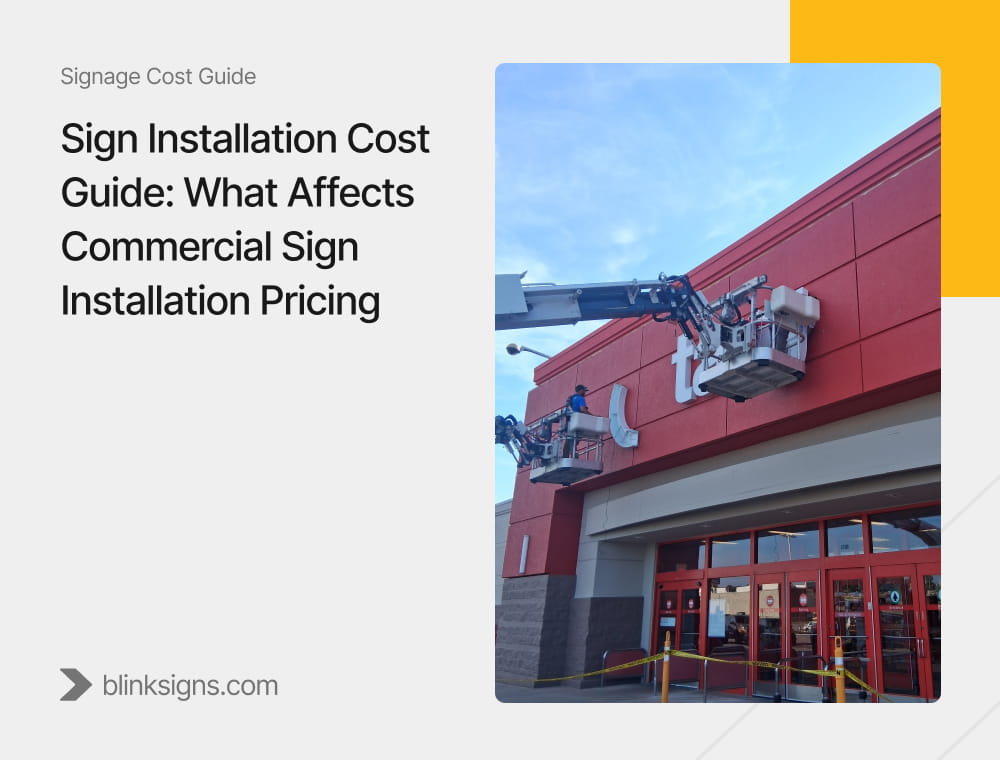
Sign Installation Cost Guide: What Affects Commercial Sign Installation Pricing
Commercial sign installation costs are among the most misunderstood parts of signage budgeting. A buyer may receive one quote for sign fabrication, another quote for field installation, and a third quote that combines fabrication, installation, permits, access equipment, and site coordination. Without knowing what each quote includes, it becomes difficult to compare options accurately.
A sign installation estimate is not only labor to place a sign on a wall, window, vehicle, post, monument base, or roadside structure. Depending on the sign type and property, installation may involve site review, mounting preparation, access equipment, electrical coordination, removal of old signage, permit-related requirements, landlord criteria, safety planning, and site-specific restrictions.
This guide explains what affects commercial sign installation pricing, why installation costs vary by sign type and property condition, and how buyers can compare installation quotes based on the total scope rather than labor costs alone.
How much does sign installation cost?
Commercial sign installation costs depend on the sign type, installation height, mounting surface, sign weight, electrical access, permit requirements, removal needs, site access, and whether lift equipment, bucket trucks, cranes, traffic coordination, or after-hours work is required.
A simple interior sign installation may involve limited field labor and basic mounting coordination. An exterior illuminated sign, monument sign, pylon sign, cabinet sign, channel letter set, or blade sign may require additional planning around mounting, electrical access, access equipment, permits, site restrictions, and service access.
The most important buyer question is not only, “How much does installation cost?” The better question is, “What installation scope is included in this quote?”
A complete installation estimate may account for:
| Installation factor | Why does it affect pricing |
| Sign type | Different sign formats require different mounting, equipment, and access planning |
| Sign size and weight | Larger or heavier signs may require more labor, stronger mounting, or equipment support |
| Mounting height | Elevated installations may require lifts, bucket trucks, cranes, or additional safety coordination |
| Mounting surface | Brick, concrete, EIFS, metal panels, glass, drywall, and ground conditions require different planning |
| Electrical access | Illuminated signs may require suitable power near the installation point |
| Permits and approvals | Local rules, landlord criteria, or right-of-way access can affect timing and scope |
| Old sign removal | Removal, disposal, patching, sealing, and wall repair may add to the field scope |
| Site access | Sidewalks, parking lots, drive lanes, canopies, overhead lines, and restricted access can affect equipment |
| Scheduling constraints | Active businesses may require after-hours or off-peak installation |
| Number of locations | Multi-location projects require coordination across different site conditions and local requirements |
Because these variables change from property to property, commercial sign installation is best evaluated through scope categories rather than a single public price range.
What sign installation pricing actually includes
A sign installation quote may include more than the physical placement of a sign. Depending on the project type, it may include preparation, coordination, field labor, access equipment, mounting hardware, site protection, electrical coordination, removal, disposal, and final placement review.
| Installation scope item | What it means | Buyer note |
| Site review | Review of sign location, mounting surface, access, height, and visible site constraints | Helps identify conditions that may affect the installation scope |
| Field labor | Labor required to place, mount, align, secure, or apply the sign | Varies by sign type, size, height, and site conditions |
| Mounting hardware | Fasteners, brackets, raceways, plates, frames, anchors, or supports where specified | May be included, excluded, or tied to the sign fabrication scope |
| Access equipment | Lifts, bucket trucks, cranes, scaffolding, or platforms where needed | Often changes based on height, terrain, clearance, and access restrictions |
| Electrical coordination | Coordination around available power or field hookup for illuminated signs, where relevant | New electrical routing may require separate qualified professionals |
| Permit-related requirements | Documentation, installation constraints, or inspections tied to local approval | Permit fees and approval timelines vary by jurisdiction |
| Old sign removal | Removal of existing sign, graphics, letters, cabinet, post, or structure | May also involve disposal, patching, sealing, or wall repair |
| Site protection | Protection of walls, windows, flooring, landscaping, sidewalks, or nearby customer areas | Important for active retail, office, hospitality, or public-facing environments |
| Final placement check | Review of alignment, placement, visibility, and installed condition | Helps confirm the sign matches the approved placement and scope |
Not every installation quote includes every item. A vendor may quote installation only, while another may quote a fully installed project. A lower number may exclude access equipment, permit fees, electrical work, removal of an old sign, wall repair, or after-hours scheduling.
Buyers should ask for a clear breakdown of what is included, what is excluded, and what remains to be confirmed after site review.
Sign fabrication cost vs. sign installation cost.
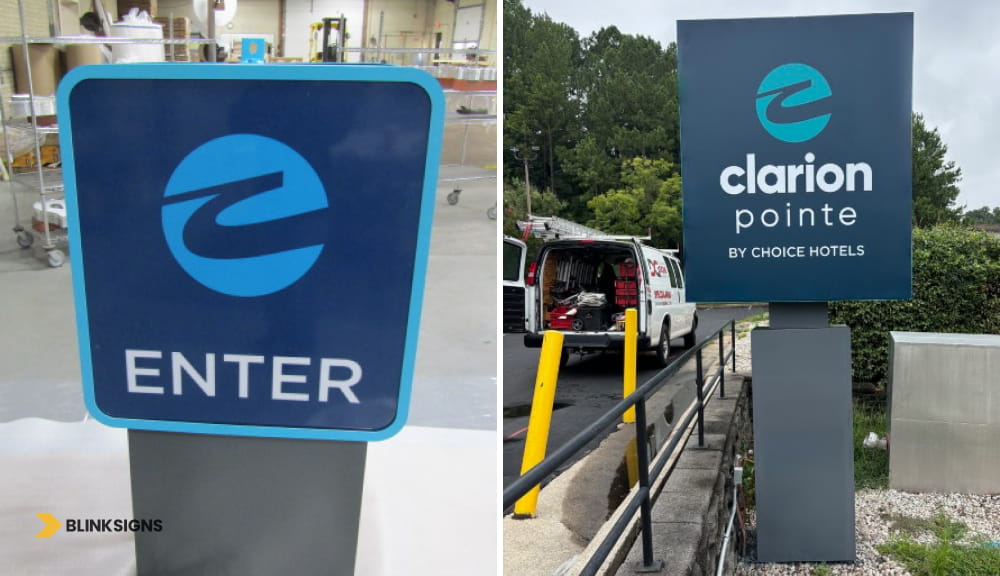
Sign fabrication and sign installation for Clarion pointe
A sign fabrication cost and a sign installation cost are not the same. Fabrication refers to producing the sign. Installation refers to placing the sign at the property. A fully installed project may combine both, but it can also include additional coordination items.
This distinction matters because many online sign prices are product-focused. They may reflect the cost of producing a sign face, letters, panel, cabinet, vinyl, or display element. They may not reflect what it takes to install that sign safely and correctly at a specific property.
Fabrication-only pricing
Fabrication-only pricing usually covers the manufactured sign asset. It may include materials, sign faces, graphics, letters, lighting components, cabinet structure, vinyl, panels, or selected hardware, depending on the sign type.
It usually does not include installation labor, access equipment, permits, removal, electrical coordination, wall repair, traffic control, or after-hours scheduling unless those items are clearly listed.
Installation-only pricing
Installation-only pricing usually covers the labor and equipment needed to install a sign that has already been produced. This may apply when a buyer already owns a sign, when a brand ships signs to multiple locations, or when a fabrication partner separates production and field installation.
Installation-only pricing may still depend on site conditions, mounting height, wall type, electrical access, equipment needs, and whether old signage must be removed.
Fully installed project pricing
Fully installed project pricing may include fabrication, selected mounting hardware, installation labor, access equipment, and some coordination items. It is usually the most useful quote type for buyers who want to understand the total project scope.
However, even a fully installed quote may exclude certain items, such as permit fees, new electrical routing, wall remediation, sidewalk closure, traffic control, or after-hours work. These exclusions should be reviewed before approval.
Retrofit or service pricing
Retrofit or service pricing applies when an existing sign is being updated, repaired, removed, converted, or reused. This may include LED retrofits, face replacements, vinyl updates, lighting services, bracket reviews, or cabinet repairs.
The cost depends heavily on the condition of the existing sign and the accessibility of the work area.
fabrication-only vs. installation-only vs. fully installed vs. retrofit
This is the most important comparison for buyers because it explains why two sign quotes may appear to describe the same project while actually covering different scopes.
| Quote type | What it may include | What may be excluded | Best-fit buyer use |
| Fabrication-only quote | Sign body, faces, letters, graphics, lighting components, selected hardware, packaging | Installation, permits, electrical work, access equipment, old sign removal, wall repair, traffic control | Useful when installation is being handled separately or when comparing production scope |
| Installation-only quote | Field labor, mounting, placement, equipment use, selected hardware, and site setup | Sign fabrication, design, permit support, new electrical routing, removal, and wall repair | Useful when the sign has already been produced or supplied by a brand |
| Fully installed project quote | Fabrication, selected hardware, installation labor, access equipment, and selected coordination items | Permit fees, electrical routing, wall remediation, traffic control, after-hours work, or special approvals may still be separate | Useful for buyers who need a broader project budget |
| Retrofit or service quote | Field update to an existing sign, such as LED retrofit, face replacement, vinyl update, repair, or removal | New sign fabrication, major structural changes, permit updates, electrical upgrades, or wall repair may be separate | Useful when the existing sign may be reused, repaired, or partially updated |
Buyers should not assume that the highest quote is excessive or that the lowest quote is incomplete. The right comparison depends on the scope. A fabrication-only number should not be compared directly against a fully installed project estimate.
Before approving any quote, buyers should ask:
| Buyer question | Why it matters |
| Is this fabrication-only, installation-only, fully installed, or a retrofit scope? | Prevents mismatched quote comparisons |
| Is the sign itself included? | Some quotes cover only the field installation |
| Is installation included? | Some product quotes exclude field labor and equipment |
| Is access equipment included? | Lifts, bucket trucks, or cranes may be required depending on height and site access |
| Are permits and permit fees included? | Permit support and government fees may be handled separately |
| Is electrical coordination included? | Illuminated signs may require suitable power or separate electrical work |
| Is old sign removal included? | Removal, disposal, patching, sealing, and wall repair may affect the total cost |
| Are site restrictions included? | Sidewalks, drive lanes, parking, canopies, or after-hours requirements can change the scope |
This quote-type comparison should be used across all commercial sign types, including channel letters, cabinet signs, monument signs, pylon signs, blade signs, ADA signs, lobby signs, window graphics, and vehicle graphics.
📋 Audit Your Signage Estimates: Eliminate hidden labor gaps and clarify line-item exclusions across alternative vendor bids by downloading our Free Sign Installation Quote Comparison Worksheet.
Sign installation cost by sign type.
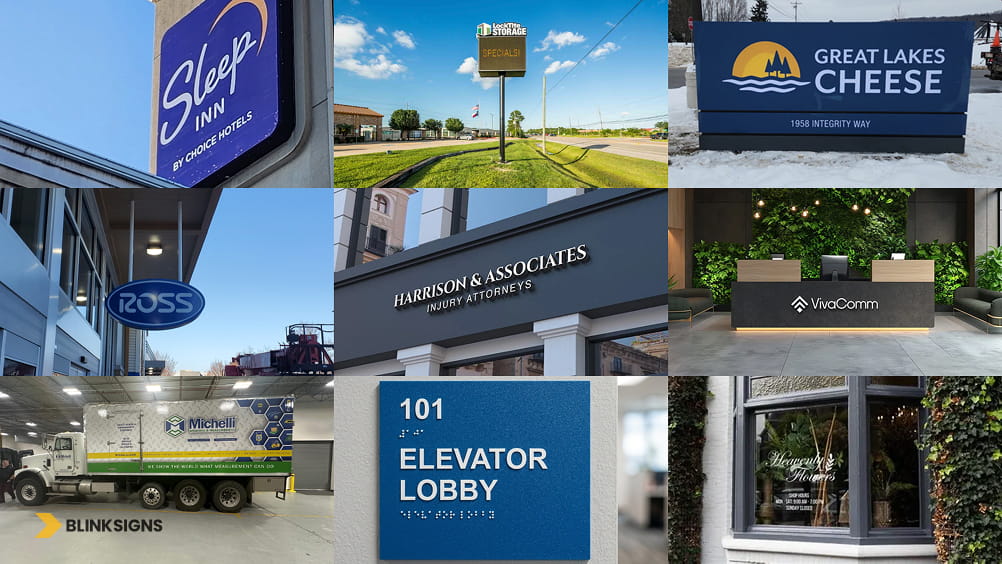
Different type of signs, including; cabinet, channel letters, pylon, monument, ADA and much more
Different sign types create different installation requirements. A vinyl window graphic does not require the same field planning as a pylon sign. A lobby sign is not installed the same way as illuminated channel letters. A monument sign may involve ground conditions, while a blade sign may involve projection distance and sidewalk access.
| Sign type | Installation scope | Main cost drivers | Buyer note |
| Channel letters | Mounting individual letters or raceway-mounted letters to a wall or facade | Letter count, wall type, installation height, electrical access, layout complexity | Each letter cost can add mounting, alignment, and electrical coordination complexity. Review full layout budgets in our channel letter sign cost guide. |
| Cabinet signs | Installing wall-mounted, monument-mounted, or freestanding sign cabinets | Cabinet size, weight, illumination, mounting height, and wall or structure condition | Fabrication price may not include installation, equipment, or electrical coordination, see our cabinet sign cost guide. |
| Monument signs | Installing low-profile freestanding signs at property entrances or roadside locations | Foundation, base materials, ground conditions, electrical access, landscaping, permits | Installation may involve ground preparation and site coordination. For site-work parameters check monument sign cost guide. |
| Pylon signs | Installing taller freestanding roadside signs or sign faces within existing pylon structures | Height, foundation context, crane access, electrical access, permits, sign face access | Often requires broader site, equipment, and permit planning. Map out roadside structures via our pylon sign cost guide. |
| Blade signs | Installing projecting signs from a facade or bracket system | Projection distance, bracket design, wall material, clearance, sidewalk access | Facade condition and public access areas can affect the scope. For better sign costing check out blade sign cost guide. |
| ADA signs | Installing code-related interior signs at doors, rooms, restrooms, exits, or wayfinding points | Quantity, placement accuracy, mounting surface, building access | Usually, there are lower equipment needs, but placement consistency is important, review our ADA sign cost guide to review product pricing before budgeting field labor. |
| Lobby signs | Installing interior brand signs behind reception desks, on feature walls, or in office entries | Wall material, sign weight, finish protection, mounting pattern, and access | Often tied to brand presentation and surface protection |
| Window graphics | Applying vinyl, film, decals, or privacy graphics to glass | Glass size, surface prep, film type, access, weather, interior or exterior application | Glass cleanliness and site conditions affect installation quality |
| Vehicle graphics | Applying decals, lettering, partial wraps, or full wraps to vehicles | Vehicle size, surface condition, coverage level, prep, controlled environment | The installation environment and surface condition affect the finish quality. Read about wrapping visibility variables in our guide to vehicle wrap ROI and visibility impact. |
This table should not be read as a price ladder. A small exterior sign in a difficult location may require more coordination than a larger interior sign in an accessible environment. Installation costs depend on the site conditions, not just the sign type.
What changes a sign installation estimate?
A sign installation estimate can change when field conditions are confirmed. The most common drivers include height, weight, mounting surface, electrical access, removal of an old sign, permits, access restrictions, weather, and scheduling requirements.
| Cost driver | Why does it change pricing | Buyer planning note |
| Installation height | Higher signs may require lifts, bucket trucks, cranes, or additional safety planning | Provide photos and approximate mounting height before quoting |
| Sign weight | Heavier signs may require more labor, stronger mounting, or equipment support | Weight affects handling, mounting, and equipment planning |
| Mounting surface | Brick, concrete, EIFS, metal panels, glass, drywall, and ground conditions require different approaches | Surface type should be confirmed early |
| Electrical access | Illuminated signs may require suitable power near the installation point | Missing or distant power may require separate electrical coordination |
| Old sign removal | Removal, disposal, patching, sealing, and repair may add scope | Existing sign photos help clarify removal needs |
| Permit requirements | Local rules may affect timing, documentation, and installation conditions | Permit approval timelines and outcomes vary |
| Access restrictions | Sidewalks, drive-thrus, parking lots, canopies, and busy entrances may affect scheduling | Site access should be reviewed before the installation date |
| After-hours work | Some active business sites require night, weekend, or off-peak installation | Scheduling constraints can affect labor planning |
| Weather and seasonality | Exterior work may be affected by rain, wind, temperature, or site safety | The timeline should account for weather-sensitive work where relevant |
| Multi-location rollout | Each site may have different code, landlord, wall, and access conditions | Standardized signs still require site-by-site review |
The same sign can have different installation costs at two locations because the properties are different. One storefront may have a clear wall, suitable power, easy lift access, and no old sign to remove. Another may have a busy sidewalk, high mounting height, poor wall condition, landlord restrictions, and missing electrical access.
That is why a reliable installation estimate depends on both the sign specification and the site conditions.
📥 Assess Your Site Risk: Pinpoint whether your property's facade material, mounting elevations, or power drops will complicate field labor by downloading the free Sign Installation Cost Driver Matrix.
Wall-mounted sign installation cost factors
Wall-mounted signs are among the most common commercial sign installations. This category includes channel letters, cabinet signs, dimensional letters, wall logos, tenant signs, blade signs, routed panels, plaques, and illuminated storefront signs.
Wall-mounted installation cost depends on the sign’s size, weight, mounting pattern, height, wall material, electrical access, and surface condition.
Wall material
Different wall surfaces require different installation planning.
| Wall surface | Planning considerations |
| Brick masonry | Common for storefronts and older buildings, the mortar condition and brick integrity should be reviewed |
| Concrete or CMU | Often suitable for many exterior sign applications, subject to wall condition and mounting requirements |
| EIFS or Dryvit | Attachment planning should account for the structural layer behind the finish system |
| Metal panels | May require coordination around cladding, seams, warranties, and hidden framing |
| Glass storefront systems | Attachment options may be limited and may require property-owner review |
| Wood-framed walls | Framing condition, backing, and moisture history can affect the scope |
| Interior drywall | Blocking, stud location, sign weight, and finish protection should be considered |
Installation height
A sign mounted at eye level inside a lobby has a different installation profile than a cabinet sign installed above a storefront sign band. Height affects equipment, labor, safety planning, and service access.
Higher wall-mounted signs may require lifts, bucket trucks, scaffolding, or other access equipment. If the installation area is above a sidewalk, drive lane, entryway, patio, canopy, or landscaped area, additional coordination may be required.
Mounting pattern
Some signs use a simple panel mount. Others require multiple mounting points, raceways, standoffs, brackets, or individual letter placement.
Channel letters can require careful layout because each letter must align with the approved design. Cabinet signs may involve fewer visible elements, but weight, cabinet depth, and electrical access can increase field planning. Blade signs add projection distance and bracket review.
Electrical access
Illuminated wall signs may require suitable power near the installation location. If power is unavailable, separate electrical coordination may be required by qualified professionals. The electrical scope should be clarified before scheduling fabrication and installation.
Freestanding sign installation cost factors
Freestanding signs are installed in the ground or on independent structures rather than directly on a building wall. This category includes monument signs, pylon signs, post-and-panel signs, directional signs, roadside signs, and some multi-tenant property signs.
Freestanding sign installation often involves site conditions that differ from those for wall signs, including ground preparation, utility awareness, foundation planning, landscaping coordination, traffic flow, and access equipment.
| Freestanding sign factor | Why it matters |
| Ground conditions | Soil, pavement, landscaping, and drainage can affect installation planning |
| Foundation or base | Monument and pylon signs may require foundation-related planning |
| Underground utilities | Utility checks may be required before digging or placement |
| Sign height | Taller signs may require more equipment and site coordination |
| Electrical access | Illuminated freestanding signs may require power routing to the sign location |
| Traffic and visibility | Roadside signs may involve access near drive lanes, parking areas, or property entries |
| Landscaping | Existing plantings, irrigation, curbs, and hardscape may affect placement |
| Permits | Freestanding signs may have zoning, setback, size, height, and illumination limits |
Monument signs
Monument sign installation may involve base preparation, footing or foundation coordination, panel or cabinet placement, electrical access, and landscape protection. The installation scope depends on whether the monument is new, being refaced, being repaired, or receiving new tenant panels.
A monument sign near a property entrance may also require coordination around drive lanes, sidewalks, irrigation, lighting, or landscaping.
Pylon signs
Pylon sign installation can involve taller structures, sign face replacement, cabinet service, crane access, electrical coordination, permit review, and site safety planning. In some cases, the scope may involve replacing faces within an existing pylon rather than installing a new structure.
Because pylon signs are usually elevated and roadside-facing, access equipment and site safety planning can be significant cost drivers.
Post and panel signs
Post-and-panel signs may be simpler than large illuminated freestanding signs. However, the installation still depends on ground conditions, placement, sign size, post depth, visibility, local code, and whether the sign is temporary or permanent.
Buyers should not assume that all ground signs are simple. The site context matters.
Illuminated sign installation cost factors
Illuminated sign installation adds electrical and service-access considerations to the field scope. This applies to channel letters, cabinet signs, blade signs, monument signs, pylon signs, neon signs, LED signs, and other illuminated exterior or interior signs.
Electrical planning should remain focused on scope and responsibility. Buyers do not need wiring instructions. They need to know whether suitable power is available, who is responsible for electrical coordination, and whether electrical access affects the schedule or budget.
| Illuminated sign factor | Why it matters |
| Existing power | Suitable power near the sign location can simplify coordination |
| New electrical routing | May require separate qualified electrical professionals |
| Junction box location | Affects where the sign can connect to available power |
| Power supplies | LED systems need accessible power supplies for service |
| Transformers | Neon systems may involve transformer planning and specialty service |
| Controls or timers | Operating schedules may require coordination with building systems |
| Service access | Future lighting maintenance depends on accessibility |
| Weather exposure | Exterior components need weather-appropriate planning |
| Permits | Illuminated signs may require additional permit documentation |
LED illuminated signs
LED illuminated signs may include LED modules, power supplies, wiring paths inside the sign, and service access points. Power supply placement and access should be considered during design because future service may be more difficult if components are not accessible.
Neon signs
Traditional neon signs may require specialty fabrication and service planning. Neon systems can involve glass tubes, transformers, protection housings, and access planning. Buyers should consider service availability in their market before specifying traditional neon for a commercial installation.
External lighting
Some signs are lit with external fixtures such as gooseneck lights or spotlights. These fixtures require their own placement, mounting, power coordination, glare review, and maintenance access.
Interior sign installation cost factors
Interior sign installation may appear simpler than exterior installation, but the details still matter. Lobby signs, ADA signs, wayfinding signs, wall graphics, dimensional letters, donor walls, plaques, directories, and interior brand signs all require accurate placement and surface-sensitive installation.
Interior installation costs depend on quantity, sign weight, mounting surface, building access, after-hours requirements, wall finish protection, and whether installation must comply with code-related placement rules.
| Interior sign type | Installation considerations |
| ADA signs | Placement height, door-side location, consistency, quantity, and surface type |
| Lobby signs | Wall finish, sign weight, mounting pattern, reception access, and brand presentation |
| Wayfinding signs | Consistent placement across floors, hallways, rooms, and common areas |
| Dimensional letters | Layout accuracy, wall finish, mounting method, and alignment |
| Wall graphics | Surface preparation, wall texture, paint condition, and installation environment |
| Directories | Mounting height, update access, wall strength, and visibility |
| Plaques | Surface type, mounting hardware, alignment, and finish protection |
ADA sign installation
ADA signs are often simpler in design, but placement accuracy matters. Quantity, building layout, room count, wall type, door-side placement, and access scheduling can all affect the installation scope.
Lobby sign installation
Lobby signs often require careful handling because they are installed in visible, finished spaces. The wall surface may be drywall, stone, wood, glass, tile, concrete, or a feature wall. Surface protection, alignment, and clean installation are important.
Wayfinding and interior systems
Wayfinding installations may involve many signs across multiple floors, corridors, departments, or rooms. The cost depends on quantity, placement plan, building access, tenant coordination, and whether installation must occur during business hours or after hours.
Old sign removal, disposal, and wall repair
Old sign removal is one of the most common installation cost variables buyers overlook. A replacement project is not only the installation of a new sign. It may also require removal of the existing sign, safe handling of old components, disposal, coordination of electrical disconnection, patching, sealing, paint matching, surface repair, or review of the underlying wall or structure.
The removal scope depends on the sign type, mounting method, age, condition, height, electrical connection, and the surface behind the sign.
| Removal factor | Why does it affect the installation scope |
| Existing sign type | Channel letters, cabinets, pylons, monuments, graphics, and interior signs require different removal methods |
| Mounting method | Adhesive, studs, brackets, anchors, raceways, posts, and frames leave different surface conditions |
| Installation height | Elevated signs may require lifts, bucket trucks, or additional site control |
| Electrical components | Illuminated signs may require electrical coordination before removal |
| Surface condition | Old signs may hide wall staining, holes, water damage, faded paint, or damaged cladding |
| Disposal requirements | Old faces, cabinets, lighting components, posts, vinyl, or debris may require handling and disposal |
| Replacement timing | Some businesses need removal and new installation coordinated in the same window |
Wall repair and surface restoration
When an old wall sign is removed, the exposed surface may not be ready for a new sign. Common issues include old anchor holes, faded paint outlines, cracked masonry, sealant residue, rust staining, adhesive residue, or damaged panels.
A new sign may cover some of the old surface area, but buyers should not assume that all wall repair is included in the installation quote. Surface restoration may require separate coordination, especially when painting, masonry repair, stucco repair, EIFS repair, or cladding replacement is needed.
Cabinet, channel letter, and raceway removal
Wall-mounted cabinet signs, channel letters, and raceways may leave multiple penetration points after removal. If the new sign uses a different mounting pattern, the old holes may need to be sealed or patched before installation.
For illuminated signs, electrical disconnection and safe handling of existing wiring should be coordinated by qualified professionals where required.
Monument and pylon sign removal
Freestanding sign removal may involve different planning than wall sign removal. Monument signs may involve bases, masonry, panels, cabinets, landscaping, lighting, or tenant panels. Pylon signs may involve elevated faces, cabinets, poles, foundations, electrical components, and access equipment.
A project may involve replacing only sign faces, removing an old cabinet from an existing structure, or removing an entire freestanding sign. These scopes should be separated clearly in the quote.
Vinyl, window graphic, and wall graphic removal
Graphic removal can also affect installation cost. Old vinyl may leave adhesive residue, ghosting, or staining, or require glass cleaning. Vehicle graphics may require surface preparation before new graphics are applied. Wall graphics may cause paint to peel if the wall was not properly prepared or if the graphic has been in place for a long time.
Buyers should ask whether removal, surface cleaning, adhesive removal, and preparation for new graphics are included. For comprehensive vinyl handling data, explore our safe vehicle wrap removal techniques guide.
Access equipment and installation height
Installation height is a major driver of the scope of sign installation. A sign installed at eye level inside a lobby does not require the same planning as a channel letter set above a storefront, a cabinet sign above a canopy, a blade sign over a sidewalk, or a pylon sign face high above a parking lot.
Access equipment may include ladders, lifts, bucket trucks, cranes, scaffolding, platforms, or specialized site-access planning, depending on the project. The exact equipment depends on sign height, sign weight, site layout, surface conditions, access to equipment, and local safety requirements.
| Access factor | Why it matters |
| Mounting height | Higher signs may require lifts, bucket trucks, cranes, or additional field coordination |
| Sign size and weight | Larger or heavier signs may require equipment-assisted handling |
| Ground surface | Sloped pavement, landscaping, gravel, curbs, or uneven ground can affect equipment placement |
| Sidewalk or pedestrian zone | Work over public areas may require protection or closure coordination |
| Drive lanes or parking lots | Active traffic areas may require scheduling, cones, access control, or off-peak work |
| Canopies and awnings | Covered entries may limit equipment reach and placement |
| Overhead obstructions | Utility lines, trees, signs, building overhangs, or canopies may restrict access |
| Interior access | Elevators, stairs, doors, ceiling height, and finished surfaces can affect interior installation |
Lifts and bucket trucks
Lifts and bucket trucks are commonly used for installing elevated exterior signs. They may be needed for channel letters, cabinet signs, blade signs, pylon sign faces, building signs, and high wall graphics.
Equipment access should be reviewed before installation. A site may have a sign location that is visible and reachable in theory, but difficult to access because of parked vehicles, narrow lanes, landscaping, canopies, drive-thrus, sloped pavement, or overhead obstructions.
Cranes and larger equipment
Some larger exterior signs may require crane support or specialized handling equipment. This is more common for large cabinets, pylon signs, monument components, oversized architectural signs, and elevated sign structures.
Crane or specialized equipment requirements should be confirmed before scheduling installation. These costs are usually tied to site conditions, equipment availability, sign size, sign weight, access, and local requirements.
Interior access constraints
Interior signs can also have access challenges. Large lobby signs, donor walls, directories, and dimensional lettering may need to be moved through elevators, narrow doors, finished corridors, or occupied office areas.
Interior installation planning should account for building access, surface protection, dust control where relevant, elevator availability, business hours, tenant coordination, and noise restrictions.
Permits, landlord rules, and site restrictions
Commercial sign installation may be affected by municipal permits, landlord rules, shopping center criteria, historic district review, public right-of-way access, insurance requirements, property management policies, and inspection requirements. These items can affect the timeline, design, installation method, access, and final approval.
Municipal permits
Many exterior signs require local permit review before installation. Permit requirements may vary by sign type, sign size, illumination, height, placement, zoning district, and property type.
Municipal rules may affect:
| Permit area | Possible effect |
| Sign size | Limits on face area, total sign area, or tenant frontage allocation |
| Sign height | Limits or clearance requirements for wall signs, blade signs, pylons, or monuments |
| Sign placement | Approved zones on the facade, property, canopy, or freestanding structure |
| Illumination | Lighting type, brightness, operating hours, or documentation requirements |
| Projection | Limits for signs that extend from the building or over pedestrian areas |
| Freestanding signs | Setbacks, height limits, foundations, landscaping, and visibility rules |
| Historic districts | Design review before installation approval |
| Inspections | Final inspection or documentation requirements after installation |
Permit timelines and outcomes are not guaranteed. Buyers should account for local review before committing to installation dates tied to openings, tenant moves, rebrands, or campaigns.
Landlord and shopping center rules
For leased properties, landlord criteria may control sign size, materials, colors, mounting location, illumination, raceway use, cabinet shape, blade sign brackets, window coverage, or installation hours.
Shopping centers, office parks, medical campuses, airports, malls, and mixed-use properties often have sign criteria separate from municipal rules. A sign may require landlord approval before submitting a permit or scheduling installation.
Buyers should provide the landlord with the sign criteria as soon as they are available.
Historic districts and special design areas
Historic districts, downtown corridors, architectural review zones, and entertainment districts may review materials, illumination, color, bracket style, sign scale, projection, and placement. These reviews can affect both fabrication and installation timing.
Approval outcomes vary by board and jurisdiction. Buyers should confirm whether the property is located in a historic district or special review area before finalizing the sign design.
Public sidewalks, drive lanes, and right-of-way access
Sign installation near sidewalks, roads, drive-thrus, parking lots, or city-controlled areas may require special access planning. Some projects may need pedestrian protection, traffic coordination, temporary closures, after-hours work, or additional approvals.
This is especially important for blade signs, awning signs, storefront signs, pylon signs, and signs installed above public areas.
Hidden installation costs and quote exclusions
The sign itself does not cause many gaps in installation quotes. They are caused by items that were not included in the original scope. Buyers should ask direct questions before comparing estimates.
| Buyer question | Why it matters |
| Is old sign removal included? | Removal, disposal, sealing, patching, and surface preparation may be separate |
| Is wall repair included? | Paint matching, masonry repair, stucco repair, EIFS repair, or cladding repair may require separate coordination |
| Is electrical work included? | Illuminated signs may require suitable power or separate coordination by qualified professionals |
| Are permit fees included? | Government fees may be pass-through costs rather than part of the base quote |
| Is permit support included? | Documentation, drawings, submission support, and revisions may be handled differently |
| Is access equipment included? | Lifts, bucket trucks, cranes, or scaffolding may be quoted separately |
| Is sidewalk or traffic control included? | Public access areas may require additional coordination or approvals |
| Is after-hours installation included? | Active retail, office, healthcare, or hospitality sites may restrict daytime work |
| Is site protection included? | Finished floors, walls, glass, landscaping, and customer areas may need protection |
| Is disposal included? | Old signs, lighting components, posts, vinyl, or debris may require handling |
| Is the engineering review included where required? | Some projects may need additional review based on sign type, size, weight, height, or local code |
| Are landlord revisions included? | Property criteria may require design or placement changes |
| Are weather delays addressed? | Exterior work may be affected by wind, rain, temperature, or unsafe site conditions |
| Are multi-location differences included? | Each site may have different wall, permit, electrical, landlord, and access conditions |
This table should be used during quote review, not after the project is already in production. The best time to identify exclusions is before approval.
Multi-location installation planning
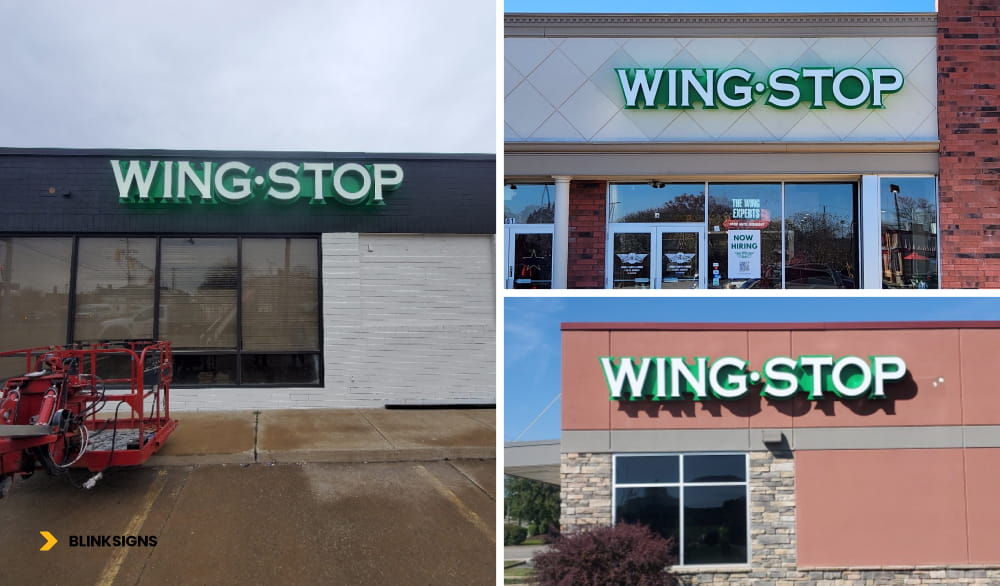
Multi-location Signage Installation for Wingstop
Multi-location installation projects require a different planning approach than single-site installations. A franchise, retail chain, restaurant group, healthcare network, hotel brand, storage company, or regional service business may want a single, consistent sign package across multiple properties. However, installation conditions still vary by location.
A standardized sign design does not guarantee a standardized installation scope. Corporate buyers should cross-reference these parameters with the franchise signage playbook for institutional guidelines.
| Multi-location variable | Why it matters |
| Local code | Each jurisdiction may have different sign sizes, illumination, permits, and placement rules |
| Landlord criteria | Shopping centers and leased properties may impose different requirements |
| Wall conditions | Facade material, height, access, and old sign condition vary by site |
| Electrical access | Some locations may have suitable power, while others may need additional coordination |
| Existing signs | Removal, reuse, or retrofit options differ by property |
| Installation access | Parking, sidewalks, drive-thrus, canopies, and traffic patterns vary |
| Scheduling | Installations may need to align with openings, rebrands, leases, or business hours |
| Weather and seasonality | Regional conditions can affect exterior installation timing |
| Documentation | Site photos, measurements, permits, approvals, and completion records must be organized |
Why multi-location installation needs a hub process
A rollout may use the same brand standards, sign drawings, and product specifications across multiple sites, but every location still needs local review. One storefront may allow a wall-mounted cabinet sign with easy lift access. Another may require landlord revisions, missing electrical access, after-hours scheduling, or sidewalk coordination.
A centralized installation planning process helps track location-specific requirements without losing brand consistency.
Site readiness
Before scheduling installation across multiple locations, buyers should confirm site readiness at each location. A location may not be ready if the wall is incomplete, electrical access is missing, landlord approval is pending, permits are not approved, old signage has not been removed, or construction access is restricted.
Site readiness checks may include:
| Readiness item | Why it helps |
| Confirmed sign location | Prevents installation at the wrong wall, entrance, or tenant space |
| Approved drawings | Reduces the risk of field changes |
| Permit status | Helps avoid scheduling before approval |
| Electrical access | Clarifies whether illuminated signs can be connected |
| Existing sign status | Identifies removal or reuse needs |
| Site photos | Helps verify access, wall condition, and obstructions |
| Landlord approval | Helps avoid rejection by property management |
| Installation window | Aligns work with business hours, construction schedules, or openings |
Rollout consistency
The goal of a multi-location installation plan is to maintain brand consistency while adapting to local conditions. That may involve standard sign specifications, consistent documentation, site-by-site approvals, coordinated schedules, and clear communication across stakeholders.
Sign installation, maintenance, and service access.
Installation planning should consider future service needs. A sign that is difficult to access during installation may also be difficult to inspect, clean, repair, or update later.
Service access matters for illuminated signs, elevated signs, freestanding signs, tenant panels, blade signs, cabinet signs, pylon signs, and signs used across multiple locations.
| Service planning factor | Why it matters |
| Lighting access | LEDs, power supplies, transformers, lamps, or fixtures may require service |
| Removable faces | Cabinet signs and illuminated signs may need face access for maintenance |
| Tenant panel access | Multi-tenant signs may need future panel changes |
| Bracket access | Blade signs may require periodic bracket and hardware inspection |
| Elevated access | Higher signs may need lifts or bucket trucks for future service |
| Cleaning access | Exterior faces, windows, and panels may need scheduled cleaning |
| Replacement planning | Future rebrands, tenant changes, or repairs may require sign removal or updates |
| Documentation | Photos, drawings, and installed condition records help future service teams |
Service access for illuminated signs
Illuminated signs should be planned with service access in mind. LED power supplies, neon transformers, lighting modules, faces, retainers, and access panels may need future attention.
If components are difficult to access, future service may require more labor, additional equipment, or partial removal depending on design and site conditions.
Service access for freestanding signs
Monument signs, pylon signs, and post-mounted signs may require future face changes, tenant panel updates, lighting service, cleaning, or structural review. Access to the sign face and internal components should be considered before approving the final design.
Service access for multi-location brands
For brands with many locations, inconsistent service access can create operational challenges. One site may be easy to repair, while another may require special equipment or after-hours access. A rollout plan should consider not only installation but also future maintenance coordination.
How BlinkSigns coordinates commercial sign installation
BlinkSigns supports commercial sign installation through project planning, site coordination, fabrication coordination, permitting support where relevant, installation coordination, maintenance planning, multi-location rollout support, and SignTrax project visibility.
Final installation requirements depend on confirmed sign type, site conditions, mounting surface, electrical access, permit requirements, landlord criteria, installation height, access restrictions, and approved specifications.
BlinkSigns helps buyers think through:
| Project area | Buyer benefit |
| Installation planning | Helps clarify whether the scope is a new installation, replacement, removal, repair, retrofit, or rollout |
| Site coordination | Helps organize site photos, property information, access notes, and installation constraints |
| Fabrication coordination | Helps align sign production with installation requirements and approved specifications |
| Permitting support where relevant | Helps organize documentation for local review, subject to jurisdictional requirements |
| Access planning | Helps identify lift, bucket truck, crane, sidewalk, drive lane, or after-hours considerations |
| Electrical coordination where relevant | Helps clarify whether suitable power exists or separate electrical work may be needed |
| Removal planning | Helps identify old sign removal, disposal, patching, sealing, or surface preparation needs |
| Maintenance planning | Helps buyers consider service access, future repairs, cleaning, and lighting service |
| Multi-location support | Helps balance brand consistency with site-by-site requirements |
| SignTrax visibility | Supports project visibility across planning, production, coordination, and installation stages |
BlinkSigns does not treat installation as a final afterthought. The installation scope is part of the project planning conversation because it affects budget clarity, timeline, safety, serviceability, and buyer expectations.
How to prepare for a sign installation estimate
A more accurate installation estimate starts with better site information. Buyers do not need to know every technical detail before requesting a quote, but they should provide enough information to clarify the project scope.
Before requesting a sign installation estimate, gather the following details.
| Information to prepare | Why it helps |
| Property address | Helps identify location, jurisdiction, and site context |
| Property type | Retail, restaurant, office, healthcare, school, hospitality, industrial, or other property types may affect access |
| Sign type | Channel letters, cabinet sign, monument sign, pylon sign, blade sign, ADA sign, lobby sign, graphics, or other |
| Project type | New installation, replacement, removal, repair, retrofit, relocation, or multi-location rollout |
| Interior or exterior | Helps define equipment, access, permits, and scheduling needs |
| Illuminated or non-illuminated | Helps identify electrical coordination requirements |
| Estimated sign size | Helps estimate handling, mounting, and equipment needs |
| Estimated mounting height | Helps identify access equipment and safety planning needs |
| Mounting surface | Wall, ground, glass, vehicle, interior surface, cabinet, post, or pylon |
| Existing sign status | Helps clarify the removal, reuse, repair, or retrofit scope |
| Site photos | Helps identify wall condition, access, obstructions, and existing signage |
| Electrical access | Helps clarify whether power exists near the sign location |
| Permit status | Helps avoid scheduling before approval where permits are required |
| Landlord criteria | Helps align the installation with property rules |
| Access restrictions | Sidewalks, drive lanes, parking, canopies, overhead lines, and tenant operations can affect the scope |
| Desired timeline | Helps align installation with opening dates, rebrands, tenant moves, or rollout schedules |
| Number of locations | Important for franchises, regional chains, and corporate rollouts |
A buyer who provides clear site photos, approximate mounting height, existing sign details, electrical access notes, landlord criteria, and timeline requirements will usually receive a more useful discussion of the installation scope.
📝 Prepare For Engineering Review: Systematically inventory your architectural heights, utility locations, and local zoning status before requesting a quote with our free downloadable Sign Installation Quote Prep Checklist.
**Public disclaimer**

This checklist is for estimate preparation only. It does not replace site-specific review, permit review, landlord review, electrical review, engineering review (where applicable), or a confirmed project quote. Final installation pricing and project requirements depend on confirmed sign type, scope, site conditions, mounting surface, electrical access, permit requirements, installation height, access restrictions, removal needs, local code, landlord criteria, and approved specifications.
***Pricing, permitting, electrical, and site-condition note***

This guide is provided for baseline budgeting and buyer education. Final commercial sign installation pricing depends on the confirmed project scope, sign type, size, weight, installation height, mounting surface, electrical access, permit requirements, site access, removal needs, scheduling requirements, and approved specifications.

Permit approvals, zoning variance outcomes, inspection outcomes, utility capacity, installation timelines, and site access conditions are not guaranteed. Requirements vary by jurisdiction, property type, landlord criteria, local code, building condition, historic district rules, weather, and project design.

Electrical work should be performed by qualified or licensed electrical professionals where required. Structural review, engineering review, foundation review, traffic control, sidewalk access, or special equipment requirements may depend on confirmed site conditions, sign type, sign size, height, weight, local code, and installation location.
FAQ
What affects the cost of commercial sign installation the most?
The biggest installation cost drivers are sign type, sign size, sign weight, installation height, mounting surface, electrical access, access equipment, old sign removal, permits, site restrictions, and scheduling requirements.
Is sign installation included in a sign fabrication quote?
Not always. Some quotes cover fabrication only, while others include installation. Buyers should ask whether the quote is fabrication-only, installation-only, fully installed, or a retrofit scope.
What is the difference between fabrication-only and fully installed pricing?
Fabrication-only pricing usually covers the manufactured sign asset. Fully installed pricing may include fabrication, mounting hardware, installation labor, access equipment, and selected coordination items. Permit fees, electrical work, wall repair, or traffic control may still be separate.
Why is my installed sign quote higher than the online sign price?
Online prices often reflect product-only or fabrication-only costs. A real installed project may also require mounting hardware, field labor, access equipment, permits, electrical coordination, removal of an old sign, site protection, or after-hours work.
Does sign installation include electrical work?
Not always. Many illuminated sign installation estimates assume suitable power is already available near the sign location. If new electrical routing is needed, separate coordination by qualified electrical professionals may be required.
Do commercial signs require permits before installation?
Many exterior signs require permits before installation, especially illuminated signs, wall signs, cabinet signs, monument signs, pylon signs, blade signs, and signs in regulated districts. Requirements vary by jurisdiction and property type.
Does old sign removal cost extra?
It can. Removal, disposal, electrical disconnection coordination, wall patching, sealing, paint matching, and surface repair may be separate from new sign installation unless clearly included in the quote.
What access equipment may be needed for sign installation?
Depending on height, sign size, site layout, and access restrictions, installation may require ladders, lifts, bucket trucks, cranes, scaffolding, or platforms. Equipment needs should be confirmed before scheduling.
Why do some installations require after-hours work?
After-hours installation may be needed when work would disrupt customers, tenants, employees, pedestrians, drive-thru lanes, parking areas, or active business operations. Some landlords or municipalities also restrict installation hours.
What makes wall-mounted sign installation more complex?
Wall-mounted installation becomes more complex when signs are heavy, elevated, illuminated, mounted to difficult surfaces, installed over sidewalks, or placed on facades with unknown conditions.
What makes freestanding sign installation more complex?
Freestanding sign installation may involve ground conditions, foundations, awareness of underground utilities, landscaping, traffic flow, electrical access, permits, and access equipment.
How should multi-location brands plan sign installation?
Multi-location brands should plan around brand standards, site readiness, local code, landlord criteria, electrical access, old sign removal, access restrictions, permit timelines, and installation scheduling at each location.
Can installation cost be standardized across multiple locations?
Some planning elements can be standardized, but the installation scope still varies by site. Wall conditions, electrical access, permits, landlord rules, access equipment, removal needs, and local requirements can differ from one location to another.
What information should I provide for an installation estimate?
Helpful information includes property address, sign type, project type, interior or exterior location, estimated size, mounting height, mounting surface, existing sign photos, electrical access notes, permit status, landlord criteria, site access restrictions, timeline, and number of locations.
How does BlinkSigns help with sign installation planning?
BlinkSigns helps commercial buyers plan sign installation through project planning, site coordination, fabrication coordination, permitting support where relevant, installation coordination, maintenance planning, multi-location support, and SignTrax project visibility.
Conclusion
The cost of commercial sign installation depends on more than just field labor. A complete estimate may include site review, mounting preparation, access equipment, electrical coordination, permit requirements, removal of the old sign, surface repair, traffic or sidewalk coordination, scheduling constraints, maintenance access, and site-specific conditions.
The most important step is to understand the quote type. A fabrication-only quote, an installation-only quote, a fully installed project quote, and a retrofit or service quote can describe very different scopes of work. Buyers should not compare them as if they are the same.
Installation requirements also vary by sign type. Wall-mounted signs depend on wall material, height, sign weight, layout, and electrical access. Freestanding signs depend on ground conditions, foundations, utilities, and access. Illuminated signs depend on power availability and service access. Interior signs depend on placement accuracy, surface protection, quantity, and building access.
For multi-location brands, installation planning should balance brand consistency with site-by-site variation. Standardized sign packages still require local review for permits, landlord criteria, facade conditions, electrical access, removal needs, scheduling, and installation constraints.
BlinkSigns helps commercial buyers plan the installation scope with clearer coordination across design, fabrication, permitting support (where relevant), installation planning, maintenance considerations, and SignTrax project visibility. Before requesting an estimate, gather property details, sign type, site photos, mounting height, surface information, electrical access notes, permit status, landlord criteria, access constraints, removal needs, and timeline requirements.