
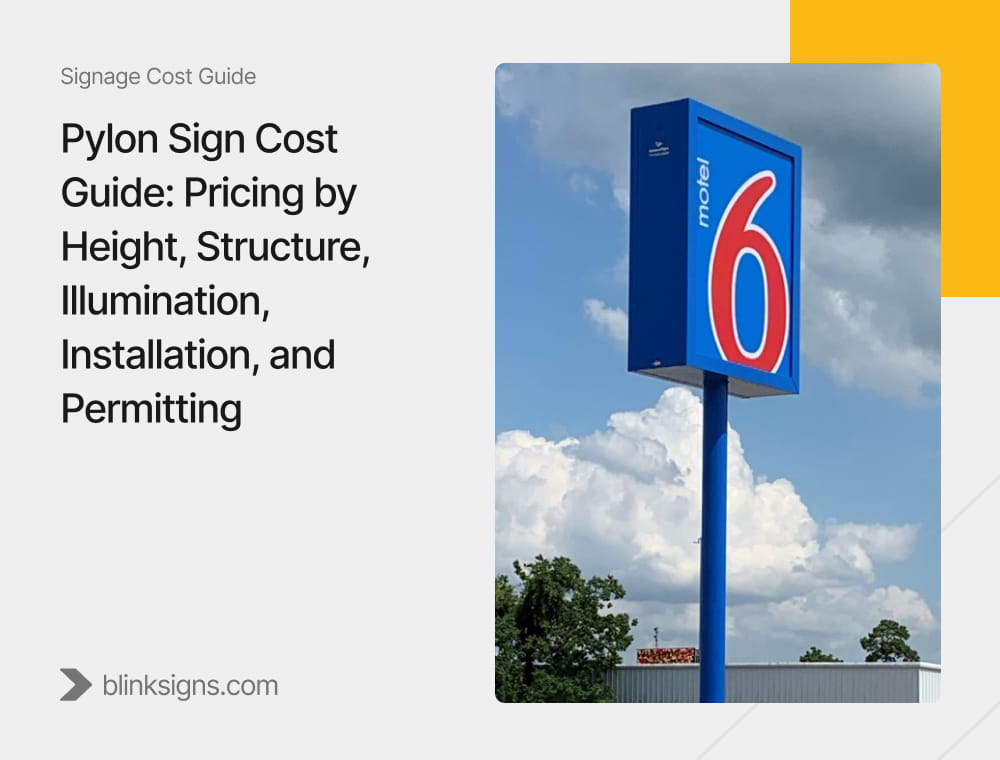
Pylon Sign Cost Guide: Pricing by Height, Structure, Illumination, Installation, and Permitting
A pylon sign is one of the most visible exterior signage investments a commercial property can make, but it is also one of the easiest to underestimate during early budgeting. Unlike smaller wall signs, window graphics, or interior signs, a pylon sign is not priced only by the sign face or cabinet. It is a freestanding roadside signage project shaped by height, structure, foundation needs, illumination, electrical access, permitting, site conditions, installation access, and long-term maintenance planning.
For business owners, shopping centers, gas stations, restaurants, hotels, property managers, franchises, and multi-location brands, the real question is not simply, “How much does a pylon sign cost?” The better question is, “What is included in the pylon sign estimate, and what project conditions can change the final price?”
This guide explains how pylon sign pricing works, why estimates vary so widely, and how to prepare for a more accurate quote.
How much does a pylon sign cost?
Pylon sign projects span a wide range of budgets, from smaller refacing work to larger fully installed roadside structures that include structural, electrical, permitting, foundation, and installation scope. Final pricing depends on the confirmed height, sign size, materials, tenant-panel layout, illumination type, electrical access, site conditions, foundation requirements, local code requirements, installation equipment, and whether the project is a new sign, a retrofit, or a reface.
For accurate budgeting, buyers should compare quotes based on the total installed project scope, not just the fabrication price.
A lower-scope pylon sign update may involve replacing existing sign faces or tenant panels on a structure that is already in place. A higher-complexity project may involve a new freestanding structure, larger sign faces, internal illumination, LED accents, a digital message center, new foundation work, electrical coordination, engineering review, permit support, and specialized installation access.
That is why pylon sign pricing should be planned by scenario, not based on a single average.
What pylon sign pricing actually includes
A pylon sign estimate may include several cost categories, depending on the project’s scope. Some quotes may focus mostly on fabrication, while others may include a more complete installed project package. Buyers should confirm what is included before comparing vendors.
A pylon sign project may include:
| Cost category | What it may involve | Why it matters |
| Site review | Photos, measurements, frontage review, existing sign review, or site access notes | Helps confirm whether the project is a new sign, retrofit, reface, or replacement |
| Design and layout | Sign face design, cabinet layout, tenant panel arrangement, brand alignment | Affects materials, readability, fabrication, and approval review |
| Fabrication | Sign cabinet, faces, panels, structure, finishes, lighting components | Often the most visible part of the quote, but not the only cost |
| Structural review | Project-specific review where required by sign size, height, local code, or site conditions | Helps determine whether the structure and support system fit project requirements |
| Foundation or footing work | Base preparation, support structure, and foundation requirements | Can significantly affect the installed project scope |
| Illumination | Internal lighting, external lighting, LED accents, or digital display components | Adds electrical, component, and maintenance considerations |
| Electrical coordination | Power access, connection planning, and code-compliant electrical work where applicable | Especially important for illuminated and digital pylon signs |
| Permitting support | Documentation support, sign code review, landlord criteria, or municipality submittals, where relevant | Local requirements may affect size, height, placement, and timeline |
| Installation | Equipment, access, staging, removal, placement, and site-specific installation conditions | Large freestanding signs often require more planning than smaller signs |
| Maintenance planning | Cleaning, lighting service, face replacement, tenant updates, and repair planning | Helps buyers understand long-term ownership needs |
The main budgeting mistake is treating a pylon sign as a product-only purchase. A pylon sign is often closer to a small exterior construction project than a simple sign order. The sign face, cabinet, or tenant panels are only part of the final project scope.
Pylon sign cost by project scope
The most useful way to understand the pylon sign cost is by project scope. A business replacing panels on an existing structure is not budgeting for the same project as a developer installing a new multi-tenant illuminated pylon sign for a shopping center.
| Project scope | Best-fit scenario | Main cost drivers | Buyer note |
| Replace the existing pylon sign | Existing sign structure remains usable, but branding or tenant panels need updating | Face size, graphics, panel materials, tenant count, lighting condition, and access | Lower scope than replacement, but the existing structure and components should still be reviewed |
| Retrofit existing pylon sign | Existing sign needs updates to lighting, cabinet, faces, or selected components | Cabinet condition, lighting type, electrical access, component compatibility, and code requirements | Useful when the structure is usable, but visual or functional updates are needed |
| New single-tenant pylon sign | Roadside business, restaurant, gas station, hotel, dealership, clinic, or standalone retail site | Height, face size, materials, illumination, foundation, permitting, installation access | Compare quotes by total installed project scope, not only fabrication |
| New multi-tenant pylon sign | Shopping center, strip plaza, business park, office park, or mixed-use property | Tenant panel count, landlord rules, panel hierarchy, illumination, future tenant replacement needs | Tenant planning should be addressed early because it affects design and long-term use |
| Digital or LED pylon sign | Fuel pricing, promotions, event messaging, changing offers, or high-visibility roadside communication | Display size, brightness rules, electrical access, service access, content needs, and local code review | Should be evaluated as both a signage investment and a content-management asset |
| Multi-location pylon sign rollout | Franchise, retail chain, restaurant group, hotel group, healthcare network, or national brand | Brand standards, site-by-site conditions, local code variation, schedule coordination, landlord requirements | Requires consistent standards with location-specific planning |
This structure helps buyers avoid misleading comparisons. A low-scope reface, a new illuminated roadside sign, and a digital pylon sign are all “pylon sign projects,” but they are not the same type of investment.
Pylon sign cost by type
Pylon sign pricing also changes by sign type. The type of sign affects fabrication, materials, structure, electrical planning, code review, installation, and maintenance access.
| Pylon sign type | Cost context | Planning note |
| Non-illuminated pylon sign | Often lower-complexity than illuminated options | Best for properties where nighttime visibility is not a major requirement |
| Internally illuminated pylon sign | Adds lighting components, electrical planning, and service considerations | Common for restaurants, gas stations, hotels, retail sites, and late-hour businesses |
| Externally illuminated pylon sign | Uses lighting directed toward the sign rather than lighting inside the cabinet | May involve fixture placement, power access, shielding, and local lighting rules |
| LED-accented pylon sign | Adds branded lighting, border lighting, or selected illuminated elements | Buyers should consider controls, service access, and local brightness limits |
| Digital pylon sign | Adds an electronic message center or digital display component | Higher-complexity option due to display, electrical, software, content, and code considerations |
| Multi-tenant pylon sign | Supports multiple businesses on one freestanding structure | Requires panel hierarchy, tenant replacement planning, landlord rules, and a long-term update strategy |
| Pole sign | Often uses a more exposed support structure | May be treated differently by local code and may have different design expectations |
| Monument sign alternative | Lower-profile architectural signage option | May fit properties where entrance identification matters more than long-range roadside visibility |
The right type depends on the property, viewing distance, road speed, landlord requirements, zoning rules, lighting needs, and brand standards. A gas station on a high-traffic road may have very different requirements than a professional office park, medical campus, or neighborhood shopping center.
Pylon sign costs by height and size
Height is one of the biggest factors that drives pylon sign prices. A taller pylon sign is not simply a smaller sign placed higher. Height can affect structure, materials, foundation needs, wind exposure review, sign face size, installation equipment, visibility planning, and local code review.
Size matters in two ways:
- Overall height, meaning how tall the sign structure is from grade to the top of the sign.
- Sign face area: the size of the visible branding, cabinet, or tenant panels.
Both can influence cost.
A taller sign may require more structural material, a different support design, deeper or more complex foundation work, additional installation planning, and more site-specific review. A larger sign face may affect fabrication, lighting, panel materials, readability, wind exposure review, and service access.
The best height is not automatically the tallest sign possible. The practical height depends on road frontage, viewing distance, speed of nearby traffic, competing visual clutter, local sign code, setbacks, property layout, and brand visibility goals.
For example:
| Height and size factor | How can it affect the estimate |
| Taller structure | May require more structural material, foundation review, and installation equipment |
| Larger sign face | Increases material, fabrication, lighting, and readability planning |
| Double-sided display | Adds a visible sign area and may affect the cabinet, faces, lighting, and structure |
| Multi-tenant panel layout | Increases layout complexity and may require modular panel planning |
| Digital message center | Adds display, electrical, code, and service considerations |
| Roadside viewing distance | May affect letter size, layout, height, and overall sign proportions |
| Local height restrictions | May limit what can be built or require additional review |
A good estimate should not only ask, “How tall do you want the sign?” It should also ask why that height is needed, what the property allows, what the municipality permits, and how the sign will be viewed from the road.
What changes the pylon sign estimate?
Pylon sign pricing changes because every project combines physical sign components with site-specific requirements. Two signs with similar face dimensions can price differently if one site has easier access, usable electrical service, and an existing structure. At the same time, the other requires new foundation work, electrical coordination, permit review, and difficult access for installation.
| Cost driver | Why does it change pricing |
| Height | Taller signs may require more material, structural review, larger faces, stronger support, and different installation equipment |
| Face size | Larger faces affect materials, readability, lighting, fabrication, and wind exposure review |
| Materials | Aluminum, steel, acrylic, polycarbonate, routed panels, retainers, finishes, and architectural elements can change the fabrication scope |
| Illumination | Internal lighting, external lighting, LED accents, and digital displays add components and electrical planning |
| Foundation | Site conditions, sign height, support structure, soil conditions, and local requirements can change the foundation scope |
| Electrical access | Available power, distance to connection, existing service, and code-compliant electrical work can affect the scope |
| Permitting | Local rules may affect height, setbacks, sign area, lighting, placement, and approval timing |
| Installation access | Parking restrictions, traffic flow, utilities, landscaping, lane access, lift or crane access, and site timing can affect installation planning |
| Existing structure condition | Reface and retrofit pricing depend on whether the structure, cabinet, faces, lighting, and electrical components are usable |
| Tenant panels | More panels increase layout complexity and future replacement planning |
| Property operations | Busy parking lots, fuel stations, drive-thrus, tenant operations, and customer access may require careful scheduling |
| Multi-location rollout | Multiple locations require brand consistency, local adaptation, schedule coordination, and site-by-site review |
The estimate changes most often when project assumptions change. For example, a buyer may request a simple reface, but the existing cabinet, lighting, or structure may need review before the project can move forward. A property manager may assume electrical access is available, but the project may still need electrical coordination. A developer may assume that one permit is enough, but local rules, landlord criteria, highway frontage, or proximity to a right-of-way may require additional review steps.
Download the Pylon Sign Cost Driver Matrix to quickly identify the project variables that can affect scope, complexity, and budgeting.

|Download Cost Driver Matrix PDF➜]
Pylon signs vs. monument signs vs. pole signs

Pylon, Monument and Pole sign
Pylon signs, monument signs, and pole signs are all exterior freestanding signs, but they are not usually planned the same way.
A pylon sign is typically an elevated, freestanding sign used for roadside visibility. It often sits higher than a monument sign and may include one or more sign faces, tenant panels, internal illumination, LED accents, or a digital display.
A monument sign is usually lower-profile and more architectural in appearance. It is often used at property entrances, office parks, campuses, medical buildings, residential developments, and retail properties that want a grounded, permanent presence near the entrance.
A pole sign often uses a more exposed pole or support structure. In some markets, buyers and competitors use “pylon sign” and “pole sign” interchangeably, but local code, design expectations, and structural details may treat them differently.
From a cost-planning perspective, the distinction matters because each option may carry different requirements.
| Sign type | Typical buyer goal | Cost planning difference |
| Pylon sign | Roadside visibility and elevated brand presence | Height, structure, foundation, illumination, electrical access, and installation equipment often play a larger role |
| Monument sign | Entrance identification and architectural branding | Base materials, masonry, stone, landscaping, lighting, and property design integration may be more important |
| Pole sign | Elevated sign visibility with exposed support | Support structure, cabinet design, local code treatment, and installation conditions affect the scope |
A pylon sign is often the better fit when a business needs long-range roadside identification. A monument sign may be better when the goal is entrance presence, architectural consistency, and a lower-profile property marker. A pole sign may be appropriate in some settings, but the final decision should be based on local code, site conditions, brand standards, viewing distance, and project budget.
Single-tenant vs. multi-tenant pylon signs
A single-tenant pylon sign and a multi-tenant pylon sign can look similar from the road, but they are planned differently.
A single-tenant pylon sign typically represents a single business. This may be a restaurant, gas station, hotel, dealership, healthcare clinic, retail store, or standalone franchise location. The design can focus on one brand identity, one logo, one message hierarchy, and one sign owner.
A multi-tenant pylon sign displays multiple businesses on a single property. This is common for shopping centers, strip plazas, office parks, business parks, and mixed-use developments. The sign must balance visibility, tenant hierarchy, landlord requirements, panel replacement needs, and long-term flexibility.
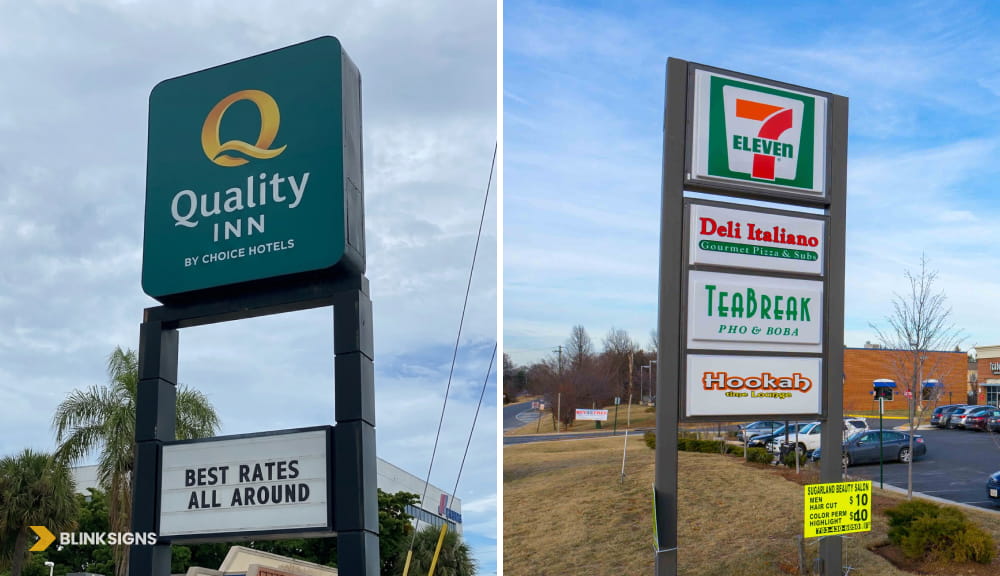
Single tenant and Multi-tenant pylon sign
| Planning factor | Single-tenant pylon sign | Multi-tenant pylon sign |
| Brand layout | Focused on one brand | Must balance multiple tenant names or logos |
| Panel planning | Usually simpler | More complex due to tenant count and replacement needs |
| Future changes | Less frequent unless a rebrand occurs | Tenant turnover may require regular panel updates |
| Approval process | Business owner, landlord, and municipality, where applicable | Landlord, tenants, municipality, and sometimes property management |
| Illumination | Based on one brand’s visibility needs | Must support consistent visibility across multiple panels |
| Maintenance | Focused on one sign owner or brand | May require ongoing panel updates and shared maintenance planning |
For shopping centers and plazas, the tenant-panel strategy should be addressed early. The number of panels, panel sizes, tenant hierarchy, anchor tenant visibility, landlord criteria, and future replacement process can all affect design and cost.
A multi-tenant pylon sign should not only be designed for the tenants currently on the property. It should also account for future tenant turnover, brand updates, replacement panels, and maintenance access.
Illuminated, LED, and digital pylon sign cost factors
Illumination is one of the most important pylon sign cost variables because it affects fabrication, electrical planning, components, service access, code review, and maintenance.
A non-illuminated pylon sign may work for some properties, but many roadside businesses need visibility beyond daytime hours. Restaurants, gas stations, hotels, convenience stores, retail centers, entertainment venues, and urgent care locations often consider lighting because their customers may arrive in the evening, at night, or early in the morning.
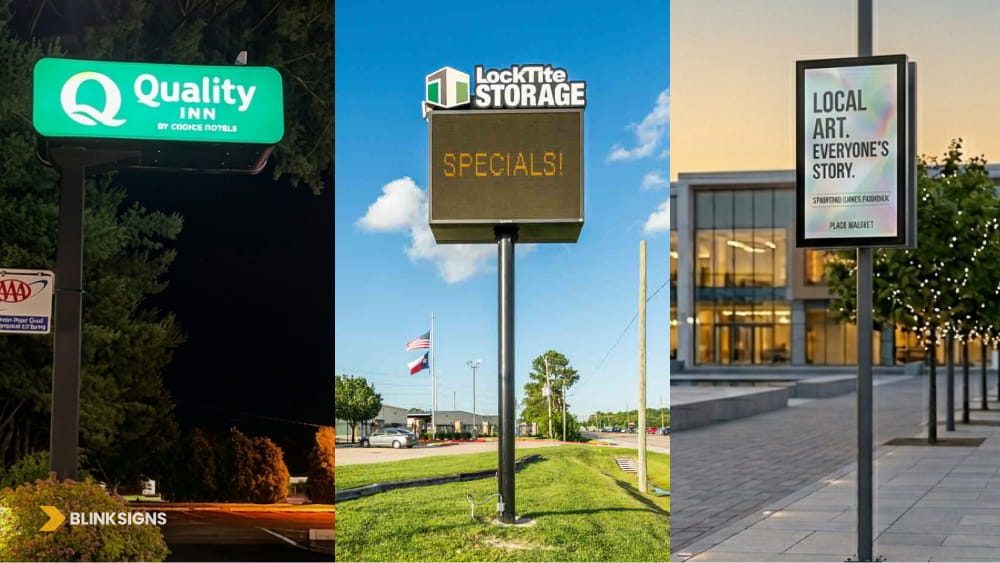
Illuminated, LED, and digital pylon sign
There are several illumination options:
| Illumination type | What it means | Cost factors |
| Non-illuminated | No built-in lighting | Materials, structure, face size, installation, and local requirements |
| Internally illuminated | Lighting is built inside the sign cabinet | Cabinet depth, faces, lighting components, wiring, electrical access, service access |
| Externally illuminated | Fixtures light the sign from outside | Fixture placement, power access, shielding, brightness rules, and maintenance |
| LED-accented | Selected elements use LED lighting | LED components, controls, service access, and branding effect |
| Digital message center | An electronic display allows changing messages | Display size, pixel pitch, software, power, brightness rules, content planning, service access |
Digital or LED pylon signs can add flexibility, but they also add complexity. Buyers should consider more than the display itself. Electrical access, local brightness rules, dimming requirements, message restrictions, service access, and content-management needs may all affect the final project scope.
For example, a digital display may be useful for a gas station showing fuel prices, a retail center promoting tenants, or a property with changing messages. However, it should be evaluated with project-specific assumptions, not generic ROI claims. The investment should be considered in relation to visibility goals, business model, traffic patterns, lease term, operating needs, and long-term content management.
Foundation, structural, electrical, and installation costs
Pylon signs are freestanding exterior structures, which means the support system matters as much as the visible sign. Foundation, structural review, electrical access, and installation conditions can all affect the estimate.
A buyer may think of the project as “the sign,” but the installed scope may involve several additional layers:
Foundation and footing needs
A pylon sign may require foundation or footing work, depending on the sign’s height, size, structure, soil conditions, site layout, and local requirements. The foundation scope should be confirmed for the specific project. Buyers should avoid assuming that the sign cabinet price includes all foundation work unless the quote clearly says so.
Structural review
A taller or larger freestanding sign may require project-specific structural review or engineering documentation. This can depend on local code, height, sign area, wind exposure, support design, and site conditions. Buyers should not treat structural review as an optional detail. It may be part of what makes the sign safe, approvable, and appropriate for the location.
Electrical access
Illuminated and digital pylon signs require electrical planning. The estimate may need to account for available power, distance to service, existing electrical capacity, wiring path, controls, code-compliant connection, and service access. Electrical work may be included, coordinated separately, or excluded depending on the quote scope, location, and project structure.
Installation access
Installation costs can vary depending on site access. A clear, open site is different from a busy retail parking lot, a gas station, a drive-thru lane, a landscaped entrance, or a road-adjacent property. Lift or crane access, parking restrictions, traffic flow, utilities, landscaping, lane access, night work, and property operations can all affect planning.
Installation should be reviewed as part of the total project, not as a generic add-on. The more complex the site, the more important it becomes to clarify access assumptions before approving a quote.
Permitting and site conditions
Permitting can be one of the most important planning factors in a pylon sign project. Because pylon signs are freestanding exterior structures, local rules may affect where the sign can be placed, how tall it can be, how large the sign face can be, how it may be illuminated, and whether additional documentation is needed before approval.
Permit requirements vary by municipality, property type, zoning district, road frontage, landlord criteria, and local sign code. A pylon sign near a highway, state road, major commercial corridor, or right-of-way may require additional review beyond a standard sign permit. In some cases, transportation-related approvals, landlord sign criteria, planning review, or zoning review may affect the timeline and final scope.
Buyers should avoid assuming that a design can be fabricated and installed simply because it looks good on paper. The sign must fit the property, the code environment, the approval path, and the installation conditions.
Common permitting and site-condition factors include:
| Factor | Why it matters |
| Local sign code | May limit sign height, sign area, placement, lighting, setbacks, or number of signs |
| Zoning district | Commercial, industrial, mixed-use, highway, or planned development zones may have different rules |
| Setbacks | The sign may need to be placed a certain distance from property lines, roads, sidewalks, utilities, or entrances |
| Right-of-way proximity | Roadway location can affect approvals, placement, and visibility planning |
| Landlord requirements | Shopping centers, plazas, and leased properties may have separate sign criteria |
| Tenant criteria | Multi-tenant properties may have rules for panel size, colors, hierarchy, and replacement |
| Highway or DOT review | Some road-adjacent projects may require additional review or approval |
| Lighting restrictions | Brightness, shielding, dimming, timers, and light spill may be regulated |
| Existing sign condition | A reface or retrofit may still need review if the existing sign is damaged, outdated, or noncompliant |
| Site access | Parking, traffic flow, landscaping, utilities, and customer access can affect installation planning |
Permitting should be treated as part of the planning process, not as an afterthought. A sign that exceeds local height limits, conflicts with landlord criteria, or requires additional review can affect cost, design, schedule, and installation planning.
BlinkSigns can support buyers by helping organize the project around confirmed scope, site conditions, design needs, permit support where relevant, fabrication, and installation coordination. Final approval requirements, however, depend on the local authority and project-specific review.
Hidden costs and quote exclusions
Pylon sign quotes can look very different depending on what is included. One vendor may quote only the sign cabinet and faces. Another may include design, fabrication, permit support, foundation, electrical coordination, removal, installation, and project coordination. A lower quote may not always mean a lower total project cost if important scope items are excluded.
Buyers should review every pylon sign quote for inclusions, exclusions, assumptions, and items marked as “by others” or “to be determined.”
Common hidden costs or quote exclusions include:
| Potential cost or exclusion | Why can it affect the final budget |
| Permit fees | Some quotes include permit support, but bill government fees separately |
| Engineering or structural review | May be required based on height, sign area, structure, or local requirements |
| Foundation work | May be excluded from fabrication-only quotes |
| Electrical work | Power access, wiring, controls, and code-compliant connections may be separate |
| Removal of existing sign | Old signs may need demolition, disconnection, disposal, or site restoration |
| Disposal | Existing faces, cabinets, poles, or components may create removal and disposal costs |
| Site survey | Some vendors require survey work before confirming the final scope |
| Landlord revisions | Property owner or tenant criteria may require design changes |
| Permit revisions | Local review may require updated drawings, size changes, or placement adjustments |
| Lane access or traffic control | Road-adjacent work may require additional coordination |
| Night work | Some properties may require work outside business hours |
| Parking lot access restrictions | Active retail centers, restaurants, and gas stations may require careful scheduling |
| Landscaping conflicts | Trees, planters, irrigation, or hardscape may affect access and placement |
| Utility conflicts | Underground or overhead utilities may affect sign placement and installation planning |
| Digital display content setup | A digital message center may require software, content planning, or user access setup |
| Ongoing maintenance | Lighting service, panel replacement, cleaning, and repairs may not be included in the original install quote |
The best way to avoid scope confusion is to ask for a quote comparison based on the same assumptions. Buyers should confirm whether the estimate is for fabrication only, fabrication plus installation, or a fully installed project with design, permit support, electrical coordination, foundation, and site-specific installation scope.
A quote that is unclear about exclusions should be clarified before approval.
Download the Pylon Sign Quote Comparison Worksheet to compare vendor estimates based on included scope rather than price alone.

| Download Free Quote Comparison Worksheet PDF➜]
New pylon sign vs. reface or retrofit
Not every pylon sign project requires a completely new structure. In many cases, a buyer already has a roadside sign, a tenant panel system, or a freestanding structure on the property. The right path depends on the condition of the existing sign, the desired brand update, local code requirements, electrical conditions, tenant needs, and whether the structure still fits the property’s current use.
There are four common project paths:
| Option | When it may fit | What to verify before quoting |
| New pylon sign | No usable structure exists, or a new development needs roadside identification | Code allowance, height, size, foundation, electrical access, site access, and landlord requirements |
| Reface | The existing structure is usable, and the visible branding needs updating | Face dimensions, cabinet condition, tenant panels, lighting condition, and access |
| Retrofit | Existing sign needs lighting, cabinet, electrical, or digital updates | Structural condition, electrical capacity, code requirements, component compatibility |
| Replacement | Existing structure is damaged, outdated, noncompliant, or no longer fits brand needs | Demolition, disposal, permit requirements, foundation needs, and fully installed scope |
When a reface may make sense
A reface may be appropriate when the existing structure and cabinet are in usable condition, but the visible signs, tenant panels, or branding need updating. This is common after a rebrand, tenant change, property sale, franchise update, or shopping center refresh.
A reface can be more limited in scope than a full replacement. However, buyers should still confirm the condition of the cabinet, faces, retainers, lighting, access, and electrical components where applicable.
When a retrofit may make sense
A retrofit may be appropriate when the existing sign structure is still useful, but the sign needs functional improvements. This could include lighting updates, cabinet improvements, digital display integration, LED conversion, tenant panel updates, or selected component changes.
Retrofit pricing depends heavily on the sign’s current condition. A structure that appears usable from the road may still require review before components are added or changed.
When replacement may be the better path
Replacement may be necessary when the existing structure is damaged, outdated, too small, poorly located, noncompliant, difficult to maintain, or no longer aligned with brand and property needs. A replacement project may involve removal and disposal, new design and structure, foundation work, electrical coordination, permitting, and full installation planning.
The key question is not only, “Can we reuse the existing sign?” The better question is, “Does the existing sign support the current brand, code environment, property needs, tenant plan, and long-term maintenance expectations?”
Pylon sign maintenance and lifespan planning
Pylon sign cost should not be evaluated only as an upfront project expense. Buyers should also consider long-term maintenance, service access, lighting updates, tenant panel replacements, cleaning, repair needs, and future brand changes.
Because pylon signs are exterior structures, maintenance needs can be affected by weather exposure, road conditions, lighting components, materials, tenant turnover, digital components, and access limitations. A property with frequent tenant changes may need a different maintenance plan than a single-tenant roadside business. A digital pylon sign may require different service considerations than a static non-illuminated sign.
Common maintenance considerations include:
| Maintenance area | Why it matters |
| Cleaning | Dirt, road dust, weather exposure, and environmental buildup can affect appearance |
| Lighting service | Illuminated signs may need service for LEDs, power supplies, lamps, wiring, or controls |
| Face replacement | Sign faces can change after rebrands, tenant turnover, or damage |
| Tenant panel updates | Multi-tenant signs may need periodic panel changes |
| Structural review after damage | Storms, vehicle impact, or visible movement may require review |
| Digital display service | Electronic components may require troubleshooting, settings, updates, or repair |
| Access planning | Tall signs or difficult locations may require lift access or scheduled service visits |
| Brand consistency | Multi-location brands may need consistent updates across properties |
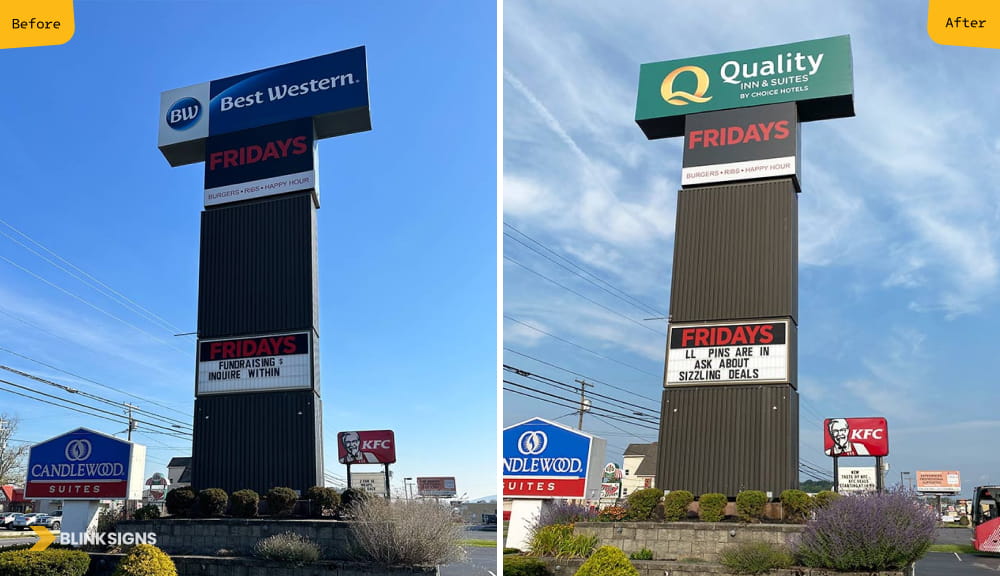
Pylon sign Face replacement
Avoid assuming that a pylon sign is finished forever once installed. A better approach is to plan for ownership. Buyers should ask how lighting can be serviced, how tenant panels can be replaced, how digital components can be accessed, and how future brand updates will be handled.
For multi-tenant properties, maintenance planning is especially important. Tenant turnover can make panel replacement a recurring need. The sign should be designed with future updates in mind, not only the first installation.
Pylon sign ROI and roadside visibility
A pylon sign can enhance roadside visibility, wayfinding, and brand presence, but it should not be evaluated based on unsupported traffic or revenue assumptions. The business impact of a pylon sign depends on location, road speed, traffic patterns, viewing distance, property access, brand recognition, sign design, business model, lease term, and customer behavior.
For example, a gas station, restaurant, hotel, urgent care location, or shopping center near a busy road may place high value on visibility and wayfinding. A professional office property may value a pylon sign more for property identification and tenant visibility. A franchise operator may evaluate pylon signage to maintain brand consistency across multiple locations.
A practical ROI discussion should include:
| ROI planning factor | Why it matters |
| Road frontage | Determines how visible the property is from passing traffic |
| Viewing distance | Affects sign height, letter size, layout, and readability |
| Traffic speed | Faster traffic may require simpler messaging and stronger visibility |
| Business model | Restaurants, fuel, hospitality, retail, healthcare, and services may value signage differently |
| Lease term | Longer property use may support a different investment view than short-term occupancy |
| Multi-tenant value | Tenant visibility can affect property presentation and leasing appeal |
| Maintenance cost | Long-term ownership cost should be included in planning |
| Brand consistency | Multi-location businesses may weigh consistency across sites |
| Digital flexibility | Digital messaging may support changing content, but it adds cost and management needs |
Buyers should connect the pylon sign ROI to a realistic signage ROI model rather than assuming guaranteed lift. For a broader budget context, use the commercial signage cost guide. For performance planning, use the signage ROI model. For comparison with lower-profile freestanding signs, review the monument sign cost guide.
The safest way to evaluate pylon sign ROI is to compare the project cost against the sign’s intended business role. Is the sign meant to improve roadside identification, support wayfinding, help tenants stand out, support brand consistency, or provide changeable messaging? The answer changes how the investment should be evaluated.
How BlinkSigns plans pylon sign projects
A pylon sign project benefits from organized planning because design, permitting, fabrication, installation, and maintenance considerations are closely connected. A change in height can affect structure and permitting. A change in illumination can affect electrical coordination and service access. A change in tenant count can affect face layout, cabinet design, and future panel replacement.
BlinkSigns supports pylon sign projects with a high-level planning approach focused on the buyer’s property, brand requirements, site conditions, installation needs, and long-term signage goals.
BlinkSigns can help coordinate key project areas such as:
| Project area | Buyer benefit |
| Project planning | Helps align sign goals, property needs, timeline, and scope |
| Design coordination | Supports brand visibility, tenant hierarchy, readability, and property presentation |
| Site and scope review | Helps identify project details that affect quoting and installation planning |
| Permitting support where relevant | Helps organize documentation and local sign code requirements, subject to jurisdictional review |
| Fabrication | Supports custom pylon sign production based on confirmed design and scope |
| Installation coordination | Helps align site access, equipment needs, scheduling, and project conditions |
| Multi-location coordination | Supports consistency across franchise, retail, restaurant, healthcare, or national brand locations |
| Maintenance and repair planning | Helps buyers plan for long-term sign ownership |
| SignTrax visibility | Provides project tracking visibility during signage coordination |
The goal is not to turn the buyer into a signage expert. The goal is to help the buyer understand the scope clearly enough to make better decisions, compare quotes fairly, and avoid budget surprises.
For single-location projects, this may mean clarifying sign type, size, location, lighting, electrical access, and permit requirements. For multi-location brands, this may mean coordinating brand standards across different site conditions, landlords, municipalities, and installation environments.
How to prepare for a pylon sign estimate
A more accurate estimate of the pylon sign starts with better project information. Buyers do not need to have every technical detail solved before requesting a quote, but the more site and scope information they can provide, the easier it is to identify the right project path.
Before requesting a pylon sign estimate, gather the following information:
| Information to prepare | Why it helps |
| Property address | Helps identify local context, frontage, and potential jurisdiction |
| Property type | A gas station, restaurant, shopping center, hotel, and office park may have different needs |
| Project type | New sign, reface, retrofit, replacement, or multi-location update |
| Existing sign photos | Helps determine whether a reface, retrofit, or replacement may be considered |
| Desired sign height | Helps begin visibility, code, and structural planning discussions |
| Approximate sign face size | Helps estimate fabrication, readability, and illumination needs |
| Single-sided or double-sided sign | Affects sign faces, visibility, cabinet, lighting, and structure |
| Tenant count | Important for shopping centers, plazas, business parks, and office properties |
| Illumination needs | Helps determine electrical and component scope |
| Digital display needs | Helps evaluate display size, brightness rules, content needs, and electrical access |
| Site photos | Helps identify access, visibility, obstructions, landscaping, and existing conditions |
| Site plan or survey | Helps with placement, setbacks, property lines, utilities, and approval planning |
| Landlord criteria | Helps avoid redesigns for leased or managed properties |
| Municipal sign criteria | Helps identify early code constraints if available |
| Electrical access information | Helps determine whether power is known, unknown, existing, or needs review |
| Installation access concerns | Helps identify parking, traffic, drive-thru, fuel canopy, landscaping, or lane constraints |
| Timeline | Helps plan around openings, rebrands, tenant move-ins, or rollout dates |
| Number of locations | Important for franchises and multi-location brands |
A buyer who provides only a logo and a desired height may still receive a preliminary conversation, but the quote will likely require additional discovery. A buyer who provides site photos, existing sign details, tenant panel needs, and property documents can usually move toward a more useful planning conversation.
Pylon Sign Quote Prep Checklist
Use this checklist before requesting a pylon sign estimate.
| Checklist item | Buyer response |
| Property type | Restaurant, gas station, retail center, shopping plaza, hotel, office park, healthcare, other |
| Property address | Add full address |
| Project type | New sign, reface, retrofit, replacement |
| Existing pylon sign on site | Yes, no, unknown |
| Existing sign photos available | Yes, no |
| Estimated sign height | Approximate height if known |
| Estimated sign face size | Approximate width and height if known |
| Single-sided or double-sided | Single, double, unknown |
| Single-tenant or multi-tenant | Single-tenant, multi-tenant |
| Number of tenant panels | Add number if known |
| Illumination needed | Yes, no, unknown |
| Digital display needed | Yes, no, unknown |
| Electrical access known | Yes, no, unknown |
| Site photos available | Yes, no |
| Site plan or survey available | Yes, no |
| Landlord sign criteria available | Yes, no, not applicable |
| Municipal sign criteria available | Yes, no, unknown |
| Installation access constraints | Parking, traffic, landscaping, utilities, drive-thru, fuel canopy, other |
| Timeline or opening deadline | Add date if known |
| Number of locations | Single location or multiple locations |
This checklist is meant for public buyer preparation. It does not replace site-specific review, engineering review, electrical review, permit review, or a confirmed project quote.
Download the complete Pylon Sign Quote Prep Checklist to organize project information before requesting estimates.

| Download Quote Prep Checklist PDF➜]
Pricing, permitting, and engineering note
Pylon sign pricing should always be treated as project-specific. Final cost depends on confirmed scope, height, sign size, materials, illumination, digital components, tenant-panel layout, structural requirements, foundation needs, electrical access, permitting, installation equipment, site access, local code, landlord criteria, and site conditions.
Permit approval is not guaranteed. Requirements vary by jurisdiction, property type, road frontage, zoning district, landlord rules, and local sign code. Some projects may require additional review, revisions, documentation, engineering, or coordination before they can move forward.
This guide is intended for planning and buyer education. It does not provide legal, engineering, electrical, or code approval advice. Buyers should request a project-specific estimate before making budget, construction, lease, or rollout decisions.
FAQ
How much does a pylon sign cost?
Pylon sign cost varies widely because projects can range from refacing an existing sign to installing a new illuminated or digital roadside structure. Final pricing depends on height, size, structure, materials, foundation requirements, electrical access, permitting, installation access, tenant panels, site conditions, and whether the project is a new sign, a retrofit, or a reface.
Why do pylon sign prices vary so much?
Pylon signs vary in price because they are not simple product-only purchases. Height, structure, sign face size, illumination, foundation work, electrical access, permits, installation equipment, site access, landlord requirements, and local code can all affect the estimate.
Is a pylon sign more expensive than a monument sign?
A pylon sign may cost more than a monument sign when it requires greater height, larger sign faces, structural review, foundation work, electrical planning, illumination, or specialized installation access. However, the comparison depends on the specific designs of the monument and pylon signs. Some architectural monument signs can also become complex depending on materials, lighting, masonry, and site work.
What is the difference between a pylon sign and a pole sign?
A pylon sign is usually an elevated, freestanding sign used for roadside visibility. A pole sign often has a more exposed support structure. In some markets, people use the terms interchangeably, but local code, design expectations, support style, and project scope may treat them differently. Buyers should confirm terminology based on their local requirements and project design.
Does pylon sign pricing include installation?
Not always. Some quotes may include fabrication only, while others may include installation, equipment, permit support, foundation work, electrical coordination, removal, disposal, or project management. Buyers should ask whether the quote is for fabrication only or a fully installed project.
Does pylon sign pricing include foundation work?
Foundation work may or may not be included, depending on the quote and project scope. Because pylon signs are freestanding exterior structures, foundation requirements should be reviewed for each project. Buyers should confirm whether footing, foundation, excavation, or related site work is included, excluded, or listed separately.
Do pylon signs require permits?
Many pylon sign projects require permits, but requirements vary by jurisdiction, property type, zoning district, sign height, sign area, lighting, placement, and road frontage. Some properties may also require landlord approval, tenant criteria review, planning review, or highway-related review.
Can a pylon sign be refaced instead of replaced?
Sometimes. A reface may make sense when the existing structure, cabinet, and lighting are usable, but the visible branding or tenant panels need updating. The existing sign should still be reviewed before assuming that a reface is enough.
What makes a multi-tenant pylon sign more complex?
A multi-tenant pylon sign must account for tenant count, panel sizes, tenant hierarchy, landlord criteria, future tenant turnover, panel replacement, lighting consistency, and property management requirements. These factors can make the planning process more complex than a single-tenant pylon sign.
Are illuminated pylon signs more expensive than non-illuminated signs?
Illuminated pylon signs are often more complex because they involve lighting components, electrical access, wiring, service access, and local lighting rules. The final difference depends on sign size, lighting type, power availability, installation access, and code requirements.
What affects the cost of a digital or LED pylon sign?
The cost of a digital or LED pylon sign can be affected by display size, pixel pitch, brightness requirements, electrical access, software or controls, content needs, service access, local message restrictions, and installation conditions. Buyers should evaluate digital signs as both signage assets and content-management tools.
What information is needed for a pylon sign quote?
Helpful quote information includes property address, property type, project type, existing sign photos, desired height, approximate face size, single-sided or double-sided needs, tenant count, illumination needs, digital display needs, electrical access, site photos, site plan, landlord requirements, municipal criteria, installation constraints, timeline, and number of locations.
How should franchises plan pylon sign rollouts?
Franchises should plan pylon sign rollouts around brand standards, site-by-site conditions, local codes, landlord requirements, tenant or franchisee needs, electrical access, installation access, and schedule coordination. A consistent brand standard may still need location-specific adaptation.
How should the ROI of a pylon sign be evaluated?
Pylon sign ROI should be evaluated based on the sign’s intended business role, such as roadside identification, wayfinding, tenant visibility, brand consistency, or changeable messaging. Buyers should consider traffic patterns, viewing distance, business model, lease term, project cost, maintenance needs, and long-term property use. ROI should not be assumed or guaranteed without project-specific analysis.
Conclusion
A pylon sign is one of the most important exterior signage investments for properties that depend on roadside visibility, tenant identification, and clear wayfinding. It can help a business, shopping center, restaurant, gas station, hotel, or franchise location be easier to find, but the cost depends on more than just the sign face.
The most accurate way to plan pylon sign pricing is to look at the full project scope: height, size, structure, foundation, illumination, electrical access, permitting, installation access, tenant panels, existing sign condition, maintenance needs, and long-term ownership goals.
Before comparing quotes, buyers should confirm whether they are pricing a new sign, reface, retrofit, replacement, digital upgrade, multi-tenant structure, or multi-location rollout. They should also confirm what is included in the quote and what may be handled separately.
BlinkSigns helps commercial buyers plan pylon sign projects with a practical understanding of design, fabrication, permitting support where relevant, installation coordination, maintenance planning, multi-location needs, and project visibility through SignTrax. For buyers evaluating a pylon sign investment, the next step is to gather project details, confirm site conditions, and request a scope-based estimate.