
Transparent LED Media Facades & Architectural Glass Displays: A Planning Guide
A transparent LED media facade turns glass walls, storefronts, atriums, curtain walls, and other glazed architectural surfaces into digital media while preserving part of the view through the glass. Unlike a conventional opaque LED display, however, a transparent LED has to work with the building itself.
Glass type, daylight, reflections, pixel pitch, brightness, viewing distance, structure, power, content, controls, service access, and local requirements can all affect whether the finished installation works as intended.
For that reason, transparent LED should not be treated as a screen-selection problem.
The better question is
Which display technology, glazing conditions, image density, brightness, infrastructure, and content strategy fit this particular building and its audience?
This BlinkSigns guide explains how to answer that question before a system is specified.
What Is a Transparent LED Media Facade?
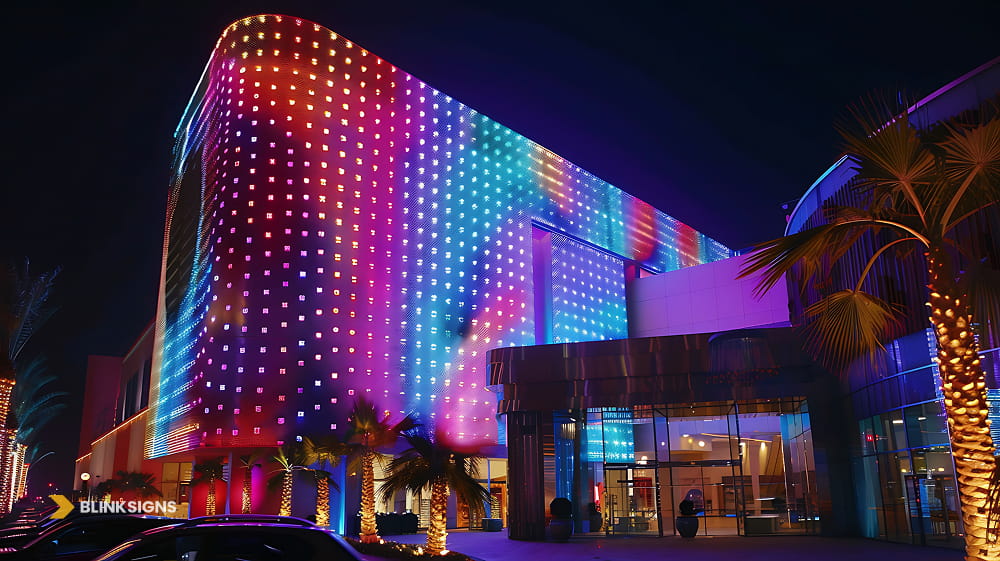
Curved transparent media facades illuminating architecture.
A transparent LED media facade is a digital display system integrated with, attached to, or positioned around architectural glazing so that digital content remains visible. At the same time, some visual openness through the glass is retained.
Depending on the project, that may involve transparent LED film, modular transparent LED panels, LED-integrated architectural glass, or an open LED mesh system.
The terminology is not completely standardized. Terms such as transparent LED screen, LED film, LED glass, media glass, curtain-wall LED, transparent digital facade, and LED mesh may describe different physical systems depending on the manufacturer.
That makes the product’s physical architecture more important than its marketing name.
A transparent display should therefore be evaluated as a connected system:
content + LED technology + architectural glass + structure + environment + viewer
With a conventional opaque LED display, the screen largely controls its visual background. With transparent LED, the real environment remains part of the image.
That distinction changes almost every planning decision that follows.
Which Type of Transparent LED System Fits the Project?
Transparent LED systems can be grouped into four practical architectural categories. These are useful planning categories rather than universal industry classifications, since manufacturers sometimes use overlapping terminology.
| System type | Where it can fit | Primary planning issue | What must be verified |
| Transparent LED film | Existing glazing, storefronts, showrooms, interiors, and glass partitions | Glass compatibility, visual openness,s and service access | Attachment method, curvature, environmental rating, and glass requirements |
| Modular transparent LED | Atriums, large glass walls, retail environments, and engineered installations | Module layout, supporting structure, depth, and maintenance | Structural support, cabling, visibility of hardware, and access |
| LED-integrated architectural glass/media glass | New construction and permanent architecture-led installations | Coordination with the facade and building systems | Glazing design, structural integration, electrical planning, and replacement strategy |
| Transparent LED mesh | Very large facades and longer-distance viewing | Scale, openness, structure, and environmental exposure | Pixel density, weather protection, content suitability, and mounting |
Transparent LED film
Transparent LED film places LEDs on a thin, relatively open layer that can be installed on compatible glazing. It can be particularly useful when an existing window needs to remain visually open, and a conventional LED cabinet would add excessive depth or create an obstruction.
Product specifications can vary substantially even within the same transparent LED category. LG’s LTAK140, for example, uses a 14 mm pixel pitch with 1,000-nit brightness and 60% transparency, while LG’s LTAK140-GW is specified at the same 14 mm pitch with up to 4,000 nits and 53% transparency. Both also illustrate that curved-glass compatibility is a product-specific capability rather than a universal characteristic of transparent LED film.
Modular transparent LED
Modular transparent LED uses panels, strips, or cabinet-style structures that leave open space between illuminated elements. It can provide easier modular servicing and support much larger areas, although framing, cables, physical depth, and supporting hardware become part of the architectural design.
LED-integrated architectural glass
In more permanent projects, the media function can be coordinated much more closely with the glazing or facade assembly itself. This approach is especially relevant to new construction, major facade renovation, transportation facilities, landmark properties, and large commercial developments.
These projects usually require earlier coordination between architectural, facade, structural, electrical, AV, signage, construction, and maintenance teams.
Transparent LED mesh
Open LED mesh can support very large architectural surfaces where scale and longer viewing distances matter more than close-range image detail.
Mesh should not automatically be treated as interchangeable with film or media glass. The support structure, display density, content behavior, environmental exposure, and viewing conditions can differ materially.
The BlinkSigns Transparent Facade Fit Framework
BlinkSigns evaluates transparent LED projects across seven connected conditions: Glass, Environment, Visibility, Resolution, Structure, Operations, and Regulation.
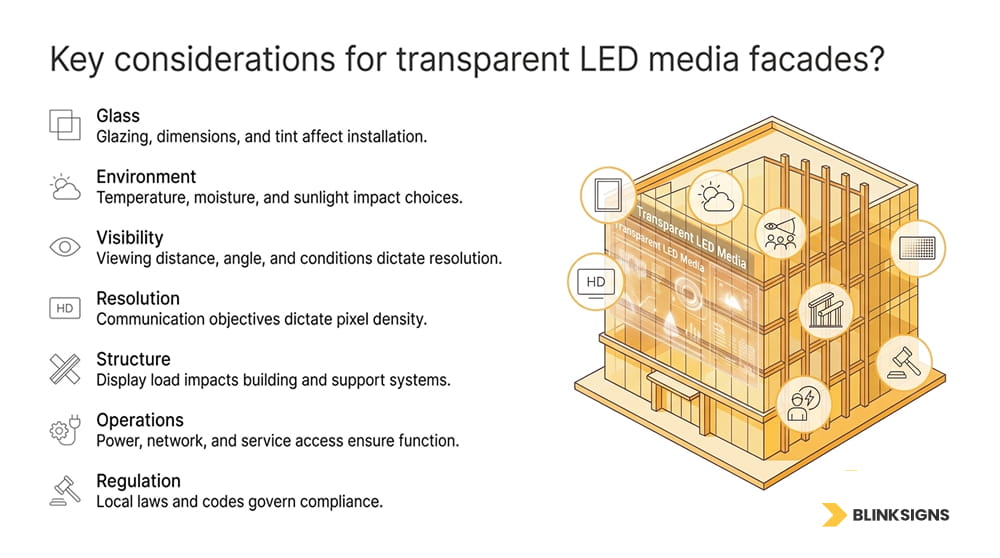
Planning framework for transparent media facades.
The purpose is not merely to collect specifications. Each condition should help narrow the appropriate system.
Glass
The first question is what the display must work with.
The project should identify the glazing type, dimensions, tint, coatings, mullion arrangement, curvature, available installation surface, facade orientation, and any physical interruptions.
This establishes whether direct-to-glass film is plausible, whether an independent support system is required, or whether the facade needs a more integrated solution.
Environment
An indoor storefront behind protected glass is not the same environment as a directly exposed exterior facade.
Temperature, moisture, rain, dust, sunlight, ventilation, and other site conditions affect which products and installation methods are appropriate. Brightness alone does not establish outdoor suitability.
Visibility
The project should identify who needs to see the display, from where, and under what conditions.
Pedestrian viewing from 15 feet away creates a different problem from architectural media intended to be seen across a plaza or city block. Approach direction, viewing angle, speed, elevation, daytime conditions, and nighttime conditions should all be considered.
Resolution
Image density should align with the communication objective and a meaningful viewing distance.
A close-range retail application displaying recognizable products may require higher pixel density than a large facade displaying logos, motion graphics, color fields, or architectural artwork.
Structure
Every display eventually transfers physical load somewhere.
Film, modular LED, media glass, and mesh can place very different demands on the glazing, mullions, brackets, frames, secondary structures, and building envelope.
Transparent should never be interpreted as structurally irrelevant.
Operations
Power supplies, controllers, network connections, processing hardware, media players, replaceable display components, and service access still need somewhere to exist.
A visually clean installation that cannot be serviced efficiently is not a fully resolved system.
Regulation
The project should identify applicable sign, zoning, electrical, building, landlord, illumination, and structural requirements before fabrication.
Installing a digital display behind glass does not automatically make it exempt from local regulation.
Once these seven conditions are understood, the project can be directed toward a film, modular transparent LED, integrated media-glass, mesh, conventional LED, or a further engineering path, rather than choosing a product first.
The Glass Is Part of the Display System
Architectural glass is not a neutral layer in front of transparent LED. Glass transmittance, tint, coatings, reflections, mullions, background conditions, and facade orientation can influence what the viewer ultimately sees.
This is one of the most important planning principles in transparent digital architecture.
The U.S. Department of Energy defines visible transmittance as a measure of how much visible-spectrum light passes through glazing. Glazing characteristics influence how much daylight is transmitted.
That should not be confused with a manufacturer’s transparent-display percentage.
A display may advertise high transparency while sitting behind glass that substantially changes the completed visual result. Conversely, highly transparent glazing does not guarantee that LED content will have sufficient visual contrast.
The finished facade is an optical combination of the glass and display, not either component alone.
Millions also matter.
If the LED canvas is designed without reference to the facade grid, important graphics may repeatedly cross structural divisions, modules may align poorly with glass bays, and cabling or service routes may become more complicated.
For significant projects, the LED layout should therefore be mapped against the architectural elevation before final content templates are created.
Is Higher Transparency Always Better?
No. Higher transparency preserves more visual openness, but a transparent LED still has to produce a usable image. The correct specification balances transparency with pixel density, brightness, contrast, viewing distance, and content.
This is why selecting a system based on the largest transparency percentage can be misleading.
The display has two simultaneous responsibilities:
preserve architecture and communicate digital content.
Too little openness can make the facade behave like a conventional screen. Too little image density or contrast can make the digital content ineffective.
The correct target is therefore not maximum transparency.
It is enough transparency for the architectural objective and enough display performance for the communication objective.
What Pixel Pitch Should a Transparent LED Facade Use?
There is no universal best pixel pitch for transparent LED. Pixel pitch should be chosen around viewing distance, content detail, display scale, architecture, and the specific display system.
Pixel pitch is the center-to-center distance between neighboring pixels. Smaller pixel pitches generally support higher pixel density and closer viewing, while larger pitches are more appropriate for longer viewing distances. Daktronics similarly identifies pixel pitch and intended viewing distance as connected display-planning variables.
For transparent architecture, content must also be considered.
A storefront showing products or more refined typography may need considerably more image information than a tower facade displaying a logo or large-scale animation.
That is why a simple universal formula such as “X millimeters equals Y feet” should not replace project-specific evaluation.
How Bright Should Transparent LED Be?
Transparent LED brightness should match the environment rather than simply be maximized. Daylight exposure, glass, reflections, facade orientation, background brightness, viewing distance, content contrast, and nighttime operation all influence perceived visibility.
A shaded corporate atrium and a street-facing glass facade exposed to strong daylight can require very different display behavior even if their physical dimensions are similar.
Content matters too.
Large, high-contrast graphics can remain understandable under conditions where fine text, low-contrast photography, and subtle details become difficult to see.
Nighttime creates the opposite problem.
A display designed for strong daytime visibility may need substantial dimming after dark. The International Sign Association’s guidance for on-premise electronic message centers recommends limiting nighttime brightness to 0.3 footcandles above ambient conditions at its defined measurement distance. That guidance specifically concerns EMCs, so it should not be treated as a universal legal threshold for every architectural transparent display. Still, it demonstrates why daytime and nighttime brightness should be planned separately.
Existing Building or New Construction?
Transparent LED can work in both existing buildings and new construction, but the design process should be different.
For an existing building, the facade becomes the constraint set. Glass dimensions, mullions, tint, coatings, power availability, equipment locations, access, cable paths, landlord restrictions, and maintenance routes are already in place. The display must adapt to those conditions.
For new construction, the media system can potentially be coordinated earlier. Facade bays, electrical capacity, data pathways, controllers, equipment areas, structural support, content sightlines, and service access can be considered during architecture development.
The result is a simple planning rule:
Do not select the transparent display first and force the building to accommodate it. Establish what the building and audience require, then select the system.
Transparent LED Feasibility Red Flags
A transparent LED concept should receive additional review before product selection when the glazing has not been identified, no practical service route exists, the required content contains more detail than the likely pixel density can reproduce, reflections or direct sunlight have not been evaluated, power and data routes remain unresolved, supporting conditions are unknown, or the permit and approval path has not been established.
Another red flag is more fundamental:
There may be no meaningful reason for the display to be transparent.
If preserving the view through the glass creates little architectural or commercial value, a conventional LED display may deliver better image density, simpler integration, or a more appropriate visual result.
BlinkSigns’ Outdoor LED Displays provide a useful comparison point for projects where transparency is not a core requirement.
What Content Works Best on Transparent LED?
Transparent LED content should be designed around the architecture, not simply resized from a conventional screen campaign. Large typography, bold shapes, logos, high-contrast motion, silhouettes, particles, digital Art, and intentional negative space generally fit transparent media better than dense text or highly detailed interface-style content.
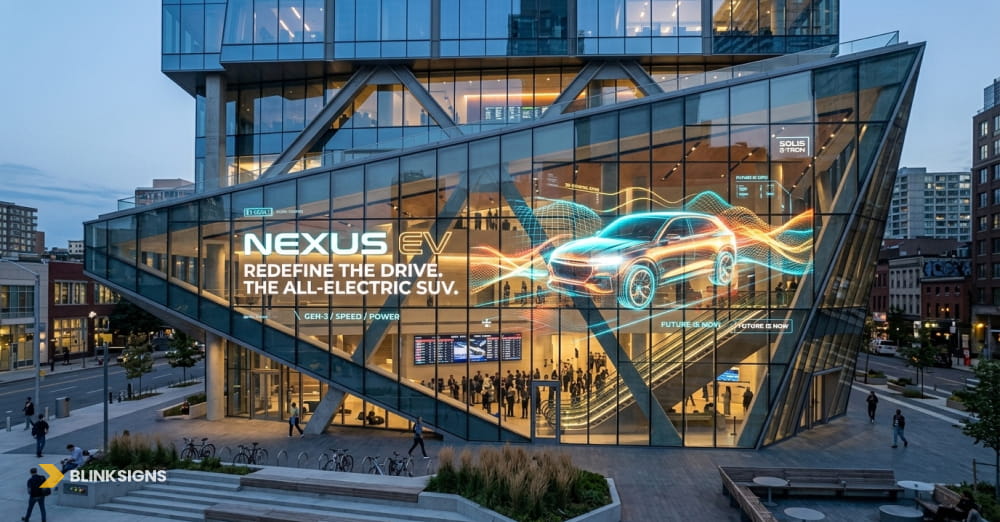
Holographic automotive content on architectural glass.
Because the real environment remains visible, it becomes part of the composition.
A retail campaign can revolve around merchandise rather than hide it. A corporate atrium can combine digital graphics with real architecture. A museum can place digital interpretation in a visual relationship with physical exhibits.
Negative space can therefore become a design tool.
Content should also be tested in the actual viewing zones rather than judged solely on a production monitor. Representative creative should be reviewed at expected viewing distances and, where relevant, under both daytime and nighttime conditions.
How Should the Content System Be Controlled?
A transparent LED can operate with simple scheduled playback or as part of a more advanced digital signage infrastructure that includes a CMS, media players, controllers, networks, remote monitoring, and external data sources.
A retail facade may require scheduled brand campaigns. A transportation environment may need to change information. A corporate installation may combine branded media with events or operational data. A multi-location network may require centralized publishing and governance.
The required architecture should therefore be decided before installation.
Organizations considering more advanced content and data integrations can explore BlinkSigns’ guide to Headless CMS and API-first digital signage architecture rather than adding unnecessary complexity to a facade project that only needs reliable, scheduled media.
How Is a Transparent LED Media Facade Planned and Installed?
A professional, transparent LED project should progress through feasibility, engineering, infrastructure, approvals, installation, and commissioning. Installation is only one stage of the process.
A practical project sequence is:
- Qualify the application. Define the audience, communication objective, display area, viewing distances, glazing, environment, and expected operating conditions.
- Survey and engineer the site. Confirm facade geometry, glass conditions, supporting structure, installation method, equipment locations, maintenance access, and display configuration.
- Plan infrastructure and content. Coordinate power, data, controllers, CMS or playback requirements, cabling, content dimensions, and facade mapping.
- Confirm approvals. Resolve landlord, sign, zoning, electrical, structural, building, and other applicable requirements.
- Install and integrate. Mount the display, connect processing and infrastructure, map the visual canvas, configure control systems, and load representative media.
- Commission the system. Evaluate the display from agreed viewing positions, validate content mapping, brightness behavior, controls, network operation, service access, and relevant day/night conditions before handoff.
Permitting should not be assumed away because equipment sits behind glazing. The International Sign Association notes that most communities require permits for new signs, although requirements and approval procedures vary by location and installation.
For a deeper BlinkSigns-specific overview, see the Commercial Sign Permits and Compliance Guide.
How Should Transparent LED Be Maintained?
Maintenance should be designed into the installation from the beginning. Technicians may eventually need access to power supplies, controllers, connectors, LED sections or modules, networks, supporting hardware, and the architectural glass itself.
A transparent facade may appear visually simple from the public side while concealing multiple service components behind it.
For larger installations, remote monitoring can also help identify playback, controller, network, or device problems before they become prolonged visible failures.
The important design question is not simply whether components are replaceable.
It is whether they remain practically reachable after the building is finished and operating.
How Much Does a Transparent LED Media Facade Cost?
There is no reliable universal price for a transparent LED media facade because the final budget depends on the complete project rather than the LED surface alone.
Display technology, active area, pixel pitch, brightness, glazing, mounting, structure, controllers, power, networking, access equipment, engineering, permitting, installation, content systems, commissioning, and service requirements can all affect the scope.
A relatively small transparent-film installation behind an indoor storefront should not be compared directly with a multi-story architectural media facade.
The most useful budgeting question is therefore:
What has to be designed, supplied, approved, installed, controlled, and maintained for this specific site?
BlinkSigns applies the same complete-system logic to broader digital projects in its Digital Signage Cost Guide.
When Is Transparent LED the Wrong Choice?
Transparent LED is not automatically the best technology simply because a building contains glass.
A conventional LED display may make more sense when maximum image density is more important than the view behind the screen, when the architecture does not benefit from transparency, when the desired creative contains fine visual detail, or when a simpler opaque digital surface better satisfies the communication objective.
Likewise, a static architectural sign, window graphic, projection system, interior display, or another digital format may sometimes resolve the actual problem more efficiently.
Technology selection should follow the communication and architectural requirements, not the novelty of the display.
What Should You Prepare Before Requesting a Transparent LED Quote?
A useful transparent LED proposal starts with project information rather than a requested product model.
BlinkSigns should ideally receive facade photographs or drawings, approximate glass and display dimensions, the project location, primary viewing distances, indoor or outdoor conditions, the intended audience, content objectives, expected operating hours, information about power and network availability, installation access, project schedule, and any known landlord or permitting constraints.
For larger architectural projects, facade elevations, glass-grid drawings, structural information, and proposed equipment locations may also become important.
Instead of asking:
“How much is a 20-foot transparent LED screen?”
A more useful project brief would be:
“We have a 20-foot retail glass facade viewed primarily from 60 to 150 feet away. We need campaign media visible during daytime and evening hours while retaining sightlines into the store.”
The second description gives the project team a defined architectural and communication problem to solve.
Planning a Transparent LED Media Facade With BlinkSigns
A successful transparent LED installation is not achieved by choosing the highest transparency percentage, the smallest pixel pitch, or the brightest screen.
It is created by coordinating:
architecture + glass + display technology + structure + visibility + power + data + content + controls + regulation + maintenance
BlinkSigns approaches transparent LED as part of the complete signage and digital-display environment.
For a storefront, that may mean balancing campaign visibility with merchandise sightlines. For a headquarters, it may involve integrating digital media with premium lobby architecture. For a transportation or mixed-use property, the project may require coordination across facade geometry, infrastructure, viewing distances, content operations, approvals, and long-term service.
The starting point remains the same:
Start with the facade, audience, and communication objective, then determine which display technology fits them.
That approach makes it possible to determine not only which transparent LED product could be installed, but whether transparent LED is the right architectural media solution in the first place.