
XR Digital Signage: How Mixed Reality Customer Journeys Are Transforming Retail and Hospitality Environments
What Is XR Signage in Retail and Hospitality?
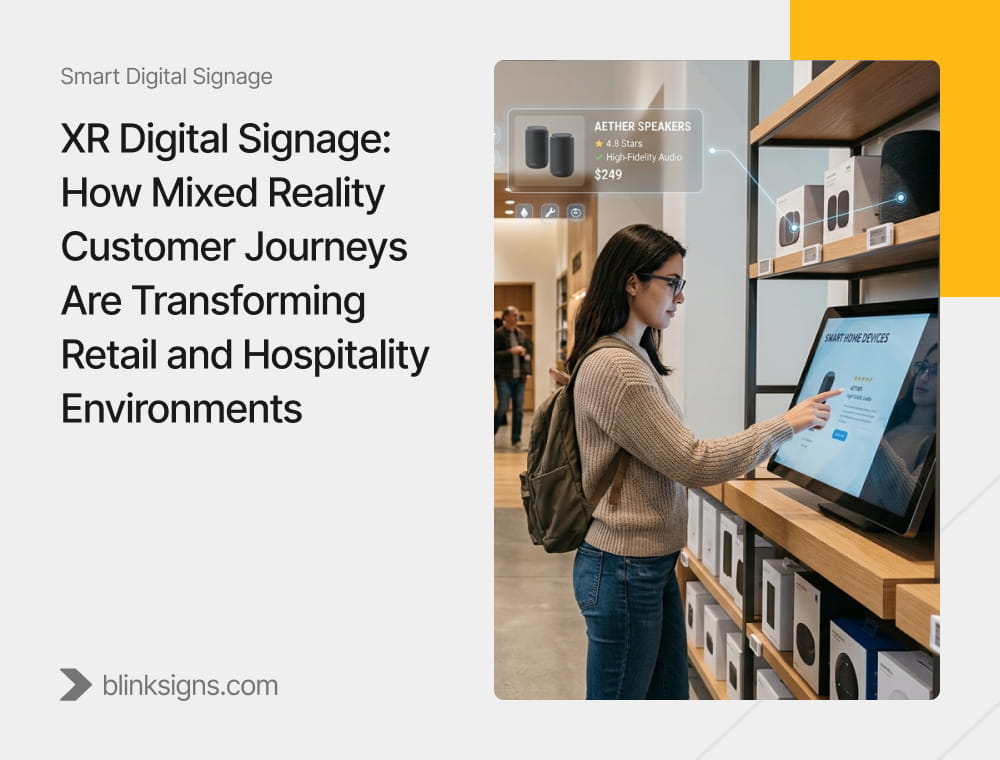
(Extended reality) XR digital signage combines physical displays with augmented and mixed reality overlays to create interactive, responsive customer environments. In retail and hospitality settings, this approach transforms static signage into a dynamic system that guides, engages, and influences customers in real time.
Traditional signage delivers information in a linear format. XR signage introduces a responsive layer that adapts to customer behavior, location, and context. Digital content is no longer confined to screens but extends into the physical environment, enabling interaction rather than passive viewing.
This distinction is critical. XR does not replace signage. It enhances how signage interacts with customers by introducing a real-time decision layer into physical spaces.
At an infrastructure level, XR signage operates across three interconnected systems. The hardware layer includes displays, sensors, cameras, and spatial computing devices. The content layer is managed through centralized CMS platforms that support both static and XR-enabled assets. The data layer connects these systems to POS platforms, customer data platforms, and operational systems.
Together, these components form an integrated framework, an XR Signage Operating System (XR Signage OS), enabling organizations to orchestrate customer journeys across multiple locations with consistency and control.
What Is the ROI of XR Digital Signage?
XR-enabled environments deliver measurable business impact by reducing uncertainty and increasing engagement at critical decision points.
According to Shopify data, products supported by 3D and augmented reality experiences can achieve conversion rates up to 94% higher than those of traditional presentations. Additional insights indicate that customers who engage with AR experiences are significantly more likely to complete purchases, with conversion lifts approaching 90 percent in certain categories.
Pre-purchase AR visualization has also demonstrated a 40% reduction in product returns, as customers make more confident buying decisions.
In physical retail environments, Macy’s mixed reality pilots demonstrated that average basket sizes increased by up to 60 percent and that returns in the furniture and home categories decreased by 2 percent.
A simple but powerful mechanism drives these results. Customers make better decisions when they can experience products before purchasing. XR reduces ambiguity, compresses the decision cycle, and directly improves conversion performance.
How Do You Integrate XR Into a Digital Signage System?
XR integration requires a structured approach that connects physical infrastructure with digital systems.
At the hardware level, XR environments rely on displays, sensors, cameras, and spatial computing devices that render or trigger interactive experiences. These include LED displays with AR overlays, smart mirrors, projection-based systems, and mobile-triggered XR interactions.
The content layer is managed through centralized CMS platforms that enable consistent deployment of both traditional and XR-enabled content across multiple locations. This ensures operational control while allowing real-time updates.
The data integration layer connects XR systems to POS platforms, inventory systems, and customer data platforms. This enables personalization, dynamic content delivery, and measurable performance tracking.
When these layers are unified, XR signage becomes an operational system rather than a collection of isolated experiences.
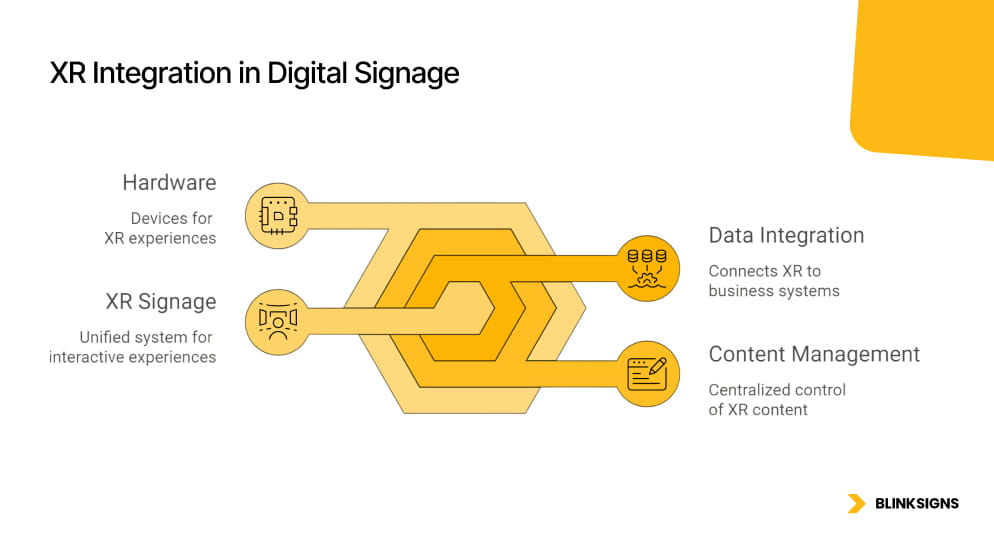
XR Integration in Digital Signage Infographics by BlinkSigns
The XR Signage Journey Map™
A structured framework for XR-powered customer environments
| Stage | Customer State | XR Signage Role | Technology Layer |
| Attract | Pre-entry | Immersive storefront displays | LED + AR overlay |
| Orient | Entry/navigation | Spatial wayfinding overlays | Interactive displays + spatial anchors |
| Engage | Exploration | Product visualization | MR kiosks / smart mirrors |
| Convert | Decision | Dynamic pricing overlays | CMS + AR triggers |
| Retain | Post-purchase | Loyalty-driven experiences | CDP-connected systems |
This framework connects XR deployment to measurable business outcomes, ensuring that each interaction point contributes to engagement, conversion, or retention.
Retail XR Customer Journeys
Transforming product discovery into conversion systems
A gap between customer interest and purchase confidence defines retail environments. XR signage addresses this gap by turning product exploration into an interactive experience. Mixed-reality kiosks and smart mirrors enable customers to visualize products in 3D. A shopper evaluating furniture can explore scale, placement, and variations before committing to a purchase. In fashion environments, smart mirrors enable virtual try-ons, reducing friction while increasing engagement time.
These interactions generate valuable behavioral data. Customer preferences, dwell time, and product combinations can be analyzed to improve recommendations and optimize merchandising strategies.
At the conversion stage, XR overlays provide decision support. Pricing, product benefits, and complementary items can be dynamically displayed based on real-time context. In quick-service restaurant environments, XR-enabled menu boards can adjust upsell prompts based on time of day, inventory levels, and purchasing behavior.
In documented multi-location retail rollouts, XR-enabled endcap displays have been used to visualize bundled product configurations. Customers interacting with these displays consistently demonstrate higher engagement and a greater likelihood of purchasing bundled items than those on standard displays.
The result is a measurable shift in purchasing behavior. XR transforms retail from passive browsing into an active decision-making system.
Hospitality XR Customer Journeys
Reducing friction and enabling personalization
Hospitality environments involve complex, multi-stage customer journeys that extend beyond product selection into navigation, service delivery, and experience management.
XR signage simplifies these environments by providing real-time guidance and interaction. AR-based wayfinding systems enable guests to navigate large properties such as resorts and convention centers with ease, reducing confusion and improving satisfaction.
Mixed reality kiosks allow guests to explore room options and amenities before committing. This improves upgrade conversion rates by reducing uncertainty and enhancing decision confidence.
XR systems can integrate with property management systems and customer data platforms to enable personalized experiences. Returning guests can be recognized, and tailored offers can be presented during check-in. Virtual concierge systems allow guests to book services, navigate properties, and access event information without staff intervention.
In large-scale events, XR navigation overlays provide real-time schedule and location information, improving operational efficiency and customer experience.
This creates a shift from static service delivery to dynamic, responsive environments.
XR Signage as Retail Media Infrastructure
XR signage introduces a new monetization layer within physical environments by transforming displays into programmable media platforms.
At the infrastructure level, XR-enabled environments create addressable inventory within physical spaces. Unlike traditional signage, which operates on fixed schedules, XR overlays can be dynamically triggered based on audience presence, interaction behavior, and contextual signals.
This enables targeted messaging at the moment of highest engagement, aligning physical environments with programmatic advertising models.
As XR systems integrate with retail media platforms, physical locations become measurable advertising channels. Audience segmentation, dwell time, and interaction depth can be used to evaluate campaign performance using metrics comparable to CPM and engagement-based pricing models.
This positions XR signage as both an experience layer and a scalable monetization channel within modern retail ecosystems.
The XR Data Layer: A First-Party Data Advantage
XR environments generate a level of behavioral data that traditional signage cannot capture.
XR systems measure interaction depth, gaze tracking, product engagement, and spatial movement patterns. These insights provide a detailed understanding of how customers interact with products and environments.
This data enables advanced personalization, optimization, and performance measurement. Organizations can identify which elements drive engagement and which interactions lead to conversion.
XR signage transforms physical environments into measurable data ecosystems, creating a valuable first-party data asset.
XR + Attribution: Measuring Real Impact
XR interaction data integrates directly with advanced measurement frameworks such as the Signage Attribution Ladder™.
Engagement signals, including dwell time and interaction sequences, can be mapped to attribution models such as geo-matched lift and incrementality testing. For organizations with customer data platform integration, advanced models such as Shapley Value analysis can distribute attribution across the entire customer journey.
This connection transforms XR from a customer experience enhancement into a measurable revenue driver.
XR Hardware Decision Matrix
| Scenario | Recommended Hardware | Rationale |
| Retail endcap | LED + AR trigger | High visibility |
| Hotel kiosk | Interactive display | Low friction |
| QSR menu | Transparent OLED | Embedded integration |
| Showroom | Vision Pro / Quest | High-intent engagement |
| Outdoor entrance | AR projection | Broad reach |
| Convention center | Smartphone AR | Scalable |
Access the XR Hardware Selection Matrix to align your deployment with the right technology.
XR Deployment Model
XR adoption follows a phased approach from pilot to enterprise deployment.
XR Investment Ranges
| Deployment Level | Estimated Investment |
| Pilot (1–2 locations) | $50K–$150K |
| Mid-scale rollout | $150K–$300K |
| Enterprise deployment | $300K–$500K+ |
These ranges vary based on hardware selection, integration complexity, and the number of locations involved.
XR + AI: The Future of Adaptive Environments
AI enhances XR by enabling real-time personalization and optimization.
At the infrastructure level, AI systems analyze data from CMS platforms, customer data platforms, and environmental signals to adjust content delivery dynamically. In retail, this enables personalized recommendations and inventory-driven promotions. In hospitality, it supports dynamic service personalization and real-time offer optimization.
This integration transforms XR signage into an adaptive system that continuously improves performance based on customer behavior.
Why BlinkSigns Wins XR Signage
Most XR solutions focus on isolated experiences. BlinkSigns focuses on infrastructure.
By integrating XR into physical signage systems, BlinkSigns enables scalable deployment across multiple locations while maintaining consistency, compliance, and operational efficiency.
This infrastructure-first approach ensures that XR is not treated as an experimental feature but as a strategic system aligned with business outcomes.
Plan Your XR Environment
Physical environments that cannot interact, personalize, or measure are losing ground to systems that can. XR signage closes this gap by redefining how environments function.
For organizations operating across retail and hospitality environments, XR is not a trend. It is an infrastructure decision that will define competitiveness over the next decade.
First explore how XR-enabled signage systems can transform your physical environments.
Request a consultation to map your deployment strategy and identify high-impact opportunities.