

Electronic Message Center Cost Guide: What Affects Outdoor Digital Message Sign Pricing
An electronic message center, often called an EMC, can range from a smaller display-only or storefront-style project to a larger outdoor monument, pylon, or roadside message sign system. Public market examples often show smaller EMC-related projects starting in the low thousands. In comparison, larger outdoor commercial EMC projects can reach much higher budgets when display size, structure, installation, electrical coordination, software, permitting, and site work are included.
These numbers should be treated as market context, not BlinkSigns pricing. EMC pricing varies because one figure may describe only the digital display panel, another may describe the LED display area by square foot, and another may describe a full outdoor sign project, including cabinet, structure, installation, software, electrical coordination, potential permit requirements, and service planning.
For commercial buyers, the better first question is not only:
How much does an electronic message center cost?
The better question is:
Does the quote cover only the digital display, or does it cover the full outdoor message sign project?
A display-only quote may still leave the buyer responsible for the monument base, pylon structure, cabinet, power access, installation, electrical coordination, software, content controls, potential permit requirements, service access, and maintenance planning. A full commercial EMC quote may include more coordination, but the scope still needs to be reviewed carefully before comparing prices.
BlinkSigns helps buyers clarify EMC scope before comparing quotes, especially when the sign must work with a monument base, pylon sign, roadside location, school campus, church property, business frontage, shopping center, public facility, or multi-location signage program.
Market pricing context: why EMC numbers vary so widely
Public EMC pricing examples can appear inconsistent because they often measure different things.
Some examples refer to:
- Display panel only: the programmable LED display module or replacement panel
- Per-square-foot LED display area: the active display surface, not always the complete installed sign
- Small outdoor units: basic or smaller single-color configurations
- Standard commercial EMCs: common outdoor message centers for schools, churches, businesses, and institutions
- Large roadside displays: bigger signs, pylon-mounted signs, billboard-style displays, or double-sided outdoor systems
- Complete project budgets: display, cabinet, structure, software, installation, electrical coordination, site work, potential permit requirements, and service planning
That is why a public price range may be useful as a planning signal but still incomplete as a project estimate.
A buyer comparing EMC quotes should ask:
- Is the number for the display only?
- Is it based on the active display area?
- Does it include the cabinet or structure?
- Does it include installation?
- Does it include electrical coordination?
- Does it include software and training?
- Does it include potential permit support?
- Does it include site work, access equipment, or service planning?
- Is it single-sided or double-sided?
- Is it for a retrofit or a new sign?
A reliable EMC budget starts by defining the project scope before comparing prices.
What is an electronic message center?

Roadside pylon with integrated electronic display.
An electronic message center is a programmable sign that displays changeable messages electronically. It may show text, graphics, event updates, school announcements, church messages, business promotions, public notices, alerts, schedules, or community information.
This guide focuses on modern outdoor LED electronic message centers used in commercial, institutional, public-facing, monument, pylon, or roadside signage. It does not focus on ordinary indoor lobby screens, office screens, menu screens, or screen-based digital signage systems.
EMCs are commonly used by:
- Schools and campuses
- Churches and faith-based organizations
- Municipal buildings
- Community centers
- Shopping centers
- Roadside businesses
- Gas stations
- Medical campuses
- Office parks
- Multi-tenant properties
- Franchise locations
- Institutions and public-facing organizations
An EMC is related to digital signage, but it is not the same as a standard indoor screen. A lobby screen or office communications display is typically designed for indoor digital signage. An EMC is usually an outdoor public-facing message sign that may involve pixel pitch, brightness, structure, power, installation, software, content controls, potential permit requirements, and service access.
An EMC is also related to LED signage, but it is not the same as every LED sign. LED channel letters, LED cabinet signs, LED blade signs, and LED retrofits use LED lighting to provide fixed-sign visibility. An EMC uses programmable LED display technology to change messages.
Who is this EMC cost guide for?
This guide is for buyers planning an outdoor programmable message sign for a business, school, church, property, institution, campus, or multi-location organization.
It is especially useful if you are asking:
- How much does an electronic message center cost?
- What affects outdoor LED message sign pricing?
- What is the difference between an EMC and digital signage?
- What is the difference between an EMC and an LED sign?
- What affects the cost of a digital church sign?
- What affects the cost of a school LED sign?
- How much does a digital sign board cost?
- What is pixel pitch in an electronic message center?
- Should the EMC be single-sided or double-sided?
- Does an EMC need a permit?
- Can an existing monument sign be upgraded with an EMC?
- What hidden EMC costs should buyers check?
- Who owns and updates the messages after installation?
- How should multi-location organizations manage EMC signs?
The best EMC decision starts with the sign environment. A school may need a campus-facing or roadside announcement sign. A church may need a monument sign with a programmable message area. A shopping center may need a pylon-mounted display. A municipality may need a public information sign. A business may need a programmable outdoor display for public-facing updates. A multi-location organization may need standards, approvals, content rules, and support routing across several sites.
What affects the electronic message center cost?
The cost of an electronic message center is determined by the display, sign structure, software, message controls, installation conditions, electrical requirements, approval process, and service expectations.
Important cost factors include:
- Active display area
- Overall sign size
- Pixel pitch
- Viewing distance
- Single-color or full-color display
- Static text, graphics, animation, or scheduled messaging needs
- Single-sided or double-sided layout
- Cabinet construction
- Monument base or pylon structure
- Wall, pole, monument, or freestanding placement
- Outdoor exposure
- Brightness requirements
- Automatic dimming or brightness control needs
- Message-change behavior
- Software and controller requirements
- Content permissions
- User training
- Power access
- Electrical coordination
- Installation access
- Equipment needs
- Potential permit requirements
- Local sign-code review
- Landlord or property criteria
- Service access
- Retrofit feasibility
- Maintenance planning
- Multi-location content governance
An EMC is more than a digital display. It is usually part of an outdoor sign system. That system can include the LED display, cabinet, structure, software, content rules, power, installation, approvals, and service plan.
Which EMC scope are you pricing?
The most important step in EMC budgeting is identifying the scope. A replacement display panel, monument sign insert, school marquee, church sign, wall-mounted display, and pylon-mounted roadside EMC are different projects.
| EMC scope | Best fit | What affects cost |
| Display panel only | Replacement panel, display upgrade, hardware quote | Size, pixel pitch, brightness, controller, compatibility |
| Monument sign with EMC insert | Schools, churches, offices, campuses, communities | Monument base, cabinet, masonry, display size, potential permits, and electrical coordination |
| Pylon or pole-mounted EMC | Roadside businesses, shopping centers, and institutions | Structure, height, wind exposure, access, visibility, power |
| Wall-mounted outdoor EMC | Building-mounted public messaging | Wall condition, display weight, brightness, power, and access |
| Single-color message board | Basic text updates and announcements | Readability, message length, controller, local rules |
| Full-color programmable EMC | Graphics, announcements, public-facing updates | Pixel pitch, software, brightness, and content complexity |
| EMC retrofit | Existing sign structure receives updated display | Existing condition, cabinet, power, compatibility, service access |
| Multi-location EMC program | Schools, churches, franchises, municipalities, campuses | Standards, approvals, content governance, support model |
This table helps buyers avoid comparing incomplete quotes. The right comparison is not simply “Which EMC is cheaper?” The better comparison is “Which quote includes the display, structure, software, installation, approvals, service access, and long-term ownership needs for this location?”
Verify municipal hold-time regulations, brightness limits, and message-scheduling workflows before finalizing your design.
Download the EMC Permit and Content Planning Checklist ↴
Display-only pricing vs complete-project pricing
One of the biggest EMC budgeting mistakes is comparing a display-only price against a complete-project price.
A display-only price may include the LED display panel, controller, and selected hardware components. It may not include cabinet fabrication, monument construction, pylon structure, installation, electrical coordination, permits, software setup, training, site work, access equipment, or service planning.
A complete project price may include more of the surrounding sign system. Depending on the scope, it may account for the display, cabinet, structure, mounting, software, message controls, installation coordination, electrical coordination, potential permit support, and long-term service access.
Neither quote type is automatically better. They are simply different scopes. Buyers should compare them only after confirming what each quote includes and excludes.
Pixel pitch, viewing distance, and brightness
Pixel pitch, viewing distance, and brightness are three of the most important planning factors for an electronic message center.
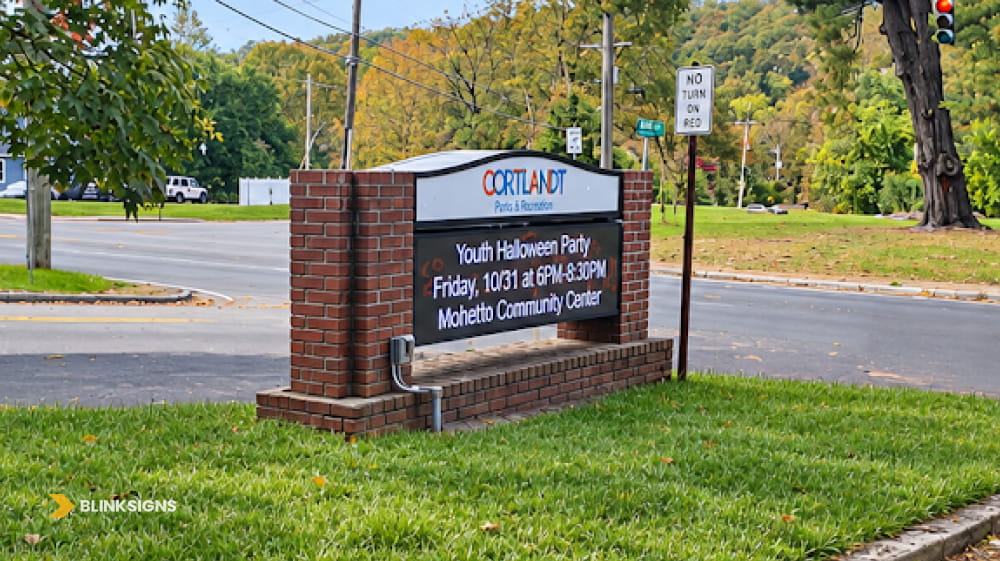
LED monument sign for community messaging.
Pixel pitch
Pixel pitch describes the spacing between pixels on an LED display. A tighter pixel pitch can support sharper-looking content at closer viewing distances. A larger pixel pitch may be suitable when the audience views the sign from farther away.
For buyers, the important question is not simply which pixel pitch sounds more advanced. The better question is:
How far away will people be when they read the sign?
A sign viewed by pedestrians near a campus entrance may require different display clarity than a roadside sign seen by vehicles from a longer distance. The message type also matters. Simple text announcements may not require the same level of display detail as graphics, logos, or other visual content.
Viewing distance
Viewing distance affects display size, text size, content design, and readability. An EMC intended for roadside visibility may need larger messages, simpler layouts, and stronger visibility planning than a sign viewed from a parking lot or sidewalk.
Buyers should consider:
- Roadside viewing
- Pedestrian viewing
- Parking-lot viewing
- Entrance visibility
- Speed of passing traffic
- Angle of approach
- Distance from the road or walkway
- Obstructions such as trees, poles, landscaping, parked vehicles, or other signs
- Daytime and nighttime readability
A larger or more advanced display will not solve every visibility problem. Placement, angle, message simplicity, brightness, and surrounding conditions matter.
Brightness and dimming
Outdoor EMCs need to be visible during the day and appropriate after dark. Brightness planning can affect the selected display, controls, settings, and local review process.
Many jurisdictions and property rules may regulate brightness, motion, animation, glare, message-change frequency, or nighttime display behavior. Requirements vary by location.
Buyers should ask:
- Will the sign need automatic dimming?
- How will brightness be managed at night?
- Are motion, scrolling, flashing, or animation limited?
- Are message-change intervals regulated?
- Does the property have its own sign criteria?
- Who will manage settings after launch?
This guide does not interpret local sign codes or brightness rules. EMC permit, brightness, dimming, motion, animation, and message-change requirements should be confirmed through the appropriate local review process before the final sign type and display behavior are approved.
Single-sided vs double-sided EMC signs
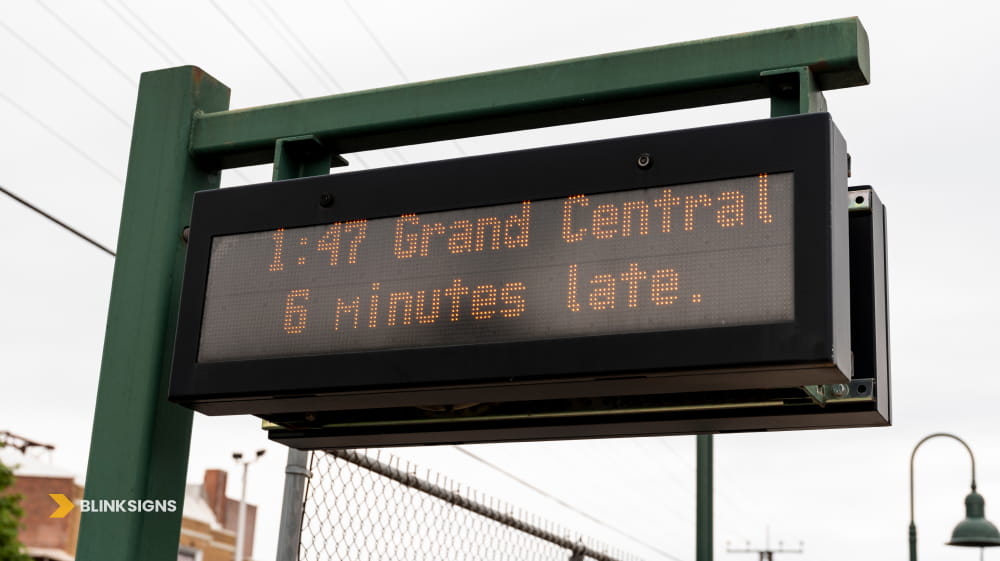
Outdoor LED display for transit updates.
An EMC may be single-sided or double-sided depending on visibility needs, traffic direction, property layout, and sign location.
A single-sided EMC may be appropriate when the sign faces one primary direction, such as a building entrance, parking lot, pedestrian area, or one-way traffic approach.
A double-sided EMC may be considered when messages need to be visible from opposing directions, such as along a road, near a campus entrance, outside a church, at a school frontage, or in front of a shopping center.
The single-sided or double-sided decision can affect:
- Display area
- Cabinet design
- Structure
- Power requirements
- Installation access
- Service access
- Message management
- Potential permit review
- Viewing angles
- Long-term maintenance planning
A double-sided sign is not automatically the better choice. It should match how people approach the property and how the message needs to be read.
Structure, installation, electrical coordination, and potential permit requirements
The surrounding sign structure can be one of the biggest differences between EMC projects.
An EMC may be installed as part of:
- A monument sign
- A pylon sign
- A pole-mounted sign
- A wall-mounted sign
- A cabinet sign
- A roadside sign
- A school marquee
- A church sign
- A retrofit into an existing sign structure
Each structure can change the planning requirements. A monument sign may involve masonry, cabinet integration, display opening, site placement, and landscape coordination. A pylon sign may involve height, wind exposure, access, and visibility from traffic. A wall-mounted EMC may require review of wall condition, display weight, mounting location, power access, and service access.
Installation and electrical coordination should also be clarified early. Outdoor programmable signs may involve power availability, conduit or electrical routing, qualified field work, access equipment, scheduling restrictions, and coordination with site conditions.
Potential permit requirements should be reviewed before the final sign design is approved. Local sign rules may address sign size, height, brightness, dimming, motion, flashing, animation, message-change frequency, location, and operating behavior. Property owners, landlords, campuses, and shopping centers may also have their own sign criteria.
This guide does not provide installation instructions, electrical instructions, structural calculations, code interpretation, or legal advice. Requirements should be confirmed through the appropriate qualified review process.
Software, message content, and ownership
An electronic message center is only useful when the content is clear, current, and responsibly managed. The software and message-control plan should be discussed before the sign is approved, not after installation.
EMC software may support:
- Message scheduling
- Content playlists
- User permissions
- Approval workflows
- Brightness controls
- Emergency messages
- Event announcements
- Time-sensitive updates
- Multi-user access
- Multi-location management
- Remote publishing
- Content expiration
- Display monitoring
The buyer should clarify who owns the message process.
Important questions include:
- Who can update the sign?
- Who approves public-facing messages?
- Can local staff publish content?
- Does leadership need approval rights?
- Can messages expire automatically?
- Are motion, scrolling, flashing, or animation restricted?
- Who removes outdated messages?
- Who handles holiday hours, closures, events, or emergency notices?
- Who responds if the software, controller, or sign display is not working?
- How will access be managed if staff changes?
A message center without content ownership can become an expensive blank display or an outdated public notice board.
EMC cost by organization type
Electronic message center cost changes by organization type because each property uses outdoor messaging differently. A church, school, shopping center, municipal building, campus, roadside business, and multi-location brand may all need a programmable outdoor sign. Still, their visibility needs, message rules, approval path, structure, software ownership, and service expectations can be very different.
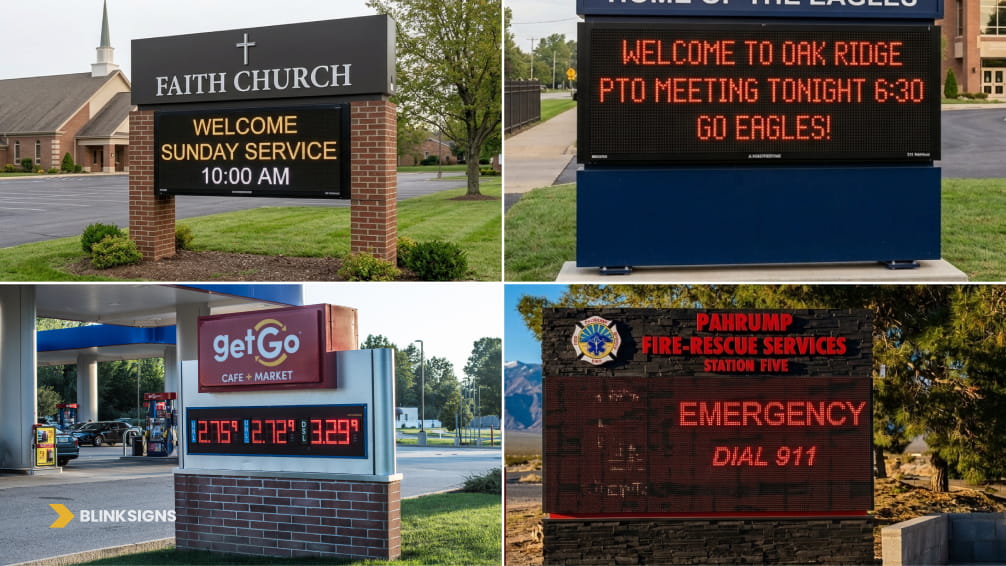
Dynamic message centers for diverse organizations.
Churches and faith-based organizations
Churches often consider EMCs for service times, event reminders, ministry updates, community notices, seasonal messages, and visitor information. The EMC may be part of a monument sign, roadside sign, or existing church sign structure.
Digital church sign cost can be affected by roadside visibility, viewing distance, monument or pylon structure, message simplicity, brightness controls, content ownership, potential permit requirements, electrical coordination, service access, and existing sign condition.
A digital church sign should not be treated as a guaranteed driver of attendance. Its value depends on message clarity, location, visibility, content discipline, local awareness, and broader community engagement.
Schools, colleges, and campuses
Schools, colleges, districts, and campuses may use EMC signs for announcements, schedules, public notices, event reminders, emergency updates, visitor guidance, and general campus communication.
School and campus EMC planning should consider student, parent, visitor, and community audiences; roadside or entrance visibility; message approval responsibilities; safety policies; brightness rules; message-change rules; campus branding; accessibility; readability; potential municipal review; maintenance ownership; and district standards.
An EMC may support public communication, but it should not replace required emergency systems, official notification systems, or regulated communication channels without appropriate review.
Shopping centers, plazas, and property managers
Shopping centers, plazas, office parks, and multi-tenant properties may use EMC signs for tenant visibility, property announcements, event messages, promotional messaging, or directional communication.
Cost can change based on pylon or monument structure, tenant display rules, message governance, display size, traffic approach, double-sided needs, content permissions, landlord criteria, potential permit requirements, maintenance access, and replacement planning.
For property managers, the ongoing content process can matter as much as the sign. Someone must decide who can publish messages, which tenants are eligible, how often content changes, and who removes expired messages.
Roadside businesses and service locations
Roadside businesses, gas stations, automotive service locations, urgent care centers, storage facilities, banks, restaurants, and service businesses may use EMC signs to communicate public-facing messages from the property frontage.
These projects may require careful planning around viewing distance, speed of passing traffic, sign placement, message readability, pole or pylon structure, brightness controls, software access, message timing, electrical coordination, potential permit requirements, and service access.
A larger display is not automatically better. The right EMC should match the site, message type, viewing distance, local rules, and long-term management plan.
Municipal, community, and institutional properties
Municipal buildings, community centers, libraries, parks, public facilities, healthcare campuses, and institutions may use EMC signs for announcements, hours, events, public notices, safety messages, and visitor information.
These projects may involve more review because the sign is public-facing and may need to align with organizational policies, local rules, accessibility expectations, message approval workflows, and long-term maintenance responsibilities.
Repair, replacement, or EMC retrofit
An electronic message center project does not always require a completely new sign. In some cases, an existing monument sign, pylon sign, cabinet sign, or manual changeable-letter sign may be evaluated for an EMC retrofit or display replacement.
A retrofit may be considered when:
- The existing sign structure is still usable
- The cabinet can support the proposed display
- Power access can be reviewed
- The sign face or opening can fit the EMC
- Service access is practical
- The sign location is still appropriate
- The display can meet visibility needs
- The project can meet property and local requirements
A full replacement may be more appropriate when the existing structure is damaged, outdated, poorly located, difficult to service, incompatible with the desired display, or unable to support the new message center scope.
This guide does not provide retrofit, wiring, installation, or structural instructions. Existing signs should be evaluated by qualified professionals where required.
Hidden electronic message center costs buyers should check
Electronic message center quotes can be difficult to compare because one quote may include only the digital display. In contrast, another may include the cabinet, structure, software, installation coordination, potential permit support, electrical coordination, content training, and service planning.
| Buyer question | Why it matters |
| Is this display-only or a full sign project? | Display pricing may exclude structure, cabinet, installation, electrical coordination, permits, software, and service access |
| Is the EMC part of a monument or pylon sign? | The surrounding sign structure can change project scope, installation needs, and approval path |
| What pixel pitch is needed? | Viewing distance and image clarity affect display selection |
| Is the sign single-sided or double-sided? | Opposing traffic and multiple approaches may require more display area and structure |
| Is brightness control included? | Outdoor EMCs may need dimming, nighttime control, and brightness management |
| Are message-change rules reviewed? | Local rules may restrict motion, scrolling, animation, flashing, or update frequency |
| Is software and content control included? | Scheduling, permissions, training, and ownership affect long-term use |
| Is electrical coordination included? | Outdoor programmable signs may require a qualified review and field coordination |
| Is permit support included where relevant? | Zoning and sign-code review can affect the timeline, design, and approval path |
| Is service access planned? | Maintenance difficulty can affect long-term ownership and response planning |
| Is the existing structure usable? | Retrofit feasibility depends on the sign condition, cabinet, power, compatibility, and access |
| Is multi-location governance needed? | Multiple signs need standards, content rules, approvals, rollout tracking, and support routing |
The safest quote comparison question is:
Does this quote cover only the EMC display, or does it cover the full outdoor message sign project?
Need help clarifying your EMC scope? BlinkSigns can help review the sign type, property conditions, viewing distance, structure, content needs, software ownership, potential permit requirements, service access, and multi-location requirements before you compare quotes.
Ensure competing bids separate LED display hardware from structural footings, crane rentals, and permit fees.
Download the Signage Quote Comparison Worksheet ↴
Common EMC budgeting mistakes
Electronic message center budgeting mistakes usually happen when buyers focus on the display price without planning the full outdoor sign system.
Common mistakes include:
- Comparing display-only quotes against full project quotes
- Ignoring monument, pylon, cabinet, or structure costs
- Choosing pixel pitch without considering viewing distance
- Assuming a larger display automatically creates better readability
- Forgetting single-sided vs double-sided visibility needs
- Overlooking brightness, dimming, and message-change rules
- Ignoring potential permit requirements or landlord criteria
- Assuming software and message controls are included
- Launching without a content owner
- Forgetting service access and maintenance planning
- Treating a church sign, school sign, roadside sign, and shopping center sign as the same scope
- Assuming an existing structure can automatically support a retrofit
- Scaling multiple signs without content governance or support routing
- Treating an EMC as a guaranteed traffic, attendance, or sales driver
The best EMC plan starts with the site, audience, viewing distance, message behavior, approval path, ownership model, and service plan. The display comes after that.
When might an EMC not be the right fit?
An electronic message center may not be the right solution for every property or communication goal.
An EMC may not be the best fit when:
- Local rules restrict electronic message centers
- The property prohibits illuminated or programmable signs
- The site has limited visibility to the intended audience
- A static monument sign would communicate the message more clearly
- The organization does not have someone to manage content
- The budget does not support long-term software, service, and maintenance
- Brightness, glare, or residential adjacency creates concerns
- The sign location is difficult to access for service
- The message does not need to change often
- The existing sign can be repaired more efficiently
- The project needs indoor digital signage instead of an outdoor public-facing message sign
In those cases, buyers may need to consider a static monument sign, pylon sign, cabinet sign, LED sign, directional signage, window graphics, or indoor digital signage instead.
Multi-location EMC planning
Multi-location organizations should treat EMC signs as a governed signage program, not as separate one-off purchases.
A multi-location EMC program may need approved display standards, sign type guidelines, pixel pitch guidance, brightness and dimming expectations, content rules, message approval workflows, user permissions, local exception handling, potential permit tracking, installation coordination, service access planning, maintenance responsibility, replacement planning, emergency messaging rules, and location-level documentation.
A school district may need consistent standards across campuses while still accounting for different road frontage and local requirements. A church network may need shared message rules with local event updates. A franchise may need brand-controlled templates with location-level publishing rights.
The goal is flexible consistency. The signs should look and function like part of the same organization while still fitting each property and approval environment.
What to prepare before requesting an EMC estimate
A clearer EMC estimate starts with clearer site and message information.
Prepare the following, where available:
- Property address
- Organization type
- Intended message use
- Existing sign photos, if any
- Proposed sign location photos
- Road, sidewalk, entrance, or parking-lot viewing paths
- Approximate viewing distance
- Single-sided or double-sided preference
- Monument, pylon, pole, wall, or retrofit preference
- Desired display area, if known
- Simple text, full-color graphics, or scheduled messages
- Content update frequency
- Who will manage messages
- Software access needs
- Power access notes, if known
- Installation access conditions
- Landlord or property criteria, if applicable
- Permit status, if already started
- Existing structure details for retrofit projects
- Number of locations, if multi-site
- Target timeline
The most useful photos show the full property frontage, the existing sign, the proposed sign location, the road approach, obstructions, landscaping, the nearby power area if visible, and the viewing path from the audience’s perspective.
How BlinkSigns helps plan electronic message centers
BlinkSigns helps buyers turn a broad request for an electronic message center into a clearer project scope.
That includes clarifying whether the project is a display panel replacement, a monument sign with an EMC insert, a pylon- or pole-mounted EMC, a wall-mounted outdoor message display, a single-color message board, a full-color programmable EMC, a retrofit inside an existing sign, or a multi-location EMC program.
BlinkSigns can support EMC planning through:
- Project scope clarification
- Sign type selection
- Display and structure coordination
- Viewing-distance planning
- Pixel pitch discussion
- Brightness and message behavior planning
- Software and content-control planning
- Installation coordination
- Permitting support where relevant
- Retrofit and replacement planning
- Maintenance planning
- Multi-location rollout support
- Project visibility through SignTrax, where applicable
BlinkSigns can also connect EMC planning to the broader signage environment, including monument, pylon, LED, cabinet, wayfinding, digital, storefront, and campus signage.
Electronic Message Center Quote Prep Checklist
Before requesting an EMC estimate, use this on-page checklist to prepare the right information:
- Confirm the property address and sign location.
- Identify whether the project is a new sign, a replacement, a retrofit, or a display-only update.
- Gather clear photos of the existing sign, the proposed location, the road approach, and the viewing paths.
- Note whether the sign should be single-sided or double-sided.
- Define the main audience: drivers, pedestrians, visitors, tenants, students, members, or the general public.
- List the types of messages the sign will display.
- Decide who will create, approve, publish, and remove messages.
- Collect any landlord, campus, district, or property criteria.
- Note whether permit review has already started.
- Document power access and installation access if known.
- Identify whether the sign is part of a multi-location program.
- Confirm support and maintenance expectations before approving the project.
Gather your site photos, road-speed viewing distances, power feeds, and municipal zoning notes before requesting an estimate.
Download the Electronic Message Center Quote Prep Checklist ↴
This checklist is designed to help buyers prepare for a clearer conversation. It does not replace site-specific review, installation review, electrical review, structural review, potential permit review, sign-code review, software review, content planning, maintenance planning, or a confirmed project quote.
Frequently asked questions
What is an electronic message center?
An electronic message center is a programmable sign that displays changeable electronic messages. It may show text, graphics, event updates, schedules, public notices, alerts, promotions, or community information. EMCs are commonly used by schools, churches, campuses, shopping centers, municipalities, roadside businesses, and institutions.
How much does an electronic message center cost?
The electronic message center cost depends on the full scope of the outdoor message sign. Public market examples vary widely because some figures refer to display panels, others to the active display area, and others to complete sign projects. Final cost depends on display size, pixel pitch, viewing distance, brightness, structure, software, installation coordination, electrical coordination, potential permit requirements, service access, and maintenance planning.
Why do EMC prices vary so much?
EMC prices vary because one quote may include only a display panel. In contrast, another may include a full monument sign, pylon structure, cabinet, software, installation coordination, electrical review, permit support, content training, and maintenance planning. Buyers should compare quotes based on the included scope.
What is the difference between display-only pricing and complete-project pricing?
Display-only pricing usually focuses on the LED display panel and related hardware. Complete-project pricing may include the display, cabinet, sign structure, installation coordination, electrical coordination, software, content controls, potential permit support, service access, and maintenance planning. Buyers should confirm what is included before comparing quotes.
What is the difference between an EMC and digital signage?
Digital signage is a broad category of screen-based communication that often includes indoor displays, menu boards, retail screens, directories, office screens, and screen networks. An EMC is typically an outdoor programmable sign used for public-facing messages and may involve structural, brightness, permitting, electrical coordination, and service access considerations.
What is the difference between an EMC and an LED sign?
An LED sign may be a fixed illuminated sign, such as LED channel letters, LED cabinet signs, or LED blade signs. An EMC uses programmable LED display technology to change messages electronically. Some EMCs are LED signs, but not every LED sign is an EMC.
What affects the cost of a digital church sign?
Digital church sign cost can be affected by display size, viewing distance, monument or pylon structure, single-sided or double-sided layout, content needs, software ownership, brightness controls, electrical coordination, potential permit requirements, installation access, service access, and whether the existing sign can be reused.
What affects the cost of a school LED sign?
School LED sign cost can be affected by campus layout, road visibility, message needs, display size, brightness controls, software permissions, approval workflows, potential permit requirements, electrical coordination, installation access, service expectations, and district standards.
What is pixel pitch in an electronic message center?
Pixel pitch describes the spacing between pixels on an LED display. It affects how sharp the content appears at different viewing distances. Buyers should choose pixel pitch based on viewing distance, message type, display size, and readability needs instead of selecting it by technical label alone.
Does an EMC need a permit?
An EMC may require permit review depending on local rules, property criteria, sign size, height, brightness, motion, animation, message-change behavior, location, and installation scope. Requirements vary. Buyers should confirm local requirements before approving the final sign type and message behavior.
Can an existing monument sign be upgraded with an EMC?
Sometimes. An existing monument sign may be evaluated for an EMC insert or retrofit if the structure, cabinet, opening, power access, visibility, service access, and approval path support the new scope. A site-specific review is needed.
Who owns and updates the messages after installation?
The buyer should define message ownership before launch. Responsibility may sit with marketing, administration, operations, facilities, a school office, church staff, property management, or a central brand team. The plan should clarify who creates, approves, publishes, updates, and removes messages.
How long does an electronic message center last?
EMC lifespan depends on display type, component quality, operating hours, brightness settings, weather exposure, ventilation, service access, maintenance, and support. Buyers should ask about warranty terms, replacement parts, service expectations, and maintenance plans rather than relying on a universal lifespan claim.
When is an EMC not the right fit?
An EMC may not be the right fit when local rules restrict programmable signs, the message does not need to change often, the site has poor visibility, the organization has no content owner, service access is difficult, or a static monument, pylon, cabinet, LED sign, or indoor digital signage system would better fit the goal.
Plan the full EMC system before comparing prices.
The electronic message center cost depends on the complete outdoor message sign system. The display panel is only one part of the project.
A reliable EMC plan should account for display size, pixel pitch, viewing distance, brightness, structure, cabinet, software, message controls, installation coordination, electrical coordination, potential permit requirements, content ownership, service access, maintenance planning, and long-term ownership.
Schools, churches, campuses, municipalities, shopping centers, roadside businesses, and multi-location organizations all use EMC signs differently. One property may need a monument sign with a programmable message area. Another may need a pylon-mounted roadside display. Another may need a retrofit inside an existing sign. Another may need consistent standards across multiple locations.
BlinkSigns helps commercial buyers clarify EMC scope before comparing quotes, so the final plan reflects the site, audience, message needs, approval path, installation conditions, ownership model, and broader signage system.
**Planning and safety note**

This guide is for buyer education and preliminary budgeting. It is not a project quote, installation instruction, electrical advice, structural guidance, engineering advice, software setup instruction, code interpretation, zoning advice, brightness compliance guidance, landlord approval guidance, or legal advice.

Final requirements depend on the selected products, approved specifications, site conditions, property criteria, vendor documentation, local requirements, installation conditions, electrical conditions, software needs, content controls, and, where applicable, permit review.

Qualified professionals should handle electrical, structural, mounting, installation, software security, and fieldwork as required. Do not attempt unsafe wiring, display installation, cabinet modification, structural work, brightness configuration, or service work beyond your organization’s approved process.