
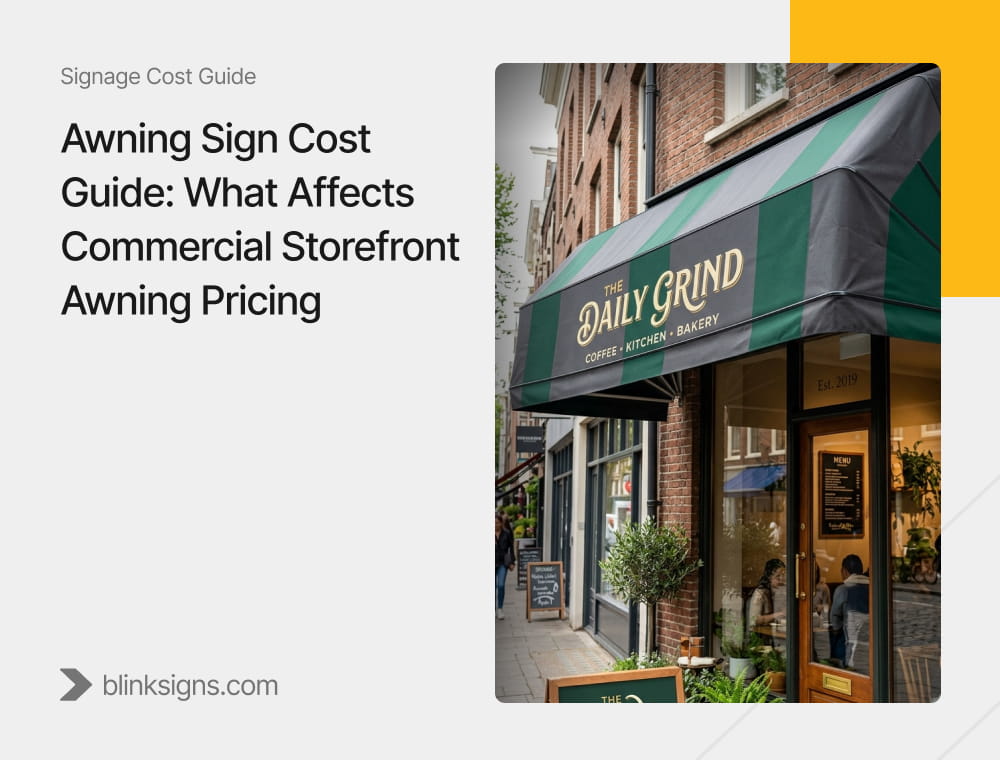
Awning Sign Cost Guide: What Affects Commercial Storefront Awning Pricing
Awning sign cost is primarily a scope question. The first decision is whether the project is a new awning, a fabric re-cover, a graphic update, an awning repair, or a full replacement. Once that path is clear, the quote can be shaped by the awning structure, storefront conditions, graphics method, illumination, installation access, landlord criteria, permit requirements, and weather exposure.
A custom awning sign can serve as a storefront identifier, a branded architectural element, a shade feature, and a customer-facing sign surface simultaneously. That is why awning signage cost can vary more than buyers expect. A simple awning lettering update on an existing frame is not the same as a new commercial awning sign, which includes frame review, custom materials, branded graphics, installation, landlord review, permit support where relevant, and lighting coordination where required.
Because awning signs can range from a simple graphic refresh to a full building-mounted storefront awning replacement, this guide uses scope-based planning instead of universal pricing. It explains what affects storefront awning sign cost, how to compare awning sign quotes, when an existing awning may be re-covered or re-skinned, and what buyers should clarify before requesting an estimate.
What affects awning sign cost?
Awning sign cost depends on five major factors:
- Project type: new awning, fabric re-cover, graphic update, repair, or full replacement
- Awning structure: width, projection, frame condition, mounting surface, and storefront height
- Branding scope: logo, awning lettering, valance graphics, side-panel graphics, color matching, and graphic method
- Site conditions: old awning removal, wall condition, sidewalk access, weather exposure, and installation timing
- Approval path: landlord review, awning sign permits, illumination rules, historic district review where relevant, and electrical coordination where required
Buyers should compare awning sign quotes by scope, not by the word “awning.” Two quotes may both say “awning signage,” but one may include only custom awning graphics. In contrast, the other may include frame review, new material, removal, fabrication, installation, approval coordination, and multi-location planning.
Who is this awning sign cost guide for?
This guide is for business owners, restaurant operators, cafe owners, retail teams, franchise teams, facilities managers, property managers, and marketing teams comparing commercial awning signs for storefronts, street-facing buildings, shopping centers, plazas, hospitality properties, offices, and multi-location brands.
It is especially useful if you are asking:
- How much does an awning sign cost?
- Why do online awning sign price ranges vary so much?
- Do I need a new awning or an awning re-cover?
- Can I update only the graphics on an existing awning?
- What is the difference between awning signs, canopy signs, and fascia graphics?
- Do awning signs require permits or landlord approval?
- What affects awning sign installation cost?
- Are awning signs good for restaurants, retail stores, cafes, offices, hotels, or franchises?
The best awning sign decision starts with the actual storefront. Buyers should review the existing frame, storefront width, mounting surface, brand requirements, weather exposure, approval path, and whether the awning needs to coordinate with window graphics, channel letters, cabinet signs, blade signs, or other exterior signage.
For related planning across your exterior facade, review our core Commercial Signage Cost Guide, explore decorative glazing in our Window Graphics Cost Guide, and check our operational guides for commercial sign installation, sign permit compliance, and sign repair and maintenance.
Why do published awning sign price ranges vary
Published awning sign price ranges can be misleading because they often lump very different scopes into a single number. One online range may describe simple awning graphics on an existing surface. Another may include a new storefront awning, custom fabric, framework, branded graphics, removal of the old awning, installation, lighting coordination, landlord review, and permit support where relevant.
A buyer comparing awning signage costs should first identify the project path. A storefront awning sign may involve:
- A new awning sign for a new storefront or rebrand
- A fabric awning re-cover using an existing frame
- An awning re-skin when the visible surface needs replacement
- A graphic refresh on an existing awning
- An awning repair for limited damage or visible wear
- A full replacement when the frame, fabric, mounting, or brand fit is no longer suitable
A lower product-only quote may not include installation, removal, frame review, permit support, landlord approval support, or electrical coordination where required. A higher quote may include a more complete commercial sign scope.
The key question is:
Does this quote cover only the visible awning graphics, or does it cover the full awning sign project?
What counts as an awning sign?
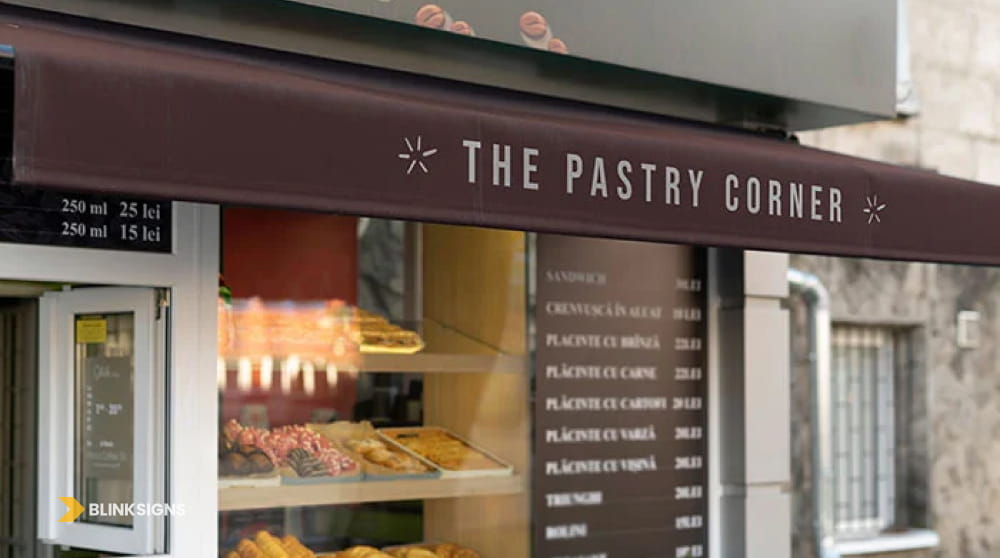
Printed valance graphics identify storefront businesses.
An awning sign is a storefront awning, canopy, or projected covering that includes a business name, logo, text, graphic, pattern, or brand message. It may be made with fabric, canvas, vinyl-coated material, metal, acrylic, aluminum, or another approved material, depending on the property, design, and local requirements.
Awning signs are commonly used above storefront entrances, windows, restaurant patios, cafe fronts, boutique retail locations, hotel entrances, salons, offices, and walkable commercial streets.
Common awning sign formats include:
- Fabric awning signs
- Canvas awning signs
- Vinyl awning signs
- Metal awning signs
- Aluminum awning signs
- Illuminated awning signs
- Backlit awning signs
- Retractable awning signs
- Valance graphics
- Awning lettering
- Custom awning graphics
- Side-panel awning graphics
- Storefront canopy signs
- Restaurant awning signs
- Retail awning signs
- Franchise awning signs
- Multi-location awning signs
An awning sign can serve as the primary storefront identifier and also support other signage. For example, a restaurant may use an awning sign above the entrance, window graphics on the glass, and channel letters or a cabinet sign as the primary building sign.
Awning sign, canopy sign, or fascia sign: what is the difference?
The terms awning sign, canopy sign, and fascia sign are sometimes used differently by sign companies, property managers, landlords, and local code offices. Buyers should not rely on terminology alone. They should describe the physical location, send storefront photos, and clarify which part of the building or awning will carry the graphics.
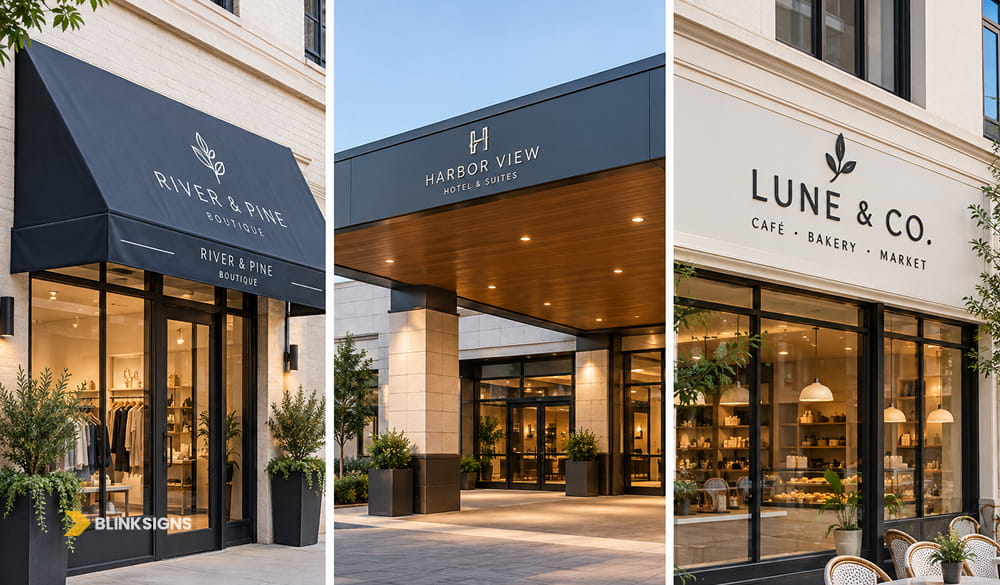
Comparing commercial awnings, canopies, and fascias.
An awning sign usually refers to a branded awning or projected covering attached to a storefront. It may include graphics on the valance, face, sides, or fabric surface.
A canopy sign may refer to a broader architectural covering, an entrance structure, a fuel canopy, a hotel entrance canopy, or a building-mounted covering that includes signage or branding.
A fascia sign may refer to signage placed on a storefront fascia, sign band, awning face, or architectural panel. In some contexts, awning fascia graphics may describe branding applied to the front face or valance area of an awning.
Because local terminology varies, the safest approach is to provide photos, measurements, business goals, and landlord criteria before asking for a final quote.
New awning, re-cover, graphic update, repair, or replacement: which quote do you need?
The most important decision in awning sign pricing is the project path. A new awning sign, fabric re-cover, graphic update, repair, and full replacement are different scopes.
| Awning sign project type | Best fit | What affects cost |
| New awning sign | New storefront, rebrand, restaurant opening, retail facade update, franchise location | Awning size, frame, material, projection, graphics, installation, permits, landlord approval |
| Fabric re-cover or re-skin | The existing frame appears usable, but the fabric is faded, damaged, outdated, or off-brand | Frame condition, measurements, material, removal, graphics method, and installation access |
| Graphic update | Existing awning fabric and frame are usable, but the name, logo, or message needs to be refreshed | Awning lettering, logo size, color matching, surface condition, and material compatibility |
| Awning repair | Limited visible damage, loose material, fading, or minor service issue | Damage type, access, material, frame condition, weather exposure, and repair feasibility |
| Full replacement | Awning is damaged, incompatible, poorly mounted, outdated, or no longer serviceable | Removal, new frame, material, mounting surface, permits, installation, disposal |
A re-cover may be practical when the existing awning frame is suitable for the new material, graphics, and project requirements. A graphic update may be enough when the awning surface is still in good condition and compatible with the new design. Full replacement may be needed when the frame, mounting surface, material, or storefront conditions do not support a safe or brand-appropriate refresh.
The buyer should not approve an awning quote until the project type is clear.
See how wall height, sidewalk access, and lighting change your project scope.
Download the Signage Cost Driver Matrix↗
Can an existing awning be re-covered or re-skinned?
Sometimes. An existing awning may be re-covered or re-skinned when the frame and mounting conditions are suitable for the new fabric, material, graphics, and project requirements.
A re-cover can make sense when:
- The existing frame appears usable
- The awning shape still fits the storefront
- The mounting conditions are acceptable
- The old fabric is faded, worn, damaged, or off-brand
- The business needs updated awning graphics
- The new brand layout works with the existing frame
A re-cover may not be the right path when the frame is damaged, poorly mounted, incompatible with the new design, unsuitable for the desired material, or no longer aligned with landlord criteria or local requirements.
Buyers should not assume that an existing frame can always be reused. Frame condition, measurements, mounting, material compatibility, and approval requirements should be reviewed before choosing re-covering instead of replacement.
What are awning graphics and awning lettering?
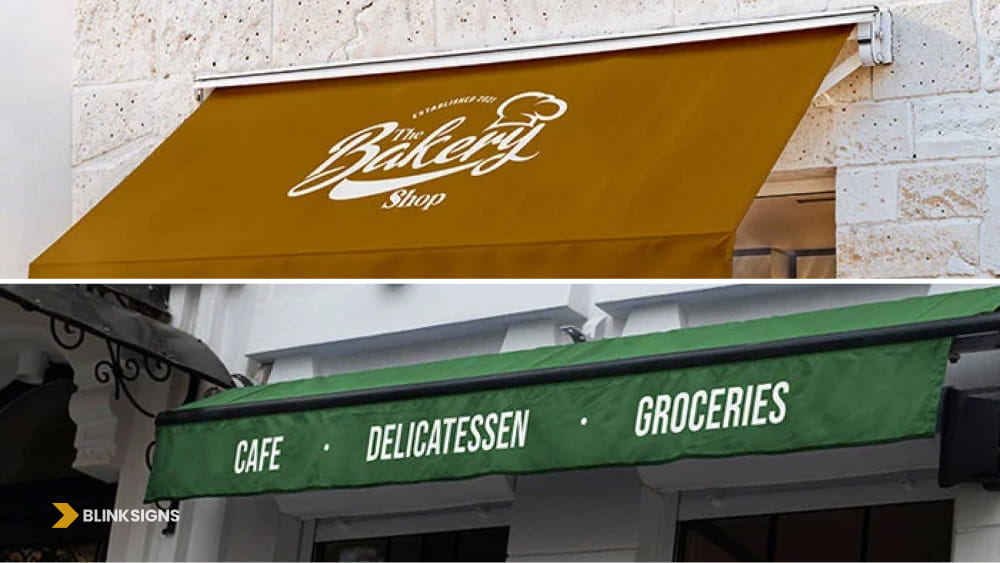
Comparing sloped face and valance lettering.
Awning graphics are the visual elements placed on the awning surface. They may include the business name, logo, brand colors, tagline, address, phone number, website, pattern, or directional message. Awning lettering is the text portion of the awning graphic system.
Common awning graphics include:
- Valance lettering
- Front-facing logo graphics
- Side-panel graphics
- Printed fabric graphics
- Applied vinyl lettering
- Painted graphics
- Sewn or integrated graphics
- Dimensional lettering where appropriate
- Brand color panels
- Repeated logos across multiple awnings
Graphics can affect costs by changing design time, production methods, material compatibility, color matching, visibility planning, and installation scope.
A simple one-color business name on a valance is a different project from a full custom awning graphic system with front graphics, side graphics, brand color matching, multiple awning sections, and multi-location brand standards.
Where should graphics go on an awning sign?
The best placement for the awning graphic depends on how customers approach the storefront.
Many awning signs place the business name or logo on the valance because it is visible from the front. Some awnings also include side-panel graphics for sidewalk visibility. Restaurants, cafes, and boutiques in walkable areas may need side visibility because customers approach from both directions. Shopping center tenants may need front-facing clarity because customers often approach from parking areas.
Graphic placement should consider:
- Sidewalk approach
- Parking lot approach
- Storefront height
- Window and door layout
- Valance size
- Awning projection
- Existing signs nearby
- Viewing distance
- Brand standards
- Landlord criteria
- Local sign rules where applicable
The goal is not to fill every surface with graphics. The goal is to make the awning easy to read, brand-aligned, and appropriate for the storefront environment.
What factors affect the cost of a commercial awning sign?
Material affects awning sign costs because it influences appearance, graphics method, weather-exposure planning, maintenance expectations, installation scope, and replacement timing.
Common material considerations include fabric, canvas, vinyl-coated material, acrylic, metal, aluminum, frame materials, printed graphics, applied vinyl graphics, painted graphics, and lighting-compatible materials.
Fabric and canvas awning signs
Fabric and canvas awnings are common for restaurants, cafes, boutiques, salons, and walkable storefronts. They can create a softer storefront look and may support color, pattern, and classic street-level identity.
Cost can be affected by awning size, fabric type, frame condition, graphics method, valance layout, and installation access.
Vinyl awning signs
Vinyl or vinyl-coated awnings may be considered when the project requires a specific surface type, printed graphics, or certain maintenance expectations. Suitability depends on the desired appearance, exposure, project specifications, and property requirements.
Metal and aluminum awning signs
Metal and aluminum awnings can create a more architectural appearance. They may be considered for modern retail, offices, hospitality properties, or storefronts where a stronger structural look is desired.
Cost can be affected by material, finish, frame, mounting conditions, graphics method, and installation complexity.
Backlit or illuminated awning signs
Backlit or illuminated awning signs may require additional planning because illumination can affect material selection, electrical coordination, permit review, landlord criteria, maintenance, and installation scope.
Illumination should be confirmed before production, especially in shopping centers, mixed-use properties, historic districts, or properties with strict tenant sign rules.
How does illumination affect awning sign pricing?
Illumination can affect awning sign pricing because it may introduce lighting components, electrical coordination, permit review where required, maintenance needs, and design limitations.
Some awning signs are non-illuminated and rely on daylight, storefront lighting, or nearby building lighting. Others may use external lighting, nearby facade lighting, backlighting, edge lighting, or other approved lighting methods, depending on the property and sign design.
Buyers should clarify whether illumination is included, excluded, optional, or not recommended for the specific awning type.
Are illuminated awning signs always allowed?
No. Illumination rules vary by jurisdiction, property, landlord criteria, awning type, zoning district, and sign design. Some properties may limit brightness, restrict internal lighting, require external lighting, prohibit certain lighting methods, or require additional review.
The safest approach is to confirm lighting expectations before fabrication, permit review, and installation.
Does awning lighting require electrical coordination?
Awning lighting may require qualified electrical coordination where required. A quote should clarify whether electrical coordination is included, quoted separately, excluded, or not part of the project scope.
This guide does not provide electrical instructions.
Do awning signs require permits or landlord approval?
Awning signs may require permits or landlord approval, depending on jurisdiction, property type, awning size, projection, material, illumination, mounting method, historic district status often assessed under the Secretary of the Interior’s Standards for Rehabilitation, sidewalk clearance, and whether the project is a new awning, a re-cover, a graphic update, a repair, or an alteration to an existing awning.
Permit review may affect:
- Awning size
- Projection distance
- Mounting method
- Materials
- Illumination
- Sign graphics
- Sidewalk clearance
- Historic district review
- Installation timing
Landlord approval may also affect the project. A shopping center, plaza, mall, office park, mixed-use building, or franchise-controlled property may have rules for awning color, material, projection, valance graphics, logo placement, illumination, mounting method, and removal responsibilities.
Buyers should not assume awnings are always permit-free or approval-free. Requirements vary by local rules, property rules, and approved specifications.
For related planning, link this section to the sign permit cost guide and storefront sign cost guide.
What affects awning sign installation cost?
Awning sign installation cost depends on awning size, projection, mounting height, wall surface, frame condition, access conditions, old awning removal, sidewalk activity, weather, permit status, landlord approval status, and whether electrical coordination is required.
A small re-cover may have a different installation scope than a full awning replacement. A storefront with easy access and a suitable mounting surface differs from one with damaged fascia, narrow sidewalk access, active pedestrian traffic, outdoor seating, or old hardware that must be removed.
The installation scope may be affected by:
- Mounting surface
- Storefront height
- Awning width
- Projection distance
- Frame condition
- Old awning removal
- Wall or facade condition
- Sidewalk or pedestrian access
- Parking lot access
- Restaurant patio or seating areas
- Weather conditions
- Electrical coordination is required where applicable.
- After-hours scheduling
- Permit or landlord approval status
A quote should clarify whether installation is included or quoted separately. It should also clarify whether removal, disposal, access equipment, wall repair, electrical coordination, and permit-related installation dependencies are included.
For related planning, link this section to the sign installation cost guide and sign repair and maintenance cost guide.
Example awning sign scenarios buyers should recognize
A cafe with a usable existing frame but faded fabric may not need a completely new awning. A fabric re-cover may be the right quote path if the frame and mounting conditions are suitable.
A boutique with good awning material but outdated branding may only need an awning graphic update, especially if the surface can support the new logo, lettering, and color requirements.
A restaurant with outdoor seating may need the awning to work with window graphics, door vinyl, lighting, and primary exterior signage, not just the business name on the valance.
A franchise location may need brand-compliant awning graphics, but the final layout may still need to adapt to landlord criteria, storefront measurements, projection limits, and local review requirements.
A storefront with an old or damaged awning may need a full replacement rather than re-skinning if the frame, mounting surface, or material no longer supports the project safely or visually.
These scenarios are why the commercial awning sign cost should be diagnosed by project type before a quote is compared.
BlinkSigns portfolio insight: why awning signs should be planned as storefront projects
Awning signs rarely exist alone. They often need to coordinate with storefront signs, window graphics, channel letters, cabinet signs, blade signs, directional signs, and property signage standards.
In real storefront projects, awning signs often become more complex when an existing frame looks reusable but does not match the new brand layout, when landlord criteria limit fabric color or projection, when illumination changes the approval path, or when the awning must align with window graphics, channel letters, or tenant sign-band rules.
BlinkSigns helps commercial buyers clarify those conditions before production so the quote reflects the actual storefront, not only the visible graphic surface. That planning matters for restaurants, retail stores, offices, hospitality properties, franchises, and multi-location brands where signage must balance brand consistency, site conditions, approvals, installation access, and future maintenance.
BlinkSigns can support awning sign planning across design coordination, storefront review, material and graphic selection, fabrication coordination, permitting support where relevant, installation coordination, repair or re-cover planning, and SignTrax project visibility.
Are awning signs good for restaurants and cafes?
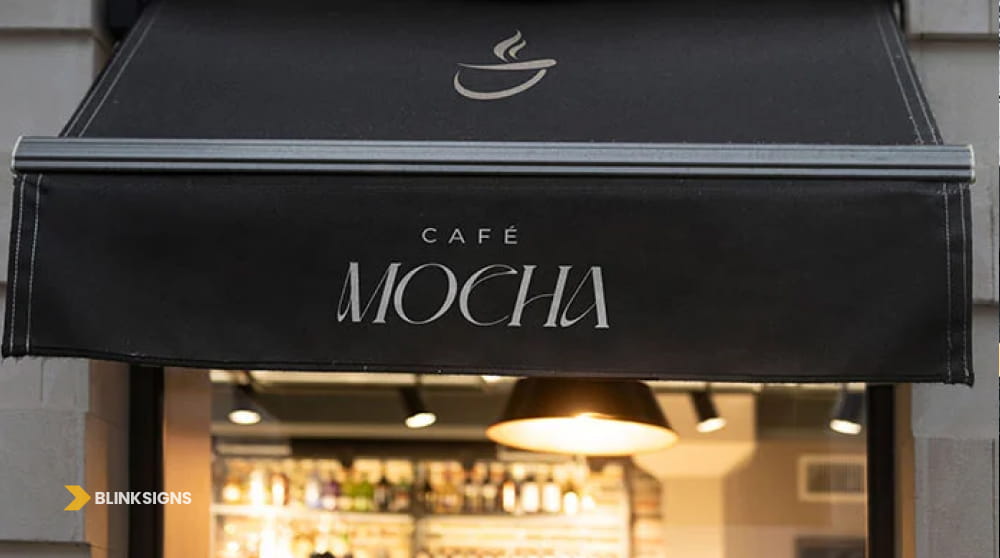
Retractable printed awning for restaurant patios.
Awning signs can be a strong fit for restaurants and cafes because they support entrance identity, sidewalk visibility, storefront atmosphere, outdoor seating areas, and customer arrival cues. A well-planned restaurant awning sign can help customers understand where to enter, what brand they are seeing, and how the storefront connects with the rest of the exterior signage.
A restaurant or cafe may use an awning sign above the main entrance, across a window line, over patio-facing glass, or as part of a larger storefront sign package. The awning may include the business name, logo, cuisine type, tagline, street number, brand color, or simple valance lettering.
For restaurants and cafes, awning sign planning should consider:
- Visibility from the sidewalk
- Visibility from the parking area
- Outdoor seating or patio layout
- Pickup or delivery flow
- Door and entrance location
- Evening operating hours
- Weather exposure
- Brand atmosphere
- Nearby window graphics
- Nearby blade signs, cabinet signs, or channel letters
- Landlord criteria
- Local review requirements are applicable
An awning sign may support storefront identity, but it may not replace the need for a primary exterior sign when stronger long-distance visibility is needed. In many restaurant projects, the awning works best with window graphics, door vinyl, blade signage, channel letters, cabinet signs, or exterior lighting.
What should restaurants check before choosing an awning sign?
Restaurants should check whether the awning supports the customer approach path. A cafe on a walkable street may benefit from a branded awning over the entrance. A restaurant in a shopping center may need the awning to fit tenant sign-band rules. A location with outdoor seating may need the awning to support both branding and customer comfort.
The best restaurant awning sign is not only attractive. It should align with the storefront, brand, seating area, operating hours, property rules, approval process, and maintenance expectations.
Are awning signs good for retail stores and boutiques?
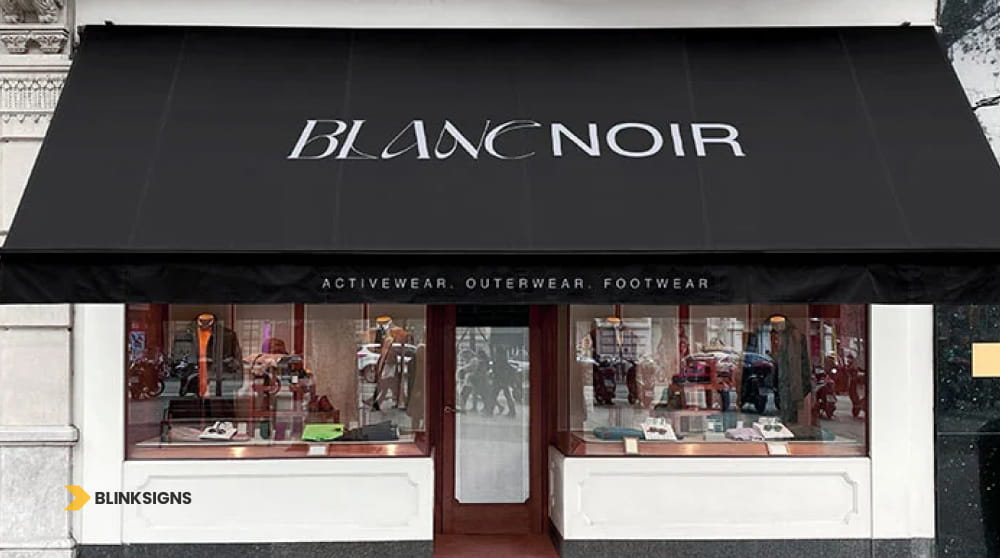
Modern storefront awning for retail boutiques.
Awning signs can work well for retail stores, boutiques, salons, specialty shops, and street-facing storefronts because they add brand presence to the facade while helping define the entrance or window line.
For retail storefronts, an awning sign may support:
- Storefront recognition
- Boutique identity
- Brand color
- Pedestrian visibility
- Window display framing
- Entrance definition
- Shopping district consistency
- Shade near display windows
- Seasonal storefront presentation
A retail awning should be planned with the rest of the storefront. If the business already uses channel letters, window graphics, a cabinet sign, or a blade sign, the awning should complement these elements rather than making the storefront feel crowded.
Should retail awnings carry seasonal promotions?
Usually, the awning itself is better suited for long-term brand identity than short-term promotional messaging. Seasonal campaigns are often better handled through window graphics, temporary signs, posters, banners, or removable campaign materials.
A retail awning can still support seasonal presentation through color, storefront framing, and coordination with window graphics. Buyers should be careful about turning a permanent awning into a short-term campaign surface unless the material, approval path, and replacement expectations support that plan.
Are awning signs good for offices and professional services?
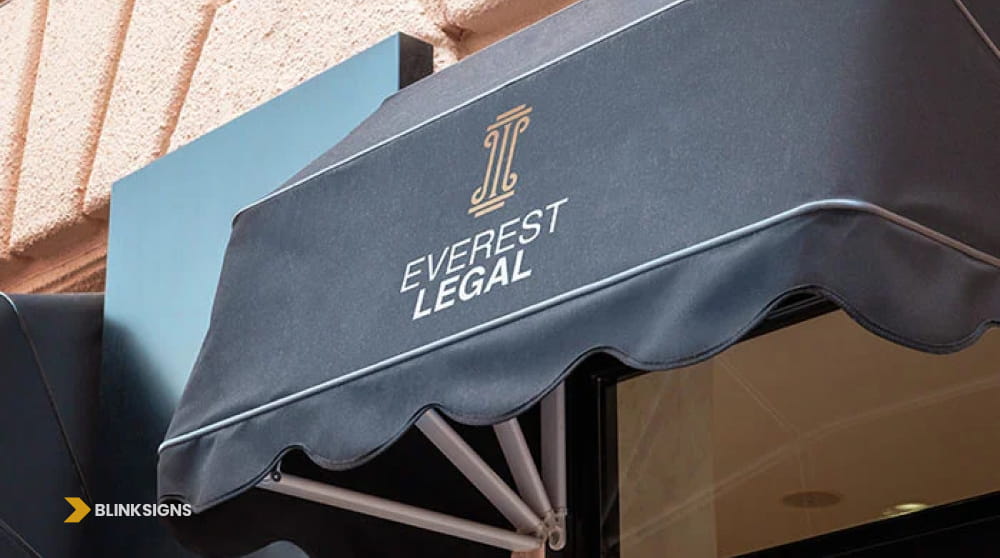
Classic dome awning for legal offices.
Awning signs can work for offices and professional services when the business needs a polished street-level presence without relying only on wall signs, door vinyl, tenant panels, or window graphics.
Professional service businesses may include:
- Real estate offices
- Medical offices
- Dental practices
- Law offices
- Financial service firms
- Salons
- Wellness clinics
- Education centers
- Local service businesses
For these businesses, awning signs often work best when the design is clean, restrained, and easy to read. The awning may include the business name, logo, suite number, or a simple brand color. It may also help the storefront feel more welcoming from the sidewalk or parking area.
Should professional offices use bold awning graphics?
Not always. Professional offices usually benefit more from clarity and trust than from heavy promotional messaging. A clean awning with simple branding may be more appropriate than a crowded design with too much text.
The design should align with the business category, building style, landlord criteria, local regulations (where applicable), and customer expectations.
Are awning signs useful for hotels and hospitality properties?
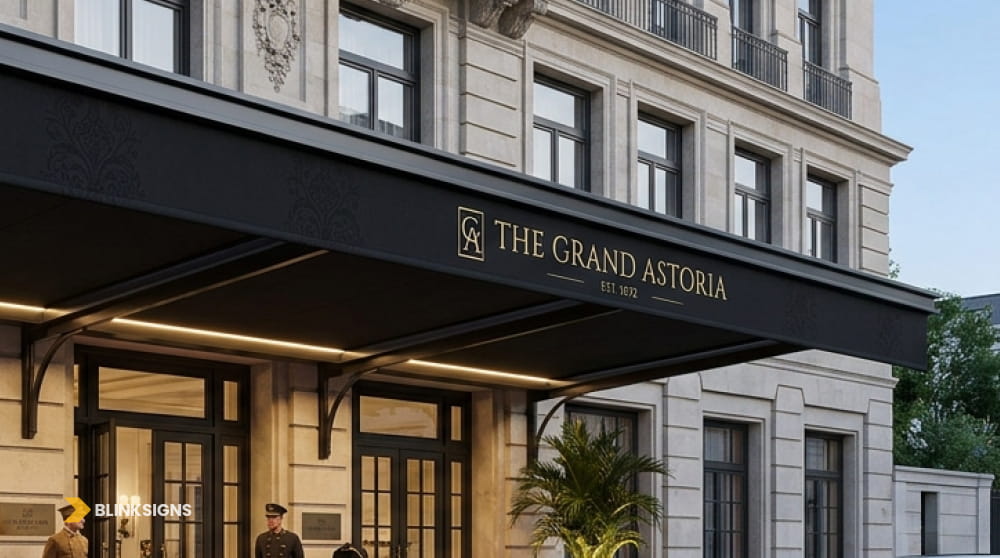
Elegant entrance canopy for luxury hotels.
Awning signs can support hospitality properties when a building needs a more defined entrance, a branded arrival point, or a coordinated exterior identity. Hotels, motels, resorts, and hospitality venues may use awnings near main entrances, valet areas, guest drop-off zones, restaurants, cafes, or street-facing retail spaces.
For hospitality properties, awning sign planning should consider:
- Guest arrival flow
- Main entrance recognition
- Vehicle approach path
- Pedestrian approach path
- Weather exposure
- Brand standards
- Coordination with monument signs
- Coordination with directional signs
- Coordination with building-mounted signage
- Long-term maintenance expectations
A hotel canopy or entrance awning must coordinate with roadside structures such as monument signs or pylon signs, as well as campus-wide wayfinding system design.
How should franchise and multi-location brands plan awning signs?
Franchise and multi-location awning signs should be planned as a controlled rollout, not as one identical awning repeated without site review. A restaurant group, retail chain, hospitality brand, healthcare network, or service business may have consistent brand standards. Still, each location can have different storefront dimensions, existing awning conditions, landlord criteria, permit exposure, climate exposure, and installation access.
A brand may approve one awning color, logo placement, typography standard, and graphic style, but execution can still vary by site. One location may need a new awning. Another may only need a fabric re-cover. Another may need a graphic update. Another may not be able to use the same projection, lighting method, color, or valance layout.
Multi-location buyers should plan around:
- Brand standards
- Storefront measurements by location
- Existing awning condition
- Frame reuse potential
- Material consistency
- Logo placement
- Color consistency
- Landlord criteria
- Local review requirements
- Climate exposure
- Installation access
- Replacement timing
- Maintenance expectations
- Site-by-site exceptions
What is the biggest challenge for awning signs for franchises?
The biggest challenge is balancing brand consistency with site-specific conditions. A franchise may want every awning to look the same. Still, each storefront may have different wall surfaces, window spacing, sidewalk conditions, landlord rules, local review requirements, and existing awning conditions.
The goal is flexible consistency. The awning should look like part of the same brand system while still fitting the actual property.
What hidden awning sign costs should buyers check?
Awning sign quotes can be difficult to compare because one quote may include only visible awning graphics. In contrast, another may include frame review, design coordination, material selection, removal of the old awning, fabrication, installation, approval coordination, and maintenance planning.
Before approving a quote, buyers should ask what is included, what is excluded, and what could change after site review.
| Buyer question | Why it matters |
| Is the project path clearly defined? | New awning, re-cover, graphic update, repair, and replacement scopes are different |
| Is frame review included? | Existing frames may not always support the new material, graphics, or design |
| Is installation included? | Fabrication and installation may be separate line items |
| Is the old awning removal included? | Removal can affect timing, disposal, wall condition, and access planning |
| Is landlord approval support included? | Leased spaces may have rules for color, projection, material, graphics, and lighting |
| Is permit support included where relevant? | Awning signs may require local review depending on project type and location |
| Is lighting coordination included where required? | Illuminated, backlit, or externally lit awnings may need qualified coordination |
| Is wall repair included or excluded? | Old awnings can leave holes, stains, faded areas, or surface damage |
| Is weather exposure considered? | Sun, rain, wind, salt air, snow, and orientation can affect material planning |
| Is the graphic method specified? | Printed, applied, painted, sewn, or dimensional graphics can change scope |
| Is multi-location variation included? | Each location may need different measurements, approvals, access, or materials |
The safest quote comparison question is:
Does this quote cover only the visible awning graphics, or does it cover the full commercial awning sign project?
Avoid hidden fees on frame inspections, removal, and graphics.
Download the Signage Quote Comparison Worksheet↗
How does BlinkSigns help plan awning signs?
BlinkSigns helps commercial buyers plan awning signs by looking at the storefront, business type, brand standards, existing awning condition, material needs, graphics method, landlord criteria, approval exposure, installation access, weather exposure, and long-term service expectations.
An awning sign project may involve more than adding a logo to fabric. It may require choosing the right project path, coordinating graphics with the storefront, reviewing existing conditions, and planning how the awning will work with other signage.
BlinkSigns supports awning sign planning through:
- Project planning
- Storefront review
- Design coordination
- Material and graphic type coordination
- Fabrication coordination
- Permitting support where relevant
- Installation coordination
- Existing awning replacement or re-cover planning
- Repair and maintenance planning
- Multi-location rollout support
- SignTrax project visibility
The goal is to help buyers move from a vague request, such as “we need an awning sign,” to a clearer scope that reflects the storefront, brand, frame condition, approval path, installation needs, and future maintenance expectations.
BlinkSigns portfolio insight: awning signs should fit the larger storefront system
Awning signs rarely exist alone. They often need to coordinate with window graphics, storefront signs, channel letters, cabinet signs, blade signs, directional signs, illuminated signs, and property standards.
That matters because awning projects can become more complex when an existing frame looks reusable but does not match the new brand layout, when landlord criteria limit fabric color or projection, when lighting changes the approval path, or when the awning must align with window graphics, channel letters, or tenant sign-band rules.
The strongest awning sign plan is the one that fits the complete storefront environment.
REQUEST A QUOTE NOW↗ | CALL FOR CONSULTATION
What should buyers prepare before requesting an awning sign estimate?
A better awning sign estimate starts with better project information. Buyers do not need to know every material or technical detail before requesting a quote, but they should provide enough information to clarify the likely project path.
Before requesting an awning sign estimate, prepare:
- Property address
- Business type
- Storefront photos
- Existing awning photos, if any
- Approximate storefront width
- Approximate awning width
- Approximate projection, if known
- Desired awning style
- Desired graphics or logo placement
- Logo files or brand guidelines
- Current frame condition, if known
- Whether the old awning removal may be needed
- Whether this is a rebrand, refresh, repair, or new location
- Landlord criteria, if available
- Permit status, if already started
- Illumination preference, if any
- Desired installation timeline
- Number of locations, if multi-site
The most useful photos show the full storefront, entrance, windows, current awning, mounting surface, side views, sidewalk area, nearby signs, and any visible damage or fading.
For multi-location programs, each site should be documented separately. A single brand standard can guide the rollout, but each awning may require its own measurements, frame review, landlord review, permit review (where required), and installation planning.
Download the Awning Sign Quote Prep Checklist
Use the downloadable Awning Sign Quote Prep Checklist before requesting an estimate. It can help organize storefront photos, existing awning details, approximate dimensions, logo files, landlord criteria, illumination preferences, project type, timeline, and multi-location notes.
The checklist is designed to help buyers prepare for a clearer conversation. It does not replace site-specific review, landlord review, permit review where required, material review, installation review, frame review, electrical review where required, structural review where required, or a confirmed project quote.
Download the Awning Sign Quote Prep Checklist Now↗
*Pricing, permitting, landlord, installation, weather, and safety note*

This guide is provided for buyer education and baseline planning. It is not legal advice, code interpretation, installation instruction, electrical guidance, structural guidance, landlord approval guidance, material performance guarantee, or a substitute for professional review.

Final awning sign cost depends on project type, awning size, storefront width, material, frame condition, projection, graphics method, lighting, mounting surface, installation access, old awning removal, landlord criteria, permit requirements, weather exposure, qualified electrical coordination where required, and approved specifications.

Awning signs may require permit review depending on jurisdiction, property type, awning size, projection, material, lighting, mounting method, historic district status, sidewalk clearance, and whether the project is new, re-covered, updated, repaired, or replaced. Landlord approval may be required for leased spaces, shopping centers, malls, plazas, office parks, mixed-use properties, and franchise-controlled locations.

Electrical documentation and field work should be handled by qualified or licensed professionals where required. Qualified professionals should handle installation, mounting, and frame and structural reviews, as required. Do not attempt DIY installation, structural modification, electrical work, or frame repair on commercial awning signs.
FAQ
How much does an awning sign cost?
Awning sign cost depends first on the project path, then on awning size, frame condition, material, graphics method, lighting, installation access, landlord criteria, permit requirements, and weather exposure.
What is included in an awning sign quote?
An awning sign quote may include design coordination, frame review, material selection, graphics production, old awning removal, re-cover work, installation, permit support where relevant, landlord approval support, lighting coordination where required, and maintenance planning. Buyers should ask what is included before comparing quotes.
What is the difference between a new awning and an awning re-cover?
A new awning may involve a new frame, new material, graphics, mounting, installation, and permit review where required. A re-cover usually uses an existing frame but replaces the visible fabric or covering. Re-covering depends on whether the existing frame is suitable.
Can I update only the graphics on an existing awning?
Sometimes. A graphic update may be possible when the awning material and structure are still in good condition and compatible with the desired graphics. If the fabric is faded, damaged, or unsuitable, a re-cover or replacement may be a better path.
What are awning graphics?
Awning graphics are the visual elements placed on the awning surface. They may include the business name, logo, tagline, valance lettering, side-panel graphics, brand colors, patterns, or other approved messaging.
What is awning lettering?
Awning lettering is the text applied, printed, painted, sewn, or otherwise produced on the awning surface. It may include the business name, suite number, tagline, phone number, website, or directional message.
Do awning signs require permits?
Awning signs may require permits depending on jurisdiction, property type, awning size, projection, material, lighting, mounting method, historic district status, and whether the project is new, re-covered, altered, repaired, or replaced. Requirements vary.
Does landlord approval affect awning signs?
Yes. Landlord criteria can affect awning color, material, projection, valance graphics, logo placement, lighting, mounting method, and removal responsibilities. Leased spaces, shopping centers, plazas, malls, office parks, and mixed-use properties often require approval.
Are awning signs good for restaurants?
Yes. Awning signs can support restaurant visibility, entrance identity, outdoor seating, sidewalk recognition, shade, atmosphere, and storefront branding. They often work best alongside other signage such as channel letters, window graphics, door vinyl, or blade signs.
Are awning signs good for retail stores?
Yes. Awning signs can help retail stores build storefront recognition, boutique identity, pedestrian visibility, brand color, and window-display framing. They are especially useful in walkable districts, street-facing storefronts, and branded retail environments.
Are awning signs good for offices?
Awning signs can work for offices and professional services when the business needs a clean street-level presence, entrance definition, or polished exterior identity. The design should match the business category, building style, landlord criteria, and customer expectations.
What affects awning sign installation cost?
Awning sign installation cost depends on size, projection, mounting height, wall surface, frame condition, access conditions, sidewalk activity, removal needs, lighting coordination, permit status, weather, and whether after-hours work is required.
Can an existing awning frame be reused?
An existing awning frame may be reusable if it is suitable for the new material, graphics, mounting conditions, and project requirements. The frame should be reviewed before assuming reuse is possible.
When should an awning be replaced instead of re-covered?
Replacement may be needed when the existing awning is damaged, outdated, incompatible, poorly mounted, unsuitable for the new design, or no longer serviceable. Re-covering may be practical only when the frame and mounting conditions support reuse.
Are illuminated awning signs allowed?
Illumination rules vary by jurisdiction, property, landlord criteria, awning type, zoning district, and sign design. Some properties may restrict lighting methods, brightness, or electrical components. Illumination should be confirmed before fabrication and installation.
How should franchises plan awning signs?
Franchises should plan awning signs on a site-by-site basis while maintaining brand standards. Each location may have different storefront measurements, frame conditions, landlord criteria, permit requirements, weather exposure, wall surfaces, and installation access.
How does BlinkSigns help with awning signs?
BlinkSigns supports awning sign planning through project planning, storefront review, design coordination, material and graphic type coordination, fabrication coordination, permitting support where relevant, installation coordination, re-cover and replacement planning, maintenance planning, multi-location rollout support, and SignTrax project visibility.
Conclusion
The cost of an awning sign depends on more than just the printed business name or logo. The final scope may include material selection, frame review, awning graphics, awning lettering, re-cover work, old awning removal, installation, landlord approval, permit support where relevant, lighting coordination where required, weather-exposure planning, and future maintenance.
The most important decision for awning signs is the project path. A new awning, fabric re-cover, graphic update, repair, and full replacement each have a different scope, approval requirements, installation conditions, and long-term maintenance expectations.
Restaurants, cafes, retail stores, offices, hospitality properties, franchises, and multi-location brands can all use awning signs in different ways. A cafe may need a street-level awning to establish its entry identity. A retail store may need a branded facade element. A professional office may need a clean and restrained exterior sign. A franchise may need a repeatable awning standard that still adapts to local storefront conditions.
BlinkSigns helps commercial buyers plan awning signs with clearer coordination across design, materials, fabrication, permitting support where relevant, installation planning, re-cover or replacement decisions, maintenance needs, multi-location visibility, and SignTrax project tracking. Before requesting an awning sign estimate, buyers should gather storefront photos, existing awning details, approximate dimensions, landlord criteria, brand files, illumination preferences, timeline, and number of locations.