
Storefront Sign Cost Guide: What Affects Business Front Sign Pricing
A storefront sign is often the first physical brand signal a customer sees before entering a business. It identifies the tenant, provides street or parking area visibility, reinforces brand standards, and helps the storefront feel complete.
Storefront sign costs depend on more than just the visible sign face. The final quote can be affected by sign type, storefront size, materials, illumination, mounting surface, installation height, electrical access, landlord criteria, permit requirements, window coverage, existing sign removal, and whether the project includes a single sign or a complete storefront signage package.
This guide explains what affects storefront sign pricing, how to choose the right sign type, why quotes vary, what buyers should prepare before requesting an estimate, and how storefront signage connects with installation, permits, repair, and long-term maintenance.
Who is this storefront sign cost guide for?
This guide is for business owners, franchise teams, facilities managers, property managers, marketing teams, and operations leaders comparing storefront signage options for retail, restaurant, office, hospitality, healthcare, and multi-location properties.
It is especially useful if you are asking one of these questions:
- What type of storefront sign do I need?
- Why are storefront sign quotes so different?
- Should I choose channel letters, a cabinet sign, window graphics, an awning sign, or a blade sign?
- Is installation included in the sign quote?
- Will landlord approval or permits affect the project?
- Can I reuse an existing sign cabinet or sign band?
- How should a multi-location brand plan storefront signs across different properties?
A storefront sign project should be planned around the business, property, visibility needs, approval path, and long-term service expectations, not around a generic sign price.
How much does a storefront sign cost?
Storefront sign costs depend on the sign format, storefront size, materials, illumination, mounting method, installation height, electrical access, landlord requirements, permit rules, window coverage, and whether the project includes a single sign or a multi-element storefront package.
A simple non-illuminated storefront sign has a different scope than illuminated channel letters, a cabinet sign, a blade sign, an awning sign, window graphics, dimensional letters, door vinyl, or a complete storefront identity package.
The better question is not only, “How much does a storefront sign cost?” The better question is:
What type of storefront sign does the business need, and what scope is included in the quote?
A storefront sign quote may include design coordination, fabrication, installation, permit support where relevant, landlord approval support, electrical coordination where required, existing sign removal, window graphic removal, wall repair, or future service planning.
When comparing quotes, buyers should confirm whether the quote includes only the sign product or the full storefront signage project.
What counts as a storefront sign?
A storefront sign is any sign or visual branding element used on or around the front of a business location to identify the company, support visibility, and communicate the brand to people outside the location.
A storefront sign is not always one product. It may be a single primary exterior sign, or a package of coordinated signs and graphics.
Common storefront signage options include:
- Channel letters
- Cabinet signs
- Blade signs
- Awning signs
- Window graphics
- Door vinyl
- Dimensional letters
- Tenant panels
- Menu-adjacent signage
- Temporary promotional signs
- Complete storefront sign packages
A retail store may need illuminated channel letters plus window graphics. A restaurant may need a blade sign, awning graphics, and vinyl hours on the door. A professional office may need dimensional letters, a tenant panel, and door identification. A franchise location may need a complete storefront package that meets brand standards and complies with landlord and local requirements.
What is a storefront sign package?
A storefront sign package is a coordinated set of signs and graphics used together on the customer-facing side of a business. It may include a primary exterior sign, window graphics, door vinyl, tenant panels, awning graphics, blade signage, and supporting wayfinding.
A package can cost more than a single sign because it may involve multiple materials, installation methods, approval requirements, window measurements, electrical coordination, and future maintenance needs.
For buyers, the key question is whether they need one sign or a full storefront system.
Which storefront sign type is best for your business?
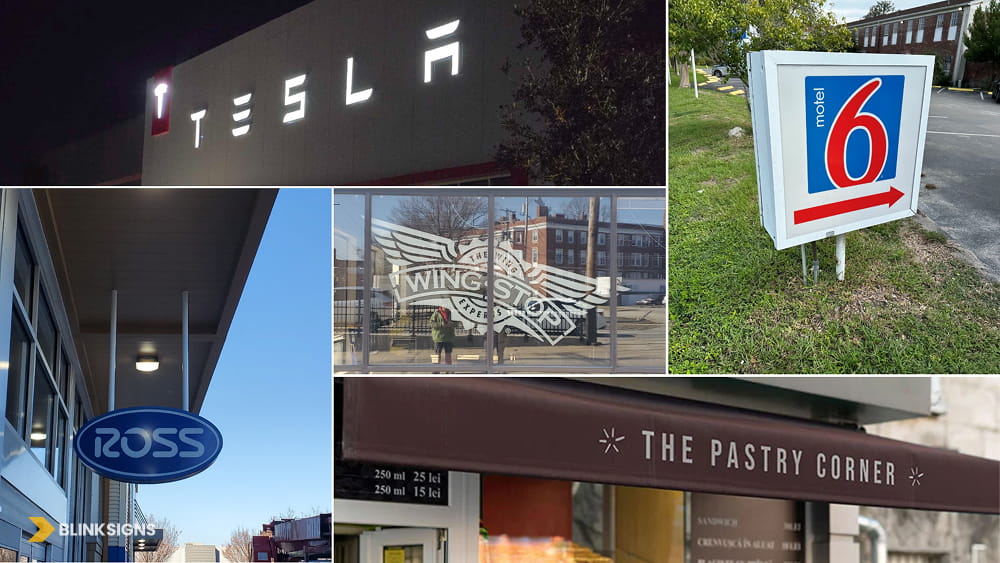
common storefront signage options
The best storefront sign type depends on how the location needs to be seen. A business on a busy road may need illuminated building identification. A business in a walkable downtown may benefit from a blade sign. A retail storefront may need window graphics to support promotions or privacy. A shopping center tenant may need to reuse an existing cabinet sign or comply with the landlord’s strict criteria.
| Storefront sign type | Best fit | What affects cost |
| Channel letters | Retail stores, restaurants, healthcare offices, franchises, banks, fitness studios | Letter size, logo complexity, illumination, raceway, mounting height, wall access, and electrical coordination. Review complete layout budgets in our Channel Letter Sign Cost Guide. |
| Cabinet sign | Shopping centers, tenant spaces, existing sign boxes, multi-tenant properties | Face size, lighting system, cabinet condition, face replacement vs full cabinet replacement. Learn more about box sign budgeting in our Cabinet Sign Cost Guide. |
| Blade sign | Walkable streets, restaurants, boutiques, downtown storefronts, hospitality districts | Projection, bracket condition, clearance, illumination, sidewalk access, facade condition. Explore architectural parameters in our Blade Sign Cost Guide. |
| Window graphics | Retail, promotions, privacy, seasonal campaigns, brand messaging | Window size, coverage, vinyl type, removal needs, surface prep, visibility goals. |
| Awning sign | Cafes, restaurants, boutique retail, storefronts with canopy structures | Awning size, fabric, lettering method, illumination, frame condition, mounting |
| Dimensional letters | Professional offices, medical practices, salons, service businesses, subtle exterior branding | Material, depth, finish, logo complexity, mounting surface, and installation conditions |
| Full storefront package | Brands needing a complete storefront identity across multiple elements | Combination of signs, design coordination, landlord review, permits, installation, and future service needs. Compare multi-element scope in our master Commercial Signage Cost Guide. |
A sign type should be selected based on visibility needs, not solely on appearance. A non-illuminated dimensional sign may look refined during the day, but may not support evening visibility. A cabinet sign may be practical when an existing sign box is already available. Channel letters may be better when the brand needs stronger building identification. Window graphics may support promotions, but they may not replace the need for a primary exterior sign.
Why storefront signs should be planned by business type
BlinkSigns has supported signage programs across retail, restaurants, hospitality, real estate, and national business environments, including work for brands such as Target, Verizon, Choice Hotels, Motel 6, Re/Max, Wingstop, and Amazon. Check out the complete case studies↗.
The lesson from multi-industry storefront signage work is that a storefront sign is rarely one-size-fits-all.
A restaurant storefront may need evening visibility, window messaging, clarity for delivery pickups, and a sign that is visible from both the sidewalk and the parking area. A retail storefront may need stronger facade recognition and promotional window graphics. A real estate office may need a professional exterior sign, clean window branding, and local property visibility. A hotel or hospitality property may need storefront signage that connects with monument signs, wayfinding, and guest arrival flow.
The sign type should match the business model, the property, the customer approach path, and the approval environment.
Why do storefront sign quotes vary so much?
Storefront sign quotes vary because the phrase “storefront sign” can describe projects that differ widely. One quote may be for vinyl lettering on glass. Another may be for illuminated channel letters. Another may be for a cabinet face replacement inside an existing shopping center sign box. Another may include design, fabrication, permits, installation, removal of old signage, electrical coordination, wall repair, and window graphics.
A storefront sign quote may change based on:
- Storefront width
- Sign type
- Letter height
- Logo complexity
- Materials
- Illumination
- Raceway or direct mounting
- Wall surface
- Installation height
- Electrical access
- Landlord rules
- Permit requirements
- Existing sign removal
- Window coverage
- After-hours installation needs
- Multi-location brand standards
A storefront with a clean wall surface and meeting approved landlord criteria may be easier to plan than one with old sign holes, damaged fascia, uncertain electrical access, strict shopping center rules, or historic district requirements.
The buyer should ask:
Does this quote cover only the sign, or does it cover the storefront signage project?
That one question can reveal whether installation, permits, landlord revisions, electrical coordination, removal of the old sign, and future service needs have been considered.
How does illumination affect storefront sign cost?
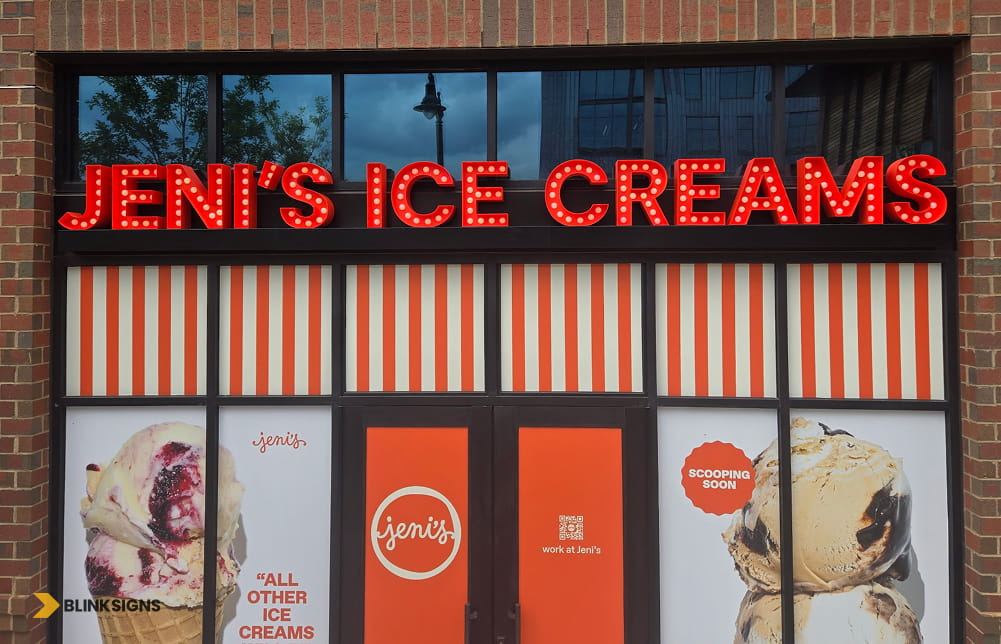
Front-lit and marquee channel letters increase night visibility for Jeni’s Ice Creams
Illumination can affect the cost of a storefront sign by influencing fabrication, components, electrical coordination, installation planning, permit review (where required), and future maintenance.
Common storefront illumination options include front-lit channel letters, halo-lit letters, internally lit cabinet signs, neon, LED neon-style signs, external lighting, and non-illuminated signs.
Are illuminated storefront signs worth considering?
An illuminated storefront sign may be worth considering when the business needs evening, roadside, restaurant, or shopping center visibility, or stronger brand recognition outside daylight hours. The right choice depends on the business type, hours of operation, landlord criteria, permit requirements, electrical access, and maintenance expectations.
What is the difference between front-lit and halo-lit channel letters?
Front-lit channel letters illuminate through the face of each letter, making the sign easier to see directly from the front. Halo-lit letters create a glow behind the letters, often giving the storefront a more refined or architectural appearance. Costs can differ because fabrication, mounting, spacing, wall surface, and lighting conditions vary.
Are neon and LED neon-style signs good for storefronts?
Neon and LED neon-style signs can support restaurants, cafes, entertainment venues, boutiques, and brands seeking a distinct visual character. Traditional neon may be selected for its original glow, while LED neon-style alternatives may be considered depending on design goals, service expectations, landlord criteria, and local requirements.
Illumination should be planned as part of the full storefront system, not as an afterthought.
How do landlord rules affect storefront signage?
Landlord rules can significantly affect storefront sign pricing because many businesses operate in leased spaces, shopping centers, plazas, malls, office parks, and franchise-controlled environments.
A landlord or property manager may have rules for:
- Maximum letter height
- Sign band placement
- Raceway use
- Cabinet sign dimensions
- Face material
- Approved colors
- Illumination type
- Awning graphics
- Blade sign projection
- Window coverage
- Installation method
- Removal requirements at lease end
A sign that fits the brand may still need revisions if it does not meet property criteria. In some cases, landlord approval is required before submitting the permit or proceeding with fabrication.
Do storefront signs require permits?
Storefront signs may require permits depending on the jurisdiction, sign type, size, illumination, placement, zoning district, property type, mounting method, and whether the project changes an existing sign.
Not every storefront sign requires the same level of review. Door vinyl or some interior-facing graphics may have a different permit exposure than illuminated channel letters, cabinet signs, awning signs, blade signs, or signs installed in historic or design-controlled districts.
Permit review may affect:
- Sign size
- Sign placement
- Illumination
- Projection
- Window coverage
- Mounting method
- Electrical documentation
- Landlord approval
- Installation timing
Buyers should not assume permits are always required or never required. The safest approach is to confirm local requirements before fabrication and installation.
For detailed permit planning, see the Sign Permit Cost Guide.
What affects storefront sign installation cost?
Storefront sign installation costs depend on the sign type, mounting surface, installation height, sign weight, access conditions, electrical coordination, old sign removal, wall condition, permit status, and whether the work must be done during business hours or after hours.
A simple vinyl door graphic has a different installation scope than illuminated channel letters mounted on a facade. A blade sign over a sidewalk has different access needs than a cabinet face replacement. A shopping center sign may require coordination with the landlord, lift access, and work outside customer-facing hours.
The installation scope may be affected by:
- Wall material
- Storefront height
- Sign size and weight
- Electrical access
- Bucket truck or lift access
- Sidewalks or pedestrian areas
- Parking lot access
- Drive-thru lanes
- Old sign removal
- Surface repair
- Weather conditions
- After-hours scheduling
A storefront sign quote should clarify whether installation is included or quoted separately. It should also clarify whether electrical coordination, access equipment, removal, disposal, wall repair, and permit-related installation dependencies are included.
For deeper installation planning, see the sign installation cost guide.
Should you reuse, reface, repair, or replace an existing storefront sign?
A storefront sign project does not always require a completely new sign. In some cases, an existing cabinet, raceway, awning frame, tenant panel, or mounting location may be reused. In other cases, replacement is better because the existing sign is damaged, outdated, corroded, poorly illuminated, nonconforming, or inconsistent with brand standards.
When does reuse make sense?
Reuse may be practical when the existing cabinet, frame, raceway, or sign structure is in good condition, properly located, compatible with the brand, and acceptable under landlord and local requirements.
When does reface make sense?
A cabinet face, tenant panel, or window graphic may be replaced when the structure remains usable, but the visible brand surface needs an update. This is common among shopping center tenants, office parks, retail centers, and multi-tenant properties.
When does repair make sense?
Repair may be an option when the existing sign has an isolated issue, such as a single dark letter, a damaged face, fading vinyl, broken trim, or a lighting issue that can be addressed without replacing the entire sign.
When does replacement make sense?
Replacement may be the better path when the sign has repeated failures, obsolete parts, cabinet corrosion, water intrusion, damaged mounting, outdated branding, or the new business needs an entirely different sign type.
For a comprehensive repair-planning framework, see the sign repair and maintenance cost guide.
What storefront signs work best for retail stores?
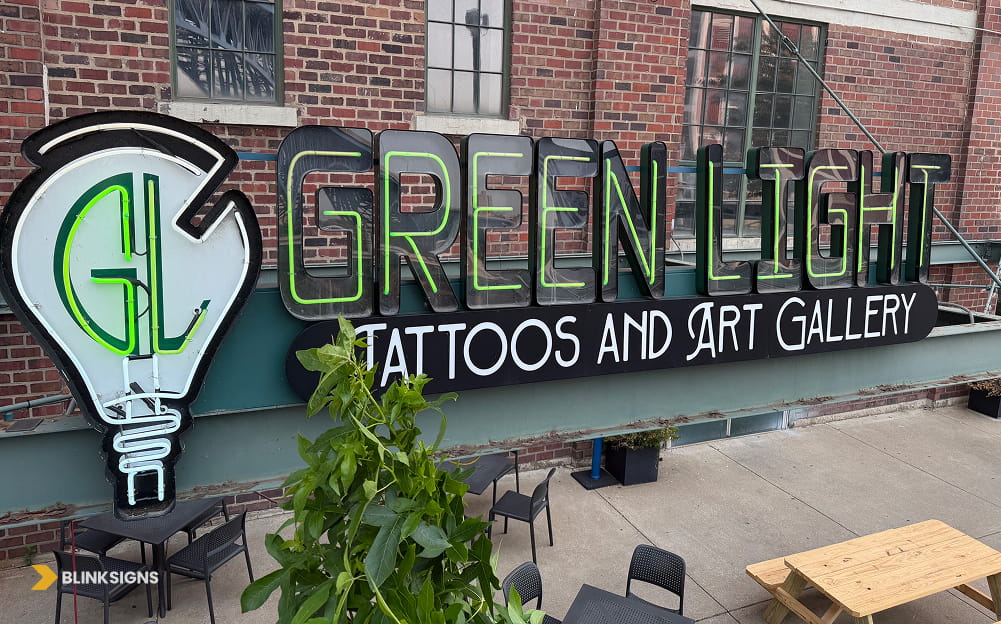
Custom neon and artistic storefront signage creates a strong visual anchor for specialty retail shops and creative studios.
Retail storefront signs should make the business easy to recognize from the customer’s natural approach path. That path may be a parking lot, a sidewalk, a shopping center drive aisle, a mall corridor, a street-facing entrance, or a curbside pickup area.
For many retail stores, the main storefront sign works together with secondary storefront graphics. A primary sign identifies the business. Supporting graphics can communicate promotions, departments, seasonal campaigns, hours, privacy, or brand personality.
Retail storefront signage may include:
- Illuminated channel letters for strong exterior identification
- Cabinet signs for shopping centers or tenant sign bands
- Window graphics for promotions, privacy, seasonal campaigns, or product messaging
- Door vinyl for hours, entry information, or customer guidance
- Dimensional letters for a more architectural storefront look
- Temporary promotional signage for short-term campaigns
A retail storefront sign quote should clarify whether the project includes only the main sign or a complete storefront package. A single-window graphic is a different scope from a retail package that includes channel letters, window graphics, door vinyl, installation, permit support (where relevant), and future service planning.
BlinkSigns case-study: retail storefronts need visibility and consistency
In a Target-style retail environment, storefront signage must support brand recognition across different property types while still aligning with building, landlord, local, sign band, installation access, and service expectations.
One retail location may need channel letters. Another may require a cabinet sign because of an existing sign box. Another may need window graphics for seasonal or promotional messaging. The cost conversation should therefore begin with the storefront role, not with one generic product price.
What storefront signs work best for restaurants and cafes?
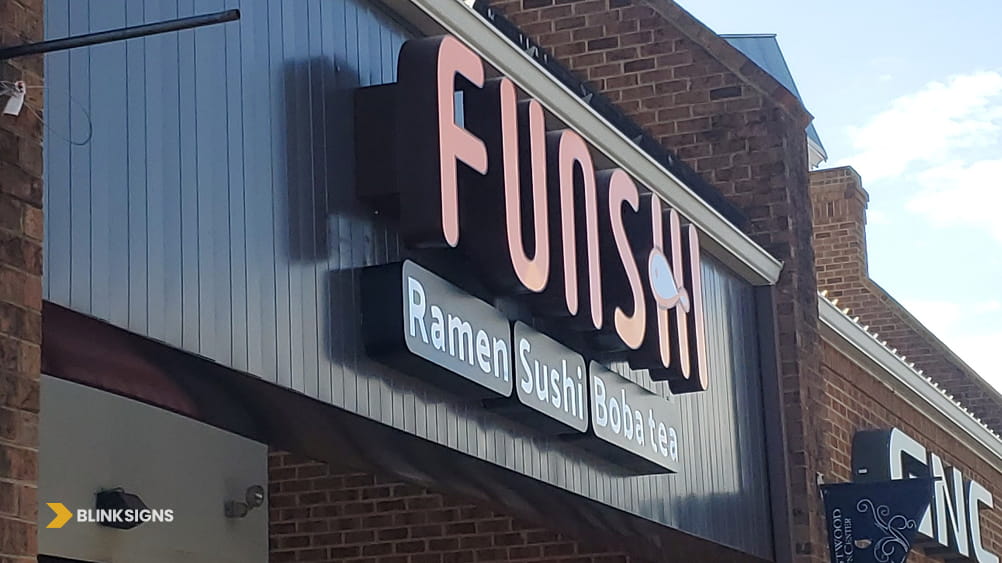
Custom dimensional channel letters mounted over a restaurant entrance clearly display brand identity
Restaurants and cafes often need storefront signage that works both during the day and at night. The sign may need to support walk-up visibility, road visibility, delivery pickup traffic, takeout customers, outdoor dining, and atmosphere.
A restaurant storefront may use illuminated channel letters, blade signs, awning signage, neon, LED neon-style signs, window graphics, menu-adjacent signage, and door vinyl. The best mix depends on the restaurant type, hours of operation, storefront width, customer approach path, landlord criteria, and local review requirements.
The key restaurant signage question is:
Will customers recognize the location quickly when they are walking by, driving past, arriving for pickup, or looking for the entrance?
That question can change the sign package. A blade sign may help pedestrians. Illuminated channel letters may support evening visibility. Window graphics may support privacy or promotions. Awning signage may help create a stronger storefront identity.
BlinkSigns case-study: restaurant storefronts often need layered signage
In a Wingstop-style restaurant setting, the storefront sign may need to support food-service visibility, evening recognition, window messaging, and consistent brand presentation across tenant spaces.
A restaurant tenant may not need only one sign. It may need a coordinated storefront package with exterior identification, window graphics, door information, and possibly blade or awning signage, depending on the property.
This is why the cost of restaurant storefront signs can vary even when the brand identity is consistent.
What storefront signs work best for offices and professional services?

Lobby & Interior Branding
Office storefront signage usually has a different goal than restaurant or retail signage. Instead of emphasizing heavy promotional visibility, the sign may need to convey professionalism, trust, clear location, and brand credibility.
Professional services may use dimensional letters, tenant panels, cabinet signs, window vinyl, door graphics, monument panels, or subtle illuminated signage. The right option depends on whether the office is in a street-facing suite, a medical plaza, an office park, a mixed-use building, a shared commercial property, or a multi-tenant building.
Common office and professional service storefront needs include:
- Tenant identification
- Door and suite information
- Professional exterior branding
- Window privacy
- Lobby continuity
- Monument or tenant panel updates
- Brand-consistent directional signage
BlinkSigns case-study: professional storefronts need clarity
In a Re/Max-style real estate office, the storefront sign should make the business easy to find while maintaining a professional, locally appropriate presentation. The sign package may include exterior branding, window graphics, door identification, tenant panels, or supporting directional elements.
A professional office does not always need the largest or brightest sign. It often needs the clearest fit between the brand, building, tenant rules, customer expectations, and long-term service needs.
How should multi-location brands plan storefront signage?
Multi-location storefront signage should be planned on a site-by-site basis, even when the brand standard is consistent. A franchise, retail chain, restaurant group, healthcare network, hospitality brand, storage company, bank, or service business may use similar signage across locations. Still, each property can have different storefront dimensions, landlord criteria, permit requirements, wall materials, electrical access, installation height, existing sign conditions, and local visibility needs.
A national brand may have one approved logo package, but the execution may still vary. One site may allow direct-mounted channel letters. Another may require raceway-mounted letters. Another may require an existing cabinet to be refaced. Another may need reduced window coverage because of landlord or local rules. Another may need a blade sign because the storefront sits in a walkable district.
Multi-location buyers should plan around:
- Brand standards
- Storefront measurements
- Landlord criteria
- Permit requirements
- Existing sign conditions
- Site photos
- Electrical access
- Installation access
- Local visibility needs
- Repair and maintenance expectations
- Rollout timing by location
BlinkSigns case-study: national brands need flexible consistency
For brands such as Verizon, Choice Hotels, Motel 6, Target, and Amazon, signage consistency matters, but each site may have different physical and approval conditions.
The practical challenge is not simply producing the same sign repeatedly. The challenge is keeping the brand recognizable while adapting to storefront width, landlord rules, code requirements, sign bands, installation access, existing sign conditions, and service needs.
That is where storefront signage becomes a planning system rather than a product-only purchase.
What hidden storefront sign costs should buyers check?
Storefront sign quotes can be difficult to compare because one quote may include only fabrication. In contrast, another may include design coordination, installation, permit support, removal, electrical coordination, landlord revisions, window graphic removal, or future service planning.
Before approving a quote, buyers should ask what is included, what is excluded, and what could change after site review.
| Buyer question | Why it matters |
| Is installation included? | Fabrication and installation may be separate scopes |
| Is permit support included? | Storefront signs may require local review depending on type, size, illumination, and location |
| Is landlord approval included? | Leased spaces, shopping centers, plazas, and malls often require property approval |
| Is electrical coordination included? | Illuminated signs may require qualified electrical coordination, where required |
| Is old sign removal included? | Existing cabinets, channel letters, awnings, tenant panels, or vinyl may need removal |
| Is wall repair included? | Old signs can leave holes, staining, faded paint, or surface damage |
| Is window graphic removal included? | Old vinyl may require removal, adhesive cleanup, and surface prep |
| Is after-hours installation included? | Retail and restaurant locations may need work outside customer-facing hours |
| Are landlord revisions included? | Property managers may request changes before approval |
| Are future service needs considered? | Lighting, faces, vinyl, awnings, and cabinet signs may need maintenance later |
| Is multi-location variation included? | Each site may have different landlord, permit, installation, and access requirements |
The safest quote comparison question is:
Does this quote cover only the sign product, or does it cover the full storefront signage project?
How does BlinkSigns help plan storefront signage?
BlinkSigns helps commercial buyers plan storefront signage by considering business type, site conditions, brand standards, sign type, landlord criteria, permit exposure, fabrication needs, installation conditions, and long-term service needs.
A storefront sign project may involve more than selecting a design. It may require confirming whether the business needs channel letters, a cabinet sign, a blade sign, window graphics, awning signage, dimensional letters, tenant panels, or a complete storefront package.
BlinkSigns supports storefront signage planning through:
- Project planning
- Site and sign-type coordination
- Design coordination
- Fabrication coordination
- Permitting support where relevant
- Installation coordination
- Existing sign replacement or reface planning
- Maintenance and repair planning
- Multi-location rollout support
- SignTrax project visibility
The goal is to help buyers move from a vague request, such as “we need a storefront sign” to a clearer scope that matches the property, brand, approval path, installation conditions, and customer visibility need.
BlinkSigns case-study: storefront planning across industries
BlinkSigns works across industries such as retail, hospitality, healthcare, education, construction, government, and self-storage. That cross-industry experience matters because storefront signage varies across environments.
A hotel property may need building identification, monument panels, and directional signage. A restaurant may need illuminated storefront visibility and window messaging. A retail brand may need stronger facade identification. A healthcare office may need exterior signage that connects with wayfinding and accessibility needs. A real estate office may need professional exterior identification and clean window branding.
The right storefront sign is the one that fits the site, brand, audience, approval path, and service expectations.
What should buyers prepare before requesting an estimate for a storefront sign?
A better estimate for a storefront sign starts with better project information. Buyers do not need to know every technical detail before requesting a quote, but they should provide enough information to clarify the likely scope of work.
Before requesting a storefront sign estimate, prepare:
- Business name and logo files, if available
- Property address
- Business type
- Owned or leased status
- Landlord sign criteria, if available
- Storefront photos from straight on and from the customer approach path
- Approximate storefront width
- Desired sign type, if known
- Existing sign photos
- Existing sign removal or reface needs
- Illumination preference
- Electrical access information, if known
- Window measurements, if window graphics are needed
- Desired installation timeline
- Permit status, if already started
- Number of locations, if multi-site
- Brand standards, if this is a franchise or national rollout
The most useful photos show the full storefront, the sign band or facade area, existing signage, windows, entry doors, surrounding wall surfaces, nearby obstructions, and any landlord-required sign zone.
For multi-location programs, each site should be documented separately. A single brand standard can guide the rollout, but each property still needs its own measurements, landlord review, permit review (where required), and installation planning.
**Pricing, permitting, landlord, electrical, and installation note**

This guide is provided for buyer education and baseline planning. It is not legal advice, code interpretation, electrical guidance, installation instruction, landlord approval guidance, or a substitute for professional review.

Final storefront sign cost depends on sign type, storefront size, materials, illumination, mounting surface, installation height, electrical access, landlord criteria, permit requirements, window coverage, old sign removal, wall condition, site access, and approved specifications.

Permits may be required depending on the jurisdiction, sign type, size, illumination, placement, zoning district, property type, and installation scope. Landlord approval may be required for leased spaces, shopping centers, malls, plazas, office parks, and franchise-controlled properties.

Electrical documentation and field work should be handled by qualified or licensed professionals where required. Qualified sign professionals should handle installation. Do not attempt DIY installation or electrical work on commercial storefront signs.
FAQ
How much does a storefront sign cost?
Storefront sign costs depend on the sign type, storefront size, materials, illumination, mounting method, installation height, electrical access, landlord requirements, permit rules, window coverage, and whether the project includes a single sign or a complete storefront signage package.
What is included in a storefront sign quote?
A storefront sign quote may include design coordination, fabrication, installation, permit support where relevant, landlord approval support, electrical coordination where required, old sign removal, window graphics, or future service planning. Buyers should ask what is included before comparing quotes.
What is the best type of storefront sign?
The best storefront sign type depends on the business, visibility goal, property type, landlord rules, permit requirements, hours of operation, and brand standards. Channel letters, cabinet signs, blade signs, awnings, window graphics, and dimensional letters each fit different needs.
Are channel letters good for storefront signs?
Yes. Channel letters are commonly used for storefront signs because they provide strong exterior identification and can be illuminated for evening visibility. Cost depends on letter size, logo complexity, illumination, raceway use, wall access, and installation conditions.
Is a cabinet sign good for a storefront?
A cabinet sign can be a good storefront option when the property already has a sign box, tenant panel system, or shopping center sign band. Cost depends on face size, lighting, cabinet condition, and whether the project is a face replacement or a full cabinet replacement.
Are window graphics part of storefront signage?
Yes. Window graphics are often part of storefront signage because they support branding, promotions, privacy, hours, seasonal messages, and visual merchandising. They may not replace the need for a primary exterior sign.
Do storefront signs require permits?
Storefront signs may require permits depending on jurisdiction, sign type, size, illumination, placement, zoning district, property type, and installation scope. Buyers should confirm local requirements before fabrication and installation.
Does landlord approval affect storefront signage?
Yes. Landlord criteria can affect sign size, letter height, raceway use, colors, illumination, awnings, window coverage, installation method, and approved placement. Landlord approval may be required before submitting the permit or proceeding with fabrication.
What affects storefront sign installation cost?
Storefront sign installation cost depends on sign type, mounting surface, installation height, sign weight, electrical access, old sign removal, wall condition, access equipment, sidewalk or parking lot access, and whether after-hours installation is needed.
Should I reuse an existing storefront sign cabinet?
An existing cabinet may be reusable if the cabinet, retainers, face size, lighting system, mounting, landlord approval, and local requirements support the new sign. It should be reviewed before assuming that only a new face is needed.
What is the difference between a storefront sign and a building sign?
A storefront sign usually identifies a specific business entrance, tenant space, or customer-facing facade. A building sign may identify the entire building, a property, a campus, or a larger commercial structure. Some storefront signs are also mounted on buildings.
What storefront signs work best for restaurants?
Restaurants often benefit from illuminated channel letters, blade signs, awning signs, window graphics, neon, LED neon-style signs, and clear door information. The right mix depends on hours, visibility needs, storefront layout, landlord rules, and brand style.
What storefront signs work best for retail stores?
Retail stores often use channel letters, cabinet signs, window graphics, door vinyl, dimensional letters, and promotional graphics. The right choice depends on road visibility, shopping center rules, storefront width, product category, and campaign needs.
How should franchises plan storefront signage?
Franchises should plan storefront signage on a site-by-site basis while maintaining brand standards. Each location may have different landlord rules, permit requirements, storefront dimensions, sign bands, electrical access, installation conditions, and visibility needs.
How does BlinkSigns help with storefront sign planning?
BlinkSigns supports storefront sign planning through project planning, sign-type coordination, design coordination, fabrication coordination, permitting support where relevant, installation coordination, maintenance planning, multi-location rollout support, and SignTrax project visibility.
Conclusion
Storefront sign costs depend on more than just the visible sign face. The final scope can include sign type selection, design coordination, fabrication, landlord approval, permit support where relevant, installation, electrical coordination, existing sign removal, window graphics, wall conditions, and future service needs.
The best storefront sign is not always the biggest or brightest option. It is the sign package that fits the business type, property, customer approach path, landlord criteria, local requirements, brand standards, and long-term maintenance expectations.
Retail stores, restaurants, offices, healthcare locations, hotels, franchises, and multi-location brands all use storefront signage differently. A single storefront may need channel letters, a cabinet sign, window graphics, awning signage, dimensional letters, tenant panels, or a complete package.
BlinkSigns helps commercial buyers plan storefront signage by enabling clearer coordination across sign selection, design, fabrication, permitting support (where relevant), installation planning, maintenance considerations, multi-location visibility, and SignTrax project tracking. Before requesting a storefront sign estimate, buyers should gather the property address, storefront photos, business type, landlord criteria, desired sign types, existing sign details, illumination needs, window graphic requirements, timeline, and number of locations.