
Sign Repair and Maintenance Cost Guide: What Affects Commercial Sign Service Pricing
The cost of commercial sign repair is rarely just the price of a replacement part. A repair estimate may include diagnosis, access equipment, replacement components, electrical coordination, sign face work, cleaning, return visits, permit review where required, and a decision about whether the sign should be repaired, retrofitted, maintained, or replaced.
This is why two signs with similar visible problems can have very different service scopes. A flickering storefront sign, a cracked cabinet face, a dark channel letter, a leaning monument sign, or a storm-damaged pylon sign may each require a different type of review before the repair path can be confirmed.
This guide explains what affects the cost of commercial sign repair, how repair differs from maintenance and replacement, what buyers should ask before approving a quote, and why BlinkSigns recommends scope-based repair planning rather than flat national repair pricing.
How much does sign repair cost?
Commercial sign repair cost depends on the sign type, visible issue, installation height, service access, lighting system, electrical components, replacement parts, sign age, weather exposure, site conditions, and whether the work requires lifts, bucket trucks, cranes, permit review, or qualified electrical coordination.
A low-scope repair may involve cleaning a sign face, replacing vinyl, updating a tenant panel, replacing a damaged face, or servicing an isolated lighting issue. A more complex repair may involve illuminated sign diagnosis, repeated outages, pylon sign access, neon service, cabinet water intrusion, storm damage, obsolete parts, or a decision to replace the existing sign when it is no longer practical to service.
The better budgeting question is not, “What does sign repair cost?” The better question is:
What failed, how hard is the sign to access, and is the existing sign still worth repairing?
Those three questions usually determine whether the buyer is looking at a small service request, a more involved repair, a retrofit, a face replacement, or a full replacement.
What is included in a commercial sign repair quote?
A commercial sign repair quote may include the service visit, visible condition review, access planning, parts coordination, repair labor, replacement faces or panels, electrical coordination where required, removal of damaged components, documentation, and follow-up service if parts must be ordered.
Not every repair quote includes the same scope of work. Some quotes cover only diagnosis. Some include a site visit and a basic repair if the issue is simple. Others require one visit to inspect the sign and a second visit after replacement parts, faces, panels, LEDs, power supplies, or specialty components are confirmed.
📋 Audit Your Repair Bids: Ensure your service vendor accounts for diagnostic labor, lift access, and replacement parts transparently by downloading our free Sign Repair Quote Comparison Worksheet.
Buyers should ask whether the quote includes:
- Diagnosis or field review
- Access equipment such as lifts, bucket trucks, ladders, or cranes
- Replacement parts and materials
- Electrical coordination is required where applicable
- Face, panel, vinyl, or trim replacement
- Cleaning or surface care
- Removal and disposal of damaged components
- Return visits after diagnosis or parts ordering
- Permit review where required
- Photos, documentation, or service notes
- Warranty review, if documentation is available
A repair quote is clearer when it separates the visible symptom from the confirmed scope. For example, “one letter is out” describes the symptom, but it does not confirm whether the issue is the LED module, power supply, wiring path, raceway, moisture exposure, or another condition.
Is the sign being repaired, maintained, retrofitted, or replaced?
The most important service distinction is between reactive repair, planned maintenance, retrofit, face replacement, and full replacement. These categories are often blended in competitor content, but they are not the same service.
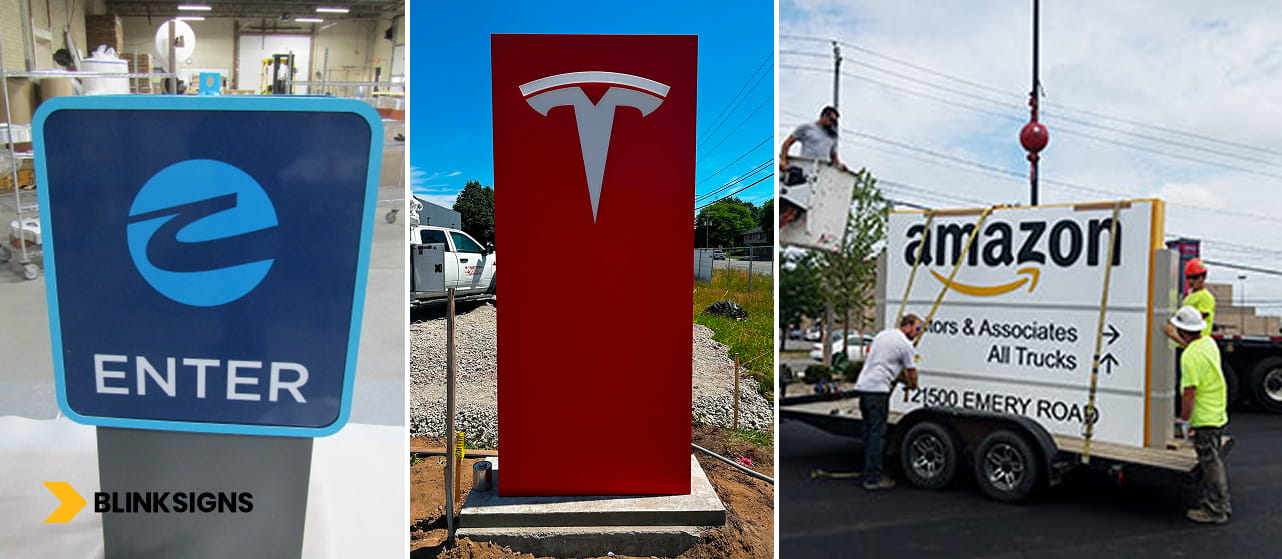
Professional sign service ensures your custom business signs remain functional
| Service category | What it means | When it usually fits | Buyer note |
| Reactive repair | Fixing a known issue after a sign fails or is damaged | Dark letters, broken faces, flickering, storm damage, impact damage Dark letters, broken faces, flickering, storm damage, impact damage | Scope depends on diagnosis, access, parts, and site conditions |
| Planned maintenance | Scheduled condition review, cleaning, lighting checks, gasket review, and documentation | Multi-location brands, illuminated signs, and high-visibility properties | Maintenance is site-specific, not a reliable flat annual number |
| LED retrofit | Updating an older lighting system while keeping the existing sign body, where practical | Older cabinet signs, channel letters, or illuminated signs with aging lighting Older cabinet signs, channel letters, or illuminated signs with aging lighting | Suitability depends on cabinet condition, wiring access, lighting expectations, and local requirements |
| Face replacement | Replacing the visible face, panel, vinyl, acrylic, polycarbonate, flex-face, or tenant panel | Rebrands, tenant changes, fading, cracked faces, vandalism, and weather damage | Existing frame, retainers, measurements, and color match should be reviewed |
| Full replacement | Replacing the sign when repair is no longer practical or aligned with business needs | Severe corrosion, obsolete parts, repeated failures, major brand refresh, structural concerns | May involve new design, permits, fabrication, installation, and removal |
Some repair companies publish flat annual maintenance ranges or simple repair tiers, but that can mislead commercial buyers. Maintenance scope depends on the number of signs, sign types, illumination, height, weather exposure, site access, service history, landlord rules, and whether the buyer manages a single location or multiple locations.
A single non-illuminated wall sign does not have the same maintenance profile as a multi-location program with channel letters, pylons, cabinet signs, monument signs, blade signs, and tenant panels. To explore initial fabrication parameters for new structures, see our master Commercial Signage Cost Guide.
Why can a sign repair estimate change after diagnosis?
A sign repair estimate can change because the visible issue does not always reveal the cause. A dark letter might look simple from the ground, but the confirmed scope may depend on the letter condition, LED modules, power supply, raceway, wall access, moisture exposure, or wiring path.
The same applies to cabinet signs and pylon signs. A cracked face may reveal brittle material, damaged retainers, cabinet corrosion, water intrusion, or a lighting system that also needs review. A storm-damaged monument sign may involve the visible panel, base, frame, lighting components, landscaping, access, or mounting conditions.
📥 Assess Service Complexity: Pinpoint whether your sign's mounting height, electrical configuration, or face material will complicate field labor by downloading our free Sign Repair Cost Driver Matrix.
A repair estimate may change when:
- The sign is higher than expected and requires access equipment
- Photos do not show the full condition of the sign
- The issue requires electrical coordination where required
- Replacement parts are custom, discontinued, or brand-specific
- Water intrusion, corrosion, or weather damage is discovered
- A second visit is needed after diagnosis
- The existing face, cabinet, trim, or retainer is not reusable
- A repair becomes a retrofit or replacement discussion
- Local permit review is required for the repair, replacement, or modification.
- The site has access restrictions, such as drive-thrus, sidewalks, parking lots, canopies, or traffic areas
This is why a repair quote should clarify whether the price is based on photos, known site history, a field visit, or a confirmed diagnosis.
Which commercial signs usually need repair?
Different sign types fail in different ways. The type of sign helps define the likely service path, but it does not determine the final scope on its own.
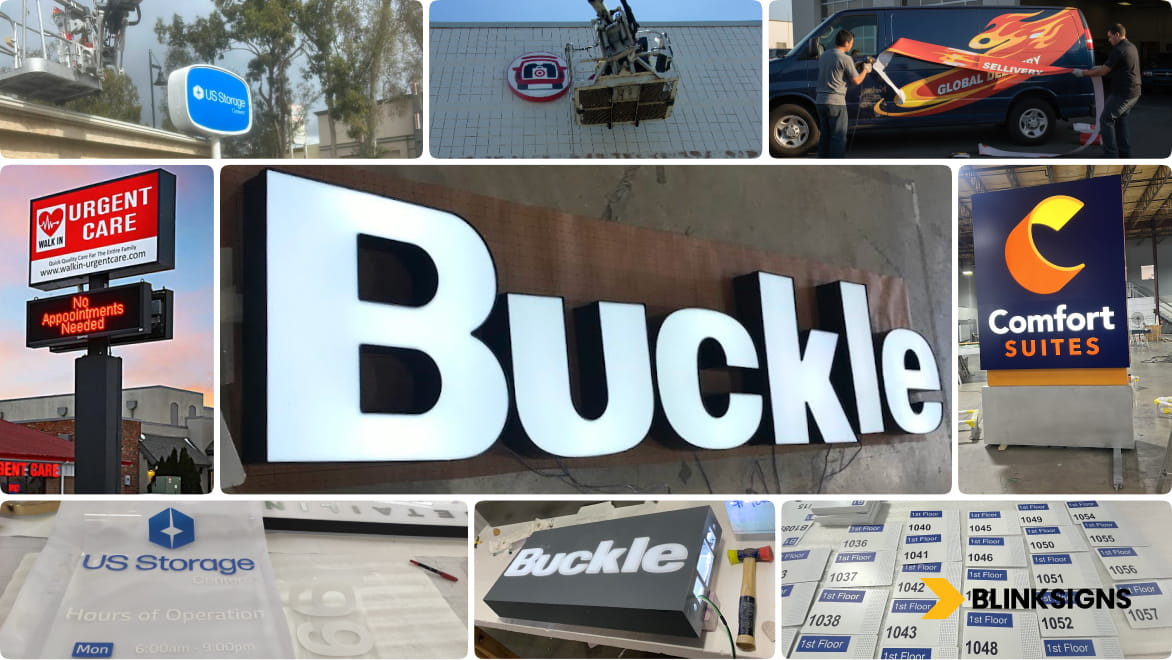
Common commercial sign repairs range from fixing broken channel letter lighting to updating interior signage.
Channel letter signs
Channel letter repair often starts with a visible symptom, such as a single dark letter, several dark letters, flickering, cracked acrylic, a damaged trim cap, halo-lighting inconsistency, or concerns about raceway access. A single dark letter may be isolated, but it can also point to a shared power supply, raceway, or wiring condition. Review initial layout and fabrication baseline metrics in our Channel Letter Sign Cost Guide.
For buyers, the most important question is whether the repair affects a single component, a single letter, several letters, or the entire illuminated system.
Cabinet signs
Cabinet sign repair may involve cracked faces, faded graphics, broken retainers, water intrusion, uneven lighting, failing LEDs, older fluorescent lighting, cabinet corrosion, or tenant panel replacement. A cabinet face can sometimes be replaced without replacing the entire sign, but the existing cabinet, measurements, retainers, lighting, and face material should be reviewed first. Explore full structural box guidelines in our Cabinet Sign Cost Guide.
Water inside a cabinet is especially important because replacing one lighting component may not solve the larger issue if moisture is still entering the sign.
Monument signs
Monument sign repair may involve face replacement, tenant panel updates, lighting service, cleaning, masonry review, base condition, landscaping access, or damage from impact and weather exposure. Monument signs are often easier to reach than pylons, but landscaping, irrigation, sidewalks, driveways, and property entry areas can still affect service planning. Review ground-level parameters in our Monument Sign Cost Guide.
Pylon signs
Pylon sign repair often requires more access planning because the sign is taller and larger, and is exposed to the weather. Common service needs include face replacement, tenant panel updates, lighting service, retainer repair, LED retrofit, storm-damage review, and elevated-access coordination. Review tall roadside structure variables in our Pylon Sign Cost Guide.
For many pylon repairs, access equipment can be a major scope driver.
Blade and projecting signs
Blade signs may need face repair, bracket review, lighting service, neon or LED service, panel replacement, or facade condition review. Because blade signs project from the building, service may be affected by sidewalk access, pedestrian areas, mounting height, bracket condition, and historic district rules. To explore initial fabrication, mounting, and projection clearance parameters, review our comprehensive Blade Sign Cost Guide.
A blade sign should not be treated as a face-only repair if the visible issue involves leaning, movement, sagging, impact damage, or bracket concerns.
Neon signs
Neon sign repair may involve tubes, transformers, housings, specialty service, access, and careful handling. Neon may be worth preserving when the sign has brand value, historic character, or a specific visual identity. In other cases, LED retrofit may be considered, but it should not be assumed automatically.
Digital signs
Digital sign service may involve modules, controls, power, display behavior, product-specific documentation, warranty status, and access. Digital display problems should be clearly described with photos or videos, especially when the issue involves blank sections, flickering, color issues, or intermittent display behavior.
Window graphics, vehicle graphics, and interior signs
Window graphics may need to be replaced due to peeling, bubbling, fading, adhesive failure, or surface issues. Vehicle graphics may need partial replacement, removal, or color-match review based on film age and vehicle condition. —review complete pricing, coverage tiers, and fleet budgeting in our Vehicle Wrap Cost Guide.
Interior and ADA signs may need replacement when signs are damaged, missing, outdated, or tied to code-required wayfinding. Review accessibility compliance in our ADA Sign Cost Guide.
Why are illuminated sign repairs more complex?
Illuminated sign repairs are more complex because the visible symptom may come from several possible diagnostic categories. Flickering, dimming, one dark letter, several dark letters, hot spots, uneven color, intermittent outages, buzzing, or water inside the sign can each point to different service paths.
This section is for buyer education only. It is not electrical troubleshooting guidance.
A flickering sign may involve a power supply issue, aging LED modules, connection issues, moisture exposure, or a control-related condition. A dim sign face may involve aging lighting, a dirty face, uneven internal lighting, reduced output, or a failing component. One dark letter may involve a local component issue, but several dark letters may point to a broader power or roadway condition. Hot spots may suggest uneven lighting layout, shallow cabinet depth, face condition, or a retrofit mismatch. Gaskets, retainers, seams, cabinet condition, face fit, or drainage issues may cause water inside a sign.
Buyers should document illuminated sign symptoms with photos or videos at the time the issue occurs. This is especially useful for intermittent outages, flickering, dimming, uneven color, or digital display issues that may not appear consistently during a service visit.
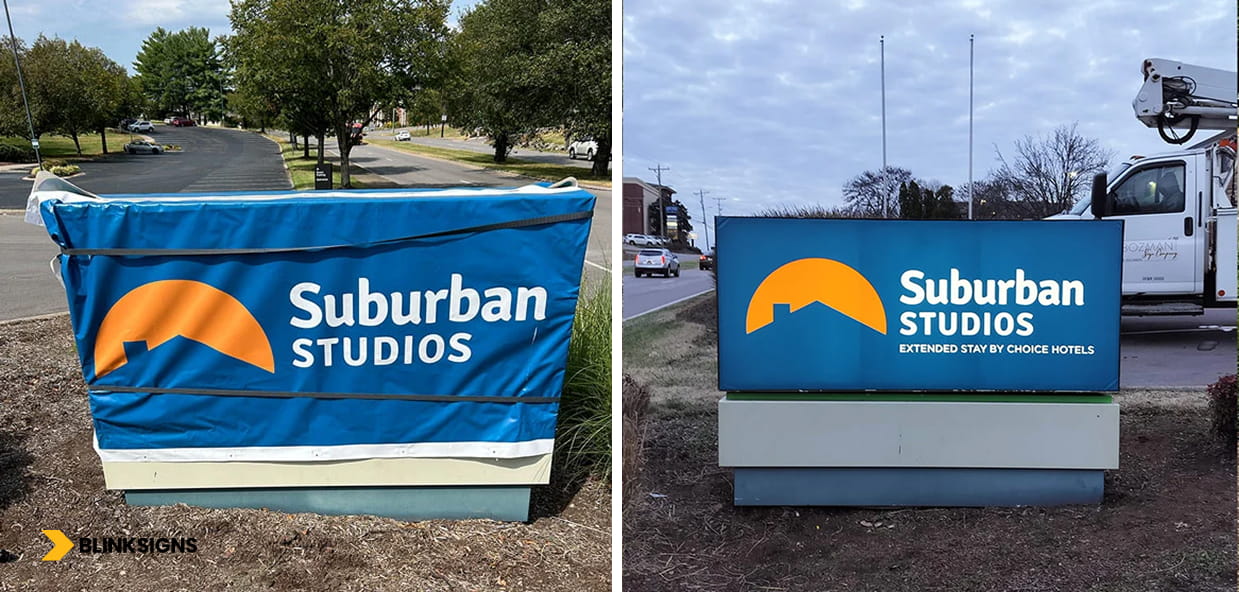
Sign repair of Suburban studios monument sign
When does an LED retrofit make sense?
An LED retrofit may make sense when an older illuminated sign remains usable. Still, the lighting system is difficult to service, inconsistent, outdated, or no longer aligned with the buyer’s maintenance goals. Retrofit planning is common for older cabinet signs, channel letters, and illuminated sign systems where the sign body remains practical to keep. Read our analysis on LED vs. traditional neon signs cost and energy for energy efficiency benchmarks.
However, LED retrofit is not automatically the best answer. The existing sign should be reviewed for cabinet condition, face material, sign depth, wiring access, color expectations, lighting consistency, component compatibility, permit review where required, and long-term brand presentation.
LED retrofit may be worth discussing when:
- Lighting failures are recurring
- Older components are difficult to source
- The sign body remains usable
- The buyer wants more consistent lighting
- The cabinet or letters can support updated components
- A full replacement is not necessary yet A full replacement is not necessary yet
- The repair history suggests repeated lighting service
LED retrofit may not be appropriate when the cabinet is corroded, faces are brittle, retainers are failing, the sign no longer meets brand standards, or replacement would solve more than the lighting issue.
How do channel letter repairs differ from cabinet sign repairs?
Channel letter repairs often focus on individual letters, faces, trim caps, LEDs, raceways, halo lighting, and wall access. Cabinet sign repairs often focus on faces, retainers, gaskets, internal lighting, water intrusion, cabinet depth, tenant panels, and corrosion. Learn more about structural variations in our guide on channel letters vs. cabinet signs.
A channel letter repair may begin with a single letter outage. The buyer may see only one dark letter, but the repair team may need to evaluate whether the issue is isolated or connected to a shared power source. Cabinet repairs often require broader review because the visible face, internal lighting, retainers, seals, and cabinet condition work together.
In simple terms:
- Channel letter repair is often letter-by-letter, system-by-system, and access-dependent.
- Cabinet sign repair is often dependent on the cabinet’s face, frame, lighting, moisture, and condition.
Both sign types can be repaired, retrofitted, refaced, or replaced, depending on the confirmed condition.
How do monument and pylon sign repairs differ?
Monument and pylon signs are both freestanding signs, but their service needs are usually different. Monument signs are often lower and closer to landscaping, entrances, sidewalks, or driveways. Pylon signs are usually taller and may require lift equipment, bucket trucks, cranes, or additional site coordination. Review structural differences in our guide to monument vs. pylon signs.
Monument sign repairs may involve tenant panels, illuminated faces, masonry or base review, cleaning, repainting, landscaping access, or impact damage. Pylon repairs may involve large faces, retainers, elevated lighting service, tenant panels, storm damage, electrical access, and access equipment.
The biggest difference is usually access. A monument sign may be easier to reach, but the surrounding site can still complicate service. A pylon sign may require elevated equipment, more planning, and more coordination before repair work can begin.
What affects the blade sign and projecting sign repair cost?
Blade sign repair cost depends on mounting height, projection distance, bracket condition, sign face material, illumination type, sidewalk access, facade condition, weather exposure, and whether the sign is located in a pedestrian-heavy or design-controlled area.
Blade signs can look smaller than cabinet or pylon signs, but their placement often complicates service. A projecting sign may sit above a sidewalk, storefront entrance, restaurant patio, retail corridor, or public-facing walkway. That means the repair scope may include access planning and scheduling, bracket and facade reviews, lighting coordination, and public access considerations.
A cracked blade sign face may be a simple visible issue, but the quote should still confirm whether the bracket, mounting points, illumination, and opposite sign face are in usable condition. If a double-sided blade sign is repaired on only one side, the new face may not match the older side if the original face has faded, yellowed, or weathered.
Does a blade sign bracket need to be reviewed during repair?
A blade sign bracket should be reviewed when the sign is leaning, moving, sagging, loose, storm-damaged, impact-damaged, or visibly stressed. In those cases, the repair should not be treated as a face-only replacement until the mounting condition is understood.
This guide does not provide instructions for structural repairs. Bracket, facade, fastener, or mounting concerns should be reviewed by qualified professionals where required.
Are illuminated blade signs more expensive to repair?
Illuminated blade signs may require more service planning than non-illuminated blade signs because repairs may involve LED modules, neon, LED neon-style lighting, external fixtures, face condition, access, and, where required, qualified electrical coordination. Historic districts or design review areas may also affect lighting choices, color, materials, and bracket style.
Should a neon sign be repaired or converted to LED?
A neon sign should be repaired when the visual character, brand value, existing structure, and serviceability support keeping the original sign. LED retrofit may be considered when the sign body remains usable, but the lighting system is difficult to maintain, inconsistent, outdated, or no longer aligned with the buyer’s service goals.
The decision is not automatic. Neon and LED signs have different service needs, visual effects, component requirements, and brand implications.
Traditional neon may be worth preserving for restaurants, bars, theaters, entertainment districts, vintage storefronts, hospitality venues, and brands that rely on a specific glow. Neon repair may involve glass tubes, transformers, housings, tube layout, specialty service, and careful handling.
LED repair or retrofit may involve LED modules, power supplies, wiring paths, color consistency, sign depth, controllers, faces, diffusers, and component compatibility. LED retrofit can be useful in some older illuminated signs, but it should not be recommended without reviewing the cabinet, face, wiring access, lighting expectations, local requirements, and brand goals.
When does neon repair make sense?
Neon repair may make sense when the damage is isolated, specialty service is available, the sign has strong brand value, and the existing sign remains practical to maintain. It may also make sense when the buyer wants to preserve an original storefront identity or district-appropriate visual character.
When does an LED retrofit make sense?
LED retrofit may make sense when the existing sign body remains usable, but the lighting system is aging, inconsistent, difficult to service, or repeatedly failing. Retrofit may be considered for cabinet signs, channel letters, and illuminated sign systems where the structure is still usable.
A retrofit should not be treated as a universal upgrade. In some cases, replacing the sign may be more practical. In other cases, preserving neon may better align with the brand.
What is included in sign cleaning and preventive maintenance?
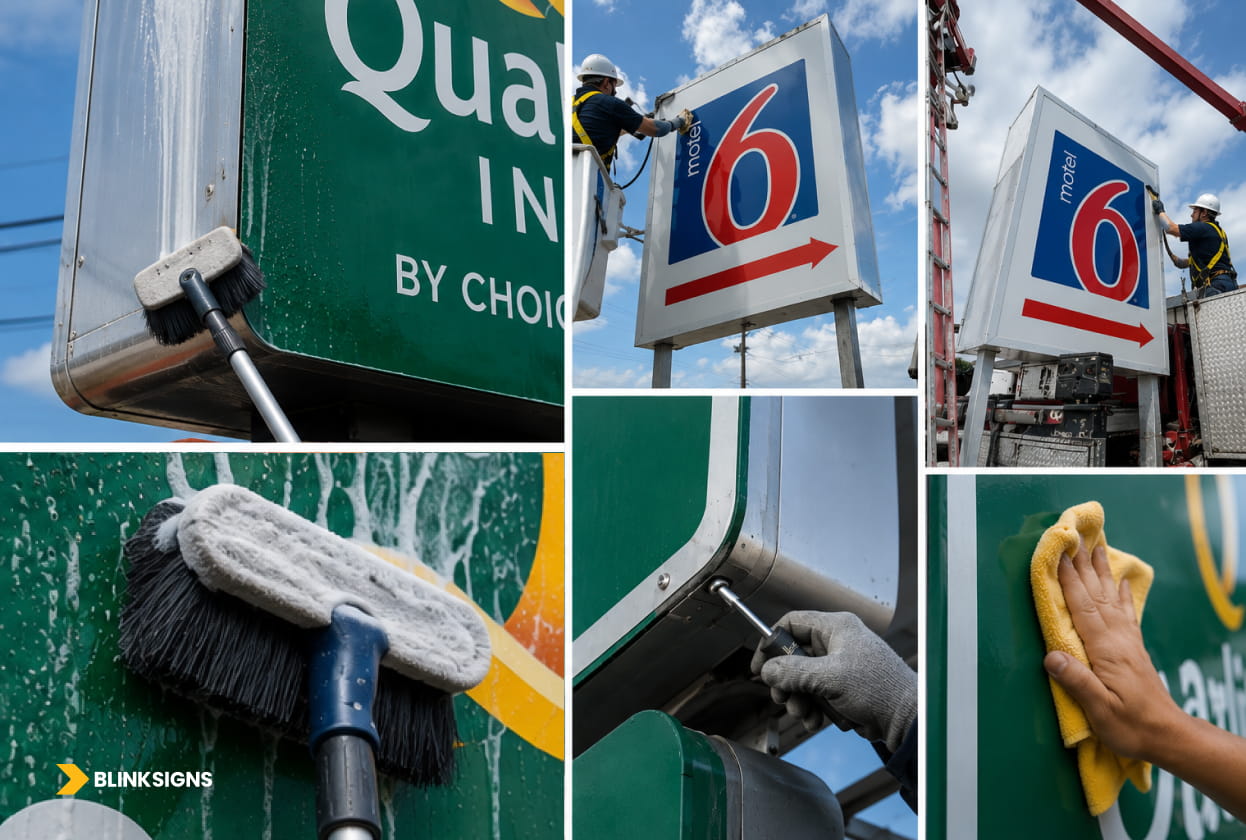
sign cleaning and maintenance
Sign maintenance may include visual inspection, cleaning, lighting review, gasket review, visible hardware review, face condition review, tenant panel review, vinyl condition review, and documentation. It is different from emergency repair because it focuses on ongoing condition, appearance, visibility, and service planning rather than a single failure. Review routine care protocols in our commercial sign maintenance guide.
Maintenance is especially useful for illuminated signs, high-visibility storefronts, restaurants, hotels, healthcare facilities, banks, retail centers, schools, shopping centers, and multi-location brands.
Planned maintenance may help buyers identify fading faces, flickering lights, water intrusion risk, damaged panels, missing fasteners, worn gaskets, peeling graphics, and outdated tenant panels before those issues become more visible to customers.
Is sign cleaning the same as sign repair?
No. Sign cleaning can improve appearance, but it does not fix underlying failures such as broken faces, failing LEDs, water intrusion, loose brackets, damaged retainers, electrical issues, or cabinet corrosion.
A buyer should clarify whether the service request is for cleaning, inspection, repair, maintenance, retrofit, or replacement. These are different scopes.
Is sign maintenance a flat annual cost?
Sign maintenance should not be treated as a flat annual number without reviewing the sign inventory. A single non-illuminated wall sign at one storefront has a very different maintenance profile than a regional program with illuminated channel letters, pylons, cabinet signs, monument signs, blade signs, tenant panels, and window graphics.
Maintenance scope depends on the number of signs, sign types, illumination, height, weather exposure, access conditions, service history, landlord rules, documentation needs, and whether the buyer manages a single site or multiple sites.
When is emergency sign repair needed?
Emergency sign repair may be needed when a sign is visibly damaged, partially detached, dark, leaning, broken, storm-damaged, vandalized, or impact-damaged, or when it creates a business-critical visibility issue. Emergency service may also be needed when a sign face is loose, a cabinet is damaged, a pylon face is compromised, or a blade sign appears unstable.
Urgent service does not always mean the final repair can be completed immediately. Some situations require temporary stabilization, removal of damaged components, documentation, parts ordering, electrical coordination, landlord approval, permit review (where required), or planning for full replacement.
What happens after storm damage?
After storm damage, the condition of visible signs should be documented with photos or videos when it is safe to do so. The repair scope may involve the sign face, cabinet, bracket, pole, base, lighting system, retainers, electrical components, or mounting condition. To evaluate durability against severe weather, review our guide to climate resilient signage.
Storm damage can also create a repair-or-replace decision. A damaged face may be replaceable, but if the cabinet, pole, base, bracket, or internal lighting system is also affected, a broader review may be needed.
Does emergency repair guarantee same-day restoration?
No. Emergency repair timelines depend on location, site access, severity, weather, equipment availability, replacement parts, permit requirements, and whether a qualified electrical or structural review is needed. A first response may address documentation, removal, stabilization, or safety-related concerns, while final repair may require a separate approved scope.
What hidden costs should buyers check before approving the sign repair?
Buyers should review sign repair quotes carefully because the visible line item may not include everything required to complete the service. The most common quote confusion comes from diagnosis, access equipment, parts, electrical coordination, repeat visits, disposal, permits where required, after-hours service, wall or cabinet repair, color matching, and warranty documentation.
| Buyer question | Why it matters |
| Is the diagnosis included? | Some sign issues require field review before the final repair scope is known |
| Is access equipment included? | Elevated signs may require lifts, bucket trucks, cranes, or other access planning |
| Are replacement parts included? | Parts may be standard, custom, discontinued, brand-specific, or subject to availability |
| Is electrical coordination included? | Illuminated signs may require qualified electrical professionals where required |
| Are repeat visits included? | Some repairs need one visit for diagnosis and another after parts are confirmed |
| Is removal and disposal included? | Damaged faces, panels, vinyl, lighting components, or cabinets may require disposal |
| Is cleaning included? | Cleaning, maintenance, and repair may be separate service categories |
| Are permits included if required? | Some repairs, replacements, retrofits, or modifications may trigger local review |
| Is after-hours service included? | Active businesses may need service outside customer-facing hours |
| Is color matching included? | Replacing one face, panel, letter, or vinyl section may require a visual match review |
| Is landlord approval included? | Leased properties may require approval before visible changes are made |
| Is warranty review included? | Warranty scope depends on documentation, product, age, vendor, and service history |
| Is storm or insurance documentation included? | Damage claims may require photos, notes, and written service details |
The safest quote comparison question is: Does this quote cover the full repair path, or only the first visible step?
How should multi-location brands plan sign maintenance?
Multi-location sign maintenance should be managed site by site, even when the brand standard is consistent. A franchise, retail chain, restaurant group, healthcare network, hospitality brand, storage company, bank, or service business may use similar signage across locations. Still, each property can have different access conditions, landlords, weather exposure, lighting systems, installation heights, repair histories, and local requirements. Learn more about institutional management in The Franchise Signage Playbook and our multi-location signage standardization guide.
A strong maintenance program should track sign inventory, reported issues, photos, diagnoses, repair scope, parts used, follow-up needs, service history, and whether retrofit or replacement should be considered.
Why does service history matter?
Service history helps buyers identify patterns. If one location has repeated outages, recurring water intrusion, chronic face damage, frequent vinyl failure, or ongoing cabinet issues, the problem may not be a one-time repair. The sign may need retrofit, face replacement, cabinet review, or replacement planning.
Without a service history, every issue can look isolated. With service history, brand, facilities, procurement, and operations teams can make better repair-or-replace decisions.
Should multi-location signs be maintained on the same schedule?
Not always. A high-visibility pylon in a storm-prone location may need different attention than an interior wayfinding package or a non-illuminated wall sign. Maintenance frequency should be based on sign type, visibility, illumination, access, weather exposure, service history, and business priority.
When should a commercial sign be repaired instead of replaced?
A sign should usually be repaired when the issue is isolated, parts are available, the sign remains structurally and visually serviceable, the brand standard has not changed, and the existing sign still supports the business.
A sign may need replacement when failures recur, components are obsolete, faces are brittle or faded, cabinets are corroded, water intrusion persists, access is repeatedly difficult, the sign no longer meets brand needs, or local review is triggered by major changes.
When is repair the better path?
Repair may be the better path when one component failed, one face is damaged, one tenant panel needs updating, one lighting section is out, or the sign is generally in good condition. Repair can preserve the existing asset when the sign is still useful and serviceable.
When is replacement the better path?
Replacement may be the better path when the sign has repeated failures, outdated lighting, major corrosion, storm damage, obsolete parts, poor visibility, mismatched branding, damaged mounting conditions, or recurring service needs that no longer make practical sense.
When is retrofit the middle path?
Retrofit may be the middle path when the sign body remains usable, but the lighting system, visible face, or service profile needs improvement. This is common with older cabinet signs, channel letters, and illuminated signs, where the structure still has value, but the components have aged.
How does BlinkSigns support sign repair and maintenance?
BlinkSigns supports commercial sign repair and maintenance through service planning, issue documentation, sign condition review, replacement part coordination, face replacement planning, retrofit planning where appropriate, maintenance planning, multi-location visibility, and SignTrax project visibility.
BlinkSigns helps buyers move from a symptom-based request to a clearer service path. Instead of treating every outage as a simple part replacement or every damaged sign as a full replacement, the project should be reviewed by sign type, site access, damage type, illumination, replacement parts, service history, landlord criteria, permit review where required, and long-term serviceability.
BlinkSigns can support buyers with:
- Repair, maintenance, retrofit, face replacement, or replacement planning
- Photo and symptom documentation
- Sign-type and site-condition review
- Replacement face, panel, lighting, and component coordination
- Access planning for elevated or difficult-to-reach signs
- Multi-location service visibility
- Maintenance planning for recurring signs needs
- SignTrax visibility across planning and coordination stages
The goal is not to over-repair or over-replace. The goal is to understand the sign condition and select the service path that best fits the asset, site, brand, and business needs.
What information should buyers provide for a sign repair estimate?
A better repair estimate starts with better information. Buyers do not need to diagnose the issue themselves, but they should describe what they can see, where the sign is located, how difficult it is to access, and whether the issue has happened before.
Before requesting a sign repair quote, gather:
- Property address
- Property type
- Sign type
- Interior or exterior location
- Illuminated or non-illuminated status Illuminated or non-illuminated status
- Visible issues, such as flickering, outage, broken face, water intrusion, vandalism, leaning sign, storm damage, fading, or missing panel
- Photos or videos
- Approximate mounting height
- Access concerns, such as sidewalks, drive-thrus, parking lots, landscaping, awnings, canopies, or road frontage
- Sign age, if known. Sign age, if known
- Prior repair history
- Warranty documentation, if available
- Landlord criteria, if the property is leased
- Timeline need
- Number of locations, if this is part of a rollout or maintenance program
📝 Streamline Your Service Request: Gather site photos, mounting heights, and power access details systematically using our downloadable Sign Repair Quote Prep Checklist.
***Pricing, electrical, structural, and safety notes***

This guide is provided for buyer education and baseline planning. It is not electrical, structural, code interpretation, safety instruction, or a substitute for professional review.

Commercial sign repair costs depend on sign type, damage type, installation height, access conditions, replacement parts, electrical components, lighting system, sign age, weather exposure, site conditions, permit review (where required), and whether the scope involves repair, maintenance, retrofit, face replacement, or full replacement.

Electrical documentation and electrical work should be handled by qualified or licensed professionals where required. Structural concerns involving pylons, monuments, blade sign brackets, facades, mounting systems, poles, cabinets, or elevated signs should be reviewed by qualified professionals where required.

Do not attempt DIY repair on illuminated, elevated, structurally compromised, storm-damaged, or electrically connected signs. Service requirements and safety conditions vary by project and site.
FAQ
How much does sign repair cost?
Commercial sign repair costs depend on sign type, damage type, height, access, electrical components, lighting system, replacement parts, sign age, weather exposure, permit review (where required), and whether the work is repair, maintenance, retrofit, face replacement, or full replacement.
Why is my illuminated sign flickering?
A flickering illuminated sign may point to several diagnostic categories, including power supply issues, aging LED modules, connection issues, moisture exposure, or control-related conditions. Diagnosis is needed before the repair scope can be confirmed.
Why is only one letter out on my channel letter sign?
One dark letter may indicate an isolated component issue, a connection issue, a power supply issue, a raceway-related condition, or another system issue. Photos and videos can help describe the symptom, but field review may be needed to confirm the cause.
Does sign repair include electrical work?
Not always. Some repair quotes include component replacement or electrical coordination, while others may require qualified electrical professionals where applicable. Buyers should ask what electrical scope is included before approving the quote.
Does sign repair require a permit?
Some repairs may not require permit review, while replacements, retrofits, structural changes, illumination changes, size changes, or relocation may trigger local review. Requirements vary by jurisdiction.
What is the difference between sign repair and sign maintenance?
Sign repair responds to a known issue after something fails or is damaged. Sign maintenance is a planned service that may include condition review, cleaning, lighting checks, gasket review, visible hardware review, face condition review, and documentation.
Is sign maintenance a flat annual cost?
Not reliably. Maintenance scope depends on sign type, number of signs, illumination, height, access, weather exposure, sign age, service history, site conditions, landlord rules, and whether the buyer manages a single location or multiple locations.
When should a sign be repaired instead of replaced?
Repair may be appropriate when the issue is isolated, the sign remains serviceable, parts are available, brand standards remain unchanged, and the existing sign still supports the business. Replacement may be worth evaluating when failures are recurring, parts are obsolete, faces are brittle, cabinets are corroded, or brand needs have changed.
What is an LED retrofit?
An LED retrofit updates an older lighting system, leaving the existing sign body usable. Retrofit suitability depends on cabinet condition, access, wiring, components, lighting expectations, local requirements, and long-term brand presentation.
Should a neon sign be repaired or converted to LED?
That depends on the sign’s condition, brand goals, visual character, parts availability, specialty service needs, local requirements, and long-term service plans. Traditional neon may be worth preserving in some settings, while LED retrofit may make sense in others.
Why does pylon sign repair often require more planning?
Pylon signs are usually taller, larger, and harder to access than many storefront signs. Service may require lifts, bucket trucks, cranes, site control, larger faces, electrical access, or more coordination.
Can a sign face be replaced without replacing the whole sign?
Sometimes. Face replacement may be practical when the existing cabinet, frame, retainers, lighting, and mounting remain usable. The existing sign should be reviewed before a replacement face is produced.
What causes water inside a cabinet sign?
Water intrusion may involve gaskets, retainers, seams, face fit, cabinet condition, weather exposure, or drainage conditions. Diagnosis is needed before the repair scope can be confirmed.
What should I provide for a sign repair quote?
Provide the property address, sign type, photos and videos, visible symptoms, mounting height, illumination status, access concerns, sign age (if known), repair history, warranty documentation, landlord criteria, timeline requirements, and number of locations.
How does BlinkSigns support sign repair and maintenance?
BlinkSigns supports commercial sign repair and maintenance through service planning, issue documentation, sign condition review, replacement part coordination, face replacement planning, retrofit planning where appropriate, maintenance planning, multi-location visibility, and SignTrax project visibility.
Conclusion
The cost of commercial sign repair is not just the cost of a replacement part. A repair estimate may involve diagnosis, access equipment, service coordination, replacement components, electrical coordination, cleaning, disposal, return visits, documentation, permit review where required, and long-term serviceability review.
The most important buyer distinction is whether the project is a reactive repair, a planned maintenance visit, an LED retrofit, a face replacement, or a full replacement. Each path has a different scope, timeline, and decision logic.
Illuminated signs require careful evaluation because symptoms such as flickering, dimming, hot spots, partial outages, complete outages, water intrusion, buzzing, or uneven color can point to different diagnostic categories. Buyers should clearly describe the symptom, provide photos or videos, and avoid assuming the cause before review.
For multi-location brands, sign maintenance should be managed as a site-by-site program rather than a flat annual assumption. Each location may have different signs, access conditions, weather exposure, landlords, repair history, lighting systems, permit considerations, and service priorities.
BlinkSigns helps commercial buyers plan sign repair and maintenance with clearer coordination across service planning, documentation, replacement parts, access needs, maintenance programs, multi-location visibility, and SignTrax project tracking. Before requesting a repair estimate, buyers should gather the property address, sign type, photos, visible symptoms, mounting height, access details, sign age, prior repair history, warranty documentation, landlord criteria, timeline needs, and number of locations.