
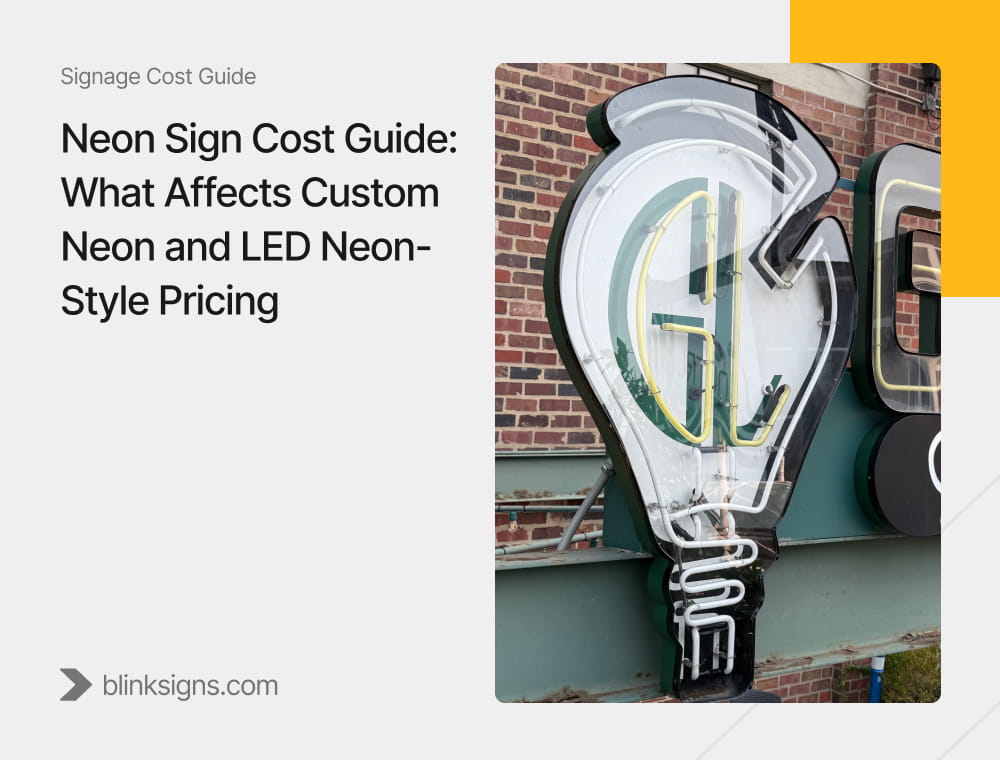
Neon Sign Cost Guide: What Affects Custom Neon and LED Neon-Style Pricing
Neon sign cost depends first on the type of “neon” project the business needs. A product-only LED neon-style sign, a traditional glass neon sign, an indoor brand wall sign, a window-facing storefront sign, an exterior-rated sign, a repair, a retrofit, and a multi-location rollout are all different scopes.
Online neon sign price guides often show simple LED neon-style products starting in the low hundreds and larger or traditional glass neon projects reaching several thousand dollars. Those figures can help buyers understand the market, but they should not be treated as guaranteed project pricing. Commercial signage quotes depend on more than the glowing sign face. Size, design complexity, backing, mounting method, power access, indoor or outdoor rating, installation, approvals, repair needs, and service expectations can all change the final scope.
This guide explains what affects the cost of neon signs, how LED neon-style signs compare with traditional glass neon, why product-only pricing can differ from installed commercial signage, and what buyers should prepare before requesting an estimate.
How much does a neon sign cost?
Neon sign cost depends on whether the project is a product-only LED neon-style sign, a traditional glass neon sign, an indoor brand sign, a window-facing storefront sign, an exterior-rated sign, a repair, a retrofit, or a multi-location rollout.
The biggest cost drivers are:
- Sign type: traditional glass neon, LED neon-style, neon flex, repair, retrofit, or replacement
- Size and line length: overall dimensions, letter height, tubing length, and number of characters
- Design complexity: script fonts, logos, icons, curves, multiple colors, RGB effects, and custom shapes
- Backing and mounting: clear acrylic, shaped acrylic, panel mounting, wall mounting, hanging hardware, or storefront mounting
- Placement: indoor wall, window-facing interior sign, exterior storefront sign, bar wall, restaurant wall, retail display, or event space
- Commercial scope: installation, power review, approvals, maintenance, and multi-location standards
A small indoor LED neon-style sign with simple text is a different project from a traditional glass neon storefront sign, a bar logo sign, an outdoor-rated commercial sign, or a neon-to-LED retrofit. Buyers should compare neon sign quotes by scope, not by the word “neon.”
Market pricing context
Many online neon sign price guides show simple LED neon-style products starting in the low hundreds, larger LED neon-style signs reaching into the thousands, and traditional glass neon or larger commercial projects reaching several thousand dollars.
For BlinkSigns commercial planning, those figures should be treated as broad market examples, not guaranteed project pricing. Final quotes depend on sign type, size, design complexity, backing, mounting, placement, installation, power access, permits, landlord criteria, repair needs, service expectations, and approved specifications.
The safest way to use online price ranges is to treat them as a starting point for questions, not as a final project budget. A product-only LED neon sign shipped to a buyer is not the same as a professionally planned commercial sign, which may require mounting review, power coordination, storefront approval, installation, repair planning, or multi-location consistency.
Who is this neon sign cost guide for?
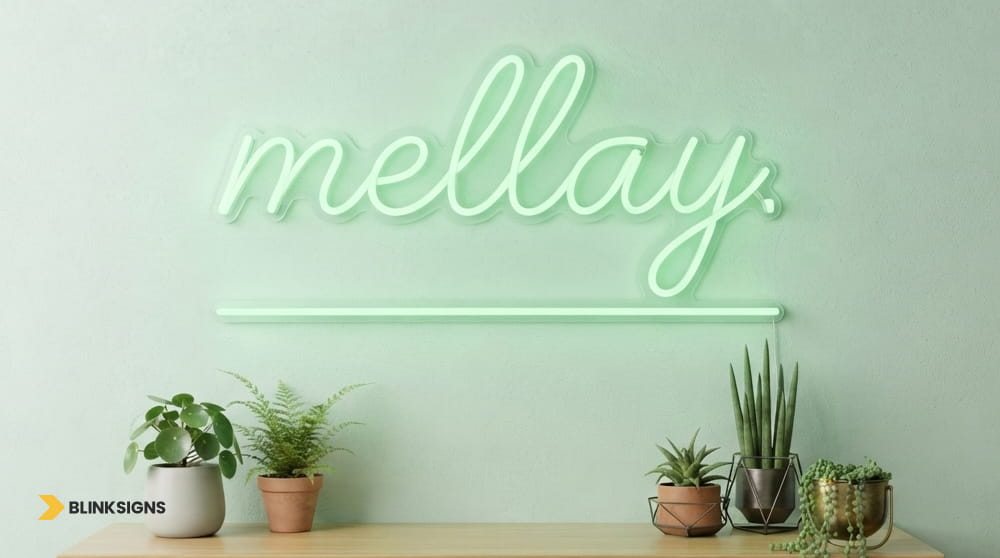
Custom cursive LED neon lettering
This guide is for restaurant owners, bar operators, cafe owners, retail teams, salon owners, office teams, hospitality groups, entertainment venues, franchise teams, facilities managers, and marketing teams comparing neon or LED neon-style signage for commercial spaces.
It is especially useful if you are asking:
- How much does a neon sign cost?
- How much does a custom neon sign cost?
- What affects the cost of an LED neon sign?
- Is traditional glass neon more expensive than LED neon-style signage?
- Should a business choose glass neon or LED neon-style?
- What changes the cost of a restaurant, bar, or retail neon sign?
- Is a window-facing neon sign different from an exterior storefront sign?
- Does installation change the quote?
- Can an old neon sign be repaired?
- Should an existing neon sign be replaced with LED neon-style lighting?
- Do neon signs require permits or landlord approval?
- How should a franchise or multi-location brand plan neon-style signage?
The best neon sign decision starts with the business use case. A bar may want an authentic atmosphere. A restaurant may want a branded wall feature or window-facing sign. A retail store may need a bright interior focal point. A franchise may need consistent LED neon-style signs across many locations. A historic storefront may need traditional neon repair or restoration planning.
Why do online neon sign prices vary so much?
Online neon sign prices vary because many results are product-only LED neon sellers. At the same time, commercial signage projects may include design coordination, backing, mounting, installation, power coordination, site conditions, landlord criteria, permits, repair planning, or multi-location rollout requirements.
A buyer may see an online LED neon-style sign priced as a shipped product. That price may not include commercial installation, storefront mounting, exterior-rated specifications, permit review, landlord approval, site access, or future service planning.
A commercial neon sign quote may involve one of several project paths:
- A product-only LED neon-style sign
- A custom indoor brand sign
- A window-facing storefront sign
- An outdoor-rated neon-style sign
- A traditional glass neon sign
- A traditional neon repair
- A neon-to-LED retrofit
- A multi-location LED neon-style rollout
- A larger illuminated sign package that may include other sign types
The key quote question is:
Is this price for the sign product only, or does it cover the full commercial neon sign project?
That distinction matters. A shipped LED neon-style sign for an interior wall is not the same scope as a storefront-facing sign that needs mounting review, power access review, landlord review, local sign review, where applicable, and professional installation.
What counts as a neon sign today?
The term “neon sign” is used broadly. Some buyers mean traditional glass neon. Others mean LED neon-style signage that looks like neon but uses flexible LED lighting. Some buyers use “neon” to describe any bright, glowing, script-style, or tube-like sign used for restaurants, bars, retail spaces, salons, offices, events, or storefront windows.
Common neon and neon-style sign categories include:
- Traditional glass neon signs
- LED neon-style signs
- LED neon flex signs
- Indoor brand wall signs
- Window-facing neon-style signs
- Exterior-rated neon-style signs
- Restaurant neon signs
- Bar neon signs
- Cafe neon signs
- Retail neon signs
- Salon neon signs
- Office neon signs
- Logo neon signs
- Script neon signs
- Open signs
- Neon repair projects
- Neon-to-LED retrofit projects
- Multi-location neon-style sign programs
For commercial buyers, the most important question is not only whether the sign “looks like neon.” The better question is whether the sign will be used indoors, near a window, outside on a storefront, as part of a brand wall, as a repair project, or as part of a larger signage package.
A neon-style wall sign inside a restaurant may have a different scope than a sign meant to face the street through glass. A sign planned for exterior exposure may have a different scope than an indoor decorative sign. A traditional glass neon repair may have a different scope from that of a new LED neon-style sign.
Traditional glass neon vs LED neon-style signs: what is the difference?

Custom Mist n Mocha and Good Vibes illuminated LED neon signs for coffee shop interior decor.
Traditional glass neon and LED neon-style signs can both create a glowing visual effect, but they are different products with different planning considerations. Traditional neon uses formed glass tubes, gas, and electrical components certified to meet the UL 48 Standard for Electric Signs.. LED neon-style signs use flexible LED lighting designed to create a similar visual appearance.
| Sign type | Best fit | What affects cost |
| Traditional glass neon | Authentic vintage glow, historic character, bars, restoration projects, specialty interiors | Glass bending, tube length, color, transformer needs, fragility, repair needs, and qualified service |
| LED neon-style sign | Modern commercial branding, restaurants, retail, salons, offices, photo walls, and multi-location consistency | Size, LED flex, acrylic backing, color, controller, mounting, indoor or outdoor rating |
| Window-facing neon-style sign | Storefront visibility from inside the glass, retail windows, restaurants, salons, and cafes | Size, brightness, mounting, power access, viewing distance, glare, and glass location |
| Exterior-rated neon-style sign | Outdoor storefront use was allowed and properly specified | Weather rating, mounting method, power access, permits, landlord criteria, and installation conditions |
| Neon repair or retrofit | Existing neon sign needs service, restoration, replacement, or conversion | Existing condition, access, parts, power coordination, repair feasibility, replacement path |
LED neon-style signs are often chosen for modern branding, lighter-weight displays, interior use, and repeatable multi-location programs. Traditional glass neon may still be preferred when the business wants an authentic vintage look, historic character, or a true glass-neon aesthetic.
Verify Neon Complexity: Identify how custom backing shapes, outdoor weatherproofing, and script line lengths shift your project scope by downloading our free Signage Cost Driver Matrix⤵︎
Neither option is automatically best for every business. The right choice depends on brand style, placement, safety expectations, installation conditions, approval requirements, maintenance needs, and whether another type of illuminated sign would better serve the storefront.
What affects the cost of a custom neon sign?
The sign type, size, design complexity, backing, mounting method, placement, lighting features, installation needs, and commercial review requirements shape the cost of a custom neon sign.
Important cost factors include:
- Traditional glass neon vs LED neon-style construction
- Overall sign dimensions
- Letter height
- Total line length or tubing path
- Number of words or characters
- Script, block, or custom typography
- Logo or icon complexity
- Number of colors
- RGB or color-changing features
- Acrylic backing type
- Custom backing shape
- Wall-mounted, hanging, panel-mounted, or window-facing placement
- Indoor-rated vs outdoor-rated use
- Dimmer, remote, controller, or animation features
- Power access
- Professional installation
- Approval coordination
- Existing sign repair or retrofit needs
- Multi-location consistency requirements
A simple one-color phrase on a clear acrylic backing is not the same scope as a multi-color logo, a custom-shaped backing, a storefront window display, an outdoor-rated sign, or a brand-standard sign repeated across many locations.
How does size affect neon sign pricing?
Size affects neon sign pricing because larger signs usually require more material, lighting, backing, mounting support, and planning. However, overall width and height are not the only size factors.
A neon-style sign can become more complex because of:
- Total text length
- Number of letters
- Letter height
- Line length
- Logo shape
- Curves and tight turns
- Multiple words
- Multiple lines
- Backing size
- Mounting method
- Viewing distance
A long script phrase can require more planning than a short block-letter word. A compact logo with tight curves may be more complex than a larger but simpler text sign. A window-facing sign may need to be sized for visibility from the outside, while an interior brand wall sign may be sized for impact in the room or for photo moments.
For commercial buyers, the better sizing question is:
What size should the sign be based on the viewing distance, location, brand message, and mounting conditions?
How does design complexity affect neon sign cost?
Design complexity affects neon sign cost because custom shapes, fonts, logos, icons, colors, and effects can change production time, material needs, backing requirements, and installation planning.
Design elements that may affect cost include:
- Script fonts
- Thin strokes
- Tight curves
- Detailed logos
- Icons or illustrations
- Multiple colors
- Color-changing RGB effects
- Layered layouts
- Custom backing shapes
- Large brand marks
- Small text that must remain readable
- Multi-line phrases
- Animation or controller features
A simple “Open” sign and a custom restaurant logo sign are not the same project. A bar slogan in one color may have a different scope than a multi-color logo with a custom acrylic backing and dimmer. A franchise-approved LED neon-style sign may need to match brand colors and layout standards across multiple locations.
Good design planning matters because neon-style signs must be readable, brand-aligned, and appropriate for the physical space. A design that looks good on a screen may need adjustment before it becomes a practical commercial sign.
How do backing, mounting, and placement affect cost?
Backing, mounting, and placement can affect the cost of a neon sign because they determine how the sign is built, supported, displayed, installed, and serviced.
Common backing options include:
- Clear acrylic backing
- Cut-to-shape acrylic backing
- Rectangular acrylic panel
- Black or colored backing
- Open backing
- Printed panel behind the neon-style lighting
- Raceway or panel-mounted systems where appropriate
Common placement and mounting scenarios include:
- Interior wall-mounted sign
- Hanging sign
- Window-facing interior sign
- Retail display sign
- Restaurant or bar wall sign
- Reception or lobby sign
- Exterior-rated storefront sign
- Panel-mounted illuminated display
- Multi-location standard sign package
A sign mounted on an interior feature wall has a different scope than a sign intended to face the street through a storefront window. A hanging sign has different mounting considerations than a flush wall-mounted sign. An exterior sign may require more review than an indoor display because exposure, mounting, power access, permits, landlord criteria, and service access may all matter.
Buyers should confirm whether backing, mounting hardware, installation, power coordination, and placement review are included in the quote.
Do neon signs require installation, permits, or landlord approval?
Neon signs may require installation planning, permit review, landlord approval, or qualified coordination depending on where the sign is placed, how it is powered, whether it is indoors or outdoors, whether it faces the storefront, and what property rules apply.
A small indoor LED neon-style sign may have a simpler scope than an exterior-rated storefront sign. A window-facing sign may still need landlord or property review if it changes the storefront appearance. A traditional glass neon sign, illuminated exterior sign, or larger commercial installation may require additional coordination.
Permit or approval review may be affected by:
- Indoor vs outdoor placement
- Window-facing visibility
- Exterior storefront use
- Sign size
- Brightness or illumination rules
- Mounting method
- Power access
- Landlord or shopping center criteria
- Local sign code
- Historic district status
- Business type
- Multi-location brand standards
Buyers should not assume that every neon-style sign is approval-free simply because it is installed indoors. Storefront-facing signs, exterior signs, shopping center signs, and signs in regulated properties may require review.
For detailed technical requirements, review our master Commercial Sign Permitting Cost Guide, evaluate field labor and electrical access factors in our Commercial Sign Installation Cost Guide.
When might another sign type be better than neon?
A neon or LED neon-style sign is not always the best choice for every visibility problem. Neon-style signage can be excellent for atmosphere, brand personality, interior features, and window-facing messages, but some business goals may require a different sign type.
Another sign type may be better when:
- Long-distance exterior visibility is the main goal
- The storefront needs primary building identification
- The property has strict illuminated sign rules
- The business needs a larger exterior sign face
- The sign must work across a parking lot or roadway
- The brand needs dimensional letters or cabinet-style illumination
- Maintenance access is difficult
- A landlord or sign code limits neon-style lighting
In those cases, channel letters, cabinet signs, blade signs, illuminated signs, window graphics, pylon signs, or monument signs may be more appropriate. The right sign choice depends on the site, viewing distance, brand style, approval path, and customer approach.
Example neon sign scenarios buyers should recognize
A cafe may want a small LED neon-style sign on an interior wall for brand atmosphere. That scope is different from a window-facing sign designed to be seen from the sidewalk.
A bar may want traditional glass neon because the authentic glow fits the space. Another bar may choose LED neon-style signage because it supports a larger graphic, easier brand matching, or repeatable interior displays.
A retail store may use a neon-style sign in a storefront window, but the sign still needs to be planned around viewing distance, glare, power access, landlord criteria, and nearby window graphics.
A salon may want a script LED neon-style sign for a photo wall, but the quote may change if the sign needs custom backing, brand color matching, a dimmer, or special mounting.
A restaurant group or franchise may need the same neon-style phrase or logo across many locations. That can require standard sizing, approved colors, mounting guidance, location-by-location review, and rollout tracking.
An older glass neon sign may not need full replacement immediately. Depending on condition and parts availability, the project may involve repair, restoration, or a neon-to-LED retrofit.
These scenarios are why the neon sign cost should be diagnosed by project type before a quote is compared.
BlinkSigns portfolio insight: why neon signs should be planned as commercial signage, not décor only
Neon and LED neon-style signs can create a strong visual impression, but commercial buyers should plan them as signage assets, not only decorative lighting. Placement, viewing distance, sign type, mounting, power access, brand standards, installation conditions, and service needs can all affect the result.
BlinkSigns helps commercial buyers clarify whether a neon-style sign should be treated as an interior brand feature, a window-facing storefront sign, an exterior-rated sign, a repair project, a retrofit, or part of a broader sign package. That planning matters because a restaurant wall feature, a retail display sign, a bar logo, and a multi-location franchise sign may all look similar in a photo but require different scopes of work.
BlinkSigns can support neon and LED neon-style planning across design coordination, sign type selection, fabrication coordination, installation coordination, permitting support where relevant, repair or retrofit planning, and SignTrax project visibility.
Are neon signs good for restaurants, bars, and cafes?

Glowing script neon signage enhances interior ambiance
Neon and LED neon-style signs can work well for restaurants, bars, and cafes because they support atmosphere, brand personality, wall features, window visibility, menu-adjacent messaging, and memorable interior moments.
A restaurant may use a neon-style sign for a brand phrase, a logo wall, a pickup area, a bar backdrop, a dining room feature, or a storefront-facing window sign. A bar may prefer traditional glass neon when the authentic glow fits the space. A cafe may use LED neon-style signage for a clean interior accent, a social-friendly wall, or a sidewalk-facing brand message.
For restaurants, bars, and cafes, neon sign planning should consider:
- Brand tone
- Interior atmosphere
- Viewing distance
- Window-facing visibility
- Dining room layout
- Bar or counter placement
- Wall color and background contrast
- Power access
- Mounting method
- Guest photos or social moments
- Cleaning and service access
- Landlord criteria
- Local review requirements when applicable
A neon-style sign can enhance the customer experience, but it should not be treated as a guaranteed driver of traffic, sales, or revenue. Visibility depends on design, placement, lighting conditions, surrounding signs, storefront layout, and customer approach path.
Should restaurants use traditional glass neon or LED neon-style signs?
Restaurants should choose based on brand style, placement, maintenance expectations, installation conditions, and approval requirements. Traditional glass neon may fit a vintage bar, retro diner, or specialty interior where authentic glow matters. LED neon-style signage may fit modern restaurants, franchises, cafes, and multi-location brands that need repeatable layouts, lighter-weight displays, and easier brand consistency.
The right answer is not always “neon.” In some storefronts, channel letters, cabinet signs, blade signs, window graphics, or digital menu boards may serve the business better than a neon-style sign.
Are neon signs good for retail stores, salons, and boutiques?
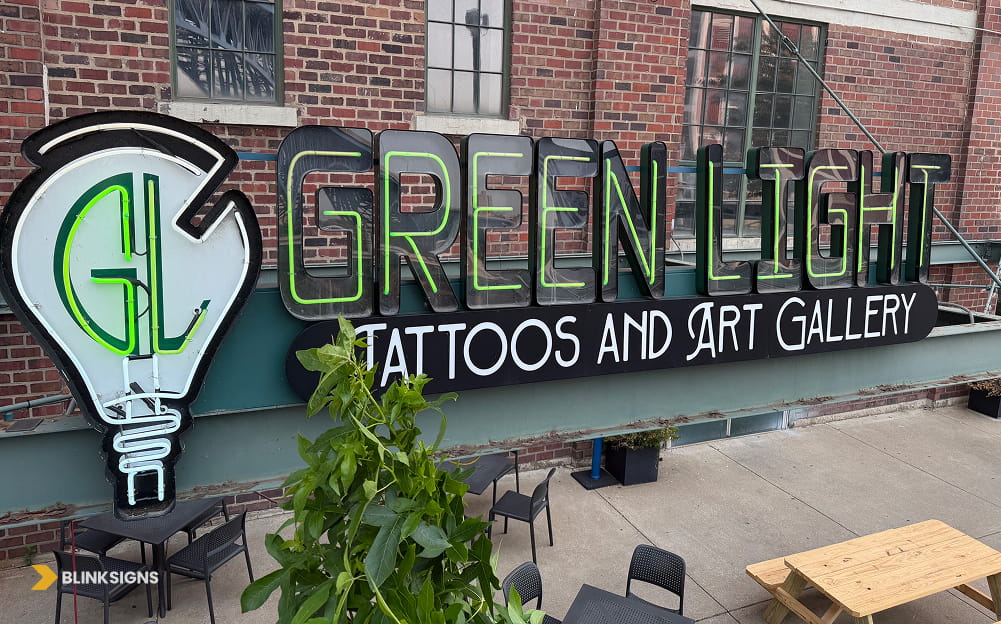
Vintage-style neon Green Light Tattoos and Art Gallery custom storefront sign
Neon-style signs can be useful for retail stores, salons, boutiques, fitness studios, wellness businesses, and beauty brands because they create a strong visual focal point inside the space or near the storefront window.
Retail and salon neon-style signs are often used for:
- Brand walls
- Window-facing messages
- Product displays
- Photo walls
- Reception areas
- Seasonal displays
- Sale or campaign moments
- Brand phrases
- Logo signs
- Interior wayfinding accents
A retail neon-style sign should fit the store environment. A bright script sign may work well for a boutique, salon, or lifestyle brand. A more restrained illuminated logo may work better for a premium retail space, office showroom, or professional service storefront.
Should retail stores place neon signs in the window?
Window-facing neon-style signs can help a storefront communicate after dark or attract pedestrian attention, but they need to be planned carefully. Buyers should consider viewing distance, glare, glass reflections, surrounding lighting, power access, landlord rules, and whether local sign rules treat the display as storefront signage.
A window-facing sign may still require review even when it is physically mounted inside the space. Buyers should confirm the property and local requirements before assuming it is only an interior decoration.
Are neon signs useful for offices, hospitality, and entertainment venues?
Neon-style signs can support offices, hospitality spaces, event venues, entertainment businesses, and experiential environments when the goal is brand atmosphere, visitor experience, or memorable interior identity.
Common use cases include:
- Lobby logo signs
- Brand phrase walls
- Event venue backdrops
- Hotel bar signs
- Hospitality lounge features
- Entertainment venue signage
- Reception area graphics
- Employee culture walls
- Showroom displays
- Photo opportunity areas
For offices and hospitality properties, neon-style signage should be planned with the broader interior sign system. It may need to coordinate with lobby signs, wall graphics, wayfinding signs, digital displays, ADA signage, room signs, and directional signs.
A neon-style sign can add personality, but it should not create visual clutter or compete with signs that help visitors navigate the space.
Are neon signs good for storefront windows or exterior use?
Neon-style signs can work for storefront windows or for exterior-facing visibility, but their scope differs from that of a simple indoor wall sign. A window-facing sign must be planned around viewing distance, glare, glass reflection, brightness, mounting, power access, and the customer approach path.
Exterior use requires more careful review. An exterior-rated neon-style sign may require different materials, weather-exposure planning, mounting review, power coordination, permit review, landlord approval, and installation planning.
Buyers should clarify:
- Is the sign indoor-only, window-facing, or exterior-rated?
- Will the sign be seen from inside, outside, or both?
- Will glass reflection affect readability?
- Is the sign near other window graphics or exterior signs?
- Is professional installation needed?
- Are property rules or sign codes relevant?
- Is the sign part of a larger storefront package?
A storefront window sign may be useful for restaurants, salons, boutiques, bars, cafes, and specialty retail. However, when long-distance exterior visibility is the main goal, another sign type, such as channel letters, cabinet signs, blade signs, pylon signs, or monument signs, may be more appropriate.
What hidden costs should buyers look for when buying a neon sign?
Neon sign quotes can be difficult to compare because one quote may include only the product. In contrast, another may include design coordination, backing, mounting, installation, power coordination, approval support, repair planning, or multi-location standards.
Before approving a quote, buyers should ask what is included, what is excluded, and what may change after site review.
| Buyer question | Why it matters |
| Is this traditional glass neon or LED neon-style? | The build, maintenance, installation, and repair scope can differ |
| Is the quote product-only or installed? | Online prices may not include commercial installation, mounting, or site review |
| Is backing included? | Acrylic backing, shaped panels, printed panels, and open backing can change the scope |
| Is mounting included? | Wall-mounted, hanging, window-facing, and exterior-mounted signs require different planning |
| Is power coordination included? | Some signs may need qualified electrical coordination |
| Is the sign indoor-rated or exterior-rated? | Placement affects materials, exposure planning, installation, and approval needs |
| Are permits or landlord approval needed? | Storefront-facing or exterior signs may require review depending on the property and local rules |
| Are add-ons included? | Dimmers, remotes, controllers, RGB effects, or animation can change the cost |
| Is repair or retrofit possible? | An existing neon sign may not always require full replacement |
| Is maintenance included or separate? | Traditional glass, neon, and LED neon-style signs can have different service expectations |
| Is multi-location consistency needed? | Franchises may need approved sizes, colors, phrases, backing, and installation standards |
The safest quote comparison question is:
Does this quote cover only the neon sign product, or does it cover the full commercial sign project?

Not sure whether you are comparing a product-only LED neon sign, an installed commercial sign, a repair, or a retrofit? Download the Neon Sign Scope Comparison Worksheet⤵︎ before approving a quote.
Should an existing neon sign be repaired, restored, replaced, or retrofitted?
An existing neon sign should be evaluated before assuming it needs full replacement. Depending on its condition, the project may involve repair, restoration, replacement with traditional glass neon, or conversion to LED neon-style signage.
Repair or restoration may be considered when the sign has brand value, historic value, design value, or a look that the business wants to preserve. Replacement or retrofit may be considered when service issues are frequent, parts are difficult to source, the sign no longer fits the brand, the business needs easier multi-location consistency, or the sign is part of a larger rebrand.
Buyers should consider:
- Is the existing sign traditional glass neon or LED neon-style?
- Is the sign still aligned with the brand?
- Is the sign damaged or unreliable?
- Is the issue limited or recurring?
- Is the sign indoors, window-facing, or exterior?
- Are replacement parts or qualified service available?
- Does the business want to preserve the original look?
- Would LED neon-style signage better fit the current scope?
- Does the project require a professional electrical review?
This guide does not provide instructions for neon repair, wiring, transformers, power supplies, or retrofits. Qualified professionals should evaluate existing neon and illuminated signage.
How should franchise and multi-location brands plan neon-style signage?
Franchise and multi-location brands should treat LED neon-style signs as a brand-standard element of signage, not a one-off decoration. A sign that works in one location may not work in another without review.
A franchise signage program may need consistency across:
- Approved phrase or logo
- Sign size
- Brand colors
- Lighting color
- Backing type
- Mounting method
- Indoor or window-facing placement
- Power access expectations
- Installation standards
- Replacement rules
- Maintenance expectations
- Location-by-location exceptions
A restaurant group may want the same neon-style wall feature across several locations. Still, each site may have different wall sizes, background colors, power access, landlord criteria, and installation conditions. A retail franchise may need the same window-facing sign across stores, but glass layout, visibility, and local rules may vary.
The goal is flexible consistency. The sign should look like part of the same brand system while still fitting each location.
How does BlinkSigns help plan neon and LED neon-style signs?
BlinkSigns helps commercial buyers plan neon and LED neon-style signage by clarifying the sign type, use case, placement, design complexity, backing, mounting, power access, installation needs, approval exposure, maintenance expectations, and multi-location requirements.
A neon-style sign project may involve more than choosing a phrase and color. It may require deciding whether the sign is product-only or installed, whether it should be traditional glass neon or LED neon-style, whether it is indoor, window-facing, or exterior-rated, and whether repair or retrofit should be considered before replacement.
BlinkSigns supports neon and LED neon-style planning through:
- Project planning
- Design coordination
- Sign type selection
- Backing and mounting coordination
- Fabrication coordination
- Installation coordination
- Permitting support where relevant
- Repair or retrofit planning
- Maintenance planning
- Multi-location rollout support
- SignTrax project visibility
The goal is to help buyers move from a vague request such as “we need a neon sign” to a clearer commercial scope that matches the brand, space, placement, installation conditions, approval path, and future service needs.
BlinkSigns portfolio insight: neon-style signs should fit the full sign system
Neon and LED neon-style signs rarely exist on their own. They often need to coordinate with storefront signs, window graphics, channel letters, cabinet signs, blade signs, wall graphics, digital displays, and interior brand elements.
That matters because a neon-style sign can look simple in a product photo but become more complex in a commercial environment. A restaurant wall feature, a retail window sign, a bar logo, a lobby sign, and a franchise rollout may all require different planning.
The strongest neon sign plan is the one that fits the complete business environment, not only the sign artwork.
What should buyers prepare before requesting a neon sign estimate?
A clearer estimate for a neon sign starts with clearer project information. Buyers do not need to know every material or technical detail before requesting a quote, but they should provide enough information to clarify sign type, size, placement, and scope.
Before requesting a neon sign estimate, prepare:
- Business name
- Property address
- Business type
- Desired phrase, logo, or artwork
- Approximate sign size
- Intended placement
- Indoor, window-facing, or exterior use
- Wall, window, hanging, or panel-mounted preference
- Brand colors or color preference
- Logo files or brand guidelines
- Background wall or window photos
- Viewing distance
- Power access information, if known
- Installation preference
- Landlord criteria, if available
- Permit status, if already started
- Repair or retrofit details if replacing an existing sign
- Number of locations, if multi-site
- Target completion date, if any
The most useful photos show the wall, storefront window, mounting area, surrounding signs, nearby lighting, and viewing path. For replacement or repair projects, include photos of the existing sign, mounting conditions, and the surrounding surface. Do not attempt to inspect or handle electrical components yourself.
For multi-location programs, each site should be documented separately. A single brand standard can guide the rollout, but each location may need its own placement review, mounting review, landlord review, permit review, and installation planning.
Download the Neon Sign Quote Prep Checklist
Use the downloadable Neon Sign Quote Prep Checklist before requesting an estimate. It can help organize sign text, logo files, approximate dimensions, placement notes, indoor or outdoor use, backing preferences, mounting details, power access notes, landlord criteria, repair details, and multi-location requirements.
The checklist is designed to help buyers prepare for a clearer conversation. It does not replace site-specific review, electrical review, installation review, landlord review, permit review, material review, repair review, or a confirmed project quote.
Prepare Your Neon Spec Sheet: Collect your exact vector artwork, mounting dimensions, and power access notes before requesting an estimate with our free step-by-step Sign Quote Prep Checklist⤵︎
*Safety, electrical, permitting, and buyer-planning note*

This guide is provided for buyer education and baseline planning. It is not electrical advice, installation instructions, repair instructions, code interpretation, landlord approval guidance, material performance advice, or a substitute for professional review.

Final neon sign cost depends on sign type, size, design complexity, backing, mounting, placement, indoor or outdoor rating, power access, installation access, repair needs, permit requirements, landlord criteria, qualified electrical coordination, and approved specifications.

Traditional glass neon, illuminated signs, exterior signs, storefront-facing signs, repairs, retrofits, and installations may require qualified review. Electrical documentation and field work should be handled by qualified or licensed professionals in accordance with National Electrical Code (NEC) Article 600 when required.. Do not attempt DIY wiring, transformer work, power supply changes, glass neon repair, LED replacement, exterior mounting, or electrical troubleshooting.
**Editorial note**

This guide is written for commercial signage planning and buyer education. It is not electrical, installation, repair, code, engineering, landlord approval, or material-performance advice. Project requirements should be confirmed through site-specific review, approved specifications, property criteria, and local requirements where applicable.
FAQ
How much does a neon sign cost?
Neon sign cost depends on whether the project is traditional glass neon, LED neon-style, indoor, window-facing, exterior-rated, product-only, installed, repaired, retrofitted, or part of a multi-location rollout. Size, design complexity, backing, mounting, power access, installation, permits, landlord criteria, and service expectations can all affect the final quote.
How much does a custom neon sign cost?
Custom neon sign cost depends on the sign type, size, text length, logo complexity, number of colors, backing, mounting method, indoor or outdoor use, add-ons, installation needs, and approval path.
What affects the cost of an LED neon sign?
The cost of an LED neon-style sign can be affected by size, LED flex length, acrylic backing, custom shape, color, RGB features, dimmer or controller, mounting method, indoor or outdoor rating, and whether the quote includes installation.
Is LED neon cheaper than traditional glass neon?
LED neon-style signs are often positioned as a lower-cost, lower-maintenance alternative to traditional glass neon, but the right choice depends on brand style, placement, installation requirements, maintenance expectations, and whether the business needs an authentic glass neon look.
What is the difference between glass neon and LED neon-style signage?
Traditional glass neon uses formed glass tubes, gas, and electrical components. LED neon-style signage uses flexible LED lighting designed to create a similar glowing look. The two options differ in appearance, construction, installation, maintenance, service needs, and commercial use cases.
Can neon signs be used outdoors?
Some neon-style signs may be planned for exterior use when properly specified. Still, outdoor use can affect material rating, mounting, power access, weather exposure, permits, landlord criteria, installation, and maintenance. Buyers should not assume an indoor product is suitable for outdoor use.
Do neon signs require permits?
Neon signs may require permits depending on location, placement, size, brightness, exterior visibility, mounting method, property rules, local sign code, and whether the sign is storefront-facing or exterior. Requirements vary.
Can an old neon sign be repaired?
Sometimes. Repair may be possible depending on the sign type, condition, parts availability, access, electrical components, and service feasibility. Qualified professionals should review existing neon signs.
Should I replace traditional neon with LED neon-style signage?
Replacement or retrofit may make sense when a business wants a different maintenance profile, easier brand consistency, a new design, or multi-location repeatability. Traditional neon may still be preferred when authentic appearance, historic value, or restoration matters.
How does BlinkSigns help with neon signs?
BlinkSigns supports neon and LED neon-style planning through project planning, design coordination, sign type selection, backing and mounting coordination, fabrication coordination, installation coordination, permitting support where relevant, repair or retrofit planning, maintenance planning, multi-location rollout support, and SignTrax project visibility.
Conclusion
Neon sign cost depends on more than the glowing phrase, logo, or sign size. The final scope can include traditional glass neon or LED neon-style construction, design coordination, acrylic backing, custom shapes, mounting, power access, installation, permits, landlord review, repair planning, retrofit decisions, and multi-location standards.
The most important decision for the neon sign project is the category. A product-only LED neon-style sign, a traditional glass neon sign, an indoor brand wall sign, a window-facing storefront sign, an exterior-rated sign, repair, retrofit, and multi-location rollout each carry distinct cost drivers and planning requirements.
Restaurants, bars, cafes, retail stores, salons, offices, hospitality properties, entertainment venues, and franchise brands can all use neon-style signage in different ways. A bar may want authentic glass neon. A retail store may need a window-facing LED neon-style sign. A salon may want a branded interior photo wall. A restaurant group may need the same sign repeated across locations. An older sign may need repair, restoration, or retrofit review before replacement.
BlinkSigns helps commercial buyers plan neon and LED neon-style signs with clearer coordination across design, sign type selection, fabrication, backing, mounting, installation, permitting support where relevant, repair or retrofit decisions, maintenance needs, multi-location visibility, and SignTrax project tracking. Before requesting a neon sign estimate, buyers should gather the desired phrase or logo, approximate dimensions, placement photos, indoor or outdoor use, backing preferences, mounting details, landlord criteria, repair details, and the number of locations.